My son Howard had a broken leg, and the man who gave it to him was sitting across the room pretending to be a concerned father.
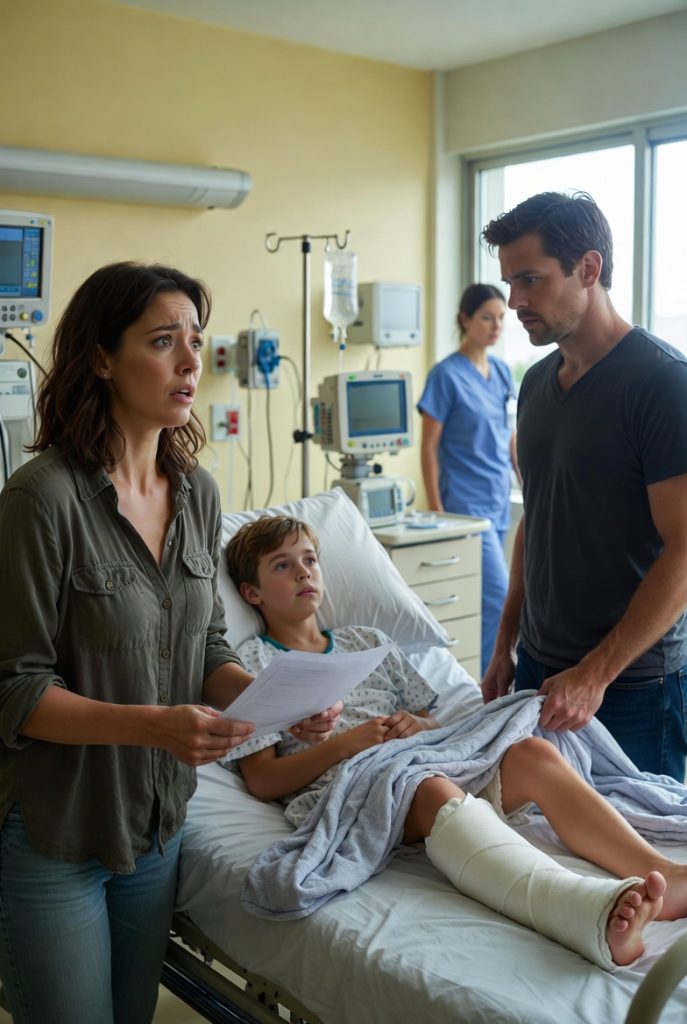
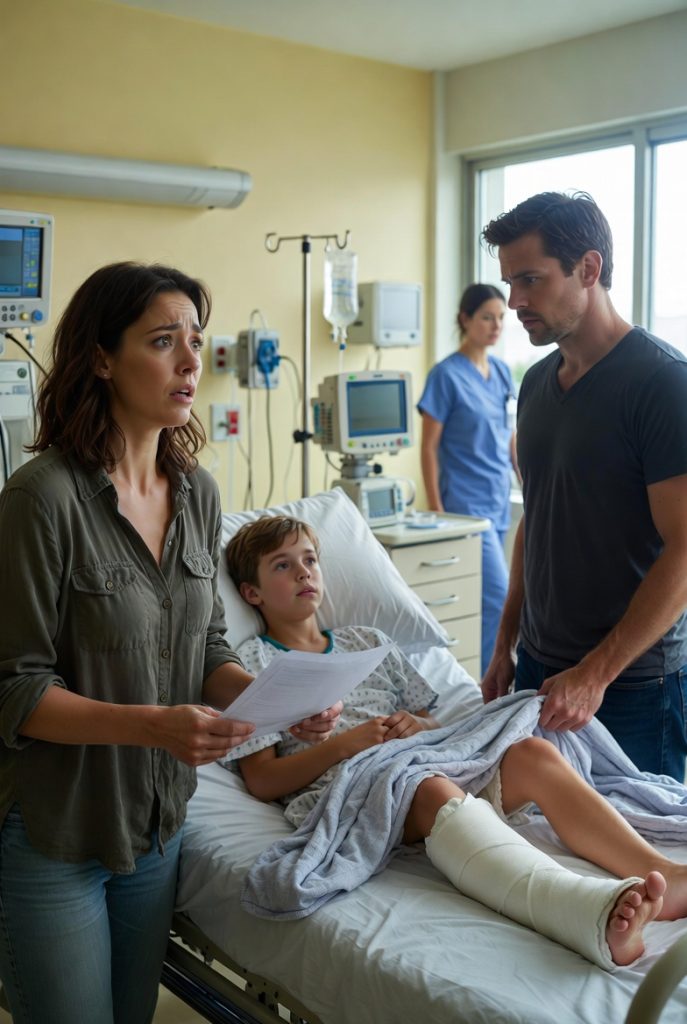
The cast was bright blue, fresh from the orthopedic tech, signed by three nurses who didn’t know what I was starting to suspect. Howard lay against the hospital pillows, pale and medicated, his ten-year-old face slack with exhaustion. Every few minutes, his eyelids would flutter, and he’d look at me with an expression I couldn’t quite name—not just pain, not just fear. Something heavier. Something that looked like guilt.
But he hadn’t done anything wrong. Had he?
“He fell off his scooter,” Jasper said from the corner chair, not looking up from his phone. “I told you. Uneven pavement. Freak accident.”
His voice was too casual. The words came out too smoothly, like he’d rehearsed them in the car on the way to the ER. I knew that voice. I’d been married to it for seven years. It was the voice he used when he was managing a situation, not describing one.
“You were right there?” I asked.
“Right there,” he said. “Saw the whole thing.”
Howard’s eyes flicked to his father, then away. Fast. Too fast.
Something cold settled in my stomach.
I didn’t push it. Not in front of Howard. Not while he was still groggy from whatever they’d given him for the pain. I kissed my son’s forehead and smoothed his hair and told him everything was going to be fine, and I felt the lie of those words even as I said them.
That evening, a woman in navy scrubs entered the room. Her badge read CHARGE NURSE—PATRICIA REID. She checked Howard’s vitals with quiet efficiency, adjusting his IV, noting something on his chart. Jasper suggested I go home. “You’ve got work tomorrow,” he said. “I’ll stay.”
“I’m not leaving.”
The nurse glanced at me, then at Jasper, then back at Howard. When she adjusted the blanket, Howard flinched.
It was subtle. A tiny recoil, barely a movement at all. But I saw it. And the nurse saw it too.
She finished her check, nodded at me, and walked toward the door. As she passed, her hand brushed mine. Something small and folded pressed into my palm.
I waited until Jasper’s attention returned to his phone. I unfolded the paper.
A Post-it note. Three lines in neat, clinical handwriting:
HE’S LYING. CHECK THE CAMERA AT 3 A.M.
My heart stopped. Then it started again, much faster.
I followed her into the hallway. She was at the nurses’ station, clicking a pen against a clipboard. She didn’t look up.
“The note,” I said, keeping my voice low. “What am I supposed to see?”
“Observation cameras in every pediatric room,” she said quietly. “Audio and video. Security records everything. Go to the security office at 2:55. Tell them I sent you. Channel 12. Three a.m.”
“What’s on Channel 12 at three a.m.?”
She finally looked at me. Her eyes were tired but steady—the eyes of someone who had seen too many children flinch when they should have felt safe.
“Your son telling the truth,” she said. “And his father making sure he doesn’t.”
She walked away before I could ask anything else.
I stood in that fluorescent hallway for a long moment, the Post-it crumpled in my fist. Behind me, through the half-closed door, I could hear Jasper humming—actually humming—as he scrolled through his phone. Comfortable. Unconcerned.
He had no idea.
None of them did.
I looked at my watch. 7:45 p.m.
Seven hours and ten minutes until I would know everything.
I went back into the room, sat down in the chair beside Howard’s bed, and started the longest wait of my life.
My son Howard had a broken leg.My ex-husband, Jasper, told me it happened in the driveway. He said Howard fell off his scooter while I was at work. The explanation sounded simple enough, but something about the way he said it felt carefully practiced.By the time I reached the ER, Howard already had a cast.He looked pale against the hospital sheets, smaller than usual somehow. I kissed his forehead and tried not to let my unease show. I didn’t want to question Jasper in front of him. Not there.That evening, I stood by the bed brushing Howard’s hair back gently. A woman in navy scrubs entered the room, her badge reading Charge Nurse.“Honey, you should go home,” Jasper said casually. “You’ve got work tomorrow. I’ll stay.”“I’ll nap in the chair,” I replied. “I’m not leaving.”The nurse checked Howard’s vitals, quiet and observant. When Jasper adjusted the blanket, Howard flinched.It was subtle.But the nurse noticed it too.As she walked past me, she pressed something into my palm without breaking stride.I unfolded the small Post-it.“HE’S LYING. CHECK THE CAMERA AT 3 A.M.”My throat tightened.By the time I looked up, she had already left the room.I followed her into the hallway, my heart beating faster…
Continue below
The call came on a Thursday afternoon while I was finishing a quarterly report that had been due two days ago, which is the kind of detail that seems irrelevant until it isn’t, until you realize that the mundane fact of running behind on paperwork was the reason my phone was still on my desk instead of in my bag, the reason I saw his name flash on the screen, the reason I answered.
Jasper. My ex-husband.
Howard was at Jasper’s house for the weekend, his scheduled custody time, and the two of them did not call me unless something was wrong. The arrangement we had built over three years of co-parenting was functional in the way of things that have been made functional through sustained effort and the continuous suppression of everything that made the marriage itself not work. We were polite. We communicated through a shared calendar app. We did not call each other on Thursday afternoons unless the situation was specific and urgent.
I answered on the second ring.
“Hey, so, don’t freak out,” Jasper said.
Those four words. If you have ever been the parent of a child and heard another adult say don’t freak out as the opening to a sentence about that child, you understand what happened to my nervous system in the next half second.
“What happened. Is Howard okay.”
“Howard broke his leg. He fell off his scooter. Totally a freak accident. I was right there with him. I saw the whole thing happen.”
Howard is ten years old. He is the kind of child who approaches the physical world with complete and total confidence in his own indestructibility, the way children are before they have accumulated enough evidence to understand that the world does not share their confidence. He is brave and energetic and smart and still, despite everything, capable of reducing me to something very close to my most primitive parental self with a single phone call.
“Where are you right now,” I said.
“The emergency room. He’s fine. Just shaken up. They’re wrapping his leg.”
I was already standing, already reaching for my purse. My boss Margaret looked up from her desk as I moved toward the door and I told her my son broke his leg and I was going to the hospital, and the details of the next seventeen minutes, the rideshare, the drive across the city, the way I held the door handle as if it were something that could be gripped into cooperation, were a kind of controlled emergency that I navigated on the surface while underneath I was simply the person who needed to get to the room where my child was.
Howard looked small in the hospital bed in the way that children sometimes look small in hospitals, as though the institution has revealed something about their actual dimensions that ordinary life conceals. A bright blue cast ran from his ankle to below his knee. His eyes were red from crying and he looked up at me when I came in with an expression that was part relief and part the particular guilt children carry when they have frightened someone who loves them.
“Hey, buddy,” I said, and kissed his forehead.
“I’m sorry,” he whispered.
“For what? You didn’t do this on purpose.”
He looked at his cast instead of at me, and something in the avoidance caught at the edge of my attention, the same edge that catches things during ordinary conversations when a word lands slightly wrong or a look doesn’t quite fit the sentence it belongs to.
“Were you doing tricks again?” I asked, gently, because I was not angry, I was frightened and relieved and the anger, if there was going to be anger, was not yet present. Howard had been trying to jump the curb on his scooter for months, a trick I had asked him approximately a hundred times to wait on until his coordination caught up with his ambition.
“He just lost his balance,” Jasper said, appearing at my shoulder. “No tricks. The pavement was slightly uneven. He went down hard.”
Howard looked at his father. Then at his cast. Then at the floor tiles with the specific attention of a child who has been told to look somewhere that is not at the person who is speaking. Something was operating underneath the surface of this conversation that I could feel without yet being able to name. I had known Howard for all ten years of his life and I knew the difference between his ordinary evasion, the kind that came from not wanting to admit to a broken rule, and something heavier than that.
But I did not start a fight in front of my injured son. I bit my tongue and sat beside him and stroked his hair while he drifted in and out of a medicated sleep and Jasper sat in the corner chair typing messages into his phone with the distracted energy of someone managing something that had nothing to do with the room.
Around six in the evening, a charge nurse came to check Howard’s vitals. She had the particular efficiency of someone who has worked pediatrics long enough to read a room very accurately and very quickly, and I watched her watch my son and my ex-husband with the professional neutrality that was doing something underneath it, making small computations and arriving at conclusions she kept to herself while she adjusted the IV and updated the chart.
Jasper suggested I go home. Said I had work in the morning. Said Howard needed rest and I needed rest. His tone was helpful and reasonable and I recognized the shape of it from the marriage, the way he phrased things as consideration for others when they were actually preference for himself. I told him I was fine staying. I was not going to leave my son in a hospital room with explanations that didn’t quite add up, and I was not going to let my ex-husband’s discomfort with my presence override my instinct that something in the story I had been given was not complete.
The nurse was leaving the room when she slowed, just slightly, as she passed me. I felt something pressed into my palm. My fingers closed around it.
I waited until she had gone and Jasper’s attention had returned to his phone. I unfolded the small yellow note. The handwriting was neat and clinical and it said:
HE’S LYING. CHECK THE CAMERA AT 3 A.M.
The fluorescent-lit hallway outside had the quality of all hospital hallways at night, of a space designed to accommodate distress without absorbing it, and I found the charge nurse at the station clicking a pen against her clipboard. I kept my voice low.
“The note,” I said. “What do you mean?”
She did not look up from her paperwork. “Observation cameras in every pediatric room. Both audio and video. Security records everything. Go to the security office at 2:55. Tell them I sent you. Channel 12 at 3 a.m.”
“But what—”
“That’s all I can say,” she said. “The rest is between you and the footage.”
She walked away before I could ask the question I was still forming.
I went back to Howard’s room and sat in the chair across from Jasper and watched my son sleep and counted the minutes in a way that was not quite patience and not quite dread but something containing both.
At five minutes to three in the morning I slipped out of the room and knocked on the security office door. A guard in his sixties with the weary expression of someone who has been trusted with too much of other people’s worst moments opened it without particular surprise. When I told him the charge nurse had sent me and gave him the room number, he pulled up the feed with the quiet efficiency of a person for whom this procedure is familiar enough that it does not require explanation.
Channel 12. Room 412.
Howard sleeping in his hospital bed, the thin blanket pulled to his chest, his face young and unguarded in the way of sleeping children. The chair beside him was empty. The digital clock in the corner of the screen read 2:59. It clicked to 3:00.
The door to the room opened.
Jasper walked in. He still had his coat on. He had been somewhere else, outside the hospital, and he had come back now and behind him a blonde woman entered the room and closed the door softly.
Howard stirred. “Dad?”
“Hey, buddy,” Jasper said, pulling the chair close to the bed, arranging himself as though he had been there all along. “You doing okay?”
The woman stayed near the wall with her arms folded, watching them with the particular discomfort of someone who is present at a moment they understand is significant and are not entirely sure they want to be.
“We need to make sure we’re telling the story about what happened the right way,” Jasper said. His voice had taken on a sharpness I recognized from disagreements during the marriage, the voice of someone who had decided what needed to happen and was now moving to ensure it did.
Howard frowned. “I told everyone I fell.”
“Right. Exactly right,” Jasper said. “You were riding your scooter. I was outside. You lost your balance on the driveway. It was a freak accident. That’s what we tell Mom. That’s what we tell everyone. Got it?”
“But Dad, I don’t want to lie to Mom.”
The guard beside me shifted in his chair, and I was glad he was there because the stability of another human being in the room was the only thing keeping me from making a sound.
“We have to, okay?” The sharp edge came through more clearly now. “Your mom can’t know I wasn’t there. She’ll flip out, and you know how she gets when she’s worried. This is better for everyone.”
Howard said, in the voice of a child trying to understand something that doesn’t parse: “But why? You just went to the store, and Kelly was there.”
Kelly, near the wall, shifted her weight. “Your mom isn’t supposed to know about me yet, remember? We talked about this.”
“We’ll tell her when the time is right,” Jasper said. “When that happens, we don’t need her thinking this is anything other than what it is. A kid trying a trick and getting hurt.”
Howard’s voice rose slightly, the honest note in it that children have before they fully understand that honesty is sometimes not what adults want from them. “But I was the one who tried the trick. Kelly wasn’t even watching me. She was inside, getting her phone.”
Kelly stepped closer to the bed. “I was only inside for a few seconds. You were fine. You should’ve been fine.”
“This is exactly what we’re trying to avoid,” Jasper said, waving a hand with the dismissiveness of a man who finds a child’s honest confusion inconvenient. “We keep things simple. You don’t say I wasn’t there. You don’t say Kelly stepped inside. You don’t say you were doing a trick. We stick to the story.”
Howard was so small in that bed. He looked the way children look when they have been handed something they don’t have the capacity to carry but have been told they must carry it anyway.
“Okay,” he whispered.
Jasper patted his shoulder. “Get some sleep, champ. You’re being very brave.”
They left. The screen showed my son alone in the room with the weight of it.
The security guard asked if I wanted the clip saved.
“Yes,” I said. My voice sounded like it was coming from somewhere farther away than my body.
The charge nurse was waiting near the elevators. Her shift had ended but she had stayed. She looked at me when I came out of the security office and didn’t ask the question out loud.
“He coached my son to lie to me,” I said. “He put his secret on a ten-year-old and told him to carry it.”
“That needs to be documented,” she said. “I’m notifying the hospital social worker.”
The next few hours were conducted in the muffled, slightly unreal quality of very significant things handled very quietly. A social worker named Dr. Patricia reviewed the footage. She had the particular composure of someone who processes difficult information as information rather than catastrophe, which I found steadying rather than cold. She made an official incident note documenting an inconsistent parental statement, confirmed absence during the time of injury, and coaching of a minor to maintain a false narrative. She told me she was required to notify child protective services and that there would be an investigation, and that Howard would need to speak with investigators.
“Is this going to be hard on him?” I asked.
“It may be difficult,” she said. “But what happened to him is already on the record. Having the truth on the record as well is what protects him going forward.”
I went back to Howard’s room at eight in the morning. Jasper was in the chair, arranged with the settled look of someone performing a vigil they had been present for all night. He looked up at me with the expression he used when he was being reasonable and responsible, the expression I had seen a hundred times during our marriage.
“Hey,” he said. “Get some rest?”
“I know what really happened,” I said.
His expression didn’t collapse exactly. It recalibrated, which I had also seen before. “I don’t know what you mean.”
“I know you weren’t with Howard when he broke his leg. I know he was with Kelly, who I didn’t know existed. I know she stepped inside for her phone and Howard tried the trick and fell. And I know you coached him to lie about all of it.”
Howard’s eyes had gone wide, moving between his father and me. I turned to him first.
“It’s okay, baby,” I said, taking his hand. “You don’t have to explain anything. You were put in an impossible situation, and none of it was your fault. None of it.”
Then I told Jasper to step into the hallway.
The door clicked shut and he rounded on me immediately. “I don’t know who’s been telling you—”
“You’re the liar here,” I said. I kept my voice low and level, which took effort, but I had spent the last several hours moving through something enormous and I had come out the other side with a clarity that did not require volume. “And the fact that you pulled our son into it is the part I find genuinely inexcusable. He is ten years old, Jasper. He told you he didn’t want to lie to me. You made him do it anyway.”
“It was ten minutes,” he said. “You’re acting like I abandoned him somewhere. I was right there.”
“You weren’t right there. That’s the point. That’s the entire point.” I looked at him. “You weren’t there, and when your girlfriend wasn’t there either and Howard got hurt, your first priority was managing what I would find out about it. Not your son. What I would find out.”
“How did you even—” He stopped, and I watched him recalculate. “There are cameras in those rooms.”
“Yes,” I said. “There are.”
Dr. Patricia appeared at the end of the hallway with a clipboard. She had the bearing of someone who has no interest in how this plays in the hallway and is focused entirely on how it plays in the documentation.
“Mr. Thompson,” she said. “We need to speak with you about the circumstances of Howard’s injury.”
I watched Jasper hear those words and understand what they meant.
“I want to call my lawyer,” he said.
“That’s your right,” Dr. Patricia replied. “The investigation proceeds regardless.”
What followed happened over weeks, and I am going to describe it the way it actually felt rather than the way it looked on paper, which was like learning to inhabit a version of myself that had been available the entire time but that I had not been fully using.
I hired a family law attorney named Sandra who had the particular quality of sharpness that comes from having won arguments that other people thought were unwinnable. I told her everything. She reviewed the documentation and the footage and the social worker’s report and said the case for modification of custody was strong.
We filed for sole custody.
Jasper’s attorney sent communications characterizing me as unreasonably hostile and proposing we work toward a more cooperative arrangement. Sandra responded with everything we had documented, which was substantial. The cooperative arrangement his attorney was proposing would have required ignoring the fact that our son had been left in the care of a woman Jasper had never disclosed to me, had been injured under those circumstances, and had then been actively coached to conceal the circumstances of his injury from his custodial parent.
The judge was a woman with no visible patience for people who lied in her courtroom. She granted sole custody. Jasper received supervised visitation, a few hours every other week with a monitor present, pending the outcome of the child protective services investigation and a formal review of the custody arrangement in six months.
Howard started therapy. His therapist was a woman named Dr. Reeves who specialized in children who had been placed in positions of adult responsibility before they had the capacity to bear it, which is more children than most people realize and more common in divorce situations than most people want to acknowledge. She was patient and skilled and in their sessions she said things to Howard that I later heard him repeat to me in small pieces.
It wasn’t your job to protect him. You’re ten. Adults protect children, not the other way around.
I watched these ideas settle into him over weeks and months. I watched him test them against his own experience and find them confirmed, and I watched what it did to him to be free of the weight he had been carrying. It was gradual and not linear, the way healing tends to be, and it required more than any single conversation or single moment of permission. But it was real.
I had spent three years since the divorce managing the edges of my own instincts because I did not want to be difficult. I knew what that word meant in the context of co-parenting after divorce, how quickly a parent who asked too many questions or pushed back too firmly on arrangements they didn’t like could be labeled difficult in the way that made other people assume the problem was the label rather than the thing prompting it. I had been good, I thought, at not causing problems. At accepting the explanations I was given. At reading the situation charitably when the charitable reading was available.
But the charge nurse had seen something in the room that I had almost talked myself out of seeing, and she had pressed a note into my hand because she understood what it meant for a child to flinch when his father reached toward him, and she had trusted me to do something with what she was offering. I had.
That trust, extended to me by a woman I did not know and have not spoken to since, is the thing I think about most when I think about that night. It was not a dramatic intervention. It was a folded Post-it and a room number and the instruction to show up at 2:55. It was confidence that the parent in the room would, when given accurate information, act on it correctly.
She was right.
The day the orthopedic surgeon cleared Howard to resume normal activity, we walked out of the medical building in the early afternoon and Howard stopped in the parking lot and looked up at me.
“Mom,” he said. “I don’t like keeping secrets.”
“I know, buddy.”
“I don’t like having to decide whether to tell you the truth or protect Dad.”
I held his hand. “You don’t ever have to do that again. Not for me, and not for anyone else. If someone ever asks you to keep a secret that makes you uncomfortable, or tells you not to tell me something, you come straight to me. No matter what they say. You tell me.”
“Even if they say it’ll make things complicated?”
“Especially then.”
He thought about this. “Okay,” he said.
We got in the car and drove home through the ordinary afternoon, the city doing what it did, indifferent and continuous and full of people whose Thursday afternoons had nothing to do with ours. Howard watched the window the way he always watched windows from the backseat, with the open attention of a child who has not yet learned to see the world as something that has already been seen.
I had not done anything exceptional. I had answered the phone. I had gone to the hospital. I had noticed something was off and not talked myself out of noticing it. I had accepted help from a stranger who offered it quietly and asked nothing in return. I had done what the documentation required and I had hired someone who knew how to use documentation correctly and I had stopped, finally, worrying about whether my insistence on protecting my child made me seem unreasonable.
Being the kind of parent who shows up and pays attention and refuses to accept incomplete explanations is not unreasonable. It is the job. It is, maybe, the most important version of the job.
Howard was quiet for most of the drive. When we pulled into our street he looked up from the window and said, “Is Dad going to be okay? Like eventually?”
“I hope so,” I said honestly. “That’s going to be up to him.”
Howard nodded like this made sense and went back to the window.
I watched him in the rearview mirror, this child who was learning at ten years old what some people never learn, that his feelings were real and his instincts were trustworthy and he did not have to protect adults from the consequences of their own choices. That was not something he should have had to learn this way, at this age, through these particular circumstances, and I carried grief about that quietly and separately from everything else, the grief of a parent who understands that she cannot protect her child from everything and that what she could do was limited and what she did within those limits was the best she had available to her.
It would have to be enough.
It was, I thought, enough.
He never had to carry the weight of someone else’s lie again. Not because the world had been made safe from that particular burden, but because he knew now that he didn’t have to, that there was someone who had shown him what happened when you brought the truth home instead of the lie, and that the thing that happened was not the catastrophe he had been told to fear but something that had led, eventually, back to ordinary afternoons in a parking lot, sunlight on the pavement, walking to the car.
That was what the truth had cost.
And what it had given back.