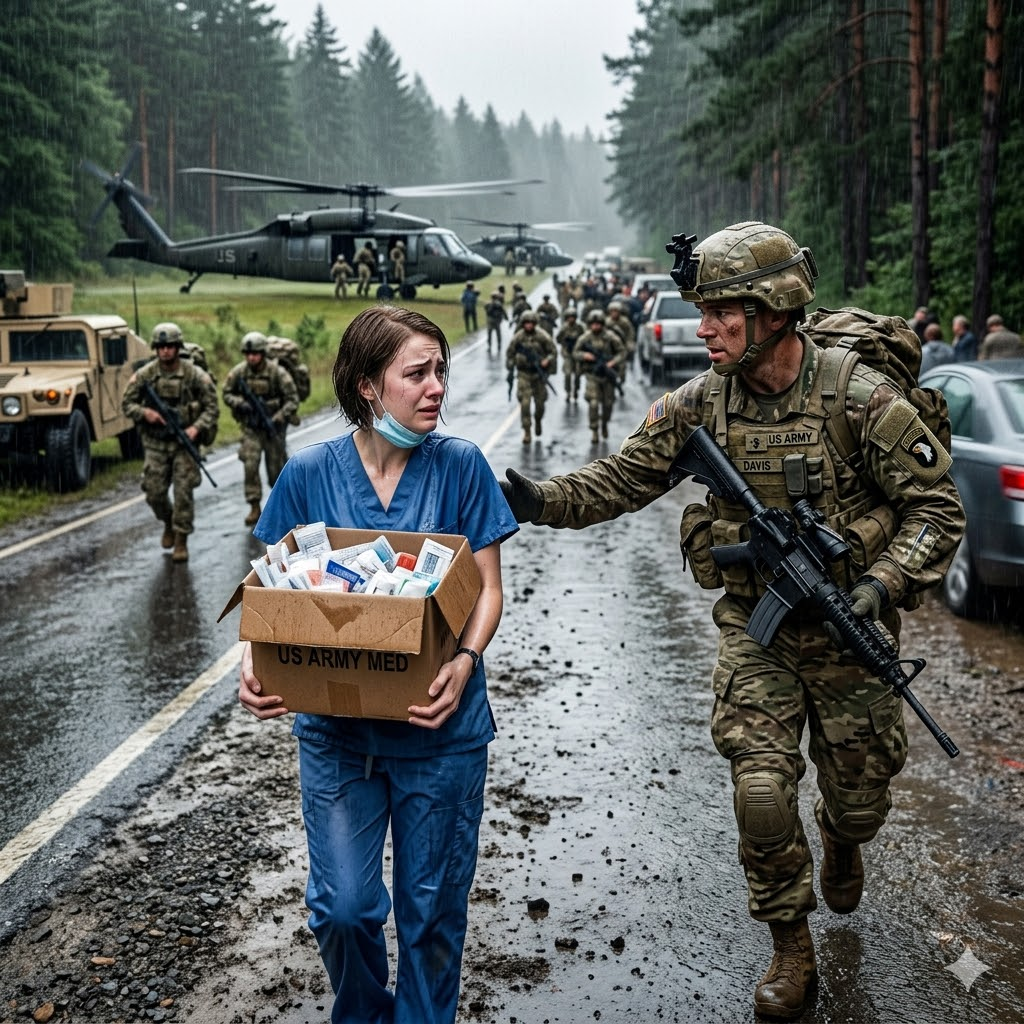
Two Blackhawk helicopters do not just land on a suburban highway during rush hour unless the world is ending or someone very important is missing. The wind from the rotors flattened the tall grass along Route 9, forcing cars to screech to a halt. Drivers stepped out, phones recording, terrified and confused. But the soldiers jumping out weren’t looking for a terrorist.
They weren’t looking for a bomb. A captain with a scarred face sprinted toward a woman walking alone on the shoulder, clutching a cardboard box of personal belongings. He didn’t point a weapon. He pointed a finger at the hospital she had just left. “Ma’am, are you the one they just fired?” When she nodded, stunned, he grabbed his radio.
“We found her, turning the birds around. Tell the general we’re bringing the angel back.”
The fluorescent lights of St. Jude’s Medical Center hummed with a headache-inducing flicker that nurse Rachel Bennett had learned to ignore after 10 years on the floor. It was 2:00 a.m. The graveyard shift, where the chaos of the day usually settled into a rhythmic beeping of monitors.
But tonight, the emergency room was vibrating with tension centered entirely around Bed 4. Rachel adjusted the IV drip, her eyes scanning the vitals of the man lying unconscious in the sheets. He had come in as a John Doe, found slumped in an alleyway three blocks from the hospital. No wallet, no phone, just tactical boots worn down at the heels and a faded gray t-shirt that clung to a frame built of solid muscle.
He was covered in sweat, his temperature spiking to 104°, and he was murmuring things in his delirium that sounded like coordinates. “He’s stabilizing, but barely,” Rachel whispered to herself, checking the fresh bandage on his side. It looked like a surgical incision that had become aggressively infected. It wasn’t a street fight wound. It was precise.
“Nurse Bennett.” The sharp nasal voice of Dr. Gregory Alcott cut through the air like a scalpel. Rachel stiffened. Dr. Alcott was the new chief of surgery, a man who cared more about billing codes and insurance pre-authorizations than patient outcomes. He walked into the trauma bay, wrinkling his nose at the muddy boots sitting in the corner, the patient’s only possession.
“Yes, doctor.” Rachel didn’t look up, focusing on cleaning the wound.
“Why is this vagrant occupying a trauma bed?” Alcott snapped, flipping through the chart on the tablet. “No insurance, no ID. We are not a homeless shelter, Bennett. We have paying patients in the waiting room. Transfer him to the county clinic.”
Rachel finally looked up. Her blue eyes were tired but fierce. “Dr. Alcott, he’s septic. His heart rate is erratic. If we move him now, he goes into cardiac arrest. I’ve seen infections like this before. It looks like—well, it looks like a battlefield staph infection. He needs aggressive antibiotics and observation, not a bus ride to county.”
Alcott scoffed, stepping closer, his expensive cologne overpowering the smell of antiseptic. “You are a nurse, Bennett. You change bed pans and follow orders. You do not diagnose. I’m telling you to clear the bed. He’s a drain on resources.”
“He’s a human being,” Rachel shot back, her voice raising slightly. “And I think he’s a veteran. Look at the scars on his shoulder. That’s shrapnel scarring.”
“I don’t care if he’s the King of England,” Alcott hissed, lowering his voice to a menacing whisper. “You have 15 minutes to discharge him. If I come back and he’s still here, it won’t be him leaving the hospital. It will be you.” Alcott spun on his heels and marched out, his white coat billowing.
Rachel looked down at the man. His breathing was shallow. He gripped the sheets suddenly, his knuckles turning white. “Easy,” Rachel soothed, placing a hand on his forehead. “I’ve got you.” She knew protocol. She knew the hierarchy. She also knew that moving him was a death sentence. She looked at the clock. 2:15 a.m.
Alcott was going to his office to nap. He wouldn’t be back for rounds until 6:30 a.m. Rachel made a choice. Instead of discharging him, she wheeled Bed 4 into the corner of the trauma bay behind a heavy curtain usually reserved for storage. She hooked him up to a fresh bag of Vancomycin, an expensive antibiotic she had to override the digital dispensing cabinet to get.
She sat by his side, sponging his forehead with cool water, listening to his mumbled nightmares. “Echo two, position compromise. Get the bird,” the man groaned, his body thrashing. “You’re safe,” she whispered. “You’re at St. Jude’s. I’m Rachel. I’m not going anywhere.”
For 4 hours, she fought his fever. She ignored her other duties, trading favors with the other nurses, asking them to cover her other patients so she could focus on the John Doe. By 5:30 a.m., his fever broke. His heart rate steadied. He opened his eyes, steel gray and sharp, instantly alert despite his condition.
“Where?” His voice was like gravel.
“Hospital,” Rachel said softly. “You were in bad shape. Septic shock.” The man tried to sit up but winced. He looked at Rachel, analyzing her like she was a tactical variable. “You stayed.”
“I stayed.” She nodded. “Dr. Alcott wanted to kick you out,” she admitted, pouring him a cup of water. “I hid you.”
The man took the water, his hand shaking slightly. “Thank you. I need to make a call. There’s a number in my head. I need a secure line.”
“We don’t have secure lines,” Rachel smiled sadly. “Just a dusty landline at the nurse’s station.”
Before he could answer, the curtain was ripped back. The plastic rings screeched against the metal rail. Dr. Alcott stood there, his face a mask of purple rage. Behind him stood two hospital security guards.
“I warned you!” Alcott spat, pointing a shaking finger at Rachel. “I gave you a direct order, Bennett. You stole medication. You misappropriated hospital resources. And you defied the Chief of Surgery!”
“He would have died!” Rachel stood up, placing herself between the doctor and the patient. “Look at him. He’s conscious. The antibiotics worked.”
“I don’t care!” Alcott screamed. “Get him out! And you—take her badge.”
The security guards hesitated. Everyone liked Rachel. She was the heart of the ER. “Now!” Alcott bellowed. One of the guards, a man named Frank, who Rachel had shared coffee with for years, looked at the floor. “I’m sorry, Rachel.”
Rachel unclipped her badge. She took her stethoscope from around her neck—the one her father had given her when she graduated nursing school—and placed it on the side table. She turned to the man in the bed. “You’re stable. Don’t let them move you until you feel ready. Drink water.”
The man in the bed didn’t say a word. He was staring at Alcott with a look that would have terrified a lesser man, but Alcott was too blinded by ego to notice. The patient’s hand moved subtly under the sheet, tapping a rhythm against his thigh as if counting.
“Get out!” Alcott sneered. Rachel grabbed her purse and her coat. She walked out of the trauma bay, her head high, but her heart shattering in her chest. 10 years of service gone in a heartbeat because she did the right thing.
The automatic doors of the emergency room slid open and the cold morning air hit Rachel like a physical blow. It was raining—a miserable, stinging drizzle that soaked through her scrubs immediately. She realized with a sinking feeling that she had left her umbrella in her locker. She wasn’t allowed to go back in to get it.
She stood on the sidewalk for a moment, looking back at the building. St. Jude’s had been her life. She had missed Christmases, birthdays, and anniversaries inside those walls. She had held the hands of the dying and celebrated with the families of the living. And now she was just a trespasser.
She checked her pockets. She had her car keys. But then she remembered her car, an old Honda Civic, was in the shop for a transmission issue. She had taken the bus to work. The next bus didn’t run until 7:00 a.m. on Sundays. It was barely 6:15 a.m.
“Great,” she muttered, wiping rain from her eyelashes. Her apartment was 5 miles away. A five-mile walk along the highway shoulder in the rain. It felt like a fitting end to the worst night of her life.
She started walking. The rubber of her nursing clogs squeaked against the wet pavement. Cars whizzed by, splashing dirty water onto her legs. She clutched a small cardboard box. Alcott had graciously allowed her to pack a picture of her dog, a coffee mug, and a spare pair of socks.
As she walked, the anger began to fade, replaced by a crushing sense of fear. How would she pay rent? Who would hire a nurse fired for insubordination and theft? Alcott would blacklist her. He was petty enough to ensure she never worked in the city again. She was 34 years old, single, and unemployed.
She was about 2 miles from the hospital, walking along a stretch of road that bordered a large open field used for local fairs in the summer. The rain was coming down harder now. She was shivering uncontrollably. “Just keep moving, Rachel,” she told herself. “One foot in front of the other.”
Then she heard it. At first, it was a low thrumming sound, a vibration in her chest more than a noise. She thought it might be a heavy truck approaching from behind, so she stepped further onto the grass. But the sound didn’t come from the road. It came from the sky.
The thrumming grew into a rhythmic beat that battered the air. It was loud, deafeningly loud. Rachel stopped and looked up. Through the gray mist and rain, two dark shapes materialized. They were massive black helicopters, low and aggressive, banking hard over the treeline. They weren’t the red and white medical choppers she was used to seeing. These were military. Matte black, no markings she could easily see, bristling with antennas and external pods.
“What in the world?” she breathed, shielding her eyes from the rotor wash.
The lead helicopter flared its nose, pitching up as it slowed dramatically. It hovered directly over the road, barely 50 feet in the air. The downdraft was immense. It tore the cardboard box from Rachel’s frozen hands. Her coffee mug shattered on the asphalt. The picture of her dog tumbled into the wet grass. She covered her head, crouching down, terrified.
Was this a crash landing? Was there an emergency?
The helicopter didn’t crash. It landed right in the middle of the four-lane road, blocking traffic in both directions. The second helicopter touched down in the field adjacent to her, its rotors still spinning, cutting the grass like a giant lawnmower. Cars were slamming on their brakes. People were screaming.
Before the skids of the lead helicopter even fully settled, the side doors slid open. Four men jumped out. They weren’t wearing standard army fatigues. They were wearing high-end tactical gear: Multicam trousers, combat shirts, heavy plate carriers, and helmets with night vision mounts. They carried rifles slung low across their chests, ready but not aimed.
They moved with a speed and fluidity that was terrifying. They fanned out, securing a perimeter around the helicopter. One man, the leader, didn’t look at the traffic. He didn’t look at the stunned drivers. He scanned the roadside. He spotted Rachel crouching near the guardrail, soaked and shivering.
He sprinted toward her. He was a giant of a man with a thick beard and a scar running through his eyebrow. He stopped 5 feet from her, raising his hands to show he wasn’t a threat.
“Ma’am!” he shouted over the roar of the engines. “Are you Nurse Bennett? Rachel Bennett?”
Rachel couldn’t speak. She just stared at him.
“Ma’am,” he barked again, urgent but respectful. “Look at me. Are you the nurse who was just at St. Jude’s? The one who treated the John Doe?”
Rachel nodded slowly, her teeth chattering. “Yes… yes, that’s me.”
The soldier tapped his headset. “Command, we have the asset. I repeat, we have the Angel. Condition is wet and cold but secure.” He reached out a hand. “You need to come with us, ma’am.”
“Why? What did I do?” Rachel backed away, hitting the guardrail. “I was fired! I didn’t do anything wrong! I just gave him antibiotics!”
The soldier’s expression softened. He stepped closer, ignoring the rain pounding on his helmet. “We know. That man you treated is Captain Elias Thorne of the First Special Forces Operational Detachment-Delta. He’s our team leader.”
Rachel’s eyes widened. The nobody in Bed 4.
“He woke up enough to make one call,” the soldier continued. “He told us what happened. He told us they threw you out because you saved his life.”
“I just did my job,” Rachel stammered.
“Well, now we’re doing ours,” the soldier said grimly. “General Higgins—that’s Captain Thorne’s father—is already inbound to the hospital. But Captain Thorne refused to let anyone touch him until you were brought back. He said, and I quote: ‘Get me the nurse who refused to let me die, or I walk out of here with my IVs trailing behind me.’”
The soldier gestured to the open door of the Blackhawk. “Please, ma’am. We have orders to retrieve you, and frankly, I wouldn’t want to be Dr. Alcott when we get back there.”
Rachel looked at her shattered mug on the road. She looked at the traffic jam caused by two military helicopters sent specifically for her. She looked at the soldier’s extended hand.
She took it. “Let’s go,” she said.
The soldier helped her up into the cabin. Someone threw a warm wool blanket around her shoulders. As the helicopter lifted off, banking sharply back towards St. Jude’s, Rachel looked down at the cars below. She wasn’t walking anymore. She was flying to war. And for the first time in her life, she had an army at her back.
The roof of St. Jude’s Medical Center was not designed for a Sikorsky UH-60 Black Hawk, let alone two of them. The structural integrity was rated for lighter medical transport choppers, but the pilots of the 160th Special Operations Aviation Regiment didn’t seem to care about hospital building codes. They set the birds down with a jarring thud that shook dust from the ceiling tiles of the trauma center four floors below.
Inside the ER, chaos had fully metastasized. Dr. Gregory Alcott was standing at the nurse’s station, screaming into a telephone receiver, his face a mottled map of indignation. “I don’t care who they are! This is a private facility! You tell the police to get those unauthorized aircraft off my roof immediately or I will sue the city into bankruptcy!”
He slammed the phone down and turned to the huddled group of nurses and residents. “Back to work! Why are you all standing there? If I see one more person looking at the ceiling, you’re fired, just like Bennett!”
The elevator doors at the end of the hallway chimed. Usually, this sound preceded the arrival of a gurney or a cafeteria cart. This time, the doors slid open to reveal a wall of Multicam. Six operators stepped out, forming a phalanx. In the center walked a man who wore a dress uniform rather than combat gear.
General Thomas Higgins was a legend in the special operations community, a man whose silence was rumored to be more terrifying than his shouting. He walked with a cane—a souvenir from Fallujah—but he moved with the momentum of a freight train. And right beside him, wrapped in a gray wool army blanket, her hair wet and matted to her forehead, was Rachel Bennett.
The ER went silent. You could hear the hum of the vending machine down the hall. Alcott’s jaw dropped. He blinked, looking from the soldiers to Rachel, his brain struggling to compute the impossible equation before him. “What is the meaning of this?”
General Higgins didn’t stop until he was nose-to-nose with the surgeon. Higgins was 60, with silver hair and eyes like frozen flint. “Are you Dr. Alcott?”
“I am the Chief of Surgery,” Alcott stammered, trying to regain his height. “And you are trespassing in a sterile zone! I demand you remove these weapons and this fired employee immediately!”
Higgins ignored the demand. He turned to the soldier on his left. “Secure the floor. No one enters or leaves without my authorization. Cut the landlines. Jam cellular signals within a 200-foot radius. This is now a secure operating base.”
“Yes, General!” the soldier barked, moving instantly to the exits.
“You can’t do that!” Alcott shrieked. “This is a hospital!”
“Correction,” Higgins said, his voice deadly calm. “This is the location of a high-value asset who is currently in critical condition. An asset you attempted to discard like garbage.” Higgins stepped back and gestured to Rachel. “Nurse Bennett is no longer your employee, doctor. She has been conscripted as a specialized medical consultant for the Department of Defense. She outranks you, effective immediately. She is the primary care provider for Captain Thorne. You will provide her with whatever she needs. If she asks for a scalpel, you hand it to her. If she asks for the moon, you start building a rocket.”
Alcott’s face turned a shade of pale violet. He looked at Rachel with pure venom. “Her? She’s a nurse! She barely passed her boards 10 years ago. I checked her file. She is incompetent to handle a trauma of this magnitude!”
Rachel stepped forward. The shock of the helicopter ride was fading, replaced by the familiar adrenaline of the ER. She looked at Alcott, then at the terrified staff, and finally at Frank, the security guard, who had apologized to her earlier. Frank gave her a subtle thumbs-up.
“Where is he?” Rachel asked, her voice steady. “Where is Captain Thorne?”
Alcott crossed his arms. “I had him moved to the basement holding area pending transfer to County. He’s not my problem anymore.”
Rachel’s eyes widened. “The basement? It’s 50 degrees down there! He’s fighting sepsis! The cold will send him into shock!” She didn’t wait for permission. She took off, running down the hall toward the service elevators, shedding the wool blanket as she went.
General Higgins gestured to two of his men. “Go with her. If anyone gets in her way, move them.”
Alcott sputtered. “General, I will have your badge for this! I know senators!”
Higgins leaned in close, his voice dropping to a whisper that chilled the room. “Doctor, my son is lying in your basement. If he dies because you wanted to save on the heating bill, I won’t need a badge, and you won’t need a lawyer. Do you understand?”
Alcott swallowed hard. For the first time, the arrogance cracked, revealing the coward underneath.
The basement holding area was essentially a storage room for broken equipment and overflow files. It smelled of mildew and old dust. Rachel burst through the double doors, the two Delta operators flanking her. In the corner, on a stretcher with a broken wheel, lay Captain Elias Thorne. He was shivering violently, his teeth chattering so hard it sounded like bone grinding on bone. The IV bag Rachel had hung earlier was empty. The line had backed up with blood.
“Elias!” Rachel rushed to his side, her hands instantly checking his carotid pulse. It was thready and fast. Too fast.
“Rachel…” Elias stammered, his eyes unfocused. “Hostiles… South Ridge…”
“No hostiles,” she said, stripping off her wet scrub top to reveal a thermal undershirt, which she immediately used to cover his chest. “Get me blankets!” she yelled at the soldiers. “And get that gurney moving! We need to get him to the ICU now!”
The soldiers—men trained to kill with their bare hands—looked momentarily lost before sprinting to find anything warm. They returned with drop cloths and a janitor’s coat. It had to do. They rushed him back up to the ICU.
The takeover of the hospital was complete. The Delta team had cleared the entire west wing, moving other patients to the east wing. The ICU was now a fortress. Rachel worked feverishly. She reestablished two large-bore IVs, pushing warm fluids to combat the hypothermia. She hooked him up to the advanced cardiac monitor. The numbers were bad. BP 80/40, heart rate 140.
But it was the blood work that came back 30 minutes later that made her pause. She was staring at the computer screen at the central station. General Higgins stood behind her, watching over her shoulder.
“Talk to me, Nurse Bennett,” Higgins said. “Is he stabilizing?”
“His temperature is coming up,” Rachel said, biting her lip. “But these white blood cell counts… they don’t make sense. He has a staph infection.”
“Standard battlefield sepsis,” Alcott’s voice came from the doorway. He was flanked by a hospital administrator, a nervous-looking woman named Mrs. Gable. “He needs Vancomycin, which you already stole.”
Rachel ignored the jab. “No. Look at the eosinophils and the liver enzymes. They’re skyrocketing. Sepsis attacks the organs, yes, but this pattern… this looks like toxicity.” She spun around to face the General. “Sir, where was he specifically? I need to know what environment he was operating in.”
Higgins hesitated. “That is classified.”
“General,” Rachel said firmly. “Your son is dying, not from an infection, but from something else. If I treat the infection, I’m just putting a Band-Aid on a bullet hole. I need to know!”
Higgins looked at his men, then back at Rachel. “He was in the Golden Triangle. A raid on a synthetic opioid lab. There were experimental compounds.”
Rachel snapped her fingers. “Chemical exposure. It’s not staph. It’s a mimetic agent. He’s been exposed to a neurotoxin that mimics infection symptoms while shutting down the autonomic nervous system.”
“Preposterous!” Alcott scoffed. “You’re watching too many movies, Bennett. You’re going to kill him with your fantasies. I am ordering a dialysis machine to filter his blood for sepsis.”
“Dialysis will kill him!” Rachel shouted. “If you filter his blood now, the stress on his heart will cause cardiac arrest! He needs an antidote! He needs Atropine and Pralidoxime immediately!”
Alcott stepped forward, trying to physically block Rachel from the medication cart. “I will not allow you to administer a nerve agent antidote to a septic patient! It’s malpractice!”
The room went dead silent. The heart monitor for Bed 1—Elias’s bed—started to alarm. A rapid, high-pitched whine. V-fib.
“He’s crashing!” Rachel yelled. She shoved Alcott. It wasn’t a gentle push. She put her shoulder into his chest and drove him backward into a linen cart. He tumbled down in a heap of sheets. “Code Blue!” she screamed. “Charge the paddles! 200 joules!”
Rachel grabbed the crash cart. The soldiers stood frozen, unsure if they should shoot the doctor or help the nurse.
“Clear!” Rachel yelled, pressing the paddles to Elias’s chest. Thump. Her body jerked with the discharge. She looked at the monitor. Flatline. “300 joules! Clear!” Thump.
Still flatline.
“Come on, soldier,” she whispered, tears stinging her eyes. “Don’t you dare quit on me now. I walked five miles in the rain for you!” She started chest compressions. Hard, rhythmic, cracking ribs if necessary. “Push one milligram of Epi!” she commanded one of the other nurses who had snuck back onto the floor, a young girl named Sarah, who looked terrified but grabbed the syringe.
Two minutes of CPR. Rachel felt sweat dripping from her forehead.
“Let him go,” Alcott sneered from the floor, adjusting his glasses. “He’s gone. You killed him.”
“Shut up!” General Higgins roared, drawing his sidearm and pointing it directly at Alcott’s head. “One more word, doctor, and you join him.”
“Stop compressions,” Rachel said breathlessly. She looked at the monitor. Nothing… then a blip… then another. A chaotic but sustainable rhythm returned. “Sinus tachycardia,” Rachel breathed. “He’s back.” She didn’t hesitate. She grabbed the Atropine syringe from the crash cart. She slammed it into the IV port, pushing the Atropine. “If I’m wrong, this stops his heart again. If I’m right, his vitals stabilize in 30 seconds.”
She pushed the plunger. Everyone watched the monitor. 10 seconds… 20 seconds… The heart rate began to drop. 140… 130… 110… 90. The blood pressure rose. 90/60… 110/70. Rachel slumped against the bed rail, exhaling a breath she felt like she’d been holding for an hour.
“He’s stabilizing,” she whispered. “It was the toxin.”
General Higgins holstered his weapon. He looked at Rachel with a reverence usually reserved for religious figures. Then he looked at Alcott. “Get him out of here,” Higgins ordered his men. “Lock him in his office. If he touches a phone, break his fingers.”
Three days passed. The ICU at St. Jude’s had become a bizarre mix of sterile medicine and forward operating base. Soldiers slept in the waiting room chairs. Pizza boxes were stacked next to ammunition crates. Rachel hadn’t gone home. She slept on a cot in Elias’s room, waking up every hour to check his vitals.
Elias was awake. He was weak, but the gray steel was back in his eyes. “You have a heavy hand with those needles, Bennett,” Elias rasped, trying to shift in the bed.
Rachel smiled, adjusting his pillows. She was exhausted, wearing fresh scrubs the military had sourced for her. “You have thick skin, Captain. Makes it hard to find a vein.”
“Call me Elias,” he said softly. “I think you’ve earned the right.” He looked at her, really looked at her. “My father told me what you did. The walk, the confrontation with Alcott, the diagnosis.”
“I just did my job,” Rachel said, looking down at her hands. “Alcott—he’s trying to get my license revoked. Even with your father here, the hospital board is furious. They’re saying I assaulted a senior physician and administered unauthorized drugs.”
“Let them try,” Elias said, his voice hardening. “I’ll buy this damn hospital and fire the board if I have to.”
“It’s not that simple,” Rachel sighed. “Politics. Even the military has to answer to lawyers eventually.” She checked his IV line. “You need rest. Your liver enzymes are almost normal, but your body took a massive hit, Rachel.”
Elias reached out and grabbed her hand. His grip was strong again. “Why? You didn’t know me. I was just a homeless guy in dirty boots. You lost your career for a stranger.”
Rachel met his gaze. “My brother—he was a Marine. He came home different. He died in a VA waiting room because nobody looked past the dirty clothes and the smell of alcohol. I promised myself that would never happen on my watch. Not again.”
A silence stretched between them, heavy with unspoken emotion. Elias squeezed her hand. “You’re a good woman, Rachel Bennett.”
Suddenly, the door to the room opened. It wasn’t the General. It wasn’t a soldier. It was a nurse. Rachel didn’t recognize the tall man with a buzzcut wearing surgical scrubs and a mask. He was pushing a medication cart.
“Scheduled rounds,” the man mumbled, keeping his head down. “Dr. Alcott ordered a sedative to help him sleep.”
Rachel frowned. “Dr. Alcott is under house arrest in his office. And I handle all meds for this patient.”
The man froze. Rachel’s instincts, honed by years of dealing with drug seekers and violent patients in the ER, flared up. She looked at the man’s shoes. They weren’t nursing clogs or sneakers. They were heavy black leather boots—expensive ones. And on his wrist, just visible under the cuff of his scrub top, was a tattoo: a black scorpion.
Rachel’s blood ran cold. She remembered Elias’s delirious murmuring from the first night. “Scorpion! They knew we were coming!”
“Hey,” Rachel said, sharp and loud. “Step away from the cart!”
The man looked up. His eyes were cold and dead. He reached into the pocket of his scrubs. He wasn’t reaching for a stethoscope.
“Gun!” Elias shouted, trying to throw himself out of bed despite his weakness.
The assassin pulled a suppressed pistol. Rachel didn’t think. She didn’t have a weapon. She had a tray of metal surgical instruments on the bedside table. She grabbed a heavy kidney dish and hurled it with all her might. It struck the assassin in the face just as he fired. The bullet went wide, shattering the glass of the window behind Elias.
The assassin staggered back, blood streaming from his nose. He raised the gun again, aiming directly at Rachel. “No!” Elias roared, ripping the IVs out of his arm and launching himself off the bed. He tackled the man, his weakened body fueled by pure rage. They crashed into the medication cart, sending vials and syringes flying across the room.
The assassin was stronger. He backhanded Elias, sending him crashing into the wall. He turned the gun toward the Captain, who was gasping for air on the floor. But before he could pull the trigger, a force slammed into his back. Rachel had grabbed the oxygen tank from the corner of the room, a solid steel cylinder. She swung it like a baseball bat. It connected with the back of the assassin’s head with a sickening crunch.
The man crumpled to the floor and didn’t move.
The door burst open. General Higgins and three Delta operators flooded the room, weapons raised. They saw the unconscious assassin on the floor. They saw Elias leaning against the wall, bleeding from his IV sites. And they saw Rachel Bennett standing over the hitman, clutching an oxygen tank, her chest heaving, looking like a warrior goddess.
General Higgins looked at the tattoo on the assassin’s wrist. He turned pale. “We have a breach,” Higgins whispered. “This wasn’t a random hit. They found us.”
Rachel dropped the tank. Her hands started to shake. “He said he was a nurse…”
Elias pulled himself up, using the bed for support. He looked at Rachel with an intensity that burned. “You saved me,” he said, breathless. “Again.”
“We’re not safe here,” Rachel said, her voice trembling but resolute. “If they can get a fake nurse into the ICU, they can get a bomb in here.”
Higgins nodded grimly. “She’s right. We need to move now.”
“Where?” Elias asked.
Rachel looked at the General. “My family has a cabin up north, off the grid. No cell service, no internet. If you want him to live, we have to disappear.”
Higgins looked at the civilian nurse who had just taken down an armed assassin. He realized he wasn’t looking at a civilian anymore. “Lead the way, Nurse Bennett,” the General said.
The convoy of black SUVs tore down the interstate, a blur of tinted glass and government plates. Inside the lead vehicle, Rachel gripped the steering wheel of her late father’s old Ford truck, which General Higgins had insisted take the middle position in the formation for camouflage. Elias sat in the passenger seat, a rifle resting across his knees, his face pale but his eyes scanning the treeline.
“You’re bleeding through the bandage,” Rachel said, her eyes flicking to his arm for a second before returning to the wet asphalt.
“I’ll live,” Elias grunted. “How far to the cabin?”
“20 miles,” she replied. “It’s up on Blackwood Ridge. It’s an old logging road. Your SUVs might struggle in the mud.”
“My SUVs have survived the mountains of Afghanistan,” Higgins’s voice crackled over the radio. “Lead on, Bennett.”
The cabin was a relic of a different time. A sturdy structure of rough-hewn pine perched on a cliff overlooking a dense valley of spruce and fir. There was no electricity, only a generator in the shed. No cell service, just the wind howling through the valley. They arrived just as the sun began to dip below the horizon, painting the sky in bruises of purple and red.
The Delta team moved with practiced efficiency. Two men took up sniper positions on the roof. Two more mined the perimeter of the driveway with claymores. Rachel helped Elias inside. The air in the cabin was stale and cold. She knelt by the fireplace, arranging kindling with shaking hands.
“Hey,” Elias said, kneeling beside her. He placed a hand on her shoulder. “Stop.”
Rachel froze. She looked at him, and the tears she had been holding back since the hospital finally spilled over. “They tried to kill you right in front of me. That man… he had dead eyes, Elias. He didn’t care.”
“I know,” Elias said softly. “But he failed because of you.” He took the match from her hand and lit the fire.
As the flames caught, casting dancing shadows on the walls, the cabin warmed. Rachel set up a makeshift clinic on the kitchen table, cleaning Elias’s wounds and checking his vitals. “You’re strong,” Elias murmured as she wrapped fresh gauze around his arm. “Stronger than half the men I served with.”
“I’m not a soldier.” Rachel shook her head. “I’m just stubborn. That’s all a soldier is.”
Elias smiled. “Stubborn enough to refuse to die.”
The night settled in. The General sat by the window, watching the darkness with thermal binoculars. The team rotated watches. Rachel and Elias sat on the rug by the fire, sharing a can of peaches from the pantry. For a moment, the war felt far away. They talked about her dog, about his childhood in Texas, about the quiet life they both secretly craved.
But the peace was a lie. At 0300 hours, the radio on the General’s vest hissed. “Contact sector north. Movement in the trees. Multiple heat signatures.”
Higgins stood up instantly. “How many?”
“20, maybe 30. They’re fanning out. They’re not using flashlights. These are pros.”
Elias grabbed his rifle, wincing as his muscles protested. “They found us fast. Too fast.”
Rachel’s mind raced. “How? We ditched the phones. We checked the vehicles for trackers.”
Elias looked at the medical bag Rachel had brought from the hospital—the one she had packed in a hurry from the supply closet before fleeing. He kicked it over. A small, blinking red light pulsed from inside a box of sterile gauze. A beacon. Elias spat. “That fake nurse… he must have planted it in the bag before he came into the room. We brought them right to us.”
The first shot shattered the window, blowing out the oil lamp on the table.
“Get down!” Higgins roared, flipping the heavy oak table onto its side for cover.
Gunfire erupted from the treeline. It was a deluge of lead. Bullets chewed through the wooden walls of the cabin like termites. The sound was deafening. The Delta operators returned fire, their suppressed rifles coughing rhythmically.
“They’re flanking!” the sniper on the roof yelled over the comms. “They’ve got RPGs! Whoosh… Boom!”
An explosion rocked the south side of the cabin. The wall disintegrated, showering the room in splinters and drywall. Rachel covered her head, coughing in the dust.
“We can’t hold this!” Higgins yelled, firing a burst through the gap in the wall. “They have the numbers and the heavy ordnance! We need an exit strategy!”
“There is no exit!” Elias shouted back, changing magazines. “The truck is toast. The SUVs are pinned down.”
Rachel looked at the layout of the room. She looked at the floorboards near the pantry. The root cellar. She screamed over the noise of the firefight. Higgins looked at her. “What?!”
“My grandfather used it during Prohibition to hide moonshine!” Rachel crawled toward the pantry. “It’s a tunnel! It comes out in the creek bed 200 yards down the ravine! It puts us behind their line!”
Elias looked at Higgins. “Go. Take the team. Flank them.”
“I’m not leaving you!” Higgins argued.
“I can’t run!” Elias said, gesturing to his leg, which had taken shrapnel in the explosion. “I’ll hold them here with Rachel. You loop around and hit them from behind. It’s the only way!”
Higgins hesitated for a split second, then nodded. “Give them hell, son.”
The General and the four operators disappeared into the pantry, prying up the floorboards and slipping into the darkness of the earth. Rachel and Elias were alone. The gunfire outside paused. The enemy was reloading, preparing for the final breach.
“You know how to use this?” Elias asked, handing Rachel a 9mm pistol.
Rachel took the cold steel in her hands. She was trembling. “Point and shoot?”
“Don’t pull the trigger,” he corrected. “Squeeze it. Breath out… squeeze.” He dragged himself to the pile of rubble that used to be the south wall. “They’re coming.”
Shadows moved in the smoke. Men in black tactical gear moving cautiously. They thought everyone inside was dead or suppressed. “Wait for it,” Elias whispered.
The first man stepped through the hole in the wall. Crack. Elias dropped him with a single shot to the chest. Chaos returned. The room filled with smoke and noise. Rachel crouched behind the overturned table, clutching the pistol. A figure loomed in the doorway to her left, a flanker Elias hadn’t seen. He raised his rifle at Elias’s exposed back.
Rachel didn’t think. She stood up. She breathed out. She squeezed. The gun kicked hard in her hand. The man in the doorway jerked back, clutching his shoulder, and fell.
“Nice shot!” Elias yelled, suppressing another attacker. But they were out of time. A grenade rolled across the floor, coming to a stop just feet from them. “Grenade!” Elias threw himself over Rachel, shielding her with his body.
The explosion was deafening. The world turned white, then black.
Rachel woke to the taste of ash and the screaming silence that follows an explosion. For a terrifying minute, she couldn’t remember how to breathe. The air in the cabin was thick with dust, swirling in the shafts of sunlight that pierced through the shattered roof. She coughed—a violent spasm that racked her bruised ribs—and pushed a heavy pine beam off her legs. Her hands were raw, her fingernails broken. She crawled through the debris, her heart hammering against her ribs like a trapped bird.
“Elias…” Her voice was a broken rasp. “Elias!”
He was lying near the remains of the fireplace, half buried under drywall and shattered furniture. He wasn’t moving. Rachel scrambled over the wreckage, ignoring the sharp pain in her knee. She reached him, her trembling fingers pressing against the carotid artery in his neck. A pause, an eternity of silence, and then—a strong, rhythmic thrum against her fingertips.
He groaned, his eyes fluttering open. They were unfocused at first, glassy with concussion before sharpening into that familiar steel gray. He looked at Rachel—at the soot on her face, the blood matting her hair—and he tried to smile. “Did we win?” he whispered.
Before Rachel could answer, the front door, hanging off one hinge, was kicked open. Light flooded the dark room. Rachel instinctively reached for the pistol lying in the dust, but a boot gently stepped on the barrel. She looked up to see General Thomas Higgins standing over them. He was covered in mud, his uniform torn, but he looked like a god of war. Behind him, through the gaps in the walls, Rachel could see Delta operators securing the perimeter, zip-tying the few surviving mercenaries.
“Easy, Bennett,” Higgins said, his voice unusually gentle. “It’s clear. The threat is neutralized.” He knelt, checking his son’s pupils. “You two held the line against 30 armed hostiles. I’ve seen seasoned operators fold under less pressure.”
Rachel slumped back against a pile of rubble, the adrenaline finally leaving her system, replaced by a bone-deep exhaustion. “It wasn’t just a hit squad,” she murmured, staring at the destroyed cabin. “They knew exactly where we were. They knew everything.”
“We know,” Higgins said grimly. “We recovered their comms gear. We found the source of the leak.” His jaw tightened. “And we’re going to fix it today.”
48 hours later, the atrium of St. Jude’s Medical Center was transformed into a media circus. News vans lined the streets, their satellite dishes pointed toward the hospital entrance. Inside, a podium had been set up in front of the donor wall, bathed in the harsh white light of camera flashes.
The story had leaked—or rather, a version of it had: a hostage situation involving a decorated war hero and a disgruntled nurse. Dr. Gregory Alcott stood at the podium, basking in the attention. He wore a crisp, tailored suit under a pristine white coat, his hair perfectly coiffed. He looked the picture of administrative competence and solemn concern.
“Thank you all for coming,” Alcott said, leaning into the cluster of microphones. His voice was smooth, practiced, dripping with faux sincerity. “This has been a harrowing week for the St. Jude’s family. We pride ourselves on healing, on safety. But sometimes, the danger comes from within.” He paused for dramatic effect, looking out at the sea of reporters.
“Nurse Rachel Bennett was a troubled woman,” Alcott continued, shaking his head sadly. “We noticed the signs—erratic behavior, insubordination, emotional instability. When I terminated her employment for theft, she snapped. It is my deepest regret that she managed to abduct Captain Thorne, a critical patient in our care. We are working with the authorities, but we must prepare for the worst. Given Captain Thorne’s condition, it is unlikely he survived the ordeal.”
A reporter from Channel 5 raised a hand. “Doctor, are you saying the nurse is responsible for his death?”
“I am saying,” Alcott said, adjusting his glasses, “that Rachel Bennett is a danger to society, and I blame myself for not acting sooner to protect my patients from her incompetence.”
The cameras flashed blindingly. Alcott soaked it in. He had spun the narrative perfectly. He was the hero doctor; she was the villain. The cartel money was already in his offshore account. He had won.
“Are there any further questions?” Alcott asked, a smug smile touching his lips.
“I have one.”
A deep voice boomed from the back of the atrium. The sound cut through the murmuring crowd like a thunderclap. Heads turned. Cameras swung around. The heavy glass automatic doors at the main entrance slid open. They didn’t just open; they seemed to part for a procession.
Captain Elias Thorne walked in. He wasn’t wearing a hospital gown. He wasn’t on a gurney. He was wearing his full dress blue uniform, the fabric straining across his broad shoulders. A Purple Heart and a Silver Star gleamed on his chest. He walked with a cane, favoring his left leg, and his right arm was in a black sling, but his posture was upright, radiating an intensity that silenced the room. The crowd gasped.
To his right walked General Higgins, flanked by two military police officers. And to his left walked Rachel Bennett. She wasn’t in handcuffs. She wasn’t wearing scrubs. She wore a simple blazer and dark jeans, her hair pulled back. She had a healing cut on her forehead and bruises on her cheek—badges of honor. She made no attempt to hide. She didn’t look down. She stared straight at the podium.
Alcott’s face went the color of old milk. He gripped the edges of the podium so hard the wood creaked. “Security!” he shrieked, his voice cracking. “Security, arrest that woman! She’s a fugitive!”
Two hospital security guards stepped forward hesitantly.
“Stand down!” General Higgins roared. The command echoed off the marble walls, freezing the guards in their tracks. “Anyone who touches a member of my team answers to the United States Army.”
Elias continued his slow, painful march towards the stage. The reporters parted like the Red Sea, sensing a story far bigger than the one they had been fed. Elias climbed the three steps to the stage. He stood next to Alcott, towering over the surgeon.
“Dr. Alcott claims I was kidnapped,” Elias said, leaning into the microphone. His voice was calm, but it carried a lethal weight. “He claims Nurse Bennett is incompetent. He claims she is a danger.” Elias looked at Rachel, who had taken her place at the foot of the stage. “The truth is,” Elias said, turning his gaze back to the terrified surgeon, “Rachel Bennett is the only reason I am breathing. And Dr. Alcott—he didn’t just fire her. He tried to sell me.”
A ripple of shock went through the room.
“That’s a lie!” Alcott screamed, sweat beading on his forehead. “He’s delirious! The sepsis has rotted his brain! Don’t listen to him!”
Elias reached into his uniform pocket with his good hand. He pulled out a small black digital recorder—the device recovered from the assassin in the cabin. “We found this on the man you sent to kill us,” Elias said. He pressed a button and held the device up to the microphone.
Static hissed through the speakers, followed by a voice. It was tiny but unmistakably Alcott’s nasal, arrogant tone: “The nurse is a problem. She knows about the neurotoxin. If Thorne survives, the cartel loses the formula and I lose my payout. Kill him. Kill the nurse. Make it look like a botched robbery in the woods. I want the remaining 2 million wired to the Cayman account by morning.”
Silence. Absolute, horrified silence hung over the atrium. Alcott staggered back, knocking over a pitcher of water. “That’s AI! That’s a deepfake! I never said that!”
Rachel stepped onto the stage. She walked up to Alcott, invading his personal space. She looked him in the eye, and for the first time, the arrogant doctor looked small. “You violated the oath, Gregory,” she said, her voice steady and clear enough for the front row to hear. “First, do no harm. You sold a soldier’s life for a paycheck. You tried to destroy my life because I did my job.”
General Higgins nodded to the back of the room. “Federal agents, take him.”
Six FBI agents in windbreakers swarmed the stage. They weren’t gentle. They spun Alcott around, slamming him against the podium he had just been preaching from. As the handcuffs clicked around his wrists, Alcott began to weep, shouting about his lawyers, about his tenure, about how this was all a mistake. Rachel watched him being dragged away, his heels skidding on the polished floor. She saw Frank, the security guard, standing by the door with a wide grin on his face. He gave her a salute. She smiled back.
As the chaos of the arrest consumed the room, Elias turned to Rachel. The adrenaline was fading, and he leaned heavily on his cane, his face pale. “You okay?” he asked softly, ignoring the reporters shouting questions at them.
Rachel looked around the hospital. This had been her world for 10 years. She saw the faces of her former colleagues—some ashamed, some cheering. “I think I’m officially unemployed,” she said, a dry laugh escaping her lips. “And I think my nursing license is probably still suspended.”
Elias smiled, and it transformed his scarred face. “Actually, that’s not true. The medical board reviewed the case this morning. Your license is active. In fact, you have a commendation pending.”
“I don’t think I want to work here anymore,” Rachel admitted, looking at the spot where Alcott had stood. “Too many ghosts.”
“Good,” Elias said. “Because I have a job offer for you. The military is establishing a new protocol for special operations medical support. We need a liaison. Someone who can think on their feet, who isn’t afraid of brass, and who can shoot a 9mm if the day goes sideways.”
Rachel raised an eyebrow. “Is the pay good?”
“Better than here,” Elias said. “And the benefits include full dental and—well, me.”
Rachel looked at him. She saw the man who had shielded her from a grenade, the man who had walked through fire to clear her name. “And the boss?” she asked playfully. “Is he difficult to work with?”
“He’s stubborn,” Elias admitted, stepping closer. “But he’s very loyal.”
Rachel took his good arm, stabilizing him. “I’ll take the job, but only if I get to drive the helicopter.”
Elias laughed—a warm, genuine sound that felt like the final closing of a dark chapter. “We’ll see about that, Nurse Bennett. We’ll see about that.”
They walked out of the hospital together into the bright afternoon sun, leaving the cameras and the corruption behind them. Rachel Bennett had walked home in the rain as a victim, but she walked out into the sun as a warrior. And for the first time in a long time, she knew exactly where she was going.
Two Blackhawk helicopters don’t shut down a civilian highway for no reason. When nurse Rachel Bennett was fired for saving a homeless John Doe, she thought her life was over. She was walking home in the rain, shivering and broken. But she didn’t know that the homeless man she saved was a Delta Force captain with a bounty on his head. Suddenly, the sky roared. Soldiers repelled onto the asphalt. They weren’t there to arrest her. They were there to salute her and the man who fired her was about to learn that you never mess with a soldier’s guardian angel. What a ride! Rachel went from being fired to fighting off assassins in a remote cabin.