
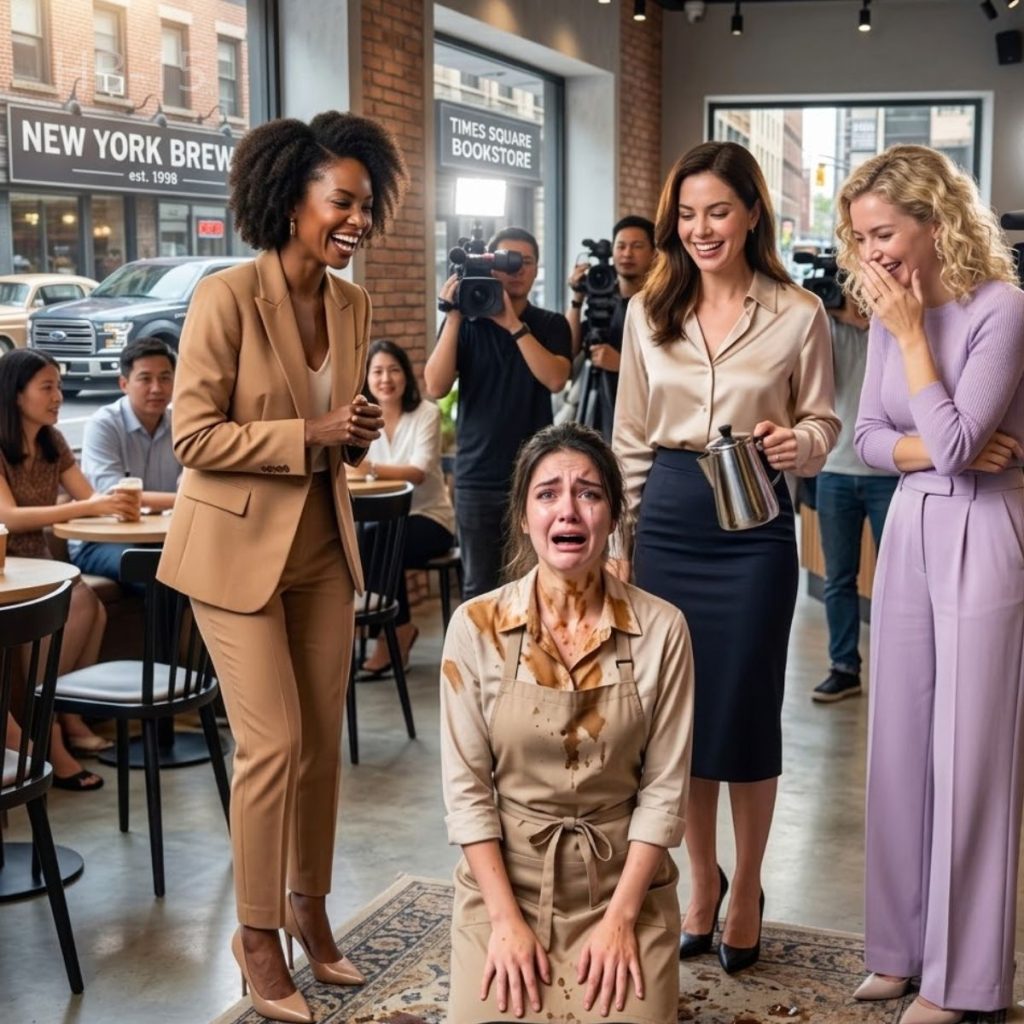
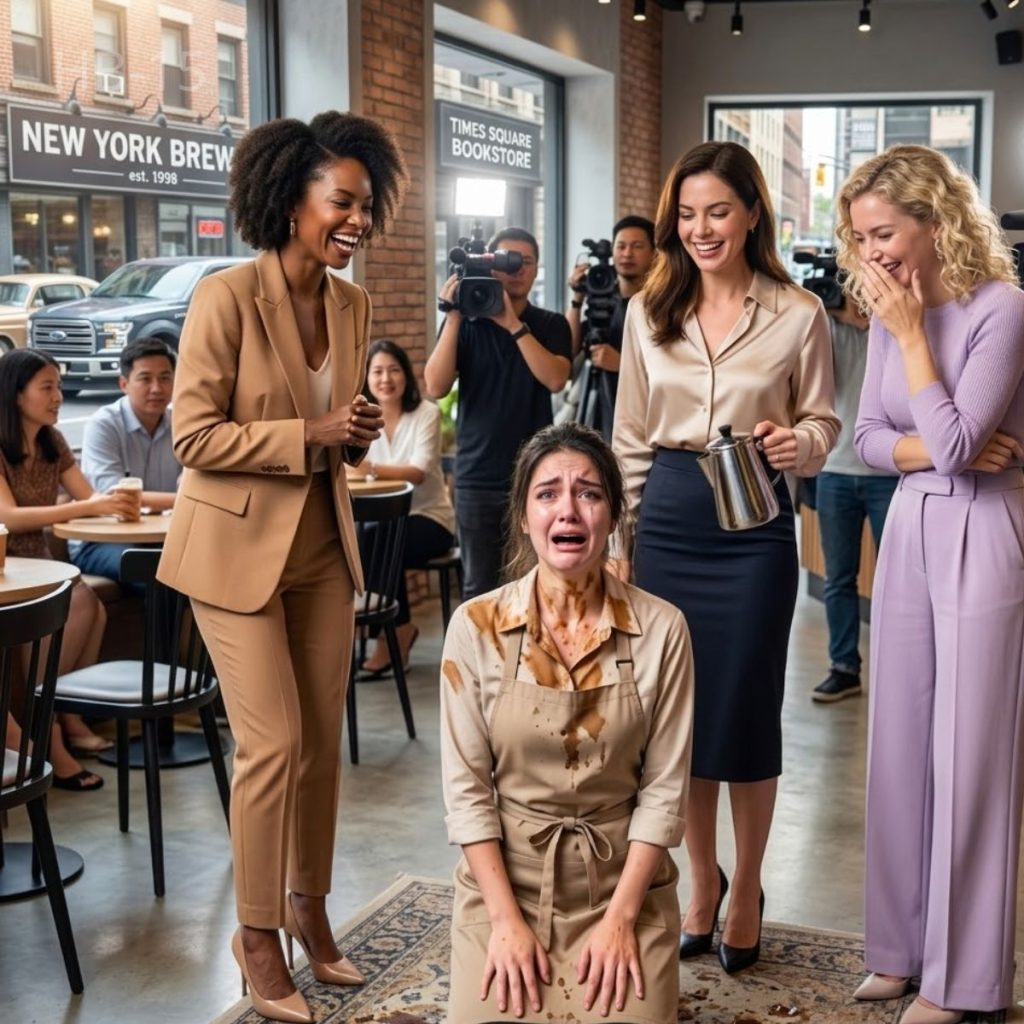
By the time the first scream tore through Morning Brew Cafe, everything that had been hidden for years was already on the verge of collapsing. People like to believe disaster begins with a single moment, a single reckless act, a single cruel decision. They imagine a spark and then the fire. But that is not how this happened. The boiling water that splashed across my skin that morning was not the beginning. It was the end of a long and carefully arranged performance, the final violent note in a symphony of humiliation that had been composed by people who believed money could buy silence, fear, loyalty, and immunity.
I know that now.
At the time, all I knew was pain. Blinding, unbearable pain that shot through my chest, neck, and arm as if my body had been split open and set aflame. I remember collapsing to the floor. I remember the smell of coffee and scorched fabric and panic. I remember hearing voices from far away, muffled as if I had been dropped underwater. Someone shouted for ice. Someone shouted not to use ice. Someone was crying. Someone was filming. And somewhere above all of that, clearer than the rest, I heard laughter.
That was the part I would never forget.
Not the heat. Not even the agony. It was the laughter.
The women who had done it were laughing.
When I think back on that day, I do not begin with the boiling water, though. I begin much earlier, in the life I had built so carefully that sometimes even I could almost believe it was stable. I begin with the version of myself I had tried to split into two people because it seemed easier than forcing the world to accept that both versions were real.
By day, I was Andrea Bennett, waitress, coffee runner, floor sweeper, girl from nowhere. I wore a plain apron, tied my hair back, memorized custom drink orders, smiled through rude comments, and lived on my feet. My hands smelled like espresso grounds and dish soap. My back ached at the end of double shifts. My paycheck was ordinary. My life, to anyone watching, was small.
By night, I went home to a penthouse apartment with floor-to-ceiling windows and a husband whose last name opened doors in every major city in the country. I wore silk instead of polyester. I slept beside Christopher Hayes, heir to one of the most powerful corporate dynasties in America. In that world, my name was Andrea Hayes, and people either looked at me with fascination or with hostility. There was almost never anything in between.
If you had asked me then which life was the lie, I would not have known how to answer. The truth was that both were real, and neither was enough on its own. That was the contradiction no one in Christopher’s world could understand. They saw wealth as proof of transformation, as if marriage should erase history, as if love should sever roots. They believed that if I had become Mrs. Hayes, then Andrea Bennett should have disappeared forever, folded up and stored like an old dress from a poorer season of life.
But Andrea Bennett was the girl who had survived. She was the girl who studied under flickering trailer park kitchen lights while her mother slept sitting upright in a chair because she had come home too exhausted to make it to bed. She was the girl who learned to smile at landlords, duck debt collectors, stretch pasta for three meals, and pretend not to notice when the electricity got shut off for a day because there was no money left until Friday. She was the girl who understood exactly how fragile dignity could be when the world had decided your poverty was a moral failure.
I could not bury her, because she was the strongest part of me.
Christopher loved that part of me. That was the strange thing. He had seen me before the world I entered tried to sand me down into something more acceptable. He had met me when I was still all rough edges and ambition and stubbornness. He had not wanted me despite that. He had wanted me because of it.
It had started in such an ordinary way that, if I did not know how the story ended, I might not believe it mattered.
Three years before the attack, I was working at a narrow downtown cafe that catered to office workers and students. It was one of those places with chipped wooden tables, handwritten menu boards, and regulars who ordered the same thing every day. I was taking classes at the community college, saving every tip I could, trying to transfer into a better program the following year. My life was all schedules and sacrifices. I measured time in shifts, semesters, overdue bills, and grocery lists.
It was raining the day Christopher walked in. Not a light rain, not the kind people can ignore with an umbrella and a joke, but the kind that turns the streets silver and makes everyone look faintly defeated. He came in soaked through, his dark coat dripping onto the tile, hair damp, jaw tight in the way of someone whose day had already gone badly before noon. He looked expensive without trying to. Even before I knew his name, I knew he did not belong to the category of men who counted coins before ordering lunch.
“Strongest coffee you’ve got,” he said.
I smiled and asked whether he wanted room for cream.
He actually looked at me when he answered. That should not have been memorable, but it was. You learn things quickly in service work, and one of those things is how many people with money stop seeing the person standing across from them. They see hands passing them a cup, a body moving out of their way, a function. Christopher saw a person.
I handed him the coffee. He paid, over-tipped, and paused long enough to glance at my name tag.
“Andrea,” he said. “That’s a good name.”
I laughed because it was a strange compliment, and he smiled for the first time.
When he left, I found a note under the bills he’d set on the counter. Your smile made my terrible day better.
I should have thrown it away.
Instead, I folded it into the pocket of my apron and kept it.
He came back the next day. Then the day after that. At first, I assumed it was coincidence, but then he started timing his visits to my shifts. He asked what I was studying. He remembered my answers. He asked how my exams went. He learned what my break times were and showed up with pastries from a bakery three blocks away because he had heard me mention once that I liked the almond croissants there but almost never bought them because they were too expensive.
There are people who pursue attention like a game, and there are people who offer it like a gift. Christopher belonged to the second category. He never pushed. He simply kept returning, kept listening, kept making me laugh on days when all I wanted was to survive my shift and go home.
When he finally asked me to dinner, I said no.
Not because I did not want to go. Because I did.
Because men like him did not drift into lives like mine without consequences.
He accepted the no with so much grace that I nearly changed my mind on the spot. Then he came back two days later and asked again, this time saying, “No pressure. But I’d be regretting it if I stopped trying too soon.”
So I said yes.
Our first date was not extravagant. That mattered. He could have taken me to someplace impossible, someplace designed to remind me of the distance between us. Instead, he took me to a small Italian restaurant where the tables were too close together and the owner knew his name. I found out later Christopher had never been there before. He had researched for an hour trying to find somewhere that would make me comfortable.
That was what disarmed me. Not his money. His effort.
For six months, I knew him simply as Christopher. He was smart, funny, thoughtful, maddeningly calm when I was angry, and incapable of pretending interest in things he found shallow. He listened when I talked about my mother, about school, about wanting more from life than mere survival. He told me about growing up in a house so beautiful it had never once felt safe. He said wealth could cushion pain, but it could also formalize it, polish it, teach it proper table manners and send it to private school. I did not understand the full meaning of that then.
The truth about who he was emerged not because he finally told me, but because I saw his face in a business magazine at the grocery store while standing in line with ramen and discounted canned soup.
Christopher Hayes. Future of Hayes Industries.
I felt stupid first, then angry, then humiliated. Not because he was rich, but because he had not trusted me with the truth. It felt like I had been allowed to know the version of him that walked into cafes in the rain and not the one who lived in headlines.
When I confronted him, he looked stricken.
“I wanted you to know me before all of that,” he said.
“All of what?” I snapped. “The billions? The boardrooms? The family empire? That is not a small detail, Christopher.”
He did not defend himself by bragging or minimizing. He simply said, “You were the first person who made me feel like none of it mattered.”
That should have fixed it. It did not. I almost left anyway. I knew what this would become if I stayed. I knew his family would look at me and see a motive instead of a person. I knew that no matter what I did, there would always be people eager to believe I had calculated my way into his life.
But leaving would have meant lying to myself more deeply than staying. I loved him. By then, I knew it with the kind of certainty that terrifies sensible people. I loved the way he could make a room feel quieter just by entering it. I loved the way he took my ambitions seriously. I loved that he never mocked where I came from and never romanticized it either. He saw how hard I had worked to become myself, and he did not treat that as a charming backstory. He treated it as evidence of who I was.
So I stayed.
We got married two years later in a ceremony that was beautiful precisely because it was small. No cathedral. No magazine spread. No society photographers. Just a garden, a few close friends, my mother crying openly in a dress she kept smoothing with trembling hands because she could not believe she was there, and Christopher looking at me as if I were the only thing in the world that had ever made sense to him.
For a few weeks after the wedding, I let myself believe love had won.
Then I met the full force of Eleanor Hayes.
There are women who weaponize silence better than most people can weaponize words. Eleanor was one of them. She was elegant in a way that made other elegant women seem overdone. Nothing about her was accidental. Her hair, her posture, the measured pace of her speech, the faintest hint of perfume that always arrived before she did. She had the air of someone who had been obeyed for so long that disagreement felt like a breach of natural law.
At the first formal family dinner after the wedding, she barely acknowledged me. Christopher had seated me beside him, but Eleanor addressed every question to him as if I were decorative. Vanessa, his younger sister, was not much better. She was pretty, sharp, and brittle, the kind of woman who had learned to survive inside Eleanor’s orbit by becoming fluent in cruelty before anyone could use it on her first.
During dessert, Eleanor finally turned her attention toward me, though not by looking at me.
“If this girl truly loves you,” she said to Christopher, her voice mild and clear over the clink of silverware, “and is not after your money, then she should prove it.”
My body went cold.
Christopher set down his fork. “Mother—”
“No,” Eleanor said, still calm. “Let her live without touching a cent of Hayes money. Let her stand on her own. Let us see how long this fairy tale survives once she understands what real life costs.”
Vanessa smiled into her wine.
Christopher was furious. I could see it in the tightness around his mouth, in the way his shoulders stiffened. He started to push back immediately, but something in me stopped him.
Not because Eleanor deserved an answer. She did not. But because I had seen the thought flicker through the room like light on broken glass. The servants standing at the edges of the dining room. The family friends Eleanor had invited under the pretense of an intimate gathering. Vanessa. The unseen network of people who would hear about this dinner before morning. They were all asking the same ugly question. Was I here for him, or for his world?
I hated that I cared. I hated even more that I did.
That night, I made the decision that would reshape everything.
I told Christopher I wanted no allowance, no trust transfer, no easy placement in some decorative role within the company. I would work. I would earn my own money. I would build something that belonged to me. He argued at first, not because he thought I could not do it, but because he understood better than I did how his mother would use my pride against me.
“She wants to make your life miserable,” he said. “Do not help her.”
“I’m not doing it for her,” I told him.
That was true, but not complete. I was doing it for me. I needed to know that if all of this vanished tomorrow, if the marriage failed, if the Hayes name slammed its gates shut in my face, I would still be standing. I needed to know I could survive without being saved.
So Andrea Bennett returned.
I used my maiden name. I found a job at Morning Brew Cafe in a different neighborhood, one far enough from the Hayes social circuit that few people there would connect me to Christopher. I did not advertise who I was. I worked full shifts, opened some mornings, closed others, and deposited every paycheck into a separate account. My plan was simple, almost embarrassingly earnest. I wanted to create a foundation eventually, something that would give scholarships, emergency support, and mentorship to kids from backgrounds like mine, kids who had intelligence and hunger but no safety net.
For a while, the arrangement was oddly peaceful.
In the mornings, I tied my apron and became invisible again in a way that felt strangely comforting. I knew the rhythms of cafe work. I knew how to carry six cups at once, how to de-escalate cranky customers, how to clean tables fast enough to look effortless. There was dignity in that labor, in the physical fact of earning. At night, I came home to Christopher, and he would listen to me recount bizarre customer requests or coworker drama while he loosened his tie and laughed. There were moments when the double life felt less like deception than balance.
But Eleanor did not stop.
She never stopped.
She hired private investigators to follow me. At first Christopher only suspected it because of how often unfamiliar cars lingered outside the cafe or appeared near our building. Then his own security team confirmed it. She spread rumors in their social circles that I was unstable, manipulative, obsessed with status. She hosted dinners and did not invite me. When she did invite me, it was always a trap. Every family gathering became a test I had not agreed to take, and every correct answer was treated as suspicious because it came from me.
If I wore something understated, Vanessa would smile and ask whether I needed shopping help. If I wore something elegant, Eleanor would arch an eyebrow as if I had overreached. If I remained quiet, I was timid. If I spoke, I was vulgar. There was no winning, because the game had never been designed for that.
Christopher defended me, over and over, until defending me began to exhaust him in ways he tried not to show. I saw what it cost him to be divided between blood and conscience. The Hayes legacy was not abstract. It was the architecture of his life. The company board, the family name, the expectations woven around him since childhood—they were not things he could casually abandon. Every time he chose me in front of them, I loved him more and feared for him more too.
For two years, we lived like that. Two years of pressure, surveillance, and brittle family dinners. Two years of my refusing to bend and Eleanor refusing to stop trying to break me.
Then Patricia Thornton, Monica Ashford, and Jennifer Whitmore began coming into the cafe.
There are some people whose wealth is visible not in price tags but in posture. Patricia was tall, polished, and heavy with the confidence of a woman who expected rooms to rearrange themselves for her. Monica had the type of beauty that had likely been rewarded so often it had become an instrument. Jennifer was the youngest, all glossy aggression and sharp amusement, like someone who had never paid for her own mistakes and had therefore learned to find them funny.
At first, they were just difficult. Anyone who has worked service can picture the type instantly. They snapped their fingers. They asked for impossible modifications. They sent drinks back for invented reasons. They left lipstick-smeared cups and crumpled napkins and no tip. They took up a table for hours and acted personally offended if anyone needed it. My coworkers groaned when they walked in. One of the baristas told me quietly that they had done the same thing at two other places nearby.
I handled them the way you handle people who need to feel important. Politely. Efficiently. Without giving them emotional traction.
That should have bored them.
Instead, it made them more interested.
Each week, their behavior sharpened. Patricia began calling me sweetheart in a tone that made it an insult. Monica would stare at me openly and then exchange glances with Jennifer, who would laugh as if some private joke had just been confirmed. They began making comments about my hair, my accent, the way I carried myself.
“You almost look elegant from a distance,” Monica said once, lifting her cup without thanking me.
Jennifer responded, “That’s because from a distance you can’t hear the trailer park.”
They made sure I heard every word.
Other customers noticed. A middle-aged woman who came in every Thursday finally complained directly to my manager after hearing Patricia mock my hands for looking “too rough for someone pretending to be cute.” A college student at the corner table muttered that they were bullies. A father with two young daughters told them sharply to watch their language. But my manager, a nervous man named Ted who hated confrontation, did nothing. He mumbled excuses about important customers and reputation. I thought he was just weak.
Later, I would learn he was frightened because Patricia Thornton sat on the board of a local charity that funded several small businesses in the district, and she had implied Morning Brew might lose support if she felt “mistreated.” In wealthy circles, corruption often arrives disguised as community involvement.
What I did not know was that this was never random. Patricia was Eleanor’s closest friend. Monica and Jennifer orbited the same country club, the same luncheon circuit, the same lacquered ecosystem of power where money softened every consequence. Eleanor had sent them. She had selected them with care. She knew exactly the kind of women who would enjoy the assignment.
Their goal was not merely to annoy me. It was to degrade me. To make me quit. To produce evidence—visible, humiliating evidence—that I could not endure a life without Hayes protection.
Every insult was intentional. Every small public embarrassment was reported back to Eleanor like progress on a campaign.
The night before the attack, Christopher and I had our worst fight.
It happened at the Hayes mansion, though mansion does not really capture it. It was an estate more than a house, a structure built to remind generations of Hayes heirs that they belonged to a lineage too substantial to be shaken by ordinary unhappiness. The ceilings were high enough to make voices feel small. The walls displayed oil portraits of men who had built fortunes and women who had protected them. Everything in that place seemed designed to outlive personal feeling.
Eleanor had invited us for what she called a family discussion. That alone should have warned us. Vanessa was already there when we arrived, seated near the fireplace with a glass of wine, legs crossed, expression unreadable. Eleanor was in her usual chair, a throne in everything but name.
“Christopher,” she began, once we were seated, “this has gone on long enough.”
He did not pretend ignorance. “What has?”
“This marriage,” she said. “This spectacle. This embarrassing charade in which your wife plays coffee-shop martyr while your name drags behind her through gossip and ridicule.”
I felt Christopher tense beside me.
Eleanor continued, smooth as silk. “Everyone knows now. Everyone. They laugh at us. At you. At the company. Your wife parading around as hired help may satisfy her delusions, but it humiliates this family.”
I said nothing. There was no point. Eleanor did not want dialogue. She wanted submission.
Then she delivered the threat.
“Either you end this,” she said, “or I will have you removed from the board.”
The room changed.
For the first time, I saw genuine shock cross Christopher’s face. Not because he doubted she would try, but because saying it aloud made the betrayal irrevocable. Hayes Industries was not just a job to him. It was the framework of his future, the legacy he had been shaped to inherit. To threaten that was to threaten his entire life.
Vanessa, who had been silent until then, spoke softly. “She’s not one of us, Chris. You know that. Open your eyes.”
There it was. The distilled poison.
Not one of us.
As if virtue and bloodline were synonyms.
Christopher argued. His voice rose. He told Eleanor she had gone too far, that the board would never allow such naked retaliation, that she was destroying whatever remained of their relationship. But beneath his anger, I heard something else. Fatigue. The bone-deep exhaustion of a man who had been fighting the same war for years and could no longer see the shape of peace.
We left in silence.
At home, the silence snapped.
“Please quit,” Christopher said the moment the apartment door closed. Not coldly. Desperately. “Andrea, please. You have proven your point.”
“It isn’t about proving a point anymore.”
“Then what is it about?”
“About me,” I shot back. “About knowing I’m more than whatever your mother says I am.”
He scrubbed a hand over his face. “You don’t need to suffer to prove your worth.”
“Easy for you to say.”
He flinched. I regretted it instantly, but I was too angry to stop.
“I am trying to build something of my own,” I said. “I am trying to live in this marriage without disappearing inside it.”
“And I am trying to protect you,” he said. “Do you think I can’t see what they’re doing? Do you think I don’t know my own family?”
There was pain in that, and I turned it into accusation because I was already halfway to cruelty myself.
“You’re tired of fighting them,” I said.
His face hardened. “I’m tired of watching them hurt you.”
“Maybe you’re starting to believe them.”
The words hung there, ugly and permanent.
Christopher stared at me as if I had struck him.
Then he said, very quietly, “That is not fair.”
No, it was not. But fairness had already left the room.
We said other things, too many of them, none worth preserving. Eventually he left, not slamming the door, which somehow felt worse. He left for work the next morning before I woke up, or pretended to. There was no note.
I cried in the shower before my shift, trying not to let myself come apart. By the time I arrived at Morning Brew, my eyes were dry but swollen, my body moving under orders my mind was too tired to give.
Then they walked in.
Patricia first, then Monica, then Jennifer, moving with the casual certainty of predators who had chosen their hour well. My stomach tightened before any of them spoke. Something about them was different that day. Not louder, not meaner at first. More focused. Like people arriving for the final scene of a play they had already rehearsed.
They took their usual table.
Patricia snapped her fingers before I even reached the counter.
I inhaled slowly, took my pad, and walked over.
“Good morning, ladies. What can I get for you today?”
Patricia looked me over from head to toe, slow enough to be obscene. “Well,” she said. “Don’t you look exhausted.”
Monica leaned back in her chair and smiled with false sympathy. “Rough night?”
Jennifer tilted her head. “Trouble in paradise, Andrea?”
My fingers tightened around the pen.
There are moments when the body understands danger before the mind has named it. That was one of them. Their tone was wrong. Too intimate. Too pleased.
Patricia let the silence stretch.
Then she said, “Or should we call you Mrs. Hayes?”
The world narrowed.
I heard cups clink behind the counter. Milk steam hissed. Somewhere someone laughed at something unrelated. But all of that seemed to move away from me, as if the room itself were taking a step back.
“I don’t know what you mean,” I said, and even to me it sounded weak.
Jennifer laughed, sharp and delighted. “Oh, sweetheart. We know exactly who you are.”
Monica leaned forward. “Andrea Hayes. Married to Christopher Hayes. Playing poor girl for what? Fun? Principle? A hobby?”
Patricia smiled like a woman finally reaching dessert. “Eleanor sends her regards.”
That was the moment the truth locked into place. Every insult. Every visit. Every escalation. Every little private cut I had tried to treat as random cruelty had been an instruction carried out on someone else’s behalf.
The room seemed colder suddenly, though my face burned.
Patricia tapped one manicured nail against the table. “She wanted us to remind you what happens when trailer trash forgets its place.”
I wish I could tell you I answered with dignity, that I found some perfect cutting line, that I turned and walked away unshaken. But the truth is uglier and more human. I froze. My throat closed. My hands began to shake.
They ordered elaborate drinks and sent them back untouched. One was too bitter. One was too sweet. One had the wrong foam pattern. Another had not been made quickly enough. They did it loudly, making sure every complaint landed in public. When Monica “accidentally” knocked her purse onto the floor, lipsticks and powder cases scattering beneath the table, she looked straight at me and said, “Well? Aren’t you going to get that?”
I knelt.
That is one of the images that stayed with me longest, even after the burns healed. Not because kneeling was inherently humiliating—service work requires all kinds of movement—but because of the delight with which they watched me do it. Jennifer bent near my ear and whispered, “This is where you belong.”
I wanted to throw the contents of the purse in her face. I wanted to stand up and scream. I wanted to quit, rip off my apron, and walk out into the street barefoot if necessary.
Instead, I gathered the makeup tubes and handed the purse back with steady hands that felt detached from me.
Other customers were staring openly now. A teenage girl near the window had her phone out, filming. A man at the counter muttered, “This is insane.” My manager hovered uselessly by the register, pale and sweating.
I returned to the counter and tried to breathe.
Then Patricia called out, “Andrea, one more thing.”
I turned.
Monica was standing.
In her hands was the fresh coffee pot I had brewed minutes earlier, still steaming. For one suspended second, my mind refused the possibility. The pot was just a pot. She was just holding it. Surely even these women would not—
Then Patricia said, clearly, almost pleasantly, “This is what you deserve.”
Monica threw it.
There are things the brain does in crisis that no one explains to you. Time fractured. I saw the arc of the liquid in impossible detail. I saw the sunlight from the front window catch the droplets. I saw Monica’s mouth twisted in a grin. I saw Jennifer’s eyes glittering with anticipation. I heard my own inhale before the scream.
Then the coffee hit.
It struck my chest first, then my neck, then my arm. Heat slammed into me so violently it felt physical in a way pain usually does not, like being punched by fire. My skin seemed to come alive only to revolt against me. I dropped instantly, not choosing to, my legs simply gone beneath me.
I screamed.
Not elegantly. Not bravely. I screamed like an animal.
The cup someone had been carrying shattered on the floor. Chairs scraped back. Someone shouted for help. One of my coworkers rushed with towels. Another yelled at Monica, who had stepped back laughing with the stunned expression of a person who had expected chaos but not consequence.
And then the front door crashed open.
Christopher entered like judgment.
That is the only way I know how to describe it. He was still in his work suit, tie loosened, hair windblown, face drained of all softness. He crossed the cafe in seconds and dropped to his knees beside me, but his hands hovered helplessly, terrified of touching the burns.
“Andrea,” he said, his voice breaking on my name. “Oh God.”
I could barely see through tears and shock, but I saw his expression shift when he looked up. The horror sharpened. Cooled. Became something far more dangerous.
The three women had recognized him by then. Their confidence evaporated so fast it was almost grotesque.
Christopher stood slowly.
“Nobody leaves,” he said.
His voice was not loud. It did not need to be. Something in it made the whole room obey.
Patricia attempted a laugh. “Christopher, darling, it was an accident—”
“I watched you,” he said.
The words landed like ice.
He looked from one woman to the next. “I have been sitting in my car outside for the last hour because I could not focus after the argument my wife and I had this morning. I came here to apologize. Instead, I watched the three of you torment her. I heard every word you said. I heard you mention my mother.”
Patricia’s face emptied.
Christopher pulled out his phone and began making calls with the kind of precision that suggests someone has stepped fully into power and has no intention of leaving it again.
“This is Christopher Hayes,” he said into the first call. “I need police and an ambulance at Morning Brew Cafe immediately. My wife has been assaulted.”
He paused, listened, then added, “No. Not random. Planned.”
Another call. “Get Matthews at Mercy Hospital ready. Second-degree burns, possibly worse.”
Another. “Bring legal. Bring security. Now.”
Then he turned back toward Patricia, Monica, and Jennifer.
“You thought my mother would protect you,” he said. “What you have done instead is give me exactly what I needed.”
By then the sirens were already coming.
The ambulance ride fractured into flashes. Cold compresses. A paramedic asking me my name, then asking again because I was crying too hard to answer clearly. Christopher’s hand wrapped around mine, careful of the uninjured side. His face over me, pale and furious and stricken all at once.
At Mercy Hospital, they moved quickly. Burn units do. There is no drama in competence, just efficiency. They cut fabric away from my skin. They assessed blistering. They spoke in calm clinical phrases that somehow made the reality more frightening. Second-degree burns. Significant surface area. Risk of infection. Possible grafting.
Pain medication blurred the edges but did not erase them.
Christopher stayed.
He was there when the doctors explained the surgery. He was there when I woke afterward, bandaged and nauseous and disoriented. He was there when I drifted in and out long enough to hear fragments of the world outside the hospital room turning explosive.
The video of the attack had already gone viral.
By evening, every major news outlet had picked it up. By morning, they knew my name. By afternoon, they knew Christopher’s. By night, they knew Eleanor’s.
One might imagine a family like the Hayeses capable of smothering scandal under legal threats and reputation management. Under ordinary circumstances, perhaps. But the footage was too clear, the witnesses too many, the cruelty too obvious. And Christopher did something no one expected.
He told the truth.
He held a press conference outside the hospital with cameras clustered so thickly the lawn looked armored in lenses. I watched from my bed, half-propped up against pillows, my mother gripping one hand and Christopher’s attorney standing in the corner like a silent shadow.
Christopher looked exhausted, furious, and completely done with protecting anyone who had mistaken his love for weakness.
“My wife,” he said, “is one of the strongest people I have ever known.”
He told them where I came from. He told them I had worked my way through school. He told them I had chosen to support myself after marriage because she—his mother—had demanded proof I was not after money. He did not omit the ugliness. He did not protect the family image. He named Patricia Thornton, Monica Ashford, and Jennifer Whitmore. He named Eleanor Hayes. He said conspiracy. He said harassment. He said assault. He said charges were coming and that no amount of money or influence would change his intention.
It was like watching a dam fail.
Public sympathy, once engaged, can be tidal, but outrage is even stronger when privilege is visible. People did not just react to my injuries. They reacted to what those injuries represented. The video was not merely of a woman being burned in a cafe. It was of wealthy women tormenting a service worker they thought was powerless. It activated a thousand buried humiliations in people everywhere. Every waitress who had swallowed insult for tips. Every cashier who had been sneered at. Every housekeeper treated like furniture. Every worker who had smiled through contempt because rent was due.
Within forty-eight hours, more than two dozen service workers came forward with stories about Patricia, Monica, and Jennifer. Restaurants. Boutiques. Hotels. Salons. Their names surfaced again and again in accounts of cruelty that had always gone unpunished because the victims had needed their jobs more than justice.
Then Christopher’s investigators uncovered something even larger.
When they began tracing Eleanor’s payments to Patricia and the others, they found financial irregularities in one of the Hayes charitable foundations. At first it looked like sloppy accounting. Then it looked like theft. Then it looked like years of embezzlement—money intended for underprivileged children quietly siphoned through shell entities and social “administration” expenses that led back to Eleanor and her circle.
The symbolism was almost too perfect to be believed. The woman who had spent years accusing me of greed had been stealing from children.
The legal case broadened fast.
Criminal charges were filed against Patricia, Monica, and Jennifer. Civil suits followed. Eleanor’s attorneys tried to negotiate, delay, contain. They discovered too late that Christopher was no longer interested in containment. He separated himself publicly and operationally from his mother. He resigned from key voting roles temporarily to avoid conflicts while launching internal investigations through outside counsel. The board, terrified of shareholder fallout, turned on Eleanor faster than I think she believed possible. Dynasties, for all their grandeur, protect themselves before they protect blood.
The hospital became a strange place of revelation.
My mother arrived the second night with a duffel bag, sensible shoes, and the face she wore only during catastrophe—calm enough to steady others, furious enough to move mountains. She kissed my forehead gently to avoid the bandages and then sat beside the bed as if she intended to guard it personally against the entire Hayes family.
“This is not your fault,” she said before anything else.
I had not realized until then how badly I needed to hear it.
Because pain does strange things to memory. Lying there, I replayed everything. The dinner. The ultimatum. The job. The insults. The fight with Christopher. Every choice seemed suddenly contaminated by consequence. I wondered whether I had been arrogant, whether my determination had made me reckless, whether my need to prove myself had dragged us all into catastrophe.
My mother did not let me stay there.
“People with power hurt people without it every day,” she said quietly. “The fault belongs to the ones who chose cruelty, not the one who kept working.”
It should not be revolutionary to hear a truth said plainly. But it was.
Vanessa came to see me a week later.
If anyone had told me, before the attack, that Christopher’s sister would one day stand crying at the side of my hospital bed, I would have laughed in disbelief. Vanessa did not cry. She weaponized composure.
Yet there she was, mascara slightly smudged, hands twisting together.
“I don’t deserve forgiveness,” she said immediately.
I stared at her.
She took a breath that shuddered halfway through. “I need to say this anyway.”
What followed was not elegant. It did not sound rehearsed. It sounded like someone dragging truth through glass.
She told me Eleanor had controlled every emotional current in that house since they were children. Approval had been conditional. Affection had been strategic. Weakness had been punished. Vanessa said she had learned to survive by aligning with her mother’s worldview before that worldview could destroy her too. She had resented me because Christopher was different with me—lighter, freer, less afraid—and rather than question what that meant about her own life, she had treated me like an intruder.
“I thought if I sided with her, I’d stay safe,” she said. “But there is no safe with people like her. There’s just your turn and then someone else’s.”
She testified later against Eleanor. Not because she became noble overnight, but because catastrophe had finally cracked the system that kept her obedient. I came to respect her for that. Redemption that costs nothing is performance. Hers cost her family, her place in society, and almost certainly the version of herself she had spent years maintaining.
The trial, when it came, was obscene in the way all trials are when private pain becomes public theater.
I testified with scars still fresh and movement still limited. There is something surreal about entering a courtroom while your body is still visibly healing from the thing everyone is there to discuss. It turns your existence into evidence.
The defense attorneys did what defense attorneys often do in cases involving women. They suggested emotional instability. Misinterpretation. Provocation. They asked whether I had ever raised my voice, whether I had ever been rude in return, whether there was any possibility the coffee throw had been accidental. They tried to reframe months of targeted abuse as social friction and me as a manipulative narrator with a grievance.
Then the prosecution played the video.
There are moments when reality becomes too undeniable even for expensive lies. Watching the footage in court was almost worse than living it. From that angle, you could see everything. Monica’s deliberate motion. Patricia’s face as she spoke. Jennifer’s anticipation. My collapse. Their laughter.
The room changed.
Witnesses followed. Customers from the cafe. My coworkers. The teenage girl who had filmed part of the earlier harassment on her phone. Former employees from restaurants and stores who had stories of these same women leaving tipped water on floors for servers to clean, calling immigrant workers slurs, throwing clothes at retail associates, forcing housekeepers to redo already spotless rooms for sport. A pattern emerged so clearly the defense could not meaningfully challenge it. Cruelty was not the exception in their behavior. It was the point.
Then came the text messages.
Eleanor and Patricia discussing “pressure.” Eleanor asking whether I was “close to breaking.” Patricia assuring her they would “push harder.” Jennifer writing that “poor girls always crack eventually.” Monica joking that if humiliation failed, “a little pain might teach her.”
The courtroom went silent at that one.
I watched Eleanor while those messages were read. She did not look ashamed. She looked offended by the inconvenience of exposure.
That, more than anything, ended whatever lingering fear I had of her. Shame implies an intact moral self. What Eleanor experienced was rage at losing control.
The verdicts came after weeks that felt like years.
Guilty. Guilty. Guilty.
The judge’s statement was severe and deservedly so. He said this was not spontaneous misconduct. This was calculated cruelty against someone perceived as socially inferior, escalated from psychological abuse to physical assault. He said wealth had not merely failed to excuse the conduct; it had enabled it. He said the court had an obligation to make clear that social standing is not a license for violence.
Patricia received three years and a massive civil judgment. Monica received two and a half. Jennifer, two. Their lawyers looked shocked, which only confirmed how fully they had expected to negotiate themselves back into the world unchanged.
Eleanor accepted a plea related to the harassment conspiracy while the embezzlement investigation continued federally. The settlement was enormous, but the money mattered less to me than the terms. Removal from family operations. Public accountability. A long restraining order. Mandatory disclosure of the charitable theft. The queen had been forced from the board she once ruled.
And then something remarkable happened.
People began sending letters.
Not to Christopher. To me.
They came from waitresses in Ohio, hotel cleaners in Nevada, receptionists in Georgia, single mothers in Illinois, college students working retail in Oregon. Some were handwritten on notebook paper. Some were typed. Some were barely coherent with anger or gratitude. They all said some version of the same thing: I saw what happened to you, and I saw my own life in it.
I realized then that the story had stopped belonging only to me.
That changed what came next.
For a long time, my dream had been abstract—a foundation someday, maybe scholarships, maybe small grants, maybe a way to help people climb without needing to beg. After the trial, abstract was no longer enough. I had lived too vividly inside the consequences of economic vulnerability to be satisfied with symbolic charity.
Christopher and I rebuilt Morning Brew.
Not just the damaged store. The idea.
The original owner, overwhelmed by the media attention and legal entanglements, wanted out. Christopher bought the location, but not as a vanity project. We redesigned it from the floor up with the people who had actually worked there. Fair wages. Health insurance. predictable schedules. tuition support. Training programs. Emergency funds. No employee was expected to absorb abuse because “the customer is always right.” We wrote policies that treated dignity as non-negotiable. We called it a cafe because that was what it visibly was, but underneath it was an argument about labor, class, and worth.
The Andrea Hayes Foundation grew from there.
We funded scholarships for first-generation students. We built partnerships with community colleges. We created micro-grants for workers leaving abusive situations. We started legal support channels for service employees facing harassment and retaliation. The first flagship cafe became a hiring pipeline for people from difficult backgrounds—former foster youth, young parents, students, women rebuilding after violence, men re-entering the workforce after instability. Every time someone called the project idealistic, I heard it as confirmation we were touching something real enough to threaten cynicism.
Christopher left Hayes Industries entirely within the year.
That decision cost him, though he tried to pretend otherwise at first. Leaving was not just professional. It was existential. He had been raised to inherit a machine and instead walked away from it publicly. But freedom reshaped him. He founded a new company built around ethical sourcing, worker representation, and transparent pay structures—principles that would have earned laughter in some corners of his old world. He invited me into it not as decoration, not as his wife lending a sympathetic story, but as an equal partner.
That changed us too.
Trauma can destroy marriages, even loving ones. Sometimes especially loving ones, because pain changes the rhythm of intimacy. There were months after the attack when I recoiled from touch without warning. Months when Christopher woke from dreams in which he was still too late, still outside in the car, still watching helplessly through the window as harm moved toward me. Guilt haunted him. Rage haunted me. Recovery was not graceful. It was physical therapy and scar management and long silences and sudden tears over nothing obvious. It was learning that being protected and being pitied are not the same thing, and insisting he understand the difference. It was apologizing for things we had said in the fight before the attack and realizing the attack had not erased the need for those apologies.
But fire, strangely, had clarified us.
We no longer had patience for half-truths. No patience for deference masquerading as peace. No patience for family mythology over reality. Whatever we were building now, it would be ours, and it would be honest.
As for the others, justice did not transform them into cautionary saints. It did something more mundane and perhaps more fitting. It made them ordinary. Patricia, Monica, and Jennifer lost the magical protection of their names. In prison and in court records and in the endless online memory of public scandal, they became women who had committed a vicious assault and paid for it. Their husbands left or distanced themselves. Their social circles evaporated. Invitations dried up. Foundations removed them from boards. Schools quietly but firmly severed ties with their families. The children, I sometimes thought of with sadness, because inherited arrogance is still inheritance, and sins rarely stop neatly at the sinner.
Eleanor’s collapse was quieter.
She moved from the estate into an apartment no gossip columnist would ever photograph. Her health declined. Some of that was age; some, I suspect, was the spiritual effect of irrelevance on a woman who had built herself around control. She wrote letters Christopher did not answer. She tried, through intermediaries, to suggest reconciliation was in everyone’s best interests. It wasn’t.
I saw her only once after the restraining terms were finalized, from a distance in a courthouse corridor. She looked smaller, though impeccably dressed as ever. For a second her eyes met mine. I expected hatred. What I saw instead was incomprehension, as if she still could not understand how someone she had considered disposable had become the axis around which her own downfall turned.
That was the final defeat. Not prison, not scandal. Reality.
The scars remain.
There are physical ones, of course. Along my chest, a pale map. Along my arm, twisting marks that catch the light differently. I no longer hide them. That took time. At first I could not bear mirrors. Then I could bear them but not strangers’ eyes. Then one day I realized hiding the scars gave the attack an afterlife it did not deserve. They are not beautiful in the sentimental way people sometimes insist scars should be. They are simply true. Evidence of pain survived.
There are invisible scars too. I still flinch sometimes when someone lifts a pot too quickly near me. Certain smells can transport me backward before I have time to reason myself out of it. Public humiliation, once lived intensely enough, leaves traces in the nervous system. But the mind heals by making meaning where it can, and meaning has grown around the damage like new tissue.
Six months after the verdicts, I stood in the newly opened flagship cafe during the morning rush and watched employees moving with confidence that came not from perfection but from respect. No one there was begging to be treated like a human being. It was already built into the structure.
The sunlight came through the front windows in long gold bands. The espresso machine hissed. Someone laughed from the kitchen. A student in one corner was studying with a scholarship-funded laptop from our program. A single mother we had hired as a supervisor was explaining inventory systems to a new trainee with the brisk patience of someone who knew competence could be taught if people were not shamed while learning. On the wall behind the counter hung a small sign, not decorative, just firm: Everyone here deserves respect.
Christopher walked up beside me, coffee in hand.
He looked at the room, then at me.
“You did this,” he said.
“We did,” I corrected.
He smiled. “You first.”
There was another truth growing quietly then, one I had not yet shared with the world.
I was pregnant.
The first time I heard our daughter’s heartbeat, I cried harder than I had expected. Not from fear, though there was fear. From the immense tenderness of imagining a life that would begin already held by more intention than I had ever known as a child. Christopher cried too, though he tried very hard to look dignified while doing it and failed completely.
We had long conversations about how to raise her. About money. About humility. About making sure privilege did not become insulation from reality. About teaching her where I came from not as a tragic origin story or a moral parable, but as family truth. About raising someone who understood that the person serving her food, cleaning her school, processing her paperwork, or watching over her hospital room is not background. Never background.
I want her to know that work has dignity whether it is glamorous or not. That power reveals character more often than hardship does. That cruelty dressed in elegance is still cruelty. That silence can be complicity. That courage does not always feel like confidence; sometimes it feels like shaking and going on anyway.
When people tell my story now, they tend to shape it into something neater than it was. A revenge story. A justice story. A Cinderella story turned inside out. From trailer park to boardroom. From waitress to founder. From victim to victor.
I understand why. Narrative likes symmetry. It likes satisfying collapse and triumphant ascent.
But living it felt messier than that.
It felt like loving a man whose family saw me as contamination. It felt like trying to prove something for reasons that changed while I was proving it. It felt like learning that self-respect can become self-endangerment if you do not let love protect you sometimes. It felt like being humiliated in public and then held through surgery by the same person you had accused, hours earlier, of doubting you. It felt like the horror of seeing a video of your own pain spread around the world and the strange gratitude of knowing that same video kept powerful people from lying successfully.
It felt like discovering that the worst thing that ever happened to me also exposed truths that would have remained buried if harm had stayed subtle enough to be deniable.
That does not make the harm good. I want to be very clear about that. I reject every lazy moral that suggests suffering is beautiful because it can be useful. I would gladly erase the attack if I could do so without erasing the justice that followed. Pain is not noble. Abuse is not instructional. There was nothing redemptive in the moment those women laughed as my skin burned.
What changed my life was not the violence. It was what the violence revealed.
It revealed Christopher completely. Not the version of him who had spent years trying to mediate, appease, negotiate, and hope. The version who chose without hesitation, who spoke the truth even when it cost him everything he had been raised to inherit. It revealed Vanessa’s buried conscience. It revealed Eleanor’s corruption. It revealed how many people were waiting, quietly, for someone with enough visibility to make their kind of humiliation impossible to ignore.
It revealed me too.
Not as someone unbreakable. I was broken in places. Anyone would have been. But as someone who could still make something after breaking. Someone who could take the exact terrain on which she had been diminished and build on it instead. Someone who no longer needed acceptance from people committed to withholding it.
In quieter moments, I still think about the younger version of myself who stood in grocery-store lines counting dollars and never imagined she would one day live in penthouses, courtroom headlines, and foundation meetings. I think she would be baffled by parts of my life and instantly understand others. She would understand why I worked at the cafe even when I did not have to. She would understand why being looked down on hurt more than physical exhaustion. She would understand the fierce need to be nobody’s charity case.
I hope she would also forgive me for how long it took to understand that proving your worth to the cruel is a game you lose simply by agreeing to play.
If there is a lesson in all of this, it is not that justice always arrives. Too often it doesn’t. Too often wealth buries evidence, fear silences witnesses, and people with less power walk away carrying scars while their abusers keep brunch reservations. I know that. I knew it before this happened, and the letters from strangers only confirmed how rare accountability can be.
The lesson, if there is one, is that cruelty depends on secrecy and hierarchy. It thrives when victims are isolated, when each humiliation is small enough to be dismissed, when every target believes they are alone. The moment patterns become visible, the moment names are spoken, the moment one person’s story unlocks twenty more, the architecture of impunity starts to crack.
That is what happened here.
Three women walked into a cafe convinced they were untouchable. They targeted someone they thought was socially beneath them, someone they believed existed outside the range of serious consequence. They were wrong about who I was, but more importantly, they were wrong about what any worker deserves. Their mistake was not just underestimating my marriage or Christopher’s resolve. It was assuming dignity can be stripped from a person by treating her as disposable.
It cannot.
It can be wounded. Violated. Denied. But not erased.
Now when I enter one of our cafes, I see people who remind me of the life I came from. Not replicas. No two stories are identical. But familiar determination. Familiar fatigue. Familiar hunger for a future bigger than surviving the week. I see the kind of people Eleanor never saw at all except as labor. I see the kind of people Patricia, Monica, and Jennifer believed existed for their amusement. I see the kind of people my mother once stood among, carrying grocery bags with aching hands and still finding the strength to tell me I could become more.
And I see my daughter’s future in the choices we make now.
One day she will ask about the scars. Children always do. I have already imagined the conversation. I will tell her the truth, but in the right order. I will tell her first that there were people who tried to use power to make others feel small. I will tell her there were people who forgot that every human being deserves respect. I will tell her that her father stood beside me when standing beside me cost him. I will tell her that pain is real, but so is rebuilding. Then, when she is old enough to understand not just the event but the system behind it, I will tell her everything.
I will tell her that class can be a weapon when people mistake wealth for virtue. I will tell her that some families pass down silver and some pass down fear and some pass down resilience, and the luckiest children inherit the chance to choose which legacy to continue. I will tell her that kindness without courage is fragile, and courage without kindness becomes tyranny. I will tell her never to confuse polish for goodness.
And I will tell her this too: the women who tried to destroy me did not free me on purpose, but they did free me all the same.
Because after them, I no longer wanted entry into their world. I wanted transformation of mine.
After them, I no longer mistook endurance for obligation. I no longer believed being respectable would protect me from contempt. I no longer thought love required me to absorb endless injury quietly just to prove I was strong enough to stay.
After them, the choice became simple.
Build differently.
Love differently.
Raise differently.
Work differently.
Fight differently.
There are days now when the old life feels almost impossible to explain. The secrecy. The double name. The morning apron and evening gala. The effort it took to move between worlds without allowing either to swallow me whole. But some traces remain. I still know how to read a room by who cleans up after themselves. I still notice who says thank you to the staff at events and who does not. I still trust people more when they are kind to workers than when they are charming to their equals.
That may be the sharpest social education wealth ever gave me: access to the private behavior of people who thought no one important was watching.
I was watching.
And so were millions of others, in the end.
Sometimes reporters still ask whether I regret taking the cafe job. It is a question that always reveals more about the person asking than about me. Regret is too small and too simple a word for a choice that carried both purpose and danger. I regret underestimating what malice can become when rich people get bored. I regret not listening more carefully when Christopher said his family was capable of worse than I imagined. I regret every moment I confused proving myself with protecting my marriage.
But I do not regret working. I do not regret believing my identity should survive wealth. I do not regret wanting to build something with my own hands, even if the path I took toward that desire was lined with people eager to punish me for it.
What I feel now is less regret than recognition.
Recognition that the world is arranged to test some people more harshly than others. Recognition that moral lectures about humility are often delivered by those who have never had to fight for rent. Recognition that the line between social cruelty and physical violence is thinner than polite society likes to admit. Recognition that once someone has decided you are beneath them, their imagination for your suffering becomes dangerously wide.
And also recognition that solidarity is real.
It appeared in the cafe customer who called 911 before anyone else moved. In the coworker who shouted at Monica with more courage than management ever showed. In the strangers who came forward with their own stories. In Vanessa’s late but costly truth. In my mother’s chair beside my hospital bed. In Christopher’s refusal to trade my dignity for boardroom peace. In every employee who now enters one of our cafes and does not have to barter self-respect for a paycheck.
That is the part of the story I want remembered after the headlines fade.
Not the spectacle of the attack, though people will always replay dramatic footage.
Not the fascination of a billionaire’s wife secretly working minimum wage, though I know that detail will follow me to my grave.
Not even the collapse of a famous family, satisfying as it may have seemed from the outside.
What matters is this: a hierarchy was challenged, and when it lashed out violently, the violence was not allowed to disappear into silence.
I survived.
And then I made survival expensive for the people who thought I wouldn’t.
That is not revenge. Not exactly. Revenge is personal. This became structural. Policies. Wages. Scholarships. Legal funds. Hiring practices. Public testimony. New businesses. Broken patterns. A daughter who will grow up hearing a very different definition of worth than the one Eleanor tried to enforce.
I began this by saying disaster rarely starts with a single moment. The same is true of justice. Justice is not one verdict. Not one settlement. Not one ruined reputation. It is a chain reaction in the opposite direction. One truth spoken aloud. Another person emboldened to speak. A system forced to answer. A wound turned into an opening through which something better can be built.
The day those women threw boiling coffee on me, they believed they were ending something. My pride. My performance. My place in a world they thought I had no right to inhabit.
What they ended, instead, was my willingness to live half-hidden inside anyone else’s terms.
My name is Andrea Hayes.
I was Andrea Bennett first.
I have scrubbed floors and signed contracts. I have worn discount shoes with holes in the soles and custom heels that cost more than my mother once made in a week. I have been ignored, envied, mocked, desired, doubted, and nearly destroyed. I have knelt on cafe tile picking up another woman’s lipstick while she laughed at me, and I have stood in a courtroom while the same woman learned what consequences look like when they finally arrive.
I know now that identity is not proven by suffering. It is revealed by what you refuse to surrender while suffering passes through you.
They burned my skin.
They did not burn out who I was.
And that is why, when I walk through the doors of our cafe now and hear the grinders running and the cups clattering and the voices of workers who know they will be treated with respect, I do not think first of pain anymore.
I think of heat transformed.
I think of fire harnessed.
I think of all the people who were told their place and then built a new one.
And I think, with a quietness stronger than triumph, that some chains only become visible when they snap.
THE END.