At my wife’s family house party, my wife’s sister cracked a joke. “If your wife cheats on you with her true love, her high school lover, will you whimper?” everyone laughed except me. “He’s impotent in bed anyway.” my wife smirked. I just raised my hot dog and said “message received,” I moved out that night, cut contact, and vanished. A year later they’re…
She was halfway drunk, loud enough for half the backyard to hear, grinning like she’d just thought of the funniest thing in the world. “If your wife cheats on you with her true love—her high school lover—will you whimper?” she asked. Everyone laughed except me.
Then my wife smirked and delivered the line that finished the job.
“He’s impotent in bed anyway.”
I raised my hot dog a few inches like I was making a toast and said, “Message received.” I moved out that night, cut contact, and vanished.
A year later, when people asked how a marriage can implode in a single evening, I had to explain that it didn’t. Not really. By the time Sabrina made her joke and Clara decided to bury me in front of her whole family, the marriage had already been dead for a long time. The party was just the moment somebody finally turned on the lights.
My name is Jack Carter. I was twenty-nine years old, and for eight long years I bought into this romantic fantasy that marriage was like cement. Mix all the right ingredients together, give it time to cure, and boom—you’ve got something solid, permanent, unbreakable. Something that could survive weather, pressure, time, mistakes, boredom, all of it.
What a load of crap that turned out to be.
But hindsight is easy. At the time, I thought Clara and I had been through enough to make us permanent. We had survived the ugly early years when we were broke beyond reason, living off instant ramen like it was gourmet cuisine. Not the fancy kind, either. I’m talking about the cheap packets of Top Ramen we stretched into two meals if we had to, adding whatever tired vegetables we could scavenge from the discount bin at the grocery store.
Our first apartment was basically a shoebox with paper-thin walls. We could hear our neighbors’ entire lives whether we wanted to or not. We slept on a mattress thinner than a pancake, probably bought from some sketchy thrift store that smelled like mothballs and broken dreams. We fought over money, over dishes, over whose turn it was to do laundry, over whether there was any point pretending we weren’t drowning.
And somehow, I thought that meant we were strong.
We had those knockdown, drag-out fights that went on until sunrise. Our voices would go hoarse from yelling. We’d throw accusations around like confetti at a divorce party, then collapse from pure exhaustion and make up with desperate kisses and whispered apologies, swearing we’d never let it get that bad again. Then we’d do it all over again a month later, because apparently we were gluttons for punishment.
The thing that gets me now is how deeply I believed we were a team.
Clara used to call me her rock, and I ate that up with a spoon. She’d tell people at parties that I was the steady one, the reliable guy, the one who kept her grounded whenever her head drifted off into the clouds with all her big dreams and wild schemes. She’d introduce me with this affectionate smile and say, “This is Jack, my anchor.” And every time she did, I’d stand a little taller, chest out, stupidly proud.
What I didn’t understand back then was that being someone’s rock can also mean being the least interesting thing in the room. Solid, dependable, useful—and easy to forget until you need something held in place.
The signs of the end crept in slowly, so slowly I nearly convinced myself I was imagining them.
Her hand stopped brushing my shoulder when she passed me in the hallway. It had once been automatic, a casual little touch that said, I see you. I’m here. I still love you. Then one day I realized it had been weeks since I’d felt that contact, and I was standing there like some pathetic ghost hoping for scraps.
She started smiling more at her phone than at me. I’d walk into a room and catch her grinning at the screen, thumbs flying, completely absorbed in some conversation that was clearly more interesting than anything I had to say. If I asked who she was texting, she’d give me a dismissive little wave and mumble something about work, or her sister, or some friend I’d never heard of. The smile would vanish the second she looked up at me, like somebody had flipped a switch.
That was the part that hurt most. Not just that she was happy somewhere else, but that the happiness left her face the moment I entered the picture.
Our laughter disappeared next. We used to laugh at everything—bad movies, weird neighbors, stupid inside jokes that probably weren’t even that funny. When you’re young and in love, somebody breathing wrong can become hilarious if it happens at the right moment. Those moments got rarer and rarer until our conversations were just logistics and reminders.
Did you pay the electric bill? Did you get milk?
Are you going to be home for dinner?
The silence between us wasn’t peaceful. It wasn’t restful. It was a living thing, thick and heavy, a wall that grew a little taller every day. I’d try to break through it with a joke or a story about work, and the words would just die against whatever invisible barrier Clara had built around herself. She’d nod, make the right noises, maybe say, “Mm-hmm,” or, “That’s nice, honey,” while her eyes stayed fixed somewhere beyond me.
It was like talking to a beautiful mannequin.
I started replaying everything in my head like I was some kind of forensic investigator trying to solve my own marriage. Was it something I said? Something I didn’t say? Had I become too predictable? Too boring? Too much of the steady rock she used to claim she loved?
The harder I tried to reconnect, the further away she drifted. It felt like trying to catch smoke with bare hands.
Friends would ask how married life was treating us, and I’d slap on the same fake smile every time. “Great,” I’d say. “Couldn’t be better.” Meanwhile I was dying a slow death inside, watching the woman I had promised to love and cherish transform into a polite stranger who happened to share my bed and my Netflix password.
The really twisted part was that I still believed we could fix it. I thought if I just tried harder, loved better, became more interesting somehow, I could win her back. Like she was a prize I had temporarily misplaced instead of a person who had simply decided I wasn’t worth the effort.
I was so busy being her reliable rock that I forgot rocks don’t get to complain when people step all over them.
Looking back, I can see that I was already becoming invisible in my own life. I was fading into the wallpaper, the kind nobody notices until it starts peeling at the edges. But at the time I just kept mixing that imaginary cement, convinced that with enough patience and the right formula, I could build something unbreakable.
What a joke.
People think yelling means a marriage is dying. Hollywood has convinced everybody that the moment dishes start flying and doors start slamming, it’s over. But I learned the hard way that silence is a thousand times worse than any shouting match.
At least when Clara and I used to fight, there was passion in it. There was fire. Even when we were furious and saying things meant to hurt, we were still engaged with each other. We still cared enough to get worked up. We still cared enough to react.
When she stopped fighting with me altogether, that was when I should have known I was truly screwed.
The transition was so gradual I almost missed it. One day we were still having those epic arguments that shook the walls, and then suddenly Clara was responding to everything with this infuriating smirk that made me want to punch something. Not her—obviously. I’m not that kind of guy. But a wall? A pillow? One of those inflatable punching bags they sell at sporting goods stores for exactly this kind of emotional emergency? Absolutely.
It started with tiny disagreements. I’d mention that maybe we should try a different restaurant for date night instead of that overpriced Italian place where the portions were smaller than a toddler’s fist and the waiters acted like bringing you water was a personal favor. The old Clara would have argued playfully. “But I love their tiramisu,” she would have said, and we’d have some harmless back-and-forth about food.
Instead, I’d get that weird half smile and a shrug that said nothing and everything at the same time.
If I asked about bigger things—whether we should repaint the living room, whether she wanted a dog, whether she felt like visiting my parents for Thanksgiving—she’d answer with phrases that weren’t really answers at all.
“Whatever you think is best, Jack.” “I’m sure you’ll figure it out.”
“You’re the responsible one.”
Every line delivered with that same maddening smirk, like she was in on some joke that I wasn’t clever enough to understand.
Eventually I worked up the courage to ask the question that had been eating through me for months. We were sitting in the living room one night—well, I was on the couch, and she was in the recliner she’d more or less claimed as her personal throne. A car insurance commercial was playing, and I blurted it out before I could lose my nerve.
“Clara, are you happy? I mean really happy—with us?”
She didn’t pause the television. Didn’t even look at me. She just kept staring at the screen while that smirk spread across her face like she’d been waiting for that exact moment her whole life.
“Why ask questions you already know the answers to?”
That sentence hollowed me out.
It hit me like a freight train loaded with broken dreams and expired warranties. It scooped out everything in me that still felt hopeful and left behind this shell that looked like Jack Carter but felt like some cheap knockoff. Because the truth was, I didn’t know the answer. I was asking because I genuinely had no idea what was going on in her head anymore. But apparently my confusion itself was pathetic.
And still, I didn’t quit.
Because I’m Jack Carter—reliable to a fault, stubborn to the point of self-destruction, the kind of idiot who thinks hard work can save anything if you throw enough of it at the problem. So I doubled down. I planned date nights like military operations. I researched restaurants, checked movie times, bought flowers from that fancy place downtown that charges twenty dollars for what the grocery store sells for five.
She brushed off every effort with excuses that got more creative over time.
“I’m too tired tonight.” “I’ve got an early meeting tomorrow.”
“Sabrina and I already made plans.”
That last one became her favorite after her sister moved in and our whole house started orbiting whatever fresh disaster Sabrina had dragged in with her.
Once that happened, I started talking less around the apartment. Part of it was self-preservation. Every conversation felt like walking through a minefield, and Clara had made it pretty clear that my thoughts ranked somewhere below the weather forecast in terms of importance. My jokes died on arrival. My observations about work or the news got distracted nods. Any attempt at a deeper conversation got volleyed away with the skill of a professional beach volleyball player.
The silence in our home wasn’t quiet anymore. It was oppressive—thick, damp, suffocating. Wet concrete for the lungs.
Sometimes I’d catch myself holding my breath just to see if anybody noticed.
They never did.
Clara was always buried in her phone or her laptop or some whispered conversation with Sabrina that seemed to require a lot of giggling, as if the two of them were plotting the overthrow of a small government. I became a ghost in my own home, floating from room to room without making much impact on anything.
In the mornings I’d make coffee for both of us out of habit, only to find she’d already left or was rushing out the door with a travel mug she’d filled herself. In the evenings I’d ask about her day and get monosyllabic answers delivered without eye contact.
“Fine.” “Busy.”
“Tired.”
To everybody else, I was still reliable Jack—the guy who showed up on time, paid his bills, remembered birthdays, helped you move furniture, fixed your computer, and kept his word. But inside, I felt like I was being erased one piece at a time, as if somebody had taken one of those giant pink erasers from elementary school and was rubbing me out of my own life.
The crazy part was that I kept telling myself it was temporary. A phase. Stress at work. Hormones. A rough patch. Space. Anything but the truth.
I made excuses for Clara the way people make excuses for flaky friends who cancel plans over and over again. Maybe next time will be different. Maybe she’ll remember why she used to enjoy my company. Maybe once things calm down, we’ll find our way back.
But deep down, in that part of your brain that knows the truth even while the rest of you is hanging onto denial like a life preserver, I was beginning to understand that this wasn’t temporary.
This was who we had become.
And it sucked worse than anything I could have imagined.
Just when I thought things couldn’t get any more awkward in my own house, the universe sent in Clara’s younger sister with enough chaos to qualify as a natural disaster.
Sabrina was twenty-six, freshly dumped, and according to her own dramatic retelling, she had just survived the worst breakup in human history. From what I could gather, her boyfriend had gotten tired of financing her lifestyle and finally decided to cut his losses.
She showed up at our apartment on a Tuesday evening with three oversized suitcases, a half-dead houseplant, and enough emotional baggage to sink a cruise ship. She breezed straight past me like I was a coat rack instead of the guy whose name was actually on the lease.
“I just need somewhere to crash for a couple weeks,” she announced. “Just until I get back on my feet.”
Famous last words.
Now, I’m not heartless. Family is family. People hit rough patches. Clara and I had hit enough of our own over the years that I understood the need for a safety net. What I did not understand was how quickly my own apartment would stop feeling like mine.
Within a week, Sabrina had colonized every inch of our modest two-bedroom place.
My home office—the tiny spare room where I actually worked to pay for the roof over all our heads—became her personal yoga studio. I’d come home from a long day of staring at code, looking forward to unwinding at my desk, only to find her twisted into some impossible position on a mat that took up the whole floor.
“Oh, hey, Jack,” she’d chirp upside down from downward dog or whatever the hell the pose was called. “Just finishing my evening flow. The energy in this room is absolutely perfect for my practice.”
Perfect for her practice. Maybe less perfect for my sanity.
My desk vanished under essential oils, crystals, and self-help books with titles like Manifesting Your Best Life and Healing Your Inner Goddess. My filing cabinet became her dresser overflow. My office chair—the one I’d saved up months to buy—ended up draped with sports bras and leggings that apparently needed to air-dry in what used to be my sanctuary.
And that was just the beginning.
Her stuff spread through the apartment like an invasive species. The bathroom turned into a war zone of products I couldn’t pronounce. Clara and I used to have maybe six bottles total between us—shampoo, conditioner, body wash, toothpaste, basics. Suddenly every surface was buried under serums, masks, exfoliants, sprays, oils, and mysterious potions that promised everything from detoxified pores to realigned chakras.
I’d go in to brush my teeth and have to move seventeen different bottles just to find the toothpaste. My razor got buried behind a jade roller Sabrina swore was essential for lymphatic drainage, whatever the hell that meant. The shower looked like a Sephora had exploded inside it.
Laundry became its own special kind of hell. Sabrina’s clothes were everywhere—hung over chairs, dangling from doorknobs, spread across the couch like some avant-garde fabric installation. She’d start a wash cycle and then abandon it for days until everything smelled sour. Then she’d rewash it and repeat the whole thing.
“I’m just so busy with my healing journey,” she’d say whenever Clara gently suggested maybe putting her clothes away.
“Can’t be bothered with mundane tasks when I’m working on my spiritual growth, right?”
Spiritual growth. Apparently that’s what they were calling unemployment these days.
But the really twisted part wasn’t Sabrina herself. It was what she did to Clara.
Clara lit up around her sister in a way I hadn’t seen in ages. It was like somebody flipped a switch I didn’t even know still existed. The woman who could barely muster interest in a conversation with her own husband suddenly became animated, bright, funny, alive.
They’d sit together for hours talking about everything and nothing. Sabrina’s ex-boyfriend, who was apparently a narcissistic energy vampire. Childhood memories. Celebrity gossip. Astrology. Social media drama. Pop psychology recycled from Instagram influencers. Clara hung on every word like Sabrina was dispensing ancient wisdom from a mountain cave instead of repackaged nonsense with cute fonts.
The inside jokes started almost immediately. Some were old ones from before my time; others were invented right in front of me and somehow always managed to exclude me.
“Remember when we convinced Mom that—” Clara would begin.
“—aliens had rearranged her garden gnomes?” Sabrina would finish.
Then they’d dissolve into giggles like they were still teenagers at a sleepover.
And I’d sit there on my own couch, in my own living room, feeling like I was watching a show I hadn’t been invited to join.
Every shared glance. Every burst of laughter. Every half-finished sentence they could somehow complete for each other. The message was always the same.
You are not part of this club, Jack.
The mornings got especially brutal. I’d stumble into the kitchen looking for coffee—that sacred ritual that made me functional enough to face another day—and Sabrina would already be there, bright-eyed and bushy-tailed, unloading some rambling monologue about her dreams or her chakra alignment or whatever mystical nonsense had captured her attention that morning.
And Clara would be right there with her, making elaborate coffee drinks for the two of them. Not coffee. Coffee creations. Whipped cream. Flavored syrups. Cinnamon sprinkles. Froth art. The works. These weren’t beverages; they were Instagram-ready performances that took twenty minutes to assemble.
Meanwhile, my old dependable coffee maker—the one that had served me faithfully for years—would be shoved to the back of the counter, unplugged and forgotten. My usual cup would sit there getting cold while Clara fussed over Sabrina’s complex order like a barista auditioning for a championship.
“Good morning, Jack,” Sabrina would sing, as if she were the lady of the house and not the guest who had now been “crashing with us” for nearly two months.
I’d mutter something back and reach for my neglected coffee, trying not to let the bitterness show. And I’m not just talking about the coffee.
The living room became their domain too. Sabrina’s friends started appearing for spontaneous wine nights that nobody bothered mentioning to me in advance. I’d come home expecting a quiet evening—maybe dinner, maybe a show, maybe some tiny shred of normalcy—and instead find five or six women camped across the furniture with wine glasses in hand, discussing their journeys, their growth, their trauma, and their toxic exes while our coffee table disappeared under cheese, crackers, and expensive bottles chosen in the name of healing.
“Oh, Jack’s home,” Clara would say, like I was some mildly interesting visitor instead of the guy who lived there. “Ladies, you remember my husband, Jack?”
They’d all smile in that way people smile at a friendly dog who wanders through a conversation. “Hi, Jack,” they’d chorus, and then immediately turn back to whatever world-changing emotional summit I had interrupted.
Standing there in cheap work clothes with a tired face in the living room I paid for, I realized I had dropped several rungs on the ladder in my own marriage.
Sabrina got the fancy coffee, the attention, the laughter, the late-night talks. I got whatever leftovers of Clara’s energy remained—if there were any at all.
And every day I could feel myself slipping a little farther down.
The breaking point came at Clara’s family house party, and when the universe finally decided to kick me in the teeth, it didn’t bother with subtlety.
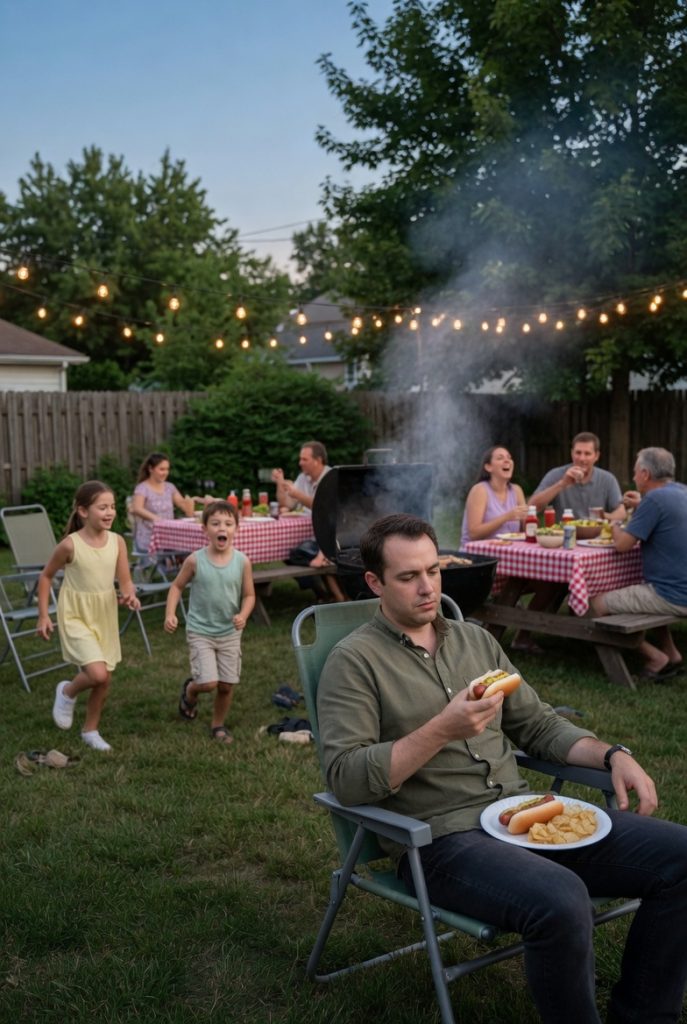
Every year the Doyle family threw this massive gathering at Clara’s parents’ place. Picture your standard American suburban circus: a sprawling backyard, a deck that had seen better years, picnic tables dressed in checkered tablecloths, folding chairs enough for a small militia, and a grill smoking away while somebody’s uncle argued about sports and somebody else’s cousin got too drunk too early.
Mrs. Doyle treated the event like she was hosting the United Nations. Weeks of planning. Potato salad by the industrial gallon. Coleslaw enough to feed a county. Enough hot dogs and burger patties to supply a youth league tournament.
That Saturday was one of those perfect late-summer days that almost trick you into liking the world. Sunshine. A gentle breeze. The smell of charcoal and lighter fluid hanging in the air like suburban incense. Under different circumstances, I might even have enjoyed myself.
But these were not different circumstances.
The entire extended Doyle ecosystem was there. Mr. and Mrs. Doyle, obviously. Aunts and uncles. Cousins I’d met maybe twice in eight years. Family friends who had known Clara since diapers. Neighbors who’d somehow earned permanent invitation status through years of borrowed lawnmowers and returned casserole dishes.
I should have seen the warning signs immediately. The minute we walked through the back gate, Clara peeled off and gravitated toward Sabrina, who was already near the drink table holding court for a cluster of listeners, probably delivering the latest chapter in her post-breakup spiritual awakening saga. The sisters slipped right into their usual act—finishing each other’s sentences, sharing loaded looks, laughing at jokes that apparently required a secret decoder ring.
So I did what I always did at Doyle gatherings. I grabbed a beer from the cooler, loaded up a paper plate with whatever barbecue Mrs. Doyle considered acceptable that year, and found a quiet corner where I could blend into the scenery like suburban camouflage.
That’s where I was when Sabrina decided I should become the entertainment.
I was sitting on a folding chair that was clearly not built for human comfort, working my way through a hot dog that had definitely peaked earlier in the afternoon. Sabrina was already half in the bag, which wasn’t surprising. She had a way of getting louder and more dramatic as the alcohol hit, like somebody slowly turning up the volume on an obnoxious radio station.
Conversation was flowing around me in that pleasant, meaningless family-party way—someone’s new job, someone else’s vacation plans, the sort of safe chatter you perform just enough to seem polite. I was actually starting to think I might get through the whole day without incident.
Then Sabrina’s voice cut through the yard like a rusty knife.
“Hey, Jack!”
She said it loud enough that half the neighborhood could have heard. The backyard seemed to freeze. It was as if somebody had hit the mute button on the entire party.
“If Clara cheats on you with her true love—her high school boyfriend—will you whimper?”
The silence that followed was deafening.
I’m talking about the kind of quiet that makes you notice everything at once: the hiss of the grill, a beer bottle clinking against a table, a dog barking three houses over, a child somewhere on the other side of the fence asking for another popsicle. Every single person in that yard turned to look at me.
And Sabrina still wasn’t done.
I looked at Clara—actually looked at her—hoping for some sign that she was going to shut it down. Hoping she would stand up for her husband of eight years and tell her sister to knock it off.
Instead, Clara’s face lit up with this ugly little delight, like Sabrina had just handed her the exact opening she’d been waiting for. She looked straight at me with that same smirk I’d been watching for months and delivered the killing blow.
“He’s impotent in bed anyway.”
The yard exploded.
Not awkward chuckles. Not nervous laughter. Hysteria.
Uncle Bob nearly choked on his beer. Cousin Sarah doubled over with tears in her eyes. Mrs. Doyle covered her mouth, but I could see her shoulders shaking. Even Mr. Doyle, who usually at least pretended to float above the family nonsense, was grinning like he’d just heard the joke of the year.
They were all laughing at me.
Every single person in that yard.
People I’d known for years. People whose furniture I had moved. People whose computers I had fixed. People whose birthdays I had remembered. People I had quietly helped in a dozen small ways without ever making a show of it.
I sat there frozen. My face burned so hot it felt like somebody had set it on fire. The hot dog in my hand suddenly weighed a thousand pounds. My beer had gone warm and flat. Everything moved in slow motion—the laughter getting bigger and meaner, faces twisted with amusement, Clara looking downright pleased with herself.
For one suspended moment, I felt like I was underwater and all that laughter was just noise from the surface—warped, distant, cruel.
Part of me wanted to disappear into the folding chair until I ceased to exist. Part of me wanted to run for the gate and never come back. Part of me wanted to stand up and tell them all exactly what I thought of their twisted idea of fun.
Instead, something inside me went perfectly still.
I looked at Clara and saw, maybe for the first time with complete clarity, what had become of us. This wasn’t a woman who loved me but was going through a rough patch. This wasn’t somebody temporarily lost. This was a person who had chosen to humiliate me in public, who had weaponized private pain for a laugh, who found my embarrassment entertaining.
So I raised my hot dog slightly, like a toast.
And I said, very calmly, “Message received.”
Those two words hit the yard like a bomb.
The laughter died instantly, cut off so hard it was almost violent. Suddenly everybody was staring into their drinks or shifting in their seats or finding the grass fascinating. The only sound left was the grill hissing in the background.
I stood up slowly. I set my warm beer down on the nearest table with deliberate care. Then I walked toward the side gate.
I didn’t run. I didn’t storm off. I didn’t give them the dramatic breakdown they probably expected. I just walked—steady, purposeful, final. I didn’t look back once, though I could feel every eye on me. I could practically hear the moment the whole crowd realized the joke had stopped being funny.
Behind me, the silence stretched heavy and awkward.
Perfect.
That night I didn’t sleep. I didn’t even try. Sleep is for people who have something worth waking up to, and I had just discovered that the life I thought I was waking up for had been wrapped in eight years of self-deception.
I sat in my car in the driveway for what felt like hours, engine off, staring at the house that was supposed to be my home. Through the living room window I could see Clara and Sabrina on the couch, probably dissecting the evening’s performance like vultures working through roadkill. Every now and then one of them laughed, and I found myself wondering if they were still squeezing entertainment out of my humiliation.
Around midnight, I finally went inside. Their little postmortem had moved to Clara’s bedroom. I could hear their voices through the door, interrupted by bursts of laughter that scraped across my nerves like nails on a chalkboard.
I stood in the hallway listening to my wife and her sister bond over the public execution of my dignity.
And something in me broke.
Not explosively. Not dramatically. More like a dry branch that had been bent for too long finally snapping under the last ounce of pressure. Clean break. No going back.
I went into the bathroom and stared at myself in the mirror. The guy looking back looked like a stranger—red-rimmed eyes, slumped shoulders, the exhausted expression you see on people standing in unemployment lines. I remember thinking: When did I become this? When did I become the kind of man who would sit there and take that in front of an audience?
But rock bottom has a funny kind of clarity. It shows you exactly how far you’ve fallen. And if you’re lucky, it also shows you the first foothold on the way back up.
I moved through the apartment in a strange, focused trance, as if my body had taken over while my mind watched from somewhere outside the room. I gathered everything that mattered. Everything that was mine rather than ours.
Two duffel bags. That was all it took.
Eight years of marriage, and my independent existence fit into two pieces of luggage.
I packed enough clothes for a couple of weeks. Nothing fancy. My laptop and the work files I needed to keep my freelance programming gigs alive. Important documents—birth certificate, Social Security card, passport, insurance papers, all the bureaucratic evidence that Jack Carter existed as something more than just Clara’s disappointing husband.
The emergency cash was still hidden in a shoebox in the back of the bedroom closet. Three thousand dollars in twenties and fifties I had squirreled away over the years. It was supposed to become a surprise vacation someday. Or maybe part of a down payment on a better place. Clara knew about the savings account. She didn’t know about the cash.
Good thing.
Because it was about to become my lifeline.
I packed quietly so I wouldn’t alert the dynamic duo, who were probably still in there giggling over their greatest hits. Every item felt like a small declaration of independence. My favorite coffee mug, the one Clara always rolled her eyes at because it had some dumb joke about programmers on it. My stack of paperback sci-fi novels she used to dismiss as “boy books.” The camping gear I’d bought years earlier when I still had fantasies about weekend adventures that never materialized.
At three in the morning, I sat at the kitchen table with a piece of paper and a pen. The note I left was short.
Hope the joke was worth it.
That was all. No speech. No emotional manifesto. No itemized list of betrayals. Just seven words that said everything worth saying.
I left the note in the exact center of the table where Clara would find it when she came out for coffee.
Then I placed something else beside it.
For weeks, during lunch breaks and moments when the future had started to feel like a trap, I had quietly prepared divorce papers. I told myself it was just practical, just a precaution in case things got worse. Turns out things can always get worse than you imagine.
I set the envelope next to the note and pictured her opening it while Sabrina sipped one of those ridiculous whipped-cream coffee drinks. The thought didn’t make me happy, exactly. It just felt right.
By four in the morning, I was loading my bags into the car. The neighborhood was dead quiet, that strange pre-dawn stillness where every small noise feels magnified. The car door sounded like a gunshot. I expected lights to flick on, curtains to shift, neighbors to peer out and witness whatever they thought was happening.
Nothing.
The whole world stayed dark and peaceful while I drove out of that subdivision like I was escaping from prison.
Which, in a lot of ways, I was.
Every mile I put between myself and that house felt like shedding another layer of the pathetic person I had become. Some sad late-night song came on the radio, something about lost love and second chances, but I turned it off. I didn’t need a soundtrack. The silence was cleaner.
I had done my homework during those sleepless weeks when Clara was busy ignoring me. I had researched remote places where a man could disappear without anybody asking uncomfortable questions. The mountains had always called to me anyway, back when I was young enough to believe adventure might still happen to people like me.
The cabin I found was simple and perfect. The owner was an old-timer named Franklin. I’d contacted him through a string of vague emails where I never explained much about my situation. He didn’t seem interested in details. He only cared that I could pay cash, that I wasn’t planning to burn the place down, and that I wasn’t going to turn it into a meth lab.
“Privacy guaranteed. No questions asked,” he told me.
Something in his voice suggested he understood exactly what kind of privacy I meant.
The drive took four hours on increasingly winding mountain roads. As the sky started to brighten, I climbed through forests that looked endless, past lakes flat as mirrors, through little towns that seemed frozen somewhere in the 1950s.
I stopped once for gas and coffee at a station that looked like it had been dropped out of another era. The guy behind the counter glanced at my clothes, nodded like we were already acquainted, and asked if I was heading up for some fishing.
“Good fishing weather,” he said, handing me my change.
“That’s what I’m hoping for,” I replied.
And I realized it was the first honest thing I had said to another person in months.
By the time I reached Franklin’s cabin, the sun was fully up and painting the world in gold and green like a postcard nobody would believe was real. The cabin sat in a clearing ringed by pines so tall they looked like they might scratch the clouds. A narrow stream ran behind it, the water making that steady, low sound that could pass for nature’s own white-noise machine.
Franklin was waiting on the porch with a mug of coffee in one hand. He looked exactly like central casting’s idea of a wise mountain man—gray beard, flannel shirt, boots that had seen some serious mileage.
“You Jack?” he asked.
“That’s me.”
“Good. Keys are on the kitchen table. Propane’s full. Firewood’s stacked on the side. Nearest neighbors are about five miles that way.” He pointed into the trees. “And they mind their own business, same as I do.”
Then he drained the last of his coffee, set the mug on the porch rail, and headed for an old pickup truck that looked like it had survived multiple wars.
“Anything else you need to know?” he asked.
“I think I’ve got it figured out.”
He nodded once. “Most folks who come up here do.”
And just like that, I was alone.
Completely, utterly alone for the first time in years.
I stood on that porch breathing air that actually smelled clean, listening to wind moving through trees and water passing over rock, and felt something I had almost forgotten existed.
Peace.
Life at the cabin became something I had never really experienced before: simple in all the best ways. No schedules dictated by someone else’s moods. No walking on eggshells wondering whether I’d accidentally said the wrong thing. No competing for attention in my own home. No silent punishments. No smug little smiles.
Just me, the mountains, and a kind of quiet that actually lets you hear your own thoughts.
The first week was rough, but not because I missed Clara. I didn’t. What I missed, or rather what I hadn’t remembered how to live without, was the constant vigilance. My nervous system had been calibrated to somebody else’s emotional weather for so long that it took time to realize there were no storms in the next room. I kept catching myself listening for footsteps in the hallway, bracing for a slammed door that never came.
It took about a week for my body to understand that the only real drama here was whether I wanted coffee or tea with breakfast.
My days developed their own rhythm. I woke when my body wanted to wake, usually around sunrise, when the first light threaded through the pines like stained glass in a cathedral. No alarm clock. No scramble for the bathroom. No starting the day already tense about the mood waiting on the other side of a bedroom door.
Coffee became a ritual instead of a survival tactic. I’d make a full pot with water from the well behind the cabin—water that tasted like actual water, not chlorine and old pipes—and sit on the porch while mist lifted from the stream. Sometimes deer drifted through the clearing and looked at me with the same mild caution I felt toward them. We respected each other’s space.
The freelance programming work turned out to be easier than it had ever been. Funny what happens when nobody is sabotaging your focus with passive-aggressive remarks and household chaos. I set my laptop up on the kitchen table by the window and lost myself in the clean, predictable world of code. Algorithms. Databases. Systems that made sense.
Problems had solutions there. If something broke, you fixed it. If a script failed, you debugged it. No hidden meanings. No emotional traps. No guessing what somebody really meant by something they absolutely refused to say outright.
Financially, things were better than I expected too. Without Clara’s expensive tastes, Sabrina’s endless stream of deliveries, and the general financial hemorrhaging that came from supporting two adults who treated money like it grew in a backyard tree, my modest freelance income stretched surprisingly far. The rent was cheap. The groceries were basic. My entertainment budget was mostly books and hiking boots.
And hiking—God, I had forgotten what it felt like to use my body for something besides sitting at a desk and soaking up emotional punishment.
The mountains were stitched with trails. Some were easy walks along streams and open meadows. Others climbed high enough to leave your lungs burning and your legs shaking in the best possible way. I started small, following a marked path that looped along the water and back. As my body got stronger, I went farther.
There were viewpoints up there that made poetry seem like the only sane response. Standing on a rock outcrop at eight thousand feet, looking out over valley after valley fading into blue distance, it became hard to believe the little suburban tragedies I had left behind were ever big enough to drown in.
The physical work changed me too. Franklin had left a solid pile of seasoned firewood, but if I planned to stay through winter, I’d need more. So I learned how to split wood properly.
Turns out there is something deeply therapeutic about swinging an axe.
You raise it, bring it down, feel the impact travel through your arms and into the block, watch a stubborn log crack cleanly in two. Each swing felt like peeling away another layer of the beaten-down version of myself. My hands toughened. My shoulders broadened from hauling logs and carrying water. I dropped weight without trying, partly from the activity, partly because I was finally eating like an adult instead of stress-eating whatever happened to be left in a hostile kitchen.
About ten miles down the mountain there was a little general store run by a guy named Hank. He became my main link to the outside world. Hank was one of those men who had probably seen every kind of person come through the mountains—people looking for something, people running from something, people pretending it was one when it was really the other.
He never pried.
“You finding everything you need?” he’d ask while ringing up groceries.
“How’s that cabin treating you?”
That was the extent of it.
Once a week I’d drive down for supplies, and we’d talk about weather patterns, washed-out roads, which trails were passable after rain, whether the old logging route was worth bothering with. He approved when I graduated from canned soup and instant noodles to real groceries.
“Man’s got to eat real food if he’s doing real work,” he told me once while bagging fresh vegetables and a decent cut of meat.
The evenings were where the real healing happened. I cooked actual dinners. Nothing fancy, but food prepared with care instead of just shoveling calories into my body. I’d eat by lantern light because something about overhead bulbs felt too harsh for the life I was building.
After dinner I read by the fire. Franklin had left a weird, wonderful collection of books behind—classics, survival manuals, philosophy, old adventure novels, field guides. I worked my way through authors I had always meant to read, back when my evenings had still belonged to navigating Clara’s moods and Sabrina’s melodramas.
Mountain silence at night isn’t really silence. There are owls, wind, running water, branches creaking, the occasional thing in the brush reminding you that you are not the only creature in the dark. But what it lacks is human noise. Human conflict. Human demands.
And once that’s gone, you realize how much energy you had been burning just trying to survive other people’s chaos.
So I sat there with a book open in my lap and thought.
Not worried. Not spiraled. Not replaying conversations like evidence.
Thought.
I thought about who I had been before Clara. Before I started measuring myself against somebody else’s approval. Before my preferences and plans and rhythms had to squeeze themselves around a partner who saw stability as dullness. I thought about what I wanted from life if mere survival stopped being the standard.
For the first time in years, I remembered what contentment felt like.
Not ecstasy. Not romance. Not some dramatic cinematic joy. Just quiet satisfaction. The deep, steady kind.
I wasn’t Jack the disappointing husband. I wasn’t Jack the easy target. I wasn’t Jack the background prop holding up other people’s lives while they mocked the scaffolding.
I was just Jack.
A man who wrote code, split wood, hiked trails, cooked dinner, read books, and went to bed when he was tired instead of when somebody else decided the night was over.
The best part was that there was no performance required. I didn’t have to be charming. I didn’t have to be entertaining. I didn’t have to be useful every minute of the day to justify my existence. I didn’t have to monitor my tone or soften my opinions or anticipate what might offend someone who was actively looking for reasons to dismiss me.
One evening, about two months in, I sat on the porch after a particularly good day. I had finished a programming project that paid well. I’d hiked out to a lake I’d been meaning to explore. I’d cooked a dinner that tasted like something a competent adult had every right to be proud of.
The sun was setting behind the mountains, painting everything orange and purple in a way no camera ever captures right.
And I realized I was smiling.
Not the fake smile I used to wear around Clara. Not the polite social expression designed to smooth things over. A real one.
I couldn’t remember the last time it had happened.
That was when I knew I wasn’t just hiding out. I was building something. A life shaped by my choices, lived at my pace, defined by what I actually valued instead of what somebody else thought should impress them.
For the first time in years, I was exactly where I wanted to be.
Three months into my mountain exile, curiosity finally got the better of me.
I had spent all that time inside a blissfully quiet bubble, but even the most dedicated hermit eventually wonders what happened to the storm he walked away from. It was like a scab you know you shouldn’t pick but can’t resist touching anyway.
So I drove into town and went to the public library.
The place looked like it hadn’t been updated since the Carter administration—and I mean Jimmy Carter, not me. Fluorescent lights buzzed overhead. The computers took forever to boot. The whole building carried that universal library smell of old paper and industrial cleaner. I found a terminal in the back corner, as far from the front desk as I could manage, and logged into my old email.
My inbox looked like a digital crime scene.
Sixty-seven unread messages.
Most of them were from Clara.
The subject lines alone told the story of her emotional evolution across those three months. The first wave, sent within hours of my disappearance, was pure fury.
Where the hell are you? This is ridiculous, Jack. You can’t just run away like a child.
Call me now.
I could hear her voice in every line—that clipped, furious tone she used when she wanted to sound righteous and offended at the same time. The emails themselves were textbook blame-shifting. According to Clara, I was being oversensitive and dramatic. The party was “just a joke” that I had wildly overreacted to because I apparently couldn’t handle harmless teasing.
“Everyone thinks you’re being ridiculous,” she wrote in one message. “Sabrina feels terrible about it. You’re making this into a huge deal when it was just family having fun.”
Family having fun.
Nothing says wholesome entertainment like publicly humiliating your spouse in front of thirty people.
As the days passed and I still didn’t answer, the tone changed. Anger gave way to manipulation. Clara had always been talented at that particular transition.
“I’m worried about you, Jack.” “This isn’t like you.” “Whatever’s going on, we can work through it together.” “I miss my husband.”
“Please come home so we can talk.”
Those messages were somehow worse. They cast her as the wounded party, the abandoned wife trying desperately to save a marriage while her unstable husband vanished into the ether. She had rewritten the script so thoroughly in her own mind that she seemed genuinely convinced I had wronged her.
Then came phase three.
The truth.
Or at least as close to the truth as Clara usually got.
“I can’t pay the mortgage alone.” “The insurance company needs both our signatures.” “Your student loan payment bounced.”
“Please at least call me. I need your help with the finances.”
There it was. The real thing she missed wasn’t my companionship or my body in the house or my voice at the dinner table. It was my labor. My organization. My ability to quietly keep everything functioning.
She didn’t miss me.
She missed what I managed.
Mixed into Clara’s spiral were a few messages from Maya, a mutual friend who had somehow managed to remain neutral through the slow-motion car crash of our marriage. Maya’s emails were refreshingly honest. More important, they gave me the outside view I didn’t know I needed.
According to her, my disappearance had triggered a domino effect none of the Doyles had seen coming.
Turns out I had been holding together far more than my own miserable marriage.
I had been managing Mr. Doyle’s construction accounts—tracking invoices, keeping tabs on payments, organizing paperwork for ongoing jobs. I had been running the books for Mrs. Doyle’s online boutique too, handling inventory, taxes, reconciliations, all the tedious stuff nobody notices when it’s done right. I had even set up and monitored Clara’s student loan autopay because she could never remember her due dates.
Without me quietly handling all the invisible adult work, their family’s economic ecosystem had started to collapse.
Mr. Doyle’s construction business lost three major contracts because nobody could find the relevant paperwork. Invoices went out late. Payments got missed. Clients started looking for more reliable contractors. The same man who had grinned through my humiliation at the barbecue was now scrambling to save the business he had spent twenty years building.
Mrs. Doyle’s boutique was even worse. Without my inventory system, she was ordering duplicates of slow movers while running out of the few things that actually sold. Her bookkeeping had become such a mess that she missed tax deadlines and got hit with penalties and interest. According to Maya, she had actually asked Clara if there was any way to get me to help “just temporarily.”
The irony nearly choked me.
The same people who had laughed the loudest were suddenly discovering how much invisible work I had been doing behind the scenes. Work they had never noticed because I never turned it into a performance.
And Clara? Clara was drowning.
The mortgage was behind. Utilities had been shut off twice. She had maxed out both credit cards trying to keep everything afloat. She had apparently attempted to take over all the financial management herself and then learned the hard way that good intentions are not a substitute for discipline.
“She keeps asking if I’ve heard from you,” Maya wrote. “I think she’s finally starting to understand how much you were doing that nobody ever acknowledged. She’s definitely not the same person who was making jokes at that party.”
I leaned back in that uncomfortable library chair and stared at the screen for a long time.
Part of me—a small, ugly, deeply human part—felt satisfied. For years I had felt invisible, like I could disappear and nobody would notice. Turns out I had only been half right. They didn’t notice the value of what I was doing until it stopped happening.
But now they noticed.
Boy, did they notice.
The bigger part of me, though, just felt tired. Tired of anger. Tired of resentment. Tired of defining myself by what they had done to me. I had spent three months building something clean and steady. Obsessing over the wreckage behind me felt like walking backward toward a fire I had already escaped.
So I closed the browser without responding to any of it.
If Clara wanted to reach me, she had my lawyer’s information. I had filed the papers. I had left the note. I had made my position clear.
Whatever disaster was unfolding back in the suburbs was no longer my responsibility.
The drive back up the mountain felt like returning to sanity after a visit to an institution. Mile by mile, elevation by elevation, other people’s chaos slid off my shoulders. By the time I pulled back into the clearing, the details of Clara’s emails already felt thin and far away.
I had code to write. Firewood to split.
Trails to walk.
The past could take care of itself.
A year later, I was behind the cabin splitting wood when I heard a car engine struggling up the gravel road.
The sound was wrong. Too much grinding, not enough power. Franklin’s truck had a deep, easy growl. This sounded like somebody forcing a tired sedan up a mountain it had no business climbing.
I paused mid-swing, listening.
Nobody came up there by accident. The road to the cabin wasn’t on most GPS maps, and you had to make several very deliberate turns off increasingly sketchy back roads to find it. Whoever was coming knew exactly where they were going.
My first thought was Franklin. Maybe he was checking on the property or collecting something he had forgotten.
Then the car finally pulled into view.
A beat-up Honda Civic. Faded paint. Engine ticking like it was barely holding itself together. The whole car looked like it had seen better decades.
It rolled to a stop beside my truck and sat there for a moment as the engine cooled.
Then the driver’s door opened.
And Clara stepped out.
I almost didn’t recognize her.
This wasn’t the polished woman who used to spend an hour getting ready to go buy groceries. Her hair was longer now and pulled back in a simple ponytail that suggested function instead of style. She wore jeans that looked genuinely worn rather than fashionably distressed, and a jacket that had clearly traveled through some hard months.
But it was her face that caught me. The smugness was gone. In its place was something I had never really seen there before.
Humility.
And exhaustion.
Then it started raining.
One of those abrupt mountain storms that arrives without warning and soaks everything in sight. Clara stood by the car for a second, getting drenched, as if she wasn’t sure she had the right to approach the porch without being asked.
“Jack,” she said.
Even her voice sounded different. Smaller. Less certain. All the edge was gone.
I planted the axe in the chopping block and walked to the porch. I didn’t exactly invite her up, but I didn’t tell her to leave either. She followed me out of the rain and stood there dripping, clutching a manila envelope that was already getting damp.
“I brought the signed divorce papers,” she said, holding them out like some kind of peace offering. “Everything’s finalized. I’m not here to ask you to come back.”
That caught me off guard.
I had spent enough time with the old Clara to expect manipulation, guilt, maybe some practical plea disguised as emotion. Another request to save her from the consequences of her own decisions. But the woman standing on my porch looked beaten in a different way.
“Then why are you here?” I asked.
She hesitated before sitting in the other wooden chair Franklin had left out there. Rain hammered on the porch roof hard enough to make the whole space feel sealed off from the world.
“I’m here to say I’m sorry,” she said. The words sounded like they had been fighting their way out of her throat for months. “I destroyed the best thing in my life, and I need you to know that I know that.”
I didn’t say anything. I just waited.
When people finally decide to tell the truth, the best thing you can do is let them keep going.
“I’ve been in therapy,” she said. “For about six months. Dr. Martinez. She’s helped me understand things about myself I didn’t want to face.”
She stared past me into the rain. “I let Sabrina poison me against you. That’s not an excuse. It’s just the truth. She was jealous of what we had—of how stable you were, how reliable. She couldn’t stand that I had something she didn’t, so she kept picking at it. Making little comments about how boring you were. How predictable. How you never did anything exciting.”
Clara wiped at her face, though at that point it was impossible to tell what was rain and what wasn’t.
“I should have shut her down. I should have defended you. Instead, I started seeing you through her eyes. I started focusing on everything you weren’t instead of everything you were. And the more you tried to fix things, the more irritated I got, because I thought you were being needy.”
She gave a bitter little laugh that carried no humor at all.
“God, Jack. You were trying to save our marriage, and I was annoyed that you cared enough to try.”
She shook her head. “What kind of person does that make me?”
I could have answered, but she didn’t need my help.
“That night at the party,” she went on, “when Sabrina made that comment about you whimpering, I had a choice. I could defend my husband of eight years, or I could go for the cheap laugh.”
She finally looked directly at me, and I could see that she was crying even through the rain.
“I chose the laugh.”
The words hung there between us.
“I threw away eight years of marriage for a thirty-second joke that wasn’t even funny. And the worst part is…” She swallowed. “The worst part is that afterward, I felt proud of myself. Like I’d won something.”
The rain came down harder, drumming on the roof and turning the clearing beyond the porch into a blur of green and silver. We sat inside that sound together, two people who had once shared everything and were now having one final honest conversation.
“Dr. Martinez helped me see that I treated you like my emotional dumping ground,” Clara said. “Every time I was scared, frustrated, insecure, angry—anything—I took it out on you, because I knew you’d absorb it. I mistook your kindness for weakness. Your stability for boring predictability.”
She paused, choosing her next words carefully.
“I turned you into my punching bag, and then I resented you for letting me hit you.”
“Pretty messed up,” I said.
“Yeah,” she whispered. “It is.”
She looked down at the envelope in her hands. “I know apologies don’t erase scars. I know I can’t undo what I did. But I needed you to know that I understand what I lost. Not just the money or the paperwork or all the practical things you handled. I lost the only person who ever loved me enough to put up with my worst impulses.”
Then she stood.
“I’m not going to insult your intelligence by asking for forgiveness,” she said. “I just wanted you to know that the woman who smirked at you that night—the woman who thought your pain was entertaining—that isn’t who I want to be anymore. Maybe it’s who I became. Maybe it was always in me. But it’s not who I want to remain.”
She set the envelope on the small table between us.
“You deserved better than what I gave you, Jack. You always did. I hope you find it.”
Then she walked back into the rain.
I watched her cross the clearing, get into the Honda, and drive away. The engine sound faded slowly down the gravel road until all that remained was rain on the roof and water spilling through the gutters.
I sat there for a long time with the signed divorce papers in my hands.
Apologies don’t erase scars. She was right about that. But sometimes they do something else. Sometimes they confirm that the wound was real, that you weren’t crazy, that what happened to you actually happened. And sometimes that acknowledgment is enough to let the last of the anger drain away.
The storm passed the way mountain storms do—suddenly. The air came out the other side washed clean. I went back to splitting wood.
And for the first time in more than a year, I realized I wasn’t angry anymore.
I was just free.
The full scope of the fallout didn’t become clear until about six months after Clara’s rain-soaked visit, when Maya drove up the mountain with groceries, gossip, and the expression of someone about to deliver a truly premium piece of drama.
Maya had always been the kind of friend who stayed in touch with everyone’s mess without personally stepping in it. A war correspondent for suburban disasters. Every few months she would come up to the cabin with supplies, local news, and updates from the civilized world I had left behind.
This time, she came armed.
“You are not going to believe what’s happened to the Doyles,” she said, settling into her usual porch chair with a beer in hand.
According to Maya’s intelligence network—which appeared to consist of every grocery clerk, hairdresser, barista, and checkout cashier within twenty miles—my strategic disappearance had started a chain reaction that was still rattling through that family a year and a half later.
Clara had officially declared bankruptcy about three months after her visit.
Turns out trying to learn adulthood on the fly while drowning in debt is not an ideal educational experience. The mortgage had gone into foreclosure. The credit cards maxed out and defaulted. Her car had been repossessed, which explained the battered Honda she had driven to see me.
But Clara’s financial collapse, Maya informed me, was only the appetizer.
The main course was what happened to her parents’ businesses.
Mr. Doyle’s construction company—the one built over twenty years of dawn starts and weekend jobs—was all but dead. Without my recordkeeping, he had lost track of timelines, supply orders, insurance paperwork, client deposits, all the mundane things that keep a small business from falling off a cliff.
“Remember the Henderson renovation?” Maya asked.
I did.
“He ordered the wrong windows three separate times because nobody could find the original measurements. By the time they sorted it out, the Hendersons hired someone else and sued for the deposit.”
Then came the commercial job at the new shopping center. Mr. Doyle couldn’t produce the right insurance documents on time, so the contract evaporated. Another client fired him after he double-ordered materials and tried to pass the cost along. In construction, reputation travels faster than a truck on a downhill grade. Soon nobody wanted to hire the guy whose paperwork was a disaster.
“He’s down to handyman jobs now,” Maya said. “Fixing leaky faucets. Painting bedrooms. The guy who used to run a crew of six is working alone out of his garage.”
Mrs. Doyle’s boutique had somehow imploded even more spectacularly.
Without my inventory system, she had managed to create a retail fever dream. She bought fifty summer dresses in January and forgot to order winter coats until March. She stopped tracking returns and couldn’t remember what had actually been sold. Then the IRS got involved after she missed quarterly payments because she no longer knew what she owed.
“The boutique closed about eight months after you left,” Maya said, grinning into her beer. “She tried to liquidate the remaining stock, but half of it was damaged because she stored it badly. And then she found out she owed the shopping center three months of back rent because she’d been calculating the lease wrong the whole time.”
“And now?” I asked.
“She works at Target. Customer service.”
There was a brief, almost respectful silence after that. The woman who once spoke about entrepreneurial vision was now asking strangers if they had found everything they were looking for.
But apparently the most satisfying part of the story belonged to Sabrina.
After the barbecue, once it became obvious that the Doyle family’s finances had begun collapsing not long after my departure, Sabrina had very quickly transformed from beloved younger sister into family scapegoat. Everybody remembered her drunken little whimpering speech. Everybody remembered how much influence she had been exerting over Clara. Once the consequences arrived, she became the most convenient target in the room.
“Nobody wants her around,” Maya said. “She’s like a walking reminder of how badly they blew up their own lives.”
Cousins stopped answering her calls. Neighbors avoided her. Even old friends started keeping their distance. Sabrina bounced from couch to couch for a while, burning through goodwill the way she burned through every other resource in her life. But it turns out people get tired of supporting someone who treats every living room like a personal stage for unresolved drama.
Eventually, she ran out of options.
“She’s thirty-five years old and living in her childhood bedroom,” Maya said, visibly delighted. “Same room. Same furniture. Same ridiculous ‘Live, Laugh, Love’ sign from when she was sixteen.”
Mr. and Mrs. Doyle barely spoke to her. She had become the ghost haunting their idea of what their family used to be.
The gatherings that were once loud, self-congratulatory celebrations had turned into tense, brittle affairs where everyone blamed everyone else for the wreckage. Maya said Thanksgiving had been especially ugly. Somebody mentioned me. Somebody else blamed Clara. Mr. Doyle said I had been too sensitive. Clara finally snapped and told him they had all treated me terribly and that I had every right to leave.
I had to admit, that part landed in a strange place.
The irony was almost too complete. The same people who had laughed when I was humiliated were now turning on one another as the structure I had quietly held together collapsed around them. The party that was supposed to be harmless fun had become the moment they all traced back to when things started falling apart.
“The best part,” Maya said, saving the richest bit for last, “is that they talk about you like you’re some kind of criminal mastermind who planned all of this from a secret mountain lair.”
She gestured around at my cabin, my stacked firewood, my plain little life.
“They’d rather believe you’re an evil genius than accept that they just took you for granted and never realized how much you were doing.”
I leaned back in my chair and watched the sun sink behind the ridge. I tried to summon sympathy for the people who had made my life miserable and found that I had none.
“You know the funny thing?” I said. “I didn’t plan any of it. I just left. Everything after that was their own doing.”
“That,” Maya said, “is what makes it perfect.”
We sat there in comfortable silence after that, the kind of silence that heals instead of suffocates. Somewhere down in the valley, the Doyle family was probably eating another strained meal, stepping around the crater left by the man they had once decided was safe to mock.
Up in the mountains, I was planning tomorrow’s hike and grilling a simple dinner.
I had never felt more content in my life.
Sometimes the best revenge really is just living well while your enemies destroy themselves.
Two years have passed now since I walked through that side gate at the Doyle family barbecue, and sometimes I still sit on my porch in the early morning, watching the mist rise from the valley, and think about how one moment of absolute clarity can rearrange a whole life.
It’s funny. The worst day of your old life can become the doorway to the best chapter of your new one.
I ended up buying Franklin’s cabin after he decided to retire to Arizona. “Too many winters up here for these old bones,” he said. But I’ve always suspected he had seen the ending before I did. Maybe something in me that first day told him I was going to be more than a temporary tenant.
The sale was simple. Franklin wasn’t a complicated man. He believed in straightforward numbers, a fair price, and paperwork only where absolutely necessary.
So now I’m a homeowner again.
But this time it means something different.
This place is mine in a way the suburban house never was. Every repair, every improvement, every path I clear, every stack of wood I build for winter—it all belongs to the life I chose. There is a particular satisfaction in owning something you’ve actually earned, something shaped by your labor rather than maintained out of obligation.
My freelance programming turned into something steadier over time. Word gets around in tech when you’re good at what you do and—more importantly—when you actually deliver. Apparently living in the mountains doesn’t hurt your professional reputation if your clients are scattered across multiple time zones anyway.
Now I’ve got a stable roster of companies that send work my way. The projects are interesting enough to keep me engaged without swallowing my whole existence. Best of all, I control my time. If I want to take a Wednesday off and hike out to the lake, I do. If I get deep into a piece of code and feel like working until midnight, there’s nobody around to complain about the sound of typing or the extra pot of coffee.
It’s amazing how productive you can become when you stop spending half your life managing someone else’s emotional weather.
But the biggest change in my life came about eight months ago on the trail to Bear Creek Falls.
I had been hiking alone for over a year by then, perfectly content with my own company, when I came around a bend and nearly collided with a woman in park ranger gear crouched over something on the ground.
“Sorry,” I said, stepping aside. “Didn’t mean to interrupt whatever scientific thing you’ve got going on there.”
She looked up with this smile that was half amusement, half curiosity.
“Scientific thing?” she said. “I’m trying to figure out whether this is bear scat or just a really unfortunate pile of berries.”
“That,” I said after a glance, “is definitely bear scat.”
She laughed. Not a polite laugh. Not a social courtesy laugh. A real one.
“Well, look at you, mountain man. Get yourself a degree in wildlife biology while I wasn’t paying attention?”
“Nope. Just common sense. You live up here long enough with your nearest neighbor five miles away and no pepper spray, you start recognizing the signs.”
That was the beginning of something I genuinely hadn’t expected to find again.
A connection that felt natural instead of draining.
Her name is Leah. She works out of the ranger station about fifteen miles down the mountain and covers trail maintenance and wildlife monitoring across the region that includes my little corner of the woods. At first she started stopping by just to check on the cabin and make sure I wasn’t doing anything that would get her in trouble with the Forest Service. Then those visits grew longer. Conversations turned into shared meals. Shared meals turned into weekends. Weekends turned into something warm and real.
Leah thinks my quiet strength is attractive. She likes that I can fix things. She likes that I know how to be alone without being lonely. She likes that I don’t need to turn every moment into a performance. The exact qualities Clara found dull are the ones Leah values most.
One night while we were cooking dinner, Leah looked at me over a skillet and said, “You’re like a Swiss Army knife.”
I stared at her. “I’m not sure whether to be flattered.”
“Oh, it’s absolutely a compliment,” she said. “Practical. Reliable. Useful. But not in a boring way. In a this-guy-can-actually-handle-life kind of way.”
That about sums it up.
It is astonishing how different a relationship feels when the other person actually likes who you are instead of merely tolerating you while waiting for you to turn into somebody else.
Leah and I cook simple meals. We take long hikes. We read by the fire. We sit in silence without needing to fill it with tension or perform affection for each other. None of it feels like settling. None of it feels like compromise. It feels like peace with a heartbeat.
We don’t live together. She has her own place closer to town, and we both value independence too much to rush into some grand domestic merger. She spends most weekends here. I stay with her sometimes when I need to be nearer to civilization for meetings or supply runs. It works because it’s built on choice rather than habit. On desire rather than dependence.
Sometimes, doing something completely ordinary—splitting wood, debugging a line of code, mapping out a hiking route—I remember that barbecue.
I can still see Clara’s smirk if I let myself. I can still hear the yard erupting around me. I can still feel the heat climbing up my neck while everyone laughed.
But what surprises me now is that I don’t feel humiliation when I remember it.
I feel gratitude.
Because that moment stripped away every last layer of wishful thinking. It gave me perfect clarity about where I stood in my own marriage. It showed me, beyond all rationalizing, that I was with someone who found my pain entertaining.
Walking through that side gate was the first good decision I had made in a very long time.
If Clara hadn’t shown me exactly who she was that night, I might have spent years longer trying to save something that was already dead. I might have gone on shrinking myself into whatever shape felt least offensive to a woman who had already stopped seeing me as fully human.
Instead, I left.
The divorce finalized without drama. Clara signed. We split the little that was left after the financial collapse. That was it. Eight years of marriage reduced to paperwork and a forwarded mailing address.
When it was officially over, I didn’t feel sadness or triumph or grief. Just the mild satisfaction that comes with completing a necessary task.
I heard through Maya that Clara eventually got her feet back under her. She’s working as a bookkeeper now for a small accounting firm. She lives in a modest apartment. Therapy seems to have done her some good. And honestly? I’m glad. Not because I want anything to do with her life, but because carrying the idea of her as a permanent villain would feel like one more tether to the past.
The Doyle family, for the most part, has faded into irrelevance. They are still out there somewhere, still living with the consequences of the choices they made, still probably trying to explain to themselves how everything unraveled so completely after one backyard party. I don’t think about them much unless Maya shows up with fresh material.
What I do think about are the lessons.
I learned the difference between being useful and being valued, and I will never confuse those two things again.
I learned that some bridges are worth burning if they only lead back to places that diminish you.
I learned that stability is not the same as weakness, kindness is not consent to mistreatment, and peace is not something another person grants you if you’re good enough. Sometimes peace is something you have to walk out and claim for yourself.
Most of all, I learned that the worst thing that happens to you can become the best thing that ever happened for you.
These days I wake up in a place I chose, with work I enjoy, next to a woman who thinks I am exactly the kind of man she wants in her life. I make my own coffee. I plan my own days. I go to bed when I’m tired instead of when someone else decides the evening is over.
I never looked back through that gate.
And I never will.
The peace I found on the other side was worth every humiliating second it took to reach it.