What is colder? The great frost of 1814 that froze the river solid, or the heart of a man who abandons his bride in the snow. When the ruthless Duke of Westford discovered his sworn rivals weeping wife freezing in the moors, the vengeance he chose changed history entirely.
The winter of 1814 was merciless. History books recorded as the year the river tempames turned to solid ice, prompting Londoners to host a frost fair upon its frozen surface. But out in the sprawling, desolate moors of Barkshire, the cold was not a novelty.
It was a killer. Tristan Pendleton, the eighth Duke of Westford, sat in the velvet lined interior of his squab carriage, nursing a glass of dark brandy. He was a man carved from the very ice that plagued the countryside.
Stoic, feared, and devastatingly pragmatic. He was returning to Westford Abbey from London, having just secured a vicious political victory in the House of Lords against his lifelong enemy, Henry Blackwood, the Earl of Croft. The feud between the Pendleton and Blackwood families was not a mere disagreement over land or titles.
It was a blood feud. 5 years prior, Blackwood’s deceit had led to the social ruin and subsequent tragic death of Tristan’s younger sister, Beatatrice. Tristan had sworn then that he would dismantle Blackwood’s life, brick by brick, pound by pound.
Outside the carriage, the blizzard howled, battering the wooden panels like the fists of desperate ghosts. Suddenly, the carriage lurched to a violent halt, throwing Tristan against the leather cushions. “What is the meaning of this, Thomas?” Tristan barked, lowering the frosted window.
His outrider, his face wrapped in wool, rode back to the window, shouting over the roaring wind. “Your grace! There is something in the road!
Or rather, someone!” Tristan frowned, reaching for the heavy iron-handled pistol beneath his seat. Highwaymen were bold, but only a fool would attempt a robbery in this tempest. He pushed open the carriage door, his heavy woolen greatcoat whipping around his tall frame as his boots crunched into the kneedeep snow.
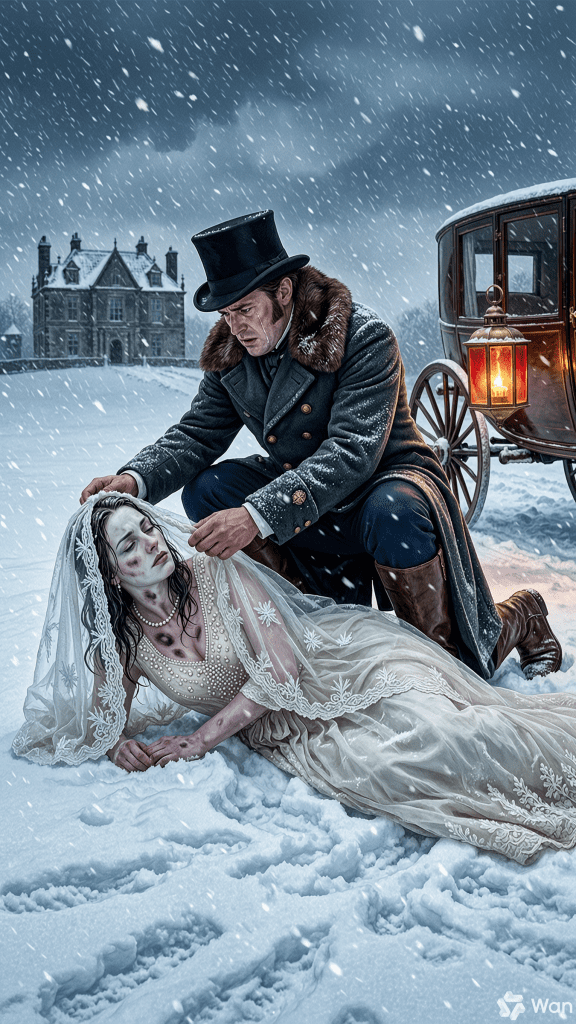
He followed Thomas’s lantern light to a snow drift near a stone marker, the very marker that divided Westford land from the Blackwood estate. Lying in the snow was a woman. [clears throat] She was curled into a tight, trembling ball.
Her attire was absurd, a tragic mockery of the weather. She wore a gown of gossamer white silk, heavily embroidered with pearls, its thin, short sleeves, offering absolutely no protection against the biting frost. A delicate lace veil, now stiff with frozen moisture, was tangled in her dark raven hair.
Tristan knelt, his gloved hands brushing the snow from her pale aristocratic face. He recognized her instantly. Lady Genevieve Sinclair.
She was the toast of the season just a year ago, the only daughter of the impoverished baron Sinclair of Cornwall. Society gossip fueled by the likes of Lady Jersey and Bo Brummel had whispered for months of the Sinclair’s crippling debts. To save her family from fleet prison, Genevieve had been sold to the highest bidder, and that bidder had been Henry Blackwood.
Tristan had read the announcement in the morning post. The wedding had taken place this very morning at St. George’s Hanover Square.
So why was the Earl of Croft’s bride of less than 12 hours freezing to death on the Barkshire Moors? Genevieve’s lips were a terrifying shade of blue. Her eyelashes were coated in frost, and her breathing was dangerously shallow.
She had clearly been walking for miles before collapsing. Tristan stared down at the woman who belonged to his worst enemy. A dark, insidious thought crept into his mind.
Leave her. Let Blackwood explain to the ton how he managed to lose his prized expensive bride on their wedding night. Let the scandal ruin him.
[clears throat] But as Tristan looked at her shivering form, he saw the pearl encrusted bodice of her gown. It was torn at the shoulder. There were dark, violent bruises blossoming on her pale collarbone, stark and terrifying against the white silk.
This was not a bride who had lost her way. This was a bride who had been discarded. “Help me,” she whispered, her voice barely a thread of sound, her eyes fluttering open to reveal irises the color of a stormy sea.
She didn’t recognize him. She only saw a shadow in the storm. Tristan’s jaw tightened, the cold pragmatism that ruled his life fractured, replaced by a sudden violent rage.
He did not know why Blackwood had done this, but he knew exactly what he was going to do in return. “Bring my blankets, Thomas,” Tristan ordered, his voice cutting through the wind like a scythe. He bent down and scooped Genevieve into his arms.
She was alarmingly light, her body stiff with cold. “Your grace?” Thomas asked, hesitating. “That is the new Lady Croft.
If the earl finds out we have taken her, let him find out, Tristan snarled, his eyes fixed on the distant, dark silhouette of the Blackwood estate on the horizon. He left his bride in the cold. But he is a fool.
He forgot that winter belongs to the Duke of Westford. Tristan carried her into the carriage, wrapping her tightly in heavy wool and fur lap robes. He pulled her against his chest, sharing his body heat, commanding his driver to whip the horses into a frenzy.
The carriage tore through the snow, leaving the boundary line behind. Tristan looked down at the unconscious woman in his arms. She was supposed to be his enemy’s triumph.
Now she was about to become his greatest weapon. Westford Abbey was a fortress of Gothic stone and roaring hearths. When Tristan burst through the massive oak doors carrying the frozen bride, the household erupted into calculated chaos.
Mrs. Higgins, a formidable housekeeper who had served the Pendletons for 30 years, took one look at the bruised, freezing girl, and asked no questions, immediately directing the maids to prepare the warmest chamber in the east wing. For three days and three nights, Genevieve hovered on the precipice of death.
A violent fever took hold of her, a consequence of the severe exposure. Tristan summoned Dr. Arbathnaugh from London, paying the man an obscene sum to brave the blocked roads and keep his mouth firmly shut about his patients identity.
Tristan spent an uncharacteristic amount of time sitting in the armchair by her fire, watching her fight. In her delirium, she cried out, her voice roar with terror. No, Henry, please, I won’t sign it.
You cannot make me, she had screamed on the second night, thrashing against the heavy quilts. Tristan had stepped forward, gently pressing a cool cloth to her forehead until she settled. He pieced together the fragments of her nightmares.
Blackwood had not merely been cruel. He had been demanding something of her, something she had refused to give, even at the cost of her own life. On the morning of the fourth day, the storm finally broke, leaving the Barkshire countryside glittering under a blinding winter sun.
Tristan was in his study, reviewing a stack of estate ledgers when the heavy oak door creaked open. He looked up. Genevieve stood in the doorway.
She was wearing a simple dark green velvet morning gown that belonged to Tristan’s late sister. Mrs. Higgins’s doing.
Undoubtedly, it was slightly too large for her, but the rich color brought out the returning flush of life in her cheeks. She looked fragile, leaning heavily against the doorframe, but her storm grey eyes were startlingly clear, and they were fixed on him with a mixture of profound caution and defiance. “You are the Duke of Westford,” she said.
Her voice was raspy, but the cultured aristocratic cadence remained. “And you are Lady Croft,” Tristan replied, leaning back in his leather chair, steepling his fingers. “Or rather, you were supposed to be.” Genevie flinched at the title, a shadow crossing her features.
She slowly walked into the room, refusing the chair he gestured toward, preferring to stand by the roaring fireplace. Why am I here?” she asked, her gaze sweeping over the masculine mahogany panled room. “My husband, Lord Blackwood, he and you despise one another.
The whole of London knows of the Pendleton Blackwood feud.” “Which makes you enemy property,” Tristan said bluntly, testing her. By all rights, I should have loaded you back into a carriage and dumped you on his front step, or sent a ransom note. Yet here you are, drinking my tea and wearing my late sister’s clothes.
Why didn’t you? She challenged, lifting her chin. Because a man who throws a woman into a blizzard on her wedding night is a man who has lost control, Tristan said, standing up and slowly walking around his desk.
And I want to know why Henry Blackwood lost his mind. What did you do to him, Lady Genevieve? Genevieve looked away, staring into the flames.
===== PART 2 =====
For a long moment, the only sound in the room was the crackle and pop of the burning logs. He did not throw me out simply because I displeased him,” she said quietly. “It was not a lover’s quarrel, your grace.” She turned back to face him, and Tristan was struck by the sudden, terrifying resolve in her eyes.
The fragility was gone, replaced by steel. “My father’s bankruptcy was no accident,” Genevieve began, her voice steadying. “Lord Blackwood engineered it.
He bought up our debts in secret, squeezing my family until we had nothing left. He did it specifically so he could claim me as his bride. “For your beauty?” Tristan asked, though he suspected the answer.
“For my bloodline,” she corrected bitterly. “The Sinclair’s possess a dormant that can be claimed through the female line, provided her husband possesses the right political backing.” He wanted the title. the parliamentary seat that comes with it and my family’s remaining coastal properties in Cornwall to facilitate his less than legal shipping ventures.
Tristan’s eyes narrowed smuggling treason. Genevieve corrected smoothly, selling British naval secrets to the French during the blockades. But I did not know that until after we said our vows.
On the carriage ride to his estate, he became drunk on his own victory. He showed me a ledger, a small black leather book. He bragged that it contained the names of every corrupt magistrate, every bribed port authority, and every French contact he possessed.
He told me he owned me, just as he owned them. Tristan felt his heart pound against his ribs. The Blackwood Ledger.
It was a myth in political circles, a rumored book of blackmail that Blackwood supposedly used to manipulate the House of Lords. If it existed, it was the key to completely destroying the Earl. “And you argued with him,” Tristan deduced.
“You threatened to expose him.” Genevieve offered a dark, humorless smile. Know your grace. I am not stupid enough to threaten a monster while trapped in a moving carriage with him.
Then why did he throw you into the snow to die? Genevieve reached into the deep pocket of the green velvet gown. Her bruised pale fingers emerged holding a small nondescript book bound in cracked black leather.
Because, Genevieve said, her voice dropping to a dangerous whisper when he fell asleep in the carriage. I stole it, and when he woke up and realized it was gone, I told him I had thrown it out the window into the snow. Tristan stared at the book in her hand.
He looked back at her face. She had lied to a violent man, endured a beating, and been thrown out to freeze to death, all while keeping the very instrument of his destruction hidden on her person. She was brilliant.
===== PART 3 =====
She was utterly ruthless. “He tore my dress apart, looking for it,” she continued, her voice devoid of emotion. When he couldn’t find it, he threw me out, telling me that if I didn’t find it in the snow and bring it to the gates by dawn, he would leave me to the wolves.
He thought I would break. He thought I would crawl back. “Where was it?” Tristan asked, genuinely astounded.
“Tucked inside the lining of my corset,” she replied, stepping forward and placing the black ledger on Tristan’s mahogany desk. I would have frozen to death before I gave it back to him. Tristan looked at the book and then at Genevie Sinclair.
The helpless frozen bride he had pulled from the snow was gone. In her place stood a queen seeking a war. “Why give this to me?” Tristan asked, his voice low.
Because I know what he did to your sister, Beatatrice, Genevieve said, striking the final fatal cord in Tristan’s heart. I know you want to see Henry Blackwood hang. And so do I.
She took a step closer, the fire light catching the fierce determination in her stormy eyes. I am officially his wife. The law says I am his property, she said.
But the law also says a wife cannot be compelled to testify against her husband. If I go to the magistrates alone, he will have me locked in an asylum before sunset. I need a protector, a man powerful enough to stand between me and the Earl of Croft, a man who wants to see him burn just as badly as I do.
Tristan Pendleton, a man who had sworn off marriage and entanglement, looked at the woman who had just handed him the weapon he had sought for 5 years. The solution was scandalous. It was dangerous.
It would shake the very foundations of London society and invite a war that could destroy them both. Tristan picked up the ledger, feeling the weight of it in his hands. He looked at Genevieve, a slow, predatory smile finally breaking across his cold features.
“Lady Genevieve,” the Duke murmured, his voice dripping with dangerous promise. “Consider me your sword.” The return to London was a masterpiece of calculated subtlety. Tristan did not parade Genevieve through Hyde Park, nor did he send a brazen announcement to the society papers.
Instead, he installed her in his heavily fortified Mayfair townhouse, guarded by handpicked men who had served under him during the peninsula campaigns. While Henry Blackwood desperately scoured the countryside, feeding the Morning Chronicle desperate fabrications about his new bride suffering a severe melancholic chill that confined her to the country. Tristan went to work.
Armed with the black leather ledger, he arranged a private unrecorded meeting with Robert Jeninson, Lord Liverpool, the prime minister. When Liverpool saw the names written in Blackwood’s arrogant scroll, detailing exactly which naval blockade routes had been sold to Napoleon spies, the prime minister’s face drained of color. High treason, especially from an earl, was a matter that required surgical precision to prosecute without destabilizing the government.
Tristan was given a blank check to handle the arrest, provided the public spectacle was managed, but Tristan didn’t want a quiet arrest. He wanted Blackwood ruined in the very society he sought to rule. By early February, the river tempames had frozen so solidly that a bustling frost fair had been erected upon the ice.
Tents, printing presses, and roasting pits dotted the river from Black Friars to London Bridge. To celebrate this historic freeze, the Prince Regent himself had commissioned a massive opulent pavilion on the ice, inviting the highest echelons of the ton for a midnight masquerade. It was the perfect stage.
Genevieve stood before the fulllength mirror in Tristan’s guest chambers. She was no longer the freezing, battered girl from the moors. Tonight she was clad in a gown of deep midnight blue velvet, the bodice embroidered with silver threads that caught the candle light like constellations.
A single sapphire rested at her throat, a piece from the Westford family vault that Tristan had quietly insisted she wear. Tristan entered the room, pausing in the doorway. He wore severe black evening wear, devoid of the usual ostentatious decorations of his peers, save for the icy gleam of a diamond pin in his crevat.
His breath caught slightly as he looked at her. Over the past weeks, spending hours together plotting Blackwood’s downfall, the cold Duke had found himself dangerously drawn to the fiery intellect and unbreakable spirit of the baron’s daughter. “You look,” Tristan began, struggling to find a word that did not sound foolish on his usually pragmatic tongue.
“Formidable, like a queen preparing for war.” Genevieve turned to him, her storm gray eyes holding a mixture of trepidation and fierce resolve. If I step out onto that ice tonight with you, Tristan, there is no turning back. The scandal will be absolute.
A wife abandoning her husband of less than a day, arriving on the arm of his sworn enemy. Let them whisper,” Tristan said, closing the distance between them and offering his arm. “By dawn, they will not be whispering about a scandalous bride.
They will be screaming about a traitor. Are you ready to look the devil in the eye?” Genevieve placed her gloved hand upon his sleeve. “I have survived his winter.
I am not afraid of his presence.” The carriage ride to the river was tense. When they stepped onto the thick strawcovered ice of the tempames, the sheer scale of the frost fair was breathtaking. The Prince Regent’s pavilion was a glowing palace of canvas and timber filled with the sounds of a string quartet and the warm scent of mulled wine and roasting meats.
Tristan and Genevieve did not wear masks. They wanted their faces seen. As they stepped through the entrance of the pavilion, the effect was immediate.
The lively chatter died away in a wave of shock. Fans paused midflutter. Lords and ladies clad in their finest winter furs parted like the Red Sea.
Standing near the prince regent’s dis holding a glass of champagne and holding court with Lord Castle Ray was Henry Blackwood. Blackwood was a handsome man but his features were marred by an underlying cruelty when his eyes locked onto Genevieve. His face went perfectly slack, the champagne glass slipping from his fingers to shatter against the wooden floorboards laid over the ice.
He stared at his bride, the woman he had left for dead in a blizzard, now standing radiant, defiant, and entirely unharmed upon the arm of the Duke of Westford. The silence in the pavilion was absolute, thick with the anticipation of bloodshed. Blackwood recovered his wits, his face flushing of violent mottled red.
He stroed across the floor, his hands bowled into fists. “Jenevie!” He roared, abandoning all societal decorum. You deceitful harlot, come here at once.
Tristan stepped smoothly in front of Genevieve, a human shield of aristocratic stone. You will lower your voice, crofted, or I will have my men throw you into the roasting pits. She is my wife, Blackwood snarled, spit flying from his lips, his eyes darting frantically between Tristan and Genevieve.
By law and by God, she is mine. You have abducted her, Westford. I will see you hang for this.
Abducted? Genevieve stepped out from behind Tristan, her voice carrying clear and cold across the silent pavilion. I was not abducted, Henry.
I was rescued from a snowbank where you left me to die. Gasps erupted from the crowd. Lady Jersey nearly fainted against a pillar.
lies,” Blackwood shouted, though a bead of sweat rolled down his temple despite the freezing temperature. “She’s mad.” The chill has rotted her mind. “Come here, Genevieve.
Give me what you stole.” “I have nothing of yours,” Genevieve said smoothly. “But I believe the Duke of Westford has something you lost.” Tristan reached into the breast pocket of his coat and withdrew the black leather ledger. He did not open it, but merely held it up in the candle light.
Blackwood’s reaction was instantaneous. He lunged forward like a fereral dog, a hidden blade flashing from his sleeve. Before Blackwood could cross the remaining distance, Tristan’s hand shot out, catching the Earl’s wrist with a sickening crunch.
Blackwood screamed, dropping the knife onto the floorboards. In the same motion, Tristan shoved him backward, sending the earl crashing into a table of crystal glasses. “Sir Nathaniel,” Tristan called out, his voice booming through the pavilion.
From the shadows near the entrance, Sir Nathaniel Conant, the chief magistrate of Bow Street, stepped forward, accompanied by half a dozen heavily armed Bow Street runners. Henry Blackwood, Earl of Croft, Sir Nathaniel announced, unfurling a heavy parchment sealed with the Prime Minister’s Crest. You are hereby placed under arrest by the Order of the Crown.
The charges are high treason, the sale of state secrets to the French Empire, and the attempted murder of your lawful wife. Panic ensued. Several lords who had done business with Blackwood attempted to quietly slip toward the exits, only to find the Bow Street runners blocking every egress.
Blackwood struggled as the officers hauled him to his feet, his aristocratic arrogance shattering into pathetic desperation. He looked wildly at Tristan. You planted it.
It is a forgery. Westford has always sought to my ruin. I sought justice for my sister, Tristan corrected, his voice dropping to a low, lethal timber that only Blackwood and Genevieve could hear.
But it was your own greed and your utter misjudgment of this woman that sealed your doom. You threw away the key to your survival, Blackwood. As the officers dragged the screaming, cursing Earl out of the pavilion and into the freezing London night, the tension in the room finally snapped.
A cacophony of whispers and shouts broke out. The prince regent, looking thoroughly entertained by the sheer theatricality of the scandal, raised a fresh glass of champagne toward Tristan before retreating behind his guards. Tristan turned to Genevieve.
She was trembling, but not from the cold. The monster who had tormented her, who had nearly killed her, was gone. “It is done,” Tristan said softly.
Genevieve looked up at him, a tear finally escaping her eye to trace a path down her cheek. “Thank you. You have given me my life back.” The aftermath was swift and merciless.
Henry Blackwood was tried behind closed doors to prevent the public from learning the full extent of the compromised naval roots. He was stripped of his titles. His lands were seized by the crown and he was transported to a penal colony for the remainder of his natural life.
He was spared the noose only because Lord Liverpool wished the matter quickly buried. As for Genevieve, Tristan utilized his immense wealth and influence to secure a rapid audience with the Archbishop of Canterbury. Given the immediate arrest of the groom for treason, the physical abuse documented by Dr.
Arbathnaugh and the sworn affidavit that the marriage had never been consummated. A decree of enulment was granted within a fortnight. Genevie Sinclair was a free woman.
Her family’s debts, which had been tied to Blackwood’s fraudulent estates, were dissolved by the crown as a gesture of gratitude for the ledger. On a bright, crisp morning in late March, as the first Thors finally began to break the ice on the tempames, Genevieve stood in the library of Westford Abbey. Her trunks were packed.
She was returning to Cornwall to rebuild her family’s estate. Tristan stood by the window, looking out at the melting snow. The crushing weight of vengeance that had occupied his soul for 5 years was gone.
Yet, as he looked at Genev, he felt a new unfamiliar ache in his chest. “Your carriage is ready,” Tristan said, the words tasting like ash in his mouth. Genevieve walked over to him, tracing the spine of a book on the desk.
I suppose I should thank you one last time, your grace. You have been a terrifyingly effective sword. It was a mutually beneficial arrangement, Tristan replied, gripping the windowsill tightly.
You have your freedom. I have my justice. Yes, she whispered, looking down.
A perfect business arrangement, she turned to leave. Tristan watched her go, his mind racing. For years he had operated on cold, calculated logic.
Love was a vulnerability, a weakness that men like Blackwood exploited. But as Genevieve reached the heavy oak door, the ice around Tristan’s heart shattered entirely. Genevieve.
She stopped, her hand on the brass knob. Tristan crossed the room in three long strides. He didn’t stop until he was standing inches from her, forcing her to look up into his dark, intense eyes.
“I told myself I was protecting you because you were the key to his downfall,” Tristan said, his voice rough, stripped of its usual aristocratic polish. “I told myself I brought you here for vengeance. But the truth is, the moment I pulled you from that snow, I knew I could never let you go.” Genevieve’s breath hitched, her gray eyes wide.
“Tristan, you are free,” he continued, gently cupping her face with his large, warm hands. “You owe me nothing. You can walk out that door and never see me again.
But if you leave, you will take the only warmth this house has ever known. Stay. Not as my weapon and not as my ward.
Stay as my equal. Stay as my duchess. Genevieve looked at the man who had been her enemy’s greatest fear and her greatest savior.
The cold, ruthless Duke of Westford was looking at her with an open, desperate vulnerability. She reached up, her fingers covering his hand on her cheek. “I survived the winter,” Genevie whispered, a brilliant, radiant smile breaking across her face.
But I think I should very much like to see the spring with you. When Tristan kissed her, it was not with the frantic, fearful urgency of a stolen moment, but with the deep, enduring heat of a fire built to last out the longest, coldest night. The Duke had found his enemy’s discarded bride in the frost, but in the end, it was she who had thored him.
If you loved this dramatic tale of historical revenge, romance, and the ultimate winter betrayal, do not leave this story out in the cold. Please click the like button to support our channel. Share this video with fellow lovers of scandalous period dramas and make sure to subscribe and hit the notification bell so you never miss another thrilling story from our historical romance collection.
F.