This was not a dramatic pronouncement made in a fit of youthful despair, but a quiet, practical conclusion drawn over six years of teaching the children of Hardscrabble, Montana territory. while watching every other woman her age marry bear children and look look upon her with that particular pity reserved for the unmarried. She was 28 years old which in the east might have been considered merely late but in the raw young towns of the frontier was an expiration date stamped plainly upon her forehead.
Her hair was a serviceable brown, her eyes a calm hazel, her figure neither slender nor stout but simply present. She owned three dresses, two bonnets, a Bible with a cracked leather cover, and a set of McGuffy readers that she loved more dearly than any living soul in hard scrabble. That was the truth that kept her awake on the night of the harvest social.
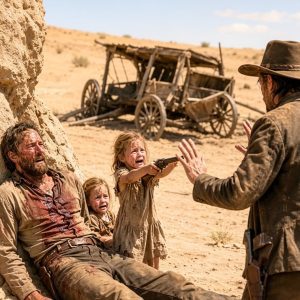
She loved those children, not in the sentimental way of poets, but in the hard aching way of a woman who poured every pope she possessed into small minds because she had nowhere else to pour them. Leo Foster, 9 years old and silent as Winter Fog, who flinched when anyone raised a hand too quickly. Beth Foster, six years old and mute since the wagon accident that took her parents.
Who communicated through fierce hugs and a single upturned palm. The Hennessy boys, all four of them, who could not read a single word but could track a deer for 10 miles. Martha Pine, whose father beat her for writing with her left hand.
Lydia taught them all. She bandaged their scrapes, memorized their fears, and wrote letters home when their parents were too drunk or too tired to care. And at night, she returned to Mrs.
Mabel Horn’s boarding house, ate her solitary supper of bread and broth, and prayed for a sign that her life had meaning beyond the multiplication table. The sign did not come. Instead, the letter came.
Her younger sister, who had married a banker in Philadelphia and now possessed three children and a permanent heir of superiority, had written the following words on cream colored stationery. I hear you are still teaching those little savages. Do you never tire of being useful, Litty?
It is not too late to come home and be a proper ant. At least here your dried up state might be overlooked if you are willing to be humble about it. Dried up.
That was the phrase that lodged itself in Lydia’s chest like a burr. She had read the letter three times, folded it, and placed it in her Bible between the pages of Ruth, where Naomi declared herself too old to have a husband. There was a bitter symmetry to that.
The harvest social was held in the town’s only meeting hall, a drafty building with a wood floor scarred by decades of boots and a pot-bellied stove that threw insufficient heat against the October chill. Lydia attended because Mrs. Horn insisted.
“You cannot hide forever, child,” the widow had said, tightening Lydia’s lavender calico bow. “The right man is not going to knock on your schoolhouse door.” “The right man has not knocked anywhere in 6 years,” Lydia had replied. But she went.
She went, and she stood near the refreshment table, and she watched the dancing with the polite, pained expression of a woman who had learned to expect nothing. The lanterns cast warm light on spinning skirts and laughing faces. Fiddle music bounced off the rafters, and every eligible bachelor and hard scrabble, all seven of them, asked someone else to dance.
Mister Vance Cooper, the youngest ranch hand in the county, swept past her with the Hennesser girl on his arm and said loudly enough for the entire room to hear, “No man wants a school momm who smells of chalk dust and old hymns. She’s been on the shelf so long. She’s part of the furniture.
The laughter that followed was not cruel. Exactly. It was thoughtless.
The way children laugh at a crippled dog because they do not yet understand suffering. Lydia’s face did not change. She had practiced this expression for years.
The pleasant neutral mask of a woman who has been rejected so often that rejection has become a kind of familiar garment. She pulled it on now, adjusted her collar, and took a sip of lemonade that tasted like nothing. Then, Mister Jud Warick walked in.
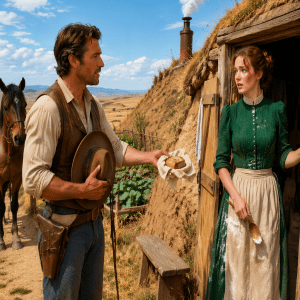
She knew him only by sight and reputation. He was a cowboy, though that word did not do justice to the quiet, watchful presence he carried. He was 32 years old, tall and lean as a fence post, with hands that had not been clean in memory, and a face that seemed carved from the same granite as the surrounding mountains.
He rarely spoke. He never attended church. He lived alone in a cabin on the edge of town and spent his days attempting to break a stallion named Diablo, a black beast with a white star on its forehead and a reputation for murder.
The horse had thrown six men in two years. It had kicked down a stable wall. It had bitten the ear off a frier who got too close.
And Jud Warick, for reasons no one understood, refused to sell it or shoot it. Mrs. Horn, who believed herself to be the instrument of divine providence in all matters of courtship, seized Jud by the elbow and marched him across the room.
“You will dance with Miss Picket,” she announced. “She has not been asked once tonight, and you have not danced at all, and the two of you can be miserable together.” Jud looked at Lydia. Lydia looked at Jud.
There was no spark. There was no recognition of kindred spirits. There was only the mutual silent acknowledgement of two people who had been pushed together by a meddling old woman and would survive the next three minutes through sheer endurance.
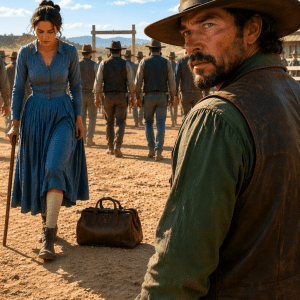
“Ma’am,” he said. “Sir,” she replied. They took the floor.
His hand hovered over her waist as if it might burn him. She placed her palm on his shoulder as if touching a fence post. They moved in stiff, awkward circles while the fiddle played a waltz that neither of them heard.
He smelled of leather and horse and something else, something like guilt. Though she could not have named it then, she smelled of chalk dust and the lavender water she had dabbed on her wrists, hoping against hope that someone might notice. No one noticed except Vance Cooper, who leaned toward his partner and whispered something that made her laugh.
The sound carried. Jud’s jaw tightened. Lydia’s mask held.
Don’t,” she said quietly when she saw his shoulders square as if to confront the young man. “It is not worth it, ma’am. I am accustomed to it.” She stopped dancing and stepped back.
The music continued around them. But they had become an island of stillness in the current. Thank you for the dance, Mr.
Warrick. I hope you find what you are looking for. She walked out of the hall.
The October wind hit her face like a slab. She did not go to the boarding house. She went to the church, a small white building with a cracked bell and a cross that leans slightly to the left.
And she sat in the third pew from the front, which had become her accustomed place. The darkness was complete. No lanterns, no candles, just the smell of old wood and the sound of her own breathing.
She prayed, not the elegant composed prayers she offered in public. This was the raw, ugly prayer of a woman at the end of her hope. Lord,” she whispered, her forehead pressed to the back of the pew in front of her.
I have tried to be good. I have tried to be useful. I have taught your children their letters and their sums and their verses.
I have comforted the orphan and the widow, and still I am nothing. Still I am the woman no one wants. If even a stray cowboy must be shamed into dancing with me, then show me what I am for.
Because I cannot keep going like this. I cannot. The silence that followed was not empty.
It was the kind of silence that listens. Lydia had read enough scripture to know that God often answered in whispers, not thunder. She waited.
She listened. And after a long time, the whisper came. Not in words, but in a memory.
===== PART 2 =====
The face of Leo Foster flinching from a raised hand. The face of Beth Foster, mute and fierce and watching. The faces of the Hennessy boys who could track but not read.
Martha Pine writing left-handed in secret. She was not nothing. She was their teacher and perhaps that was enough.
Lydia wiped her eyes, smoothed her calico skirt, and walked home in the dark. She did not know that the next morning would change everything. She did not know that Jud Warick had not gone back into the social.
He had watched her leave, stood in the shadows of the hall’s exterior wall, and listened to Vance Cooper’s further remarks with a cold, steady anger that surprised him. He had been a bitter man for two years, bitter and guilty and half dead inside. But something about the school teacher’s quiet dignity, her refusal to retaliate, her simple declaration that she was accustomed to pain, something about that had cracked a thin seam in the granite of his heart.
He went home to his cabin, looked at the stallion pacing its corral, and thought, “She is accustomed to it.” Then he thought, “So am I.” The morning broke cold and gray. Lydia arrived at the schoolhouse at dawn, as she always did, to build the fire and arrange the slates and say a prayer over each desk. She had just finished lighting the second lantern when she heard the screaming.
Not human screaming, horse screaming, that high, terrible sound of an animal in a blind rage. She ran to the door. Main Street was chaos.
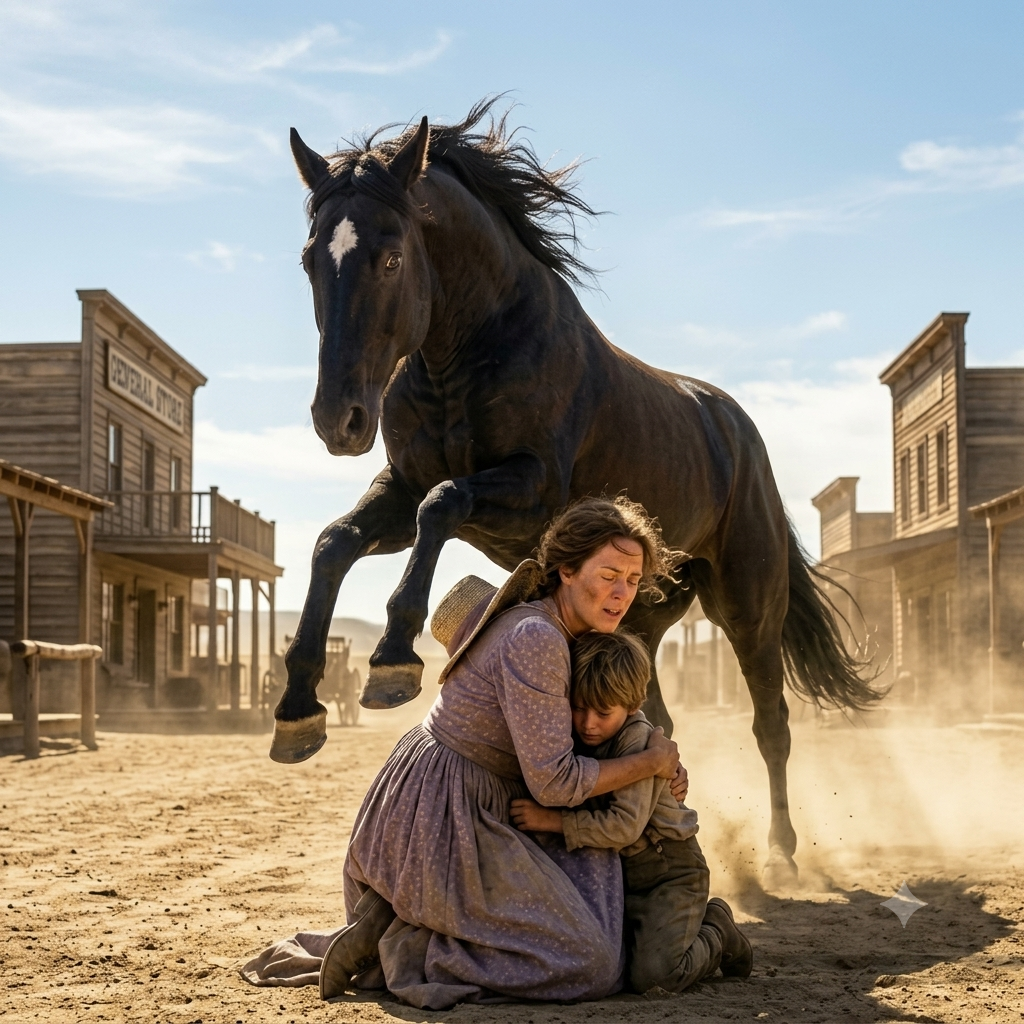
Diablo, the Black Stallion, had broken free of Jud Warick’s corral and was charging down the center of Hardscrabble with froth on its lips and murder in its rolling eyes. Two men lay in the dirt where it had thrown them. A third was climbing a post, and in the street, directly in the horse’s path, stood little Leo Foster.
Leo had been sent to fetch a pale of water from the well. He had not seen the horse. He was staring at something on the ground, a dropped coin perhaps, or a pretty stone, and he was utterly, fatally unaware.
The stallion was 50 yards away and closing fast. Jud Warick was running after the beast, rope in hand, but he was too far. Other men shouted.
Women screamed. Lydia did not think. Her body moved before her mind could catch up.
She ran into the street, seized Leo by the collar, and threw herself over him like a shield. her back to the horse, her arms around the child, her mouth moving in the only prayer she had left, and then she began to hum, not a hymn of petition, but a hymn of peace. What a friend we have in Jesus.
The melody rose from her throat, trembling, but clear, as the shadow of the great black stallion fell over her. She waited for the impact. It did not come.
===== PART 3 =====
Slowly trembling, she turned her head. Diablo had stopped. His hooves were planted in the dirt inches from her skirt.
His sides heaved, his eyes still rolled white, but he was not moving. He was staring at her with an expression that looked impossibly like confusion. Lydia kept humming.
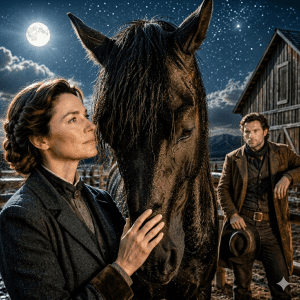
She did not stop. She reached up very slowly and laid her palm against the horse’s sweating neck. The stallion lowered its head.
From the other end of the street, Jud Warick dropped his rope. He had seen many things in his 32 years. He had seen men die.
He had seen horses break. But he had never in all his days seen a wild stallion tamed by a hymn and a woman’s touch. “No man has ever done that,” he whispered to the empty air.
“Only her.” “Lydia Picket did not think of herself as brave.” In the days that followed the incident in Main Street, she deflected praise the way a tin roof deflects rain. Politely, efficiently, and without letting a single drop soak in. The town wanted to call her a hero.
She called herself a woman who had done what any woman would do for a child. The fact that Diablo had not trampled her was not courage, she insisted. It was luck.
It was the horse’s own exhaustion. It was anything and everything except the truth which she refused to acknowledge even to herself that something had passed between her and that animal in the moment of stillness. Something she did not understand and could not explain.
But Jud Warick understood, or rather, he understood that he did not understand, and that ignorance drove him to the edge of madness. He watched her. He could not help it.
Every afternoon when she released her students, she walked past his corral on the way to the boarding house. Every afternoon, she slowed. She did not approach.
She simply looked at Diablo, the stallion now confined to a reinforced pen, still lunging at the rails, still wild as the wind. And her eyes held a sorrow that Jud recognized. It was the same sorrow he saw in the mirror each morning.
The sorrow of a creature that had been wounded and could not find the words to ask for healing. On the third day, she stopped. “May I bring him an apple?” she asked.
Jud was mending a bridal on his porch. He did not look up. He’ll take your hand off.
No, she said quietly. He won’t. There was no arrogance in her voice.
Only certainty. Judge set down the bridal and watched as she walked to the fence. An apple cradled in both palms.
Diablo charged the rails. The wood groaned. Lydia did not flinch.
She held the apple out, flat palmed, and began to hum. The same him. What a friend we have in Jesus.
The stallion stopped. Its nostrils flared. Its ears swiveled forward and back, forward and back, as if caught between two instincts.
Then slowly it stepped forward. It sniffed her hand. It took the apple.
And when it had finished chewing, it lowered its head and allowed her to touch the white star on its forehead. Judge stood up so fast that his chair overturned. How, he demanded.
Lydia looked at him over her shoulder. Her expression was not triumphant. It was gentle, almost sad.
He is not evil, Mr. Warrick. He is afraid.
No one has ever taught him that he can trust. She left without another word. Jud stood in his yard until the sun went down, staring at the stallion that had suddenly become a stranger to him.
He had spent two years trying to break Diablo with force, whips, spurs, long hours in the saddle, fighting the animals every move, determined to prove that he was strong enough, hard enough, man enough to master what no one else could master. And now a school momm in a lavender calico dress had done in three minutes what he could not do in three years. It was not the horse that was broken.
He realized it was him. That night Jud did something he had not done since his brother Caleb died. He opened his mother’s Bible.
It was a small worn thing held together with twine and it fell open to the book of Psalms. His eyes caught on verse 34 18. The Lord is close to the brokenhearted.
He read it once. He read it 10 times. And then he closed the Bible and wept.
The weeping was not gentle. It was the ugly heaving sobs of a man who had been holding back a flood for 2 years and could hold back no longer. Caleb had been 19 when he was thrown from a horse that Jud had promised to Gentle.
The horse had not been mean. It had been startled by a rattlesnake, and Caleb, young and inexperienced, had lost his seat and landed on a rock. He died before Jud could reach him.
And Jud, instead of grieving, had bought the wildest stallion in the territory and spent every waking hour trying to break it. He told himself it was a penance. He told himself that if he could master Diablo, he would have proven himself worthy of his brother’s memory.
But the truth was simpler and darker. He had been trying to punish himself. Every bruise, every throne ride, every fresh wound was a payment on a debt he could never repay.
Lydia visited the corral every afternoon after that. She never asked permission. She simply appeared, always with an apple or a carrot or a handful of oats.
And she sat on the fence and read aloud from her Bible. Not the fire and brimstone passages, the gentle ones, the rd Psalm, the sermon on the mount, the story of the good shepherd who left the 99 to find the one. Diablo would stand at the fence and listen, ears forward, breath slowing, until the sun dipped below the mountains, and Lydia closed her book and said, “Good night, old friend.” The town laughed.
The old maid has given up on men and now courts a horse. Vance Cooper joked at the saloon. But the laughter was thinner now.
Even Vance had noticed the change in Diablo. The stallion no longer charged the rails. It no longer tried to bite.
It stood in its corral like a horse waiting. not for a master, but for a friend. Jud watched all of this from his porch, and his heart cracked open a little more each day.
On the seventh afternoon, he found himself walking to the fence before Lydia arrived. He waited. When she came, he said, “Why do you do it?” She climbed onto the fence rail and settled herself as if she had been invited.
“Because he needs someone to see him,” she said. “Not his strength, not his rage, him. And what about me?” The question came out before Jud could stop it.
He looked away ashamed. I mean, you do not know me. You do not know what I have done.
Does it matter? He turned back. Her hazel eyes were steady, kind, and utterly without judgment.
Something in his chest cracked further. I killed my brother, he said. The words hung in the cold air.
Lydia did not gasp. She did not recoil. She simply waited.
So Jud told her the whole story. the horse he had promised to Gentle, the rattlesnake, the rock, the blood on Caleb’s head, and the terrible silence that followed. He told her about the two years of punishing himself with Diablo, the sleepless nights, the prayers he had stopped praying because he was certain God would not listen.
He told her everything, and when he was finished, he was shaking. Lydia reached out and took his hand. Not romantically, the way a sister might take a brother’s hand.
Mr. Warrick, she said, the Lord does not want you to break the stallion. He wants you to break the lie that says you are unforgivable.
Jud looked at her hand on his. He looked at Diablo, who had walked to the fence and was now standing quietly watching them both, and for the first time in two years, he did not feel the weight of his guilt as a physical thing. He felt it lifting.
He felt it scattering like dust in a wind. That night, he did not go to his cabin. He went to the church.
He knelt at the altar rail, the same rail where Lydia had prayed after the harvest social. And he confessed everything to God. He did not hold back.
He did not clean up his language or his tears. He simply poured out his brokenness and waited. And God answered, not with a voice from heaven, not with a sign, but with a profound, bone deep peace that settled over him like a blanket.
He was forgiven. He had always been forgiven. He had simply refused to accept it.
The next morning, Jud Warick sold Diablo. The buyer was a gentle horse trader from the next valley, a man who promised never to use a whip or a spur. Jud accepted a fraction of what the stallion was worth, and he did not negotiate.
He had not tamed Diablo. Lydia had, but in letting the horse go, Jud finally tamed himself. He went to the schoolhouse after classes ended.
Lydia was erasing the slate board. The room smelled of chalk and wood smoke and the faint sweetness of dried apple slices. She did not turn around when he entered.
She simply said, “You sold him.” “Yes,” that was wise. Miss Picket. Jud’s voice cracked.
He cleared his throat and tried again. Miss Picket, I have nothing but a callous heart and a half-repaired soul. But I saw you tame a wild stallion with a hymn, and I saw you cover a child with your own body.
I am not offering you passion. I am offering you a life of prayers, hard work, and faithfulness. Lydia turned.
Her eyes were wet. Mr. Warick, that is the only proposal I would ever accept.
She did not embrace him. There was no kiss. They stood three feet apart, trembling with the weight of what had just passed between them.
And then, Mrs. Horn appeared in the doorway as if summoned by divine providence. Well, the widow said, it is about time.
I will chaperon. The wedding was set for three months hence. Jud would court Lydia properly with calls and chaperoned walks and letters placed in her hand on Sunday afternoons.
He would repair the cabin and build a proper school desk for her to use at home. And every evening he would walk her to Mrs. Horn’s door and leave her there untouched and honored because that was what a man did for a woman he intended to marry.
The town was astonished. Vance Cooper stopped making jokes. The matrons who had pied Lydia began instead to envy her.
But Lydia did not care about their envy. She cared about one thing only. The look in Jud Warick’s eyes when he said her name.
Lydia, not ma’am. Not Miss Picket. Lydia, she wrote in her journal that night.
The Lord did not send me a hero. He sent me a wounded man who was willing to be healed. And that I think is the greater miracle.
The wedding took place on a Sunday in January in the same small white church where both Lydia and Jud had wept out their prayers. The bell did not crack. The cross did not lean.
The sun broke through the winter clouds at the exact moment Bishop Timothy Reed pronounced them husband and wife. And the congregation, every soul in hard scrabble, including the Hennessy boys and Martha Pine and Leo and Beth Foster, rose to its feet and applauded. Lydia wore a new dress.
It was not white. White was for brides who had never known poverty, but a deep, warm blue that matched the winter sky. She had sewn it herself by lamplight, while Mrs.
Horn read aloud from the Song of Solomon. Jud wore a clean shirt and a new leather vest. He had shaved.
He had combed his hair. He looked, the women whispered, almost handsome. He did not kiss her at the altar.
That was not their way. Instead, he took her hand in both of his, lifted it to his forehead, and held it there for a long moment. A benediction, a promise.
Then he led her down the aisle and out the church doors and into the sleigh that would carry them to the broken wheel ranch. The cabin was small but warm. Jud had spent the past 3 months repairing the roof, building a proper bed frame, and whitewashing the walls.
There was a cast iron stove, a table for two, a shelf of books that Lydia had brought from the schoolhouse, and a rocking chair by the fire that had belonged to Jud’s mother. It was not a grand home. It was a humble home, and it was theirs.
That night, they prayed together, kneeling side by side on the braided rug, and then Jud spread a blanket on the floor and slept there. “I aim to court you proper, wife,” he said when Lydia protested. Even after the wedding, you will come to me when you are ready and not a moment before.
Lydia lay in the new bed, staring at the ceiling, and marveled at the man she had married. He was not romantic. He would never write her a poem or buy her a ribbon.
But he was faithful. He was gentle, and he had chosen her, not because she was beautiful or young or charming, but because she had shown him mercy, that she realized was the truest love. the love that sees a person’s wounds and does not run away.
The first year of their marriage was not easy. The ranch was poor. The winter was brutal.
There were mornings when the water froze in the bucket and the fire went out before dawn. And the only food was hard bread and older cheese. But they did not quarrel.
They worked. Jud chopped wood. Lydia mended fences.
They read scripture aloud in the evenings. And they prayed. and they learned the slow, patient rhythm of two lives becoming one.
In the spring, a letter arrived from St. Louis. The aunt of Leo and Beth Foster had finally been located, and she was coming to claim the children.
Lydia’s heart stopped when she read the words. Leo and Beth had been in her care for 8 months. She had taught Leo to read.
She had coaxed Beth to communicate with small signs and written notes. She loved them as if they were her own. The aunt arrived in June.
She was a thin, pinched woman with a loud voice and small eyes. She looked at Leo with cold appraisal and at Beth with open disgust. “The girl is mute,” she announced.
“I will not take her. She is useless.” Lydia stepped forward. She did not shout.
She did not weep, she said in a voice as steady as a rock. “Then she is mine.” Jud was beside her in an instant. “Ours,” he corrected.
“She is ours.” The aunt signed the papers. Leo and Beth Foster became Leo and Beth Warrick that very afternoon. The adoption was not legal by the territory standards.
There was no judge in hardcrable, no courthouse, no seal, but it was legal by every standard that mattered. That night, Lydia tucked Beth into a small bed she had built in the corner of the cabin, and Leo climbed into a bunk above her, and Jud stood in the doorway with his arms crossed and his jaw tight, fighting back tears. Beth spoke her first word two weeks later.
It was not mama or papa. It was Diablo. She pointed at the empty corral and said the name as clear as a bell.
And then she looked at Lydia and smiled. The smile broke something in Lydia’s heart. Something that needed breaking.
They did not have a baby. That was a conscious choice made in prayer and confirmed by the bishop. These children are your gift, Bishop Reed said.
raise them well, and the Lord will bless the fruit of your womb in his own time.” Lydia accepted this. She had never been the kind of woman who demanded her own way. She trusted.
She waited. The summer brought drought. The creek dried up.
The cattle grew thin. Jud woke at 4 each morning to haul water from a distant spring. And Lydia stretched every meal with wild greens and the last of the winter stores.
One night, Judge sat at the table with his head in his hands and said, “I could go to the Dakota territory. They are hiring hands. I could send money.” Lydia set down her mending.
She walked to his chair, knelt beside him, and took his face in her hands. “We face this together,” she said, “under this same roof, or we are no different from the world.” “I did not marry a man who runs. I married a man who stays, he stayed.” They prayed for rain.
For 40 days, no rain came. On the st day, the clouds rolled in from the west, black and heavy and full of promise. The rain fell for three days straight.
The creek ran again. The cattle drank, and Jud Warick, standing on his porch with his wife’s hand in his, looked up at the sky and said, “The Lord provides.” In the autumn, Diablo returned. The gentle horse trader had lost him in a storm, and the stallion had found his way back across 50 mi of rough country.
He arrived at the broken wheel ranch with a deep gash on his flank, three ribs showing and fire still in his eyes. The town said, “Shoot him. He is dangerous.” Jud took his rifle.
He walked out to the corral. He raised the gun. Lydia put her hand on his arm.
We do not shoot what God has brought home to heal. Jud lowered the rifle. They nursed Diablo through the winter.
Leo, who had been terrified of horses since the day the stallion nearly trampled him, brought the animal hay each morning. Beth braided its mane, and slowly, impossibly, the wild stallion became a gentle pasture horse, the safest mount on the ranch, trusted with children and old men alike. 10 years passed.
Leo became a veterinary apprentice, tall and steady, with a soft voice that calmed even the most frightened animals. Beth became a school teacher herself, talkative and confident, engaged to a young blacksmith named asterisk Mr. Owen Tate.
Jud became a lay minister, preaching in the church every other Sunday. And Lydia became the matriarch of the county, running a Sunday school from the ranch’s bunk house and writing letters to every lonely woman she could find. The world had called her an old maid.
God had called her a wife, a mother, a teacher, a tamer of wild things. The two were not the same. On their th anniversary, Lydia read aloud from her journal.
Jud sat across from her at the kitchen table, gray at the temples, lines around his eyes, still lean and quiet and full of a peace he had not known when they first met. The children were asleep. Diablo was dozing in the corral.
The fire crackled. She read, “The world said no man wanted an old maid school teacher. But the Lord sent a cowboy too broken to run and a stallion too wild to break so that I would learn.
Gods know is not a rejection. It is a redirection to a love that tames without tearing.” Jud reached across the table and took her hand. He did not speak.
He did not need to. The silence between them was full of everything that mattered. faith, forgiveness, and the quiet, stubborn miracle of two broken people who had chosen to heal together.
They lived out their days on the Broken Wheel Ranch. They never grew rich, but they never grew hungry. They never had a baby of their own, but they raised a generation of children who called them Aunt Lydia and Uncle Jud.
And when the end came for each of them, first Lydia, then Jud many years later, they were not afraid. They had learned long ago that the same god who tames wild stallions also welcomes home his children. The stallion’s corral stands empty now.
The schoolhouse has a new teacher, but the people of Hardcrabble still tell the story of the old maid school teacher and the cowboy who saw her tame a wild horse. They tell it to their children and their grandchildren. And they add this moral which is the truest thing about it.
A woman’s worth is not measured by the man who wants her, but by the God who made her. And a man’s strength is not measured by the beasts he breaks, but by the pride he breaks in himself. If this story stirred something in your heart, if you have ever felt rejected, overlooked, or too broken for love, remember that Lydia Picket waited six years in obscurity before God revealed her purpose.
She did not chase after Jud. She did not compromise her values. She simply trusted, served, and remained faithful in the small things.
You are not an old maid. You are not a failure. You are a woman being prepared for something only you can do.
If you believe that God writes the truest love stories, not with passion, but with patience, share this story with one woman who needs to hear it, then kneel and pray this prayer. Lord, make me faithful in the waiting. Make me gentle in the rejection.
And when you send my Jud or my Diablo, give me eyes to see what the world overlooks. Subscribe for more faithfilled frontier romance at fictional publishers name. Until then, remember the wildest stallions are tamed by the gentlest hands, and so are the wildest hearts.