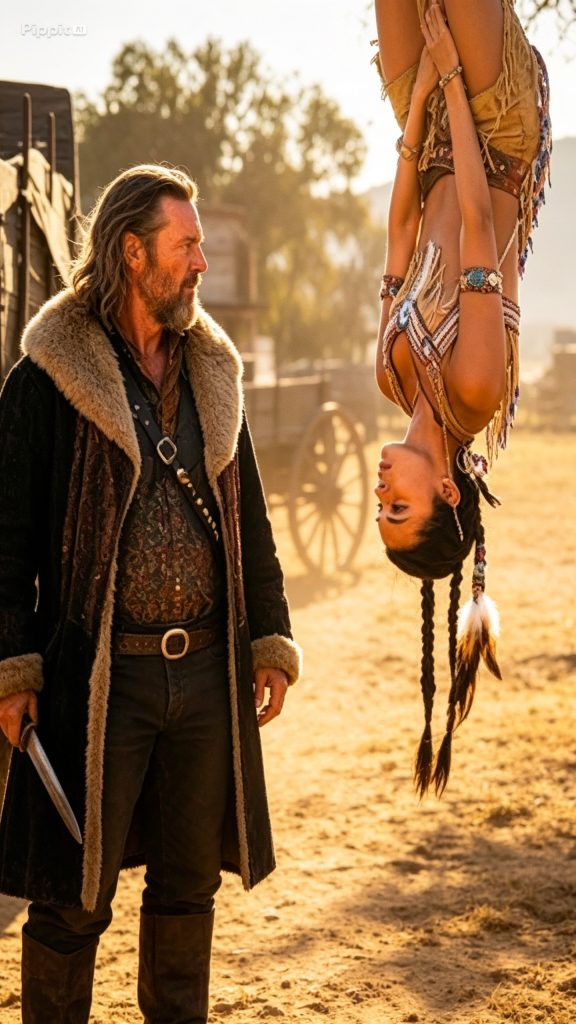
It was bone white, the kind that makes your eyes ache. I was riding the fence line, just me, my horse, and the sound of the world trying to tear itself apart. There ain’t much left for a man like me but land, chores, and the silence between the wind gusts.
I’d made peace with that, or so I thought. The storm rolled in fast. Dust swallowed the horizon until the whole world turned the color of rusted iron.
My horse, Buck, snorted and jerked his head, uneasy. That’s when I saw her, or what I thought was a rag tangled in the wire. But rags don’t bleed.
She hung there by the arms, half naked, the skin of her wrists, torn open from the barbs. A woman, maybe 20, maybe less. The wind pushed her body like a broken puppet.
The first thing I noticed wasn’t the blood. It was the silence. Not a scream left in her, just the sound of rope creaking.
I don’t remember getting off the horse. I just remember the knife in my hand and the feel of steel in my fingers. Easy now, I said to no one.
My voice came out rough like gravel kicked under boots. Up close, she didn’t look human, more like something the desert had half finished. Hair matted with blood, mouth split, breath shallow.
A crude sign lay half buried in dust. The savage gets what she gave. Whoever did this wanted her to be found.
Wanted someone to remember. For a long minute, I just stood there staring, thinking maybe it was a bad idea to get involved. The kind of idea that gets you killed in these parts.
The army didn’t take kindly to anyone helping their runaways. But then her hand twitched barely. That’s all it took.
I cut the wire. She fell hard like a sack of sand. And the sound she made, half gasp, half sobb, hit me straight in the gut.
I wrapped her in my coat, carried her to the horse, and laid her across the saddle. She was light, too damn light. By the time I reached the cabin, night had crawled up behind me.
The wind was dying down, but it left the land looking scoured and mean. The door hinges moaned when I pushed inside. The cabin smelled of smoke, coffee, and years gone stale.
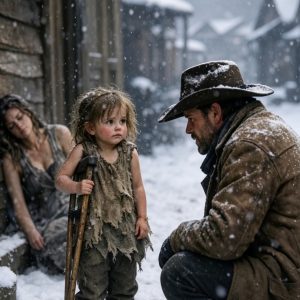
I set her down on my cot, lit the lamp, and for the first time saw her face. She wasn’t white, skin like copper dust, cheekbones sharp as the ridges outside. A Cheyenne girl, maybe.
There were brands burned along her shoulder, army iron. By the look of it, my stomach turned. She opened her eyes once, dark, wild, then closed them again.
I boiled water, tore up an old shirt, cleaned what I could. She didn’t flinch, not even when I poured whiskey on the wounds. I kept talking anyway, not sure for whose sake.
maybe my own. “You’re safe here,” I told her, though I wasn’t sure it was true. For a long while, the only sound was wind pushing against the cabin walls.
It sounded like the land was breathing slow, heavy, waiting. I used to think the war took everything that could hurt me. Turns out I was wrong.
Watching her chest rise and fall, slow and fragile. Felt like looking at something I wasn’t supposed to touch. Something sacred or cursed, maybe both.
I fed the fire, sat down, stared at her till my eyes burned, and then hell, I don’t know why I said a prayer, first one in 15 years. Lord, if this is trouble, let it be the kind worth dying for. The night answered with silence.
I reckon that was as close to a yes as I’d ever get. If you enjoy the story, hit that subscribe button right away. And if you don’t, then just hit the like button anyway to keep more Wild West love stories coming.
I didn’t sleep that night. Every time I shut my eyes, I saw her hanging there again. Her body swinging like a ghost in the wind.
By dawn, the world outside was washed clean sky, pale blue, the creek whispering down the gully. She was still breathing. That was something.
When she finally stirred, her voice came soft, broken like a reed. Why? I didn’t have an answer.
Maybe because no one else would have stopped. Maybe because I was too damn tired of walking past pain like it wasn’t there. I poured her a cup of water.
She drank slow, eyes never leaving mine. I saw fear there and something else, something like defiance. Name?
I asked. She hesitated, lips dry. Ayana, she whispered.
The word carried a sound older than English, like wind through pine. It stuck in my mind long after she slept again. Ayana.
I looked out the window. The prairie rolled on forever. Yellow grass, blue sky, ghosts between them, and I knew one thing for sure.
Whatever peace I thought I had was gone for good. Days passed slow like molasses sliding down a cold tin cup. The storm had stripped the world bare, left only wind and silence.
Out here, silence has weight. You can feel it pressing on your ribs, reminding you how small you are. Ayana slept most of the time.
When she woke, her eyes darted like a trapped animals. I moved quiet, tried not to startle her. She’d flinch if I stepped too close, but never cried.
Whatever had been done to her, tears had dried long ago. I patched fences, chopped wood, did all the little things that keep a man from thinking too much. But every time I looked at the cot, I remembered the brand on her shoulder, the mark of the same cavalry regiment I once rode with.
That knowledge sat in my gut like a stone. The morning she stood up for the first time. I was mending the gate.
She pushed open the door, sunlight spilling over her like she didn’t belong to it yet. The wind caught her hair, tangled it across her face. “You shouldn’t be up,” I said.
Her answer came short, clipped by pain. “You shouldn’t have cut me down.” I stopped hammering. “Would have been easier if I hadn’t,” I said.
She stared at me for a long second, like she could see straight through to the ghosts crawling inside my chest. Then she turned away. By noon, she was outside, washing blood from her shirt in the creek.
I watched from the porch, the hammer still in my hand. The river ran clear, catching sunlight in shards. Her reflection wavered with the current, half there, half gone.
I didn’t know if she’d stay or if I even had the right to ask her to. That night, while she slept, I found her satchel. Inside were a handful of beads, a strip of leather with carvings too old for me to read, and a broken knife.
The handle had a name burned into it. Tayawa. I didn’t know the word, but I could tell it meant something that once mattered.
Next morning, the sound of hoof beatats rolled down from the ridge. Two riders, blue coats, cavalry. I stepped out slow, my rifle across my arm.
Morning, mister, one called. We’re looking for a runaway Cheyenne woman about so high. He held a wanted paper ink still wet.
You seen her? I kept my face blank. Ain’t seen nobody but my own horse for a week.
They eyed the cabin. The younger one leaned in his saddle, smirking. You live alone?
Mostly, I said. The older one squinted, spit tobacco into the dirt, then nudged his horse. If you do see her, Mr.
Boon, let us know. She’s dangerous. took a knife to one of ours.
“Sure,” I said. “If she comes round, I’ll remember that.” They rode off slow, dust curling behind them. I didn’t move till they disappeared past the hill.
Inside, Ayana was crouched by the hearth, clutching the broken knife from her bag. Her knuckles were white. “They’ll come back,” she whispered.
“I know.” She looked at me then, eyes dark and endless like the creek at night. “You were one of them, the words cut clean.” I was, I said, a long time ago. Silence stretched between us, heavy as the storm before thunder.
She didn’t speak again, but she didn’t turn away either. That was something. That night, she built the fire herself.
Didn’t ask for help. The flames danced on her skin, turning her into something carved from light and dust. I sat across the room, listening to the wood pop and crackle.
===== PART 2 =====
After a while, she said in my tongue, “Tawa means what’s mine.” “Your knife,” I said. She shook her head. “No, my brother.” The air went still.
She stared into the fire. Her face unreadable. They took him when they took me.
I never found his body. I didn’t know what to say. Words don’t fix things like that.
So, I just let the silence do the talking. Sometimes silence is all a man can offer that’s worth anything. After a while, she asked, “Why did you leave the soldiers?” I hesitated because I got tired of fighting ghosts.
Did you kill my people? The question hit like a hammer. I didn’t answer right away.
The truth was in my hands. The blood, the years, the faces I still saw when I closed my eyes. I don’t know their names, I said finally.
But yes, I reckon I did. Her gaze didn’t flinch. Then the spirits brought me here to make you remember.
Maybe they had. Later that night, when the wind rose again, I caught her standing at the doorway, hair whipping across her face, watching the planes. She looked like she belonged to the storm.
“You planning to run?” I asked. “Would you stop me?” I thought about it. “No,” she looked at me then.
Really looked. “Then I’ll stay until the wind changes?” I nodded. Sometimes that’s all the agreement two people need.
If you like wild west love stories or wild west stories, drop a bunch of one second and your place in the comments for the Wild West love channel. Tell me where you’re listening from so I don’t feel so alone out here. Morning came red and brittle.
She was already outside hanging washed clothes on the line. Her arms bore scars. The sun could never fade, but her movements were steady.
When she saw me, she gave a short nod. The kind a soldier gives. Another soldier.
Not forgiveness. Not yet, but something close to peace. And for the first time in years, I felt like I wasn’t the only ghost left wandering these plain.
The week turned lean and quiet. We slipped into a rhythm that didn’t belong to words. Water fetched, wood split, horses brushed, wounds checked.
The kind of work that makes two people move like they’ve known each other a long while, even if they don’t. She learned my cabin the way a hawk learns wind. All by feel.
The kettle whistled. She’d lift it without looking. A shutter knocked.
She’d set a peg. If a board groaned, she knew which step to avoid. Sometimes I’d catch her in the doorway, palms open to the light like she was testing its weight.
When she noticed me watching, she didn’t blush. She just lowered her hands and went back to the fire. I rode fence and checked traps mostly, but I took the long loops, scouring for sign.
===== PART 3 =====
Twice I found it. A bent stem where no cow passed. A bootprint that cut too deep for a ranch hand.
Ash from a fire made with hard coal, not sage. Soldiers or men who moved with soldier habits. Either way, the kind that don’t knock before they take.
On the third evening, as dusk bled gold across the grass, I saw smoke stacking thin from the far ridge. Not a cook fire, a signal. I came home slow, dust in my teeth, my hat pulled low so she wouldn’t read the news before I said it.
She was mending the torn hem of her shirt on the step. The needle flashed. My heart did a trick I wasn’t ready for.
It felt like a horse stumbling on a rock and finding its feet again. Riders, I said. How many?
Can’t tell. Enough. She pushed the needle into cloth, set it down.
They don’t ride for me alone, she said. They ride for the memory of me. I nodded.
I knew something about being chased by memory. We ate in the quiet way. We had one plate passed back and forth, the spoon clicking the rim.
She took smaller bites than a person ought to, not because she wanted to be dainty, because hunger had taught her the rules of rations. When we finished, she set the tin aside and looked at me over the rim of the lamplight. “You wear your shame like a coat,” she said.
“Too heavy for summer.” “Winter’s never far out here,” I said. Her mouth almost tipped into a smile, but didn’t. She folded her mended shirt.
Then she pulled the leather strip from her satchel and laid it on the table. Shapes cut into it caught the lampglow curves and lines like river beds and antelope tracks. “What’s it say?” I asked.
“That a person is not what was done to them,” she said. “A person is what they choose next.” I let that hang a while. Wind pressed against the walls and eased off like the land practicing its breathing.
I chose wrong once, I said. More than once. She didn’t reach for my hand.
She didn’t say it wasn’t my fault. She just gave me the thing this country almost never gives. A place to set the truth down without it being kicked aside.
Tell me, she said. So I told her, not all at once, in pieces. Like pulling wire from an old wound.
About the march through snow that broke horses lungs. About smoke pillars over lodges we were told were raider camps. About faces I’d only seen in firelight because I’d been a coward in daylight.
about a boy with a bead thong tied to his wrist, who stared at me like I owed him the Sunday. When words ran out, I braced for the crack of judgment. None came.
She tied her hair back with the leather strip and stood, the fringe of her shirt, brushing her hips like grass and wind. “Sometimes the land takes back a river,” she said. “Because it was never meant to run there.” “I don’t know where mine was meant to run,” I said.
Then you listen, she said, and touched her palm to the table twice. Slow to wood to mourning to your own breath when you are not trying to be brave. I didn’t know how to do that.
Not yet. But I could learn. Men have learned worse things than peace.
That night, coyotes sang thin along the ridge. I set a second rifle by the door and left the window latch loose. She curled on the cot with her back to the wall and a blanket over her shoulders.
I took the chair. I always did. Sometime near midnight, I woke to a sound.
A man doesn’t mistake the slow, careful shift of weight over boards outside. Not wind, not animal, human. Two, maybe three.
The lamplight was snuffed. The room held its breath. Ayana, I whispered.
She was awake already. In two steps, she’d slid to the shadow beside the hearth. Knife in hand, the broken one, yes, but sharp enough where it counted.
I lifted the rifle and kept the barrel low. The way you do when you mean to live through what’s coming. A finger found my latch.
The door creaked. The moon laid a pale blade on the floorboards. A boot toe tested it.
Then another. A smell came with them. Wet wool, horses, black powder oil.
A voice low and sure. Don’t be foolish now. Even in Sergeant Cray, I said into the dark.
A shift surprise shaped itself into a small laugh. Well, hell, Boon, I’ll be. Thought I recognized your tracks.
You always angled left coming out of a turn. Old habits, old men, old wars. What do you want?
I asked. The girl, he said, and a clean trail. I can leave you breathing if you’ve lost your taste for the country’s work.
Um um behind me, the fire hissed as a sap pocket burst in the log. I heard Ayanna move no more than a breath. Funny, I said.
I was about to ask the same of you, he sighed. We brought a paper to town. Signed proper.
She’s property of the United States, far as it goes. She’s a person, I said. That ain’t how it reads.
Maybe you’re reading it upside down, I said, and fired. The shot blew the latch back into Craig’s hand and slammed the door. He cussed.
A second later, a muzzle flash ripped the window to my left and glass sprayed. Ayana slid along the wall, low and silent as water. I racked the lever and put a second round into the window frame to give her cover.
Footsteps thutdded off the porch. Another voice barked from the yard. Horses screamed, then settled.
“Two more,” I said. She touched my boot with her fingertips just once, the smallest signal. I moved toward the door.
She moved toward the window. I kicked the door hard and caught a shadow crossing the yard. The shadow fell like a sack.
The second man fired wild and high. My ears rang cold. I rolled behind the porch post and howled a curse in a voice I hadn’t used since I wore government blue.
It worked. He came for the sound, not the shape. Ayana’s knife flashed from the window and bit his wrist.
His pistol dropped like a dead bird. I stepped out and drove him into the dirt with the butt of my rifle. Silence came hot and quick, which is to say, “Not silence.
The kind of quiet that listens for the next bad thing.” Craig spoke from the dark. “You always were a stubborn cuss,” he said. “I’m going to come back for you in daylight with paper men.
I’ll leave a lamp in the window,” I said. His horse clattered off. The other horses fussed, then settled into the takeaway rhythm you hear after men decide not to die yet.
I stood there until the night gave me back my breath. Then I went inside and fixed the door with what nails I had left. Ayana washed the blood off her hands without comment.
It wasn’t all theirs. She bound the cut across my forearm with steady fingers and a strip of cloth from her mended shirt. When she finished, she pressed her thumb against my pulse for a count I didn’t know.
“You didn’t have to stay in that doorway,” she said. “I’ve stood in worse,” I said. She lifted an eyebrow.
“You say that like it’s a thing to be proud of.” “Oh, it’s the only thing I ever learned,” I said. “No,” she said. “You learn to listen.
Maybe I had.” The cabin was full of small sounds I’d never noticed until they meant survival. Fire ticking low. Horses breathing like old men.
The night asking questions through the chinks in the wall. We didn’t sleep. We watched the dark toward morning when the sky pald to tin.
She set a small bowl between us and sprinkled dry leaves into water. The smell rose sharp and green. My grandmother, she said, called this the drink that makes your heart walk slower so your eyes can walk faster.
I took a sip. It tasted like rain we never get. You told me one thing, she said.
Now I tell you one thing. I wasn’t born Ayana. That’s a name I carried to keep my true one from being called by men with guns.
What do you want me to call you? She studied my face like the first day, but gentler. Later, she said, “When you’ve earned the right to know something that belongs to me,” I nodded.
The nod felt like placing a stone where a post would go later. Not a fence, a house, maybe. Near noon, the town sent its question in dust again.
This time, not soldiers, men with tin stars, and men with tin souls who rented their aim by the hour. A marshall I didn’t know wrote at their head. The kind that wears a badge like a sermon and a gun-like punctuation.
They stopped at my gate. The marshall tipped his hat, respectable. Behind him, a face I knew the storekeeper’s boy, older and meaner, stared at the broken glass in my window and the scuffed dirt by the porch and made a choice with his smile.
Mr. Boon, the marshall called. We’d like to talk friendly.
Talks cheaper than bullets, I said, and walked down to the fence with my hands open. Ayana stood in the dark behind me, just off the window line. I didn’t look back.
It’s a funny thing, trust. It isn’t loud when it arrives. It just takes a chair and sits.
Paper says, the marshall began and lifted a folded thing. You’re harboring a fugitive who cut a trooper and fled government custody. We’re here to collect her without fuss if you’ll allow.
What if the papers wrong? I asked. Then a court can say so.
I glanced at the storekeeper’s boy. He shifted like a child waiting for pie he didn’t earn. She’ll never see a court, I said.
The marshall sighed. I’ve seen you around, Boon. You pay your bill.
You don’t pick fights. Don’t start now. Hand the girl over.
I could feel the weight of the moment hinge under my boots. Behind me, the air of the cabin changed the way a room does when a person stands. “No,” I said.
“She stays.” The boy spat. Figures always was soft on savages. I looked at the marshall.
You can come inside with two men, leave your guns at the gate, and we’ll talk what’s true, or you can try the door with all of you, and we’ll talk smoke and splinters.” He studied me the way men study weather. Then he did a thing I didn’t expect. He nodded, handed his pistol to the deputy, swung down from his saddle, and walked to the gate alone, paper in one hand, hat in the other.
Inside, he touched the brim to Ayana without looking at her face too long. the way a person looks at the sun when they remember what it can do. He read the paper.
We told him what happened last night. He measured the holes in my door, the blood on the threshold, the angle of a bullet path like a carpenter measuring a beam. When he was done, he folded the paper and put it away.
Sergeant Craze a liar, he said. Been one for years. He turned to Ayana.
Miss, I can’t tear this paper, but I can put 2 hours between it and you. How far is 2 hours? I asked.
As far as two good horses and a man who knows how to miss being seen, he said. Then he looked hard at me. You that man?
I was once. I might be again, he left the way he came. The man outside muttered.
The boy sneered and turned it into a cough when the marshall’s eye cut his way. Dust swallowed them down the lane. The yard went quiet as a church after the hymn.
Ayana closed the door. She leaned her forehead against the wood and set her palm flat like a prayer. 2 hours, she said.
Well make them worth more, I said. We packed without noise. Not much to take.
Rope, jerky, a coffee bag, her beads. I left the photograph I never looked at, and the bottle I looked at too much. I took the old Bible because a man needs a thing to hold when his hands remember hell.
I stoked the hearth until the belly of it was red and laid a fresh log the way you do when you’re telling a fire to keep a place for you in case you find your way back. Out by the corral, I saddled Buck and my spare mayor. She moved to the gate and stood there like the path had been waiting for her feet since the day she was born.
Sunlight ran along the top wire like a thin river. I handed her the canteen. She drank slow, tilted it my way.
I took my swig, wiped my mouth and felt something new, something simple and dangerous in its gentleness. A life I wouldn’t hate living. She tied the leather strip around her wrist.
“When we ride,” she said, “you ride beside me, not in front, not behind. Beside,” I said. The word fit right in the mouth.
We swung up. The saddles took us like old friends. I looked once at the cabin window patched with cloth door scarred smoke lifting a thin thought into the big sky.
“You ready?” I asked. She didn’t answer. She leaned into the mayor and the mayor took the ask.
We moved together. Two figures cutting a line through yellow grass toward the cottonwoods that hid the creeks bend. The world opened.
Wind found us. It didn’t bite this time. It carried.
We rode the bank where hooves leave less print. We fored where stones break water into noise. We let the land teach us how not to be seen.
And somewhere between one breath and the next, I realized the thing I hadn’t dared name. I didn’t feel alone anymore. Night waited for us beyond the cottonwoods, and men waited beyond night.
But right then the sun was warm on my shoulders, and a woman rode within reach of my hand, and the west, hard, unforgiving, beautiful, gave us a corridor of light to pass through. Tell me something true, she said without looking over. I will stay, I said, and heard how much it cost to speak it and how cheap it sounded next to the debt I owed.
She nodded. Then ride. We did.
The creek threw a silver laugh under us. A hawk wrote secrets in the sky. Far off, the ridge held a promise I didn’t trust yet, but wanted to.
Maybe that’s all a man like me gets. Maybe it’s enough. Hey there, friend.
Take a moment and get yourself a full glass of water. Your body will thank you. By the time we hit the foothills, the sun was gone and the moon looked like it had bled thin.
2 hours had become four. And still we rode. The horses were lthered, breathing hard through the dart.
Every so often, Ayana would turn her head, scanning the trail behind us like she could hear ghosts in the wind. Maybe she could. We stopped by a stand of cottonwoods where the creek bent wide.
I slipped off Buck and let him drink. My hands were shaking, not from fear, but from the thing that comes after it. The body, remembering it’s alive, she crouched by the water, cupping her palms.
The moonlight caught her face, and for the first time since I’d known her, I saw it without shadow. She wasn’t young the way girls are young. She was young the way fire is burning, because there’s no other choice.
They’ll come by dawn, she said. I know you could leave me here. I could.
She looked up. But you won’t. Um, “No,” I said.
“I won’t.” For a long while, neither of us spoke. The water whispered through the reads like an old story that didn’t care who heard it. I found a dry patch under the trees and started a small fire no bigger than a man’s hand.
She sat across from me, quiet, watching. “You still haven’t told me your true name,” I said. She tilted her head.
“Would it change what you’ve already done?” “No.” Then it can wait till morning. I nodded. Sometimes words don’t fit in the hours that matter most.
The night pressed in heavy coyotes sang [snorts] far and lonely. I felt the ache in my side where Craze bullet had grazed me days before. She noticed.
Let me see. She said it’s fine. Her look said it wasn’t a request.
I pulled up my shirt. The skin was angry red edges blackened. She soaked a cloth and pressed it to the wound.
I hissed. Hurts less if you don’t fight it, she murmured. Everything worth something hurts, I said.
She almost smiled. You sound like a man who finally learned to listen. When she was done, she sat back on her heels.
The fire painted her skin gold in shadow. There was a silence between us that wasn’t fear anymore. It was something heavier, something alive.
“You asked what my name means,” she said softly. It’s not Ayana, it’s manah. It means the wind that remembers.
Minaah, I repeated, and the word felt like a prayer I didn’t know I’d been saying my whole life. She looked straight at me. You remember too much, she said.
You carry your ghosts like metals. Maybe they’re all I got. She shook her head.
Not anymore. The fire cracked. My hand was still on my rifle, but for once, it didn’t feel like protection.
It felt like habit I was ready to let go of. She reached out then, slow, unafraid, and touched the scar on my knuckles. Her fingers were warm, steady.
“You can stop fighting,” she whispered. “Maybe it was the night. Maybe it was the blood still drying on both of us.
But when I took her hand, the world stopped feeling like a place I had to survive and started feeling like one I could belong to. By dawn, the sky had turned the color of ash and rose. We packed light and crossed the ridge before the sun cleared it.
The valley below was long and yellow, dotted with sage. In the distance, dust curled like smoke riders. They’re coming, I said.
She didn’t look back. Then we ride toward the light, not away from it. We spurred hard.
The horses stretched into the run like they remembered freedom. The wind tore at my coat, filled my ears till I couldn’t tell if I was hearing gunfire or thunder. A shot cracked behind us, then another.
The sound carried like lightning splitting wood. “Mina!” I shouted. She leaned low over the mayor, braid whipping like black fire.
“Keep right,” we veered down through a gully where the creek narrowed. Stones clattered, hooves slipped, but the water gave us cover. The riders fired blind into the dust.
A bullet sang past my head, close enough to clip my hat brim. I fired back once, more for warning the name. The echo bounced through the canyon like a promise not yet decided.
Then the world went wrong. Buck stumbled, pitched forward, and I hit the ground hard. My side burned.
I tasted iron. Mina was off her horse before the dust settled. “Don’t move,” she said, voice sharp as flint.
“I’m fine,” I lied. She tore cloth from her skirt, pressed it to my wound. Her hands were steady even when her eyes weren’t.
They’ll circle back, I gasped. “Let them,” she said. The look in her eyes stopped the sky.
Fierce, sacred, something older than any flag or bullet. She stood, rifle in hand, back straight, the creek shining at her feet. When the riders came into view again, she fired first.
The shot rang clear. Sure. One fell, another ducked.
They scattered, not expecting fight from what they thought was prey. I forced myself to sit, blood thick in my throat. You’ll get yourself killed.
She glanced at me, a strange calm in her face. Then you’ll have to die with me. There was no fear in it.
Just truth. I pulled myself to my knees, found the rifle, and took aim beside her. Two hearts, one line of sight.
We fired together. The last of them turned and fled into the hills. The echo faded slow, leaving only wind and our breathing.
She lowered the rifle. I couldn’t tell if the shaking in her hands came from exhaustion or the weight of survival. I reached for her, but my arm gave out.
She caught me before I hit the ground. Her arms were small, but they held me like steel. “Stay with me,” she said.
“Don’t let the wind take you.” Her voice wavered, but her grip didn’t. She laid me against the earth, pressed her forehead to mine, and whispered something in her language. Words I couldn’t understand, but somehow knew meant not yet.
When I woke, it was night again. The fire was burning low. My side was wrapped tight, and Mana was sitting beside me, watching the embers like they were stars that had fallen just close enough to keep.
“You came back,” I croked. She smiled, small and tired. You’re too stubborn to leave alone.
Oh, I wanted to answer to say something worth the blood she’d spilled for me, but all I managed was a whisper. You saved me. She shook her head.
No, you remembered me. That’s what saved us both. Outside, the wind had changed.
Softer now, carrying the smell of rain. I didn’t know what tomorrow would bring. More soldiers, more miles, or something we hadn’t yet learned to name.
But for the first time since war, I wasn’t afraid of waking up. If you’re watching on TV, don’t hesitate. Grab your phone and hit subscribe to my channel so you’ll never miss out on our amazing characters.
We followed the water because water remembers. It keeps a map under its skin. Old crossings, safe bends, places where men once laid down rifles because the sound of the current told them to.
For 3 days we rode by the creek, sleeping light, waking at every shift in wind. By the fourth morning, the world’s softened grass turned green again. Cottonwoods rose like sentinels.
The air lost its iron taste. Here, Mina said, sliding from her mare where the bank rose into a small shelf of earth. The wind stops to listen here.
I tied off the horses and looked around. The bend of water was slow, clean stones lay like they’d been waiting to be walls. A strip of meadow stretched wide enough for fence and dream both.
We can’t stay forever. I said, “No one stays forever,” she answered. “We stay long enough to grow something that remembers us.” So we stayed.
We built with what the land allowed cottonwood and clay, sweat, and quiet eyeshaped posts. She tested them with her hands until the wood gave a true note. By week’s end, the cabin stood square and honest, the kind of place that didn’t ask to be called home, but acted like it already was.
When the door swung open without complaint, she laughed for the first time. It sounded like a stone dropped into still water, small, perfect, gone too soon. At night, we cooked what we had.
She thickened my stew with wild roots, and I told her stories I hadn’t spoken since war. She didn’t answer most of them. Sometimes silence is the only kind of mercy a man deserves.
One storm rolled through hard, shaking the roof till I thought the whole thing might lift. We sat shouldertosh shoulder on the floor, counting thunder. When lightning flashed, her hand found mine.
Not to claim, just to steady. By morning, the world smelled washed. The creek shone like a new coin.
She stepped into it barefoot, water up to her calves, and said, “Cold proves you’re alive.” “Oh, I worked the fence, shoulders aching the good way.” She moved through the house, humming. Once she found my old Bible and set it by the window. You don’t read it, she asked.
Not since the war. Then maybe it just wants the sun, she said, and left it there. Days passed like breath.
We spoke less and understood more. When I poured coffee, she woke before it boiled. When she brought wood, I cleared space without being told.
One evening, she handed me a small bundle wrapped in cloth. The weight was too soft to be weapon, too light to be danger. It’s early, she said.
But the wind told me first. Inside was a strip of blue fabric, beads, and a tiny stitched shape like a child’s dream. My hands shook.
Are you sure? I asked. She nodded once.
I’m sure of this road. I’m sure of walking it with you. I swallowed the lump that wanted to climb my throat.
Then I’ll build stronger corners, I said. And carve a cradle that doesn’t creek. Oh, she smiled.
Not the cautious kind, but the kind that forgives the past a little. Good, she said. The wind likes quiet.
Later, under a thin moon, she told me of her brother Tawa, the boy whose knife she still carried. He’s the wind between us, she said. When I breathe, he moves.
[snorts] I told her about the faces I still saw when I shut my eyes. She didn’t flinch. She said, “If you can remember them, you’ve already made peace.” lie.
We set a small post by the river and burned one word into it. Remember, not a grave, a mile marker. Summer found us.
The grass bowed under its own weight. The horses learned our whistles. The fire stopped, needing to be big.
Some nights she’d sing without words, a sound low and soft as the earth turning. One morning I woke to her sitting in the doorway, watching dawn spill across the plane. I sat beside her, close enough to hear her heartbeat match mine.
No talk, just the sound of two people who had run out of reasons to hide. She never asked me to say love. She asked for smaller words, “Stay, listen, equal.” I gave them one by one, the way a man gives up armor he no longer wants to wear.
When the first cold rode down from the ridge, we packed the seams with clay and hung an extra quilt. She filled jars with dried mint. I built the cradle and set it near the bed so the night wind could rock it for us.
We stood a long time looking at what our hands had made. Not perfect, I said. Human, she said.
Which is better? We never saw Sergeant Cray again. Maybe the desert took him.
Maybe his own ghosts did. The marshall’s promise of 2 hours head start had turned into seasons. We lived by that mercy, careful and grateful.
A hawk nested on the bluff. Deer came to drink without fear. Sometimes travelers smoke rose on the far horizon, and we douse our fire until night swallowed the threat.
But danger never reached our door again. One Sunday, while the light thinned to gold, Mina said, “Do you think the world will remember us? I looked at the river, at the cradle, at the word carved in the post.
If not the world, then the wind. And maybe that’s enough.” She nodded. The wind keeps better stories than people do.
We didn’t ride off into the sunset. We stood still and let the light ride over us, painting the scars and the new wood with the same patient hand. Somewhere out there, men still tried to cure loneliness with bullets.
Papers still carried names of people the law would never understand. But here at Medicine Creek, one woman and one man had chosen each other freely, and that choice was louder than any sermon I ever heard. When it came time to rest, she leaned into me, not because she needed to, but because she wanted to.
The horizon stretched wide, a long door God forgot to close. “Think well make it?” I asked. She looked at the house, the post, the cradle shadow in the fire light.
“We already did,” she said. And I believed her because for the first time in years my lungs worked without command and the weight I’d worn like armor felt more like a blanket shared between two breathing hearts. If we ever have to move, we’ll take the cradle and leave the door latch oiled.
The hearth swept. Maybe someone else will find this place and hear the sound of two tin cups stacking. A sound small as grace, but big enough to keep.
Whatever comes will meet its side by side. Not in front, not behind. Out here, the wind forgets names fast.
But it remembers hearts that refuse to turn cold. I ain’t the man I was when this story began. Somewhere between the dust and her voice, I learned that strength ain’t about the trigger you pull.
It’s about the hand you choose to hold when the sun goes down. And if you’ve made it this far, I know you’re a true fan of WWL. You understand that love in the Wild West isn’t a shout across the canyon.
It’s a quiet vow whispered over the crackle of a small fire where two souls choose trust over fear. So I’ll leave you here, friends. Standing at the door of that little cabin by Medicine Creek, watching the river talk to the wind and the sky open like a prayer.
Because out here, endings don’t close. They ride on toward the next sunrise. Today’s story is about pains that seem to have no way out until a small ray of light changed everything.
Do you believe that even in the darkest times, there’s always a miracle waiting at the end of the road? And if deep down you still believe that God is watching over you, quietly arranging everything, then right now leave a comment amn below this video. Because who knows at the very moment you write it, a blessing may quietly find its way into your