Part 1
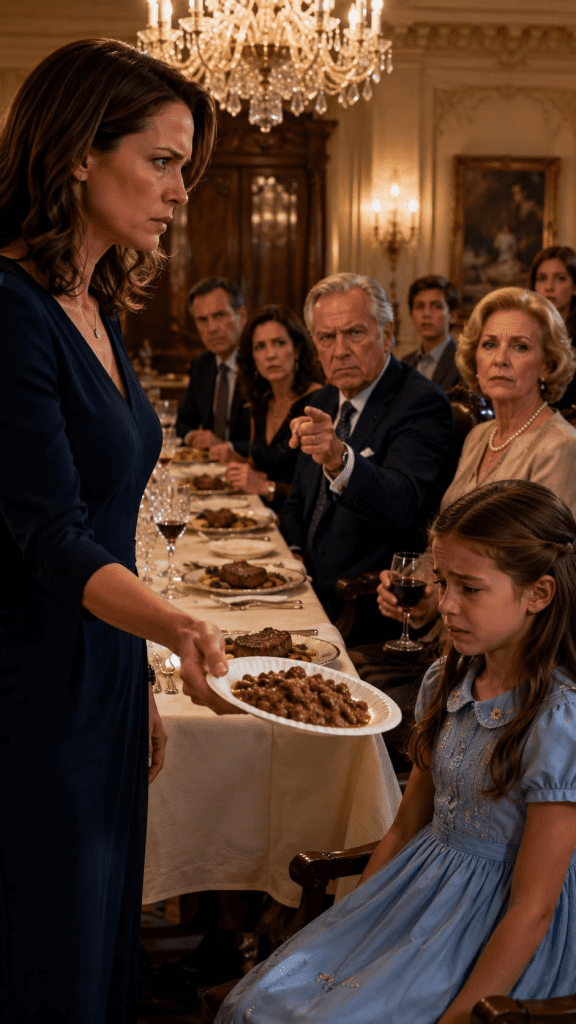
My father looked my nine-year-old daughter straight in the eyes and said, “Eat it or starve,” while pointing at a paper plate of dog food.
For a second, I honestly thought my mind had broken.
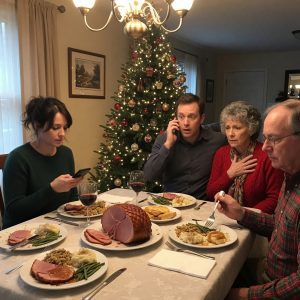
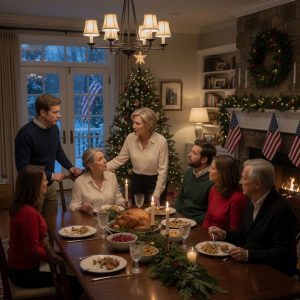
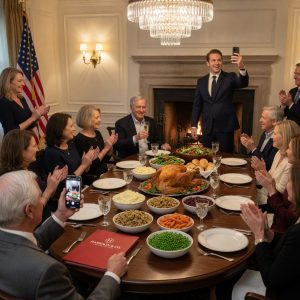
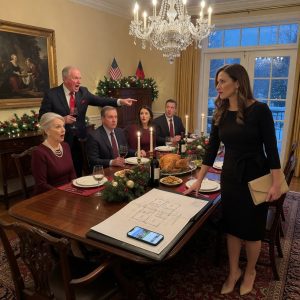
The dining room inside my parents’ mansion went so silent I could hear the ice melting in my father’s glass of scotch. Eight family members sat around the long mahogany table, dressed in silk, wool, pearls, and expensive watches, while my little girl sat in her pale blue birthday dress staring down at a pile of wet brown dog food sliding across a cheap paper plate.
Everyone else had steak.
Perfectly seared filet mignon on white china plates. Roasted asparagus. Garlic mashed potatoes. Red wine in crystal glasses. Even the other children had smaller portions of the same expensive meal.
But Mia, my Mia, my sweet nine-year-old daughter who had spent all afternoon curling her hair and practicing how to say “thank you, Grandma,” had dog food.
She looked at me with eyes so confused and humiliated that something in my chest stopped beating normally.
“Mommy,” she whispered, her voice cracking. “What did I do?”
My mother lifted her wine glass like she was watching a business presentation instead of the destruction of a child’s heart.
“This is not punishment,” Patricia Winters said calmly. “It is a lesson.”
My father leaned back in his chair, smug and cold, his silver hair glowing under the chandelier. George Winters had built a real estate empire by finding desperate people and calling it opportunity. He believed money made him wise. He believed poverty was a moral failure. And more than anything, he believed I had embarrassed him by marrying a mechanic.
“She needs to understand consequences,” he said. “If her mother insists on raising her like trash, then perhaps she should learn what trash eats.”
Mia’s small hands disappeared under the table. I knew she was twisting her fingers together the way she did when she was scared.
It was her ninth birthday.
She had wanted this dinner so badly.
For two weeks after the cream-colored invitation arrived in the mail, Mia had treated it like a royal summons. It was addressed to “Miss Mia Winters” in gold letters, and she kept it on her dresser beside a photo of her father, Paul.
Paul had been gone for three years.
A drunk driver ran a red light and took him from us on a rainy Thursday night. One moment, he was a loving husband driving home from the auto shop with grease under his fingernails and Mia’s favorite candy in his jacket pocket. The next, I was standing in a hospital hallway while a doctor with tired eyes told me he was sorry.
After Paul died, I became everything at once. Mother. Father. Provider. Protector. The woman who cried in the shower and smiled at breakfast. I worked as a manager at Target, forty-five hours a week, sometimes more when bills got tight. We lived in a small apartment with thin walls and old carpet, but Mia’s drawings covered the refrigerator, and every Friday night we made popcorn in a dented pot Paul had bought before we were married.
It wasn’t rich.
But it was home.
My parents hated that.
They hated Paul when he was alive because he fixed cars instead of owning dealerships. They hated me after he died because I refused to move back into their mansion and let them raise Mia as one of their polished little trophies. They offered money, of course. Money was the only language they trusted.
“We will pay for Mia’s education,” my father had said after Paul’s funeral, while my husband was barely in the ground. “But you will move home and follow our rules.”
I told him no.
That no had followed me for three years like a curse.
So when they invited Mia to a birthday dinner, I knew better than to trust them. But Mia didn’t. Children have a heartbreaking faith in people who have not earned it. She still made my parents cards. She still asked if Grandpa might be proud of her straight A’s. She still hoped.
Now she sat at their table with tears shining in her eyes while my father told her to eat dog food.
I looked around the room.
My brother Dennis stared down at his steak, jaw clenched. His wife Lorraine had gone pale. Great-Aunt Dorothy held a trembling hand over her mouth. My cousins sat frozen. The servers stood near the wall pretending to be invisible.
Eight people saw it.
Nobody moved.
Nobody said, “Stop.”
My father smiled slightly, waiting for me to explode. He wanted that. He wanted me screaming, sobbing, throwing things, proving to the room that I was unstable, poor, dramatic, beneath him.
But when I looked at Mia, I understood something clearly.
This moment would live in her forever.
And what she remembered next mattered.
So I stood slowly.
“Rachel,” my mother warned, “do not embarrass yourself.”
I looked at the plate.
Then I looked at my daughter.
“I’m not embarrassed,” I said quietly.
My father’s smile faded.
I picked up the paper plate of dog food, careful not to spill a single piece.
Then I took my daughter’s hand.
And I walked her out.
Part 2
The only sound behind us was the small clink of silverware against china.
No one chased us.
No one apologized.
No one stood up and said, “That little girl deserves better.”
Mia’s hand was cold inside mine as I led her through the marble hallway past framed portraits of my parents shaking hands with mayors, senators, charity directors, and men who measured morality in donations. In every picture, my mother smiled like compassion was something she owned. My father stood beside her like a king who had purchased the kingdom.
Behind us, his voice cut through the air.
“If you walk out that door, Rachel, you are finished.”
I stopped near the front entrance but did not turn around.
“We were finished the second you put that plate in front of my child.”
“You think anyone will care?” he snapped. “You are a retail worker throwing a tantrum because you cannot handle truth.”
I turned then.
Mia pressed herself against my side, her face wet with tears.
“No,” I said. “I am a mother leaving with evidence.”
My mother laughed.
“Evidence of what? A bad joke?”
I held up the plate.
“Of cruelty witnessed by eight people.”
For the first time that night, my father’s confidence cracked. It was small, just a tightening around his mouth, but I saw it.
Then I opened the front door and stepped into the cold night.
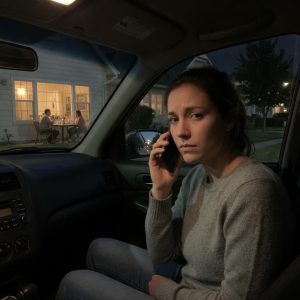
Mia didn’t break until we reached the car.
The second I closed her door and buckled her seat belt, she folded into herself and sobbed so hard she could barely breathe.
“Mommy, why do they hate me?” she cried. “I tried to be good. I said thank you. I wore the dress. I got good grades.”
I knelt beside the open car door, the paper plate balanced on the passenger floorboard like something radioactive.
“Listen to me,” I said, holding her face gently. “You did nothing wrong. Nothing. What happened in there was not because of you. It was because they are cruel people who wanted to hurt me and used you to do it.”
Her lips trembled.
“But Grandpa said I should eat it.”
“Grandpa was wrong.”
“Am I poor?”
The question hit me harder than anything my father had said.
I swallowed the anger burning in my throat.
“We are not rich like them,” I said. “But being rich does not make someone good. And not having a mansion does not make someone worthless.”
Mia looked down at her birthday dress, now wrinkled from crying.
“I don’t want to be a dog.”
I pulled her into my arms right there in the driveway of my parents’ million-dollar estate and held her while the fountain splashed behind us like nothing terrible had happened.
“You are not a dog,” I whispered. “You are a child. You are my daughter. You are loved. And nobody, not even family, gets to treat you like that again.”
We drove in silence at first.
A few blocks away, I stopped at a gas station. I bought a plastic food container, a roll of tape, and a permanent marker. Mia watched me from the back seat, exhausted and hollow-eyed.
In the harsh fluorescent light of the parking lot, I transferred the dog food from the paper plate into the container without touching it. Then I slid the plate itself into a plastic bag. I wrote the date, time, and location across the tape.
March 15. Mia’s ninth birthday dinner. Served by George and Patricia Winters.
My hands shook only after I finished.
Then I called Janine.
Janine Brooks had been my closest friend since college and an emergency room nurse for nearly fifteen years. She had been with me the night Paul died. She had taken Mia to the vending machine when I had to identify my husband’s body. She knew the sound of my voice when I was holding myself together with string.
“Rachel?” she answered. “What’s wrong?”
“I need help documenting something.”
Twenty minutes later, we were at her house.
Janine opened the door in sweatpants and a hospital hoodie. One look at Mia’s face and she pulled us inside without asking questions.
When I told her what happened, her expression changed from concern to disbelief to a kind of cold professional anger.
“They served her dog food?” she asked.
“Yes.”
“And told her to eat it or starve?”
“Yes.”
Janine looked at Mia, who sat on the couch clutching a blanket.
“This is emotional abuse,” she said softly.
“I know.”
“No, Rachel. I mean it. This needs to be reported. Documented properly.”
That night, Janine photographed everything. The plate. The container. Mia’s tear-streaked face, with my permission. She wrote down Mia’s symptoms: shaking hands, elevated pulse, nausea, panic, repeated statements that she believed she had done something wrong. She documented the time we arrived and what Mia said without prompting.
Mia eventually fell asleep on Janine’s couch.
I sat at the kitchen table staring at the sealed container.
Janine placed a cup of coffee in front of me.
“What are you going to do?”
I looked at my daughter sleeping in the next room, still wearing her blue birthday dress.
“I’m going to make sure they never get close enough to hurt her again.”
The next morning, I called three attorneys before one receptionist stopped sounding bored.
“Harold Quinton handles family abuse and emotional distress cases,” she said. “He has an opening at eleven.”
At eleven sharp, I walked into Harold Quinton’s office wearing the same clothes from the night before and carrying a sealed container of dog food in a paper grocery bag.
Harold was in his sixties, with white hair, kind eyes, and the calm presence of a man who had seen people at their worst and still believed justice mattered.
I placed the bag on his desk.
“My parents served this to my daughter at her ninth birthday dinner,” I said. “While everyone else ate steak.”
He opened the bag, looked inside, and went very still.
Then he closed it carefully.
“Mrs. Winters,” he said, “tell me everything from the beginning.”
So I did.
And when I finished, Harold leaned back in his chair, removed his glasses, and said the words that changed everything.
“They thought this was a private humiliation. We are going to make it a public record.”
Part 3
My parents responded exactly the way rich people respond when they are caught doing something ugly.
They attacked first.
By the end of the week, Harold had filed for a protective order preventing George and Patricia Winters from contacting Mia. He also filed a civil claim for intentional infliction of emotional distress. I did not understand all the legal language at first. I only understood the core of it: what they had done was not just cruel. It mattered.
My father’s lawyer sent back a letter so insulting Harold read only part of it aloud.
They called me unstable.
They called me financially desperate.
They claimed I had “misinterpreted an educational demonstration.” They said the dinner had been a “symbolic lesson” about responsibility and that I was using my daughter as a weapon to extort money.
Then they made their biggest mistake.
They filed for grandparents’ visitation rights.
Harold looked almost pleased when he told me.
“They opened the door,” he said.
“To what?”
“To discovery.”
That word sounded harmless until I learned what it meant.
Phone records. Emails. Text messages. Witness statements. Security footage. Household staff interviews. My parents had spent their entire lives believing money could hide anything. But arrogance makes people careless.
The first crack came from a server named Elena.
She had worked for my parents’ caterer for six years and remembered the dinner clearly because she had been the person ordered to bring out the paper plate. She gave Harold a written statement saying my mother had called the catering company the day before and requested a can of “cheap wet dog food” be purchased and served only to the birthday girl.
Only to the birthday girl.
When Harold read those words aloud, I had to sit down.
It had not been spontaneous.
It had not been a joke.
It had been planned.
The second crack came from Dennis.
My brother avoided my calls for ten days. Then, one rainy evening, he appeared outside my apartment building looking like he had not slept since the dinner.
I opened the door but did not invite him in.
“Rachel,” he said, voice breaking. “I’m sorry.”
I stared at him.
“You watched.”
He flinched.
“I know.”
“She looked at you, Dennis. She looked at every adult in that room, waiting for one person to say it was wrong.”
Tears filled his eyes.
“Dad threatened to cut me out of the will.”
“And that was worth more than my daughter?”
He covered his face with one hand.
“No. God, no. But in the moment, I froze. I was a coward.”
I wanted to slam the door.
But Harold had told me that truth mattered, even when it came from people who did not deserve mercy.
“Will you say that under oath?” I asked.
Dennis looked up.
Fear crossed his face first.
Then shame.
Then something else.
“Yes,” he said. “I will.”
After Dennis came Lorraine. Then Great-Aunt Dorothy. Then even Bryce, Dennis’s seventeen-year-old son, who admitted he had recorded part of the dinner on his phone because he thought his grandfather was “acting insane.”
The video was only forty-six seconds long.
It started after the plate had already been served.
Mia was crying. My father’s voice was clear.
“Eat it or starve.”
Then my voice: “She is nine years old.”
My mother: “Old enough to learn.”
The video shook because Bryce’s hands were trembling.
When Harold played it for me in his office, I had to leave the room before it ended. I stood in the hallway with one hand pressed against my mouth, trying not to make a sound.
Harold followed me.
“I’m sorry,” he said.
“I thought I remembered how bad it was,” I whispered.
“You did. But seeing it again is different.”
I nodded, wiping my face.
“Will Mia have to testify?”
His expression softened.
“I am going to fight hard to keep her off the stand. We have enough without making her relive it in front of strangers.”
That became my only condition.
I would walk through fire. I would sit across from my parents. I would listen to their lawyers call me greedy, dramatic, bitter, and unstable. But Mia would not be turned into entertainment for their defense.
Meanwhile, my daughter changed.
She stopped asking about Grandma and Grandpa.
She also stopped eating meat for almost two months.
At school, her teacher called me because Mia had cried during lunch when another child joked that the meatloaf looked like dog food. At home, she asked whether other people could tell we were poor by looking at us. One night, I found her standing in front of the bathroom mirror, whispering, “I’m not bad. I’m not bad. I’m not bad.”
That was when I started therapy.
Not just for Mia.
For both of us.
Dr. Elaine Porter had a small office with yellow lamps and a basket of stuffed animals in the corner. Mia chose a gray rabbit during her first session and held it against her chest while she answered questions in a tiny voice.
“Do you know why you’re here?” Dr. Porter asked gently.
Mia nodded.
“Because my grandparents fed me dog food.”
“And how did that make you feel?”
Mia stared at the rabbit’s ears.
“Like maybe I was secretly not a real person.”
I turned my face toward the window because I did not want her to see me cry.
Dr. Porter documented everything. Nightmares. Shame. Food anxiety. Fear of family gatherings. Emotional distress caused by deliberate humiliation.
The case grew stronger.
My parents grew nastier.
They cut Dennis out of several business arrangements. My mother called Dorothy a “senile traitor.” Their lawyers offered a private settlement with a nondisclosure agreement and a demand that I drop the protective order.
The number was large enough to pay off every bill I had.
I said no.
Harold studied me from across his desk.
“You understand they are offering this because they are scared.”
“I know.”
“And you understand a trial will be painful.”
“I know.”
He leaned forward.
“Then why refuse?”
I thought about Mia in her blue dress. Mia asking what she did wrong. Mia whispering into a mirror that she was not bad.
“Because they want silence,” I said. “And silence is how they got away with it in the first place.”
Six months after the birthday dinner, I walked into court.
My parents sat across the aisle.
My father wore a navy suit and a look of practiced contempt. My mother wore pearls, diamonds, and the same expression she used when a waiter brought the wrong wine.
They still thought they were untouchable.
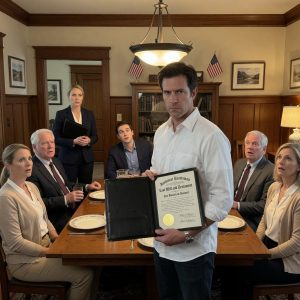
Then Harold opened his briefcase.
And placed the paper plate on the table.
Part 4
The courtroom was full by the second day.
At first, I thought it was my imagination. Then I noticed reporters in the back row. Local news had heard whispers about a millionaire couple, a granddaughter, a birthday dinner, and dog food. People are drawn to cruelty when it wears expensive clothes.
Judge Maria Martinez presided over the case with the controlled patience of a woman who had no interest in being impressed by wealth. She was in her late fifties, sharp-eyed, and unmoved by my parents’ legal team of three attorneys.
Harold stood alone on our side.
But he did not look outnumbered.
“Ladies and gentlemen,” he began, facing the jury, “this case is not about hurt feelings after an unpleasant family dinner. This case is about deliberate humiliation of a child. It is about power. It is about adults using money and fear to make a nine-year-old girl believe she deserved to be treated as less than human.”
My mother looked away.
My father did not.
He stared at Harold as if he were an employee about to be fired.
The defense claimed the dinner was a misunderstood lesson. They said my parents had been concerned about Mia’s future. They said I had exaggerated the incident because I resented my family’s success. They used words like “symbolic,” “discipline,” and “family disagreement.”
Then Harold called Elena, the server.
She walked to the stand in a simple black dress, hands folded tightly in her lap.
“Did you serve the plate to Mia Winters?” Harold asked.
“Yes.”
“Who instructed you to do so?”
“Mrs. Patricia Winters.”
My mother’s attorney stood. “Objection. Hearsay.”
Judge Martinez looked over her glasses.
“If the witness personally received the instruction, it is not hearsay. Overruled.”
Harold continued.
“What exactly were you told?”
Elena swallowed.
“That there would be one paper plate. That it was for the little girl. Mrs. Winters said not to confuse it with the dog’s actual food because this one was supposed to look disgusting.”
A murmur moved through the courtroom.
My mother’s face flushed.
Harold let the silence sit.
Then he asked, “Did Mrs. Winters say why?”
“She said the child and her mother needed to learn their place.”
I closed my eyes.
Beside me, Harold’s assistant touched my arm lightly.
Dennis testified next.
He looked smaller on the stand than I had ever seen him. My brother had always lived in my father’s shadow, but that day he looked like a man finally seeing the shape of it.
“Did your father tell Mia to eat the dog food?” Harold asked.
“Yes.”
“What words did he use?”
Dennis’s voice cracked.
“He said, ‘Eat it or starve.’”
“Did Mia cry?”
“Yes.”
“Did you intervene?”
Dennis looked toward me, his face wet.
“No.”
“Why not?”
He took a long, shaky breath.
“Because my father threatened to cut me out of the will. And because I was weak.”
The defense tried to save him.
“Mr. Winters, isn’t it true your sister has always been resentful toward your parents?”
Dennis looked at the attorney.
“My sister worked forty-five hours a week after her husband died to keep her daughter safe. My parents served that daughter dog food on her birthday. If Rachel resents them, she has reason.”
Lorraine cried through most of her testimony. Great-Aunt Dorothy spoke softly but clearly.
“I am ashamed,” Dorothy said. “Not only of George and Patricia, but of myself. I sat there. I watched a child be humiliated. I did nothing. That silence will follow me to my grave.”
Then came the video.
The courtroom lights dimmed.
Bryce’s shaky recording filled the screen.
Mia’s small voice came through the speakers.
“But it’s my birthday.”
My father’s voice answered, cold and cruel.
“Then consider this a birthday gift. Reality.”
A juror in the front row wiped her eyes.
Another stared at my father with open disgust.
My parents’ attorney stood after the video ended.
“Your Honor, we object to the emotional manipulation of the jury.”
Judge Martinez’s voice was ice.
“The court finds the video relevant. The jury is entitled to see what occurred.”
Finally, Harold presented the evidence.
The preserved paper plate.
The sealed container.
The photographs Janine had taken that night.
The medical notes.
The therapy reports.
“This,” Harold said, holding up the plate inside a protective evidence sleeve, “is what George and Patricia Winters served their granddaughter while they ate steak.”
My father shifted in his seat.
For the first time since the trial began, he looked uncomfortable.
But it was his own testimony that destroyed him.
He walked to the stand like a man entering a boardroom. Even under oath, he carried himself as if truth were negotiable.
“Mr. Winters,” Harold said, “did you instruct your granddaughter to eat dog food?”
“I instructed her to learn a lesson.”
“That was not my question.”
My father’s jaw tightened.
“Yes.”
“Was the dog food safe for human consumption?”
“I assume so.”
“You assume so?”
“It was symbolic.”
“Did you eat any?”
“No.”
“Did your wife?”
“No.”
“Did any adult at the table?”
“No.”
“But a nine-year-old child was expected to?”
My father leaned forward.
“She needed to understand what her mother’s choices would lead to.”
The room went still.
Harold stepped closer.
“What choices?”
“Marrying beneath her. Refusing help. Working a dead-end job. Living like—”
He stopped.
Harold waited.
“Living like what, Mr. Winters?”
My father glanced at the jury and realized too late that they were watching him closely.
“Living irresponsibly,” he said.
Harold nodded slowly.
“So because Rachel married a mechanic, became widowed, worked full-time, paid her bills, and raised a straight-A student, you believed her child deserved dog food?”
“No, that is not—”
“Yes or no?”
My father’s mask finally slipped.
“She embarrassed this family.”
There it was.
Not concern.
Not love.
Embarrassment.
Harold turned toward the jury.
“No further questions.”
My mother tried to do better.
She tried tears.
She said she loved Mia. She said she had only wanted to help. She said everything had been blown out of proportion.
Harold asked one question.
“Mrs. Winters, after Mia left crying that night, did you call to check on her?”
My mother hesitated.
“No.”
“Did you apologize?”
“No.”
“Did you ask whether she was emotionally harmed?”
“No.”
“What did you do?”
Her lips tightened.
“I finished dinner.”
The jury heard enough.
Part 5
The jury deliberated for two hours and seventeen minutes.
I remember every minute because I spent them in a hallway outside the courtroom with my hands clasped so tightly my fingers hurt.
Harold sat beside me, quiet and steady.
Mia was at school. I had promised her she would not have to come to court, and I kept that promise. But that morning, before I left, she hugged me longer than usual.
“Are you scared?” she asked.
“Yes,” I told her honestly.
“Me too.”
“I know.”
“What happens if they win?”
I brushed her hair behind her ear.
“Then we keep living our life without them. No verdict changes your worth.”
She nodded like she was trying to believe me.
But I knew what this meant to her. It was not about money. It was not about revenge. Somewhere inside her nine-year-old heart, she needed a room full of adults to say what no one had said that night.
This was wrong.
When the bailiff finally opened the courtroom doors and announced that the jury had reached a verdict, my legs felt hollow.
My father looked confident again.
My mother adjusted her pearls.
I stared at the jury foreman, a middle-aged man with tired eyes and a wedding ring he kept twisting.
“We find in favor of the plaintiffs,” he said.
The words reached me slowly.
Harold exhaled beside me.
The foreman continued.
“We award Rachel and Mia Winters five hundred thousand dollars in damages for intentional infliction of emotional distress.”
My mother gasped.
My father stood up so violently his chair hit the railing behind him.
“This is outrageous,” he barked. “Do you know who I am?”
Judge Martinez struck her gavel once.
“Sit down, Mr. Winters.”
“This is theft!”
“Sit down, or I will hold you in contempt.”
He sat, but his face had gone purple.
Judge Martinez looked at him for a long moment.
“In thirty years on the bench, I have seen many family disputes. I have seen greed, bitterness, betrayal, and cruelty. But rarely have I seen adults so deliberately humiliate a child and then insist the child should be grateful for the lesson.”
My mother began crying quietly.
Judge Martinez did not soften.
“The protective order remains in place. George and Patricia Winters are to have no contact with Mia Winters. Any attempt to approach her school, home, activities, or medical providers will be treated seriously by this court.”
She looked directly at my parents.
“Money does not purchase the right to harm a child.”
The story hit the local news that evening.
Millionaire Couple Served Granddaughter Dog Food at Birthday Dinner, Jury Finds.
By morning, it was everywhere.
My parents had spent decades building a reputation on polished charity galas and carefully photographed generosity. It collapsed in forty-eight hours.
My father’s business partners issued statements. One withdrew from a major development deal. Another resigned from the board of a foundation they shared. A third, a man with four grandchildren, told a reporter, “There are some things character cannot survive.”
My mother’s country club membership was suspended first, then revoked. Two charities removed her from their boards. Her friends stopped inviting her to luncheons. The salon where she had gone every Friday for twenty years suddenly had no available appointments.
That would have hurt her more than the verdict.
My father tried to appeal, but his lawyers advised him to settle the remaining matters quietly. He hated that. He hated being told no. He hated that people who used to return his calls immediately now let them go to voicemail.
But the strangest consequence was Dennis.
Three weeks after the verdict, he came to our apartment carrying a folder.
Mia was at soccer practice with Janine, and I almost didn’t let him in.
“I deserve that,” he said when I hesitated.
“Yes,” I said.
He stepped inside and looked around my living room. The couch was faded. Mia’s backpack sat by the door. Her latest drawing was taped to the wall, a picture of the two of us standing under a giant yellow sun.
Dennis stared at it for a long time.
“I set up a college trust for Mia,” he said, handing me the folder. “Full tuition anywhere she wants to go. It is irrevocable. You control it. Dad can’t touch it. I can’t take it back.”
I did not open the folder.
“Is this guilt money?”
“Yes,” he said.
The honesty surprised me.
He wiped his eyes.
“It is guilt money. Shame money. Coward money. Whatever you want to call it. But it is also Mia’s money, and I want her to have something good come from my failure.”
“You think this fixes it?”
“No.” His voice broke. “Nothing fixes it.”
I sat across from him.
“Why now?”
“Because my children won’t look at me the same,” he said. “Bryce asked me what kind of man lets a little girl cry while he eats steak. Tammy said if I stayed silent because of inheritance, then maybe I was the one who deserved dog food.”
He covered his mouth for a second.
“They were right.”
I wanted to hate him forever. A part of me still did.
But I also knew people could become better only after they stopped defending the worst thing they had done.
“You don’t get instant forgiveness,” I said.
“I know.”
“You don’t get to buy your way back.”
“I know.”
“If Mia ever wants you in her life, it will be on her terms. Not yours.”
He nodded.
“And if she gives you that chance, you stand up for her every time. No matter who is in the room. No matter what it costs.”
Dennis looked me in the eye.
“I will.”
It took months.
Mia refused to see him at first. Then she agreed to let him come to one soccer game as long as he stood far away. Then he brought orange slices for the team. Then he came to her school play and cried in the back row when she said her one line.
Slowly, carefully, he became Uncle Dennis again.
Not because blood entitled him to it.
Because he earned small pieces of trust back one honest act at a time.
A year after the dinner, a lawyer representing my parents sent a formal request for mediation. They wanted to apologize, he said. They wanted to see Mia. They wanted to heal the family.
I read the letter twice.
Then I showed it to Mia.
She was ten by then. Taller. Stronger. Still healing.
“Do you want to see them?” I asked.
She thought about it for a long time.
“Are they sorry they hurt me,” she asked, “or sorry everyone found out?”
I had no answer.
Mia handed the letter back.
“I don’t want people in my life who need a judge to tell them I’m a person.”
I threw the letter away.
And for the first time in years, I felt free.
Part 6
Mia’s tenth birthday was held in our apartment.
No mansion.
No chandelier.
No silver vases full of roses.
No place cards designed to isolate a child at the end of a table.
Just pizza boxes on the counter, balloons taped to the wall, a homemade chocolate cake, and twelve kids running through the living room with paper crowns on their heads.
Mia had chosen the decorations herself. Purple streamers. Gold stars. A banner from the dollar store that said Happy Birthday in crooked glitter letters. She helped me frost the cake, and when one side collapsed a little, she stuck extra sprinkles on it and declared it “abstract.”
Janine came early with chips and juice boxes. Dennis arrived with Lorraine, Bryce, and Tammy, all carrying gifts and wearing expressions full of nervous hope. Mia let Dennis hug her. Not a long hug, but a real one.
That was enough.
When it came time for candles, everyone crowded around the kitchen table. The cake leaned slightly to the left. The candles dripped wax onto the frosting. Someone started singing too early, and half the room joined in late.
It was messy.
It was loud.
It was perfect.
Mia closed her eyes before blowing out the candles. Her face looked peaceful in the soft yellow light, and for one sharp second, I saw Paul in her smile. Not the grief of losing him. The gift of having loved him.
She blew out all ten candles.
Everyone cheered.
Then Mia opened her eyes and looked at me.
“Mom,” she said, “can I say something?”
The room quieted.
“Of course.”
She stood on a chair, still holding the plastic cake knife like a microphone. A few of her friends giggled, but she did not laugh. She looked serious, older than ten in a way I wished she never had to be.
“Last year,” she said, “something really bad happened on my birthday.”
Dennis lowered his head.
Lorraine reached for his hand.
Mia continued.
“Some people who were supposed to love me tried to make me feel like I was nothing. For a while, I believed them a little. I thought maybe if adults said something about you, it was true.”
My throat tightened.
“But my mom told me the truth. She told me that cruel people don’t get to decide who I am. Dr. Porter helped me understand that, too. And everyone here helped because you came back. You showed up. You ate pizza with me. You cheered at my soccer games. You remembered my birthday without making it hurt.”
Her eyes found Dennis.
“Uncle Dennis made a bad choice last year. A really bad one.”
Dennis nodded, crying openly.
“But he also said sorry and kept showing up. I think that matters.”
Then she looked around the room, at the children, at Janine, at me.
“So my birthday wish already came true. I wanted a real family. And I have one.”
No one spoke for a second.
Then Janine started clapping.
Soon everyone joined.
Mia jumped down from the chair, embarrassed by the attention, and I pulled her into my arms.
“I’m proud of you,” I whispered.
She hugged me hard.
“I’m proud of us.”
Later that night, after the guests left and the apartment was quiet, Mia and I sat on the couch surrounded by wrapping paper. She had received books, art supplies, soccer socks, a purple hoodie, and a bracelet from Dennis that had her name engraved on the inside.
She leaned against me, sleepy and content.
“Do you think Grandma and Grandpa are lonely?” she asked.
I was careful with my answer.
“I think people who hurt others often end up alone if they refuse to change.”
She nodded.
“I don’t hate them anymore.”
That surprised me.
“You don’t?”
“No.” She looked at the crooked birthday banner still hanging above the kitchen doorway. “Hating them feels like carrying their plate around forever. I don’t want to carry it.”
Tears filled my eyes.
“What do you want to do instead?”
“Leave it where it belongs.”
“And where is that?”
“In the past.”
I kissed the top of her head.
“That sounds healthy.”
She smiled a little.
“But I still don’t want to see them.”
“You don’t have to.”
“Ever?”
“Ever, if that is what you choose.”
She relaxed against me.
“Good.”
After she went to bed, I stood in the kitchen and looked around our small apartment. The sink was full of dishes. Frosting was smeared on the counter. Balloons sagged near the window. The carpet had a new soda stain.
My parents would have called it cheap.
I called it evidence of joy.
The money from the verdict went into a trust for Mia’s future. The college fund from Dennis sat beside it. I stayed at Target for another year, then used part of my share to take business classes at night. Two years later, I opened a small home organization company with Janine as my first investor and loudest supporter.
We called it Second Key.
Because sometimes life locks you out of the family you thought you had, and you have to build a new door.
Mia grew.
She became the kind of girl who noticed lonely kids at lunch and invited them over. She played soccer with fierce determination. She gave speeches in school about kindness, not the soft kind people pretend to value, but the brave kind that stands up when someone is being hurt.
At thirteen, she wrote an essay called “The Plate I Did Not Eat.”
It won a statewide student writing contest.
In it, she wrote: “The worst thing someone tried to give me became the thing my mother used to protect me. I learned that dignity is not served to you. Sometimes you have to pick it up with shaking hands and carry it out of the room.”
I kept a copy framed in my bedroom.
My parents never changed.
At least, not in any way that reached us.
Their mansion remained. Their money remained. But the invitations stopped. The photos disappeared from society pages. My father’s name became less powerful. My mother’s charity smile became something people whispered about behind napkins at luncheons she no longer attended.
Years later, I heard through Dorothy that they had moved to Florida.
Mia only shrugged when I told her.
“I hope they learn to be better people,” she said. “But they don’t get to practice on me.”
That was my daughter.
The little girl they tried to break.
The child they thought could be taught her worth through humiliation.
They were wrong.
My parents thought power meant controlling who sat at the table and what they were served. They thought money meant they could turn cruelty into a lesson and silence into agreement. They thought if eight people watched and nobody objected, then the truth would stay buried beneath crystal glasses and expensive steak.
But they forgot about mothers.
They forgot that a mother can be quiet and still be dangerous.
They forgot that walking away is not surrender when you carry the evidence with you.
And they forgot that a child’s tears may dry, but justice has a long memory.
I have replayed that night many times. Not because I enjoy the pain, but because I want to remember the exact moment I stopped begging my parents to love us properly.
It was not when my father insulted my job.
It was not when my mother called my life simple.
It was not when the others stayed silent.
It was when Mia looked at me and asked, “What did I do?”
The answer was nothing.
She had done nothing.
And from that moment on, I made sure she never had to ask again.
Some families are inherited.
Some families are chosen.
And some families are proven in the moment when a child is crying at a table and the whole room waits to see who will stand.
That night, eight people saw what happened.
Only one person moved.
I picked up the plate.
I took my daughter’s hand.
And together, we walked out of that mansion into the cold night with nothing but each other, the truth, and a paper plate that would one day make a jury understand what my parents never could.
A child’s dignity is not for sale.
A mother’s love is not weak.
And money can buy steak, mansions, pearls, and silence for a while.
But it cannot buy the right to destroy a little girl.
Not anymore.
THE END