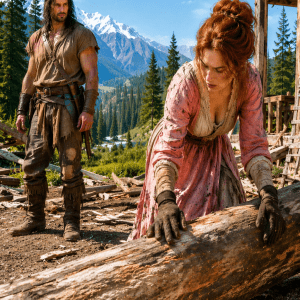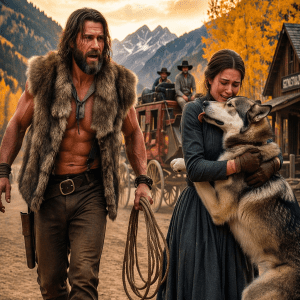
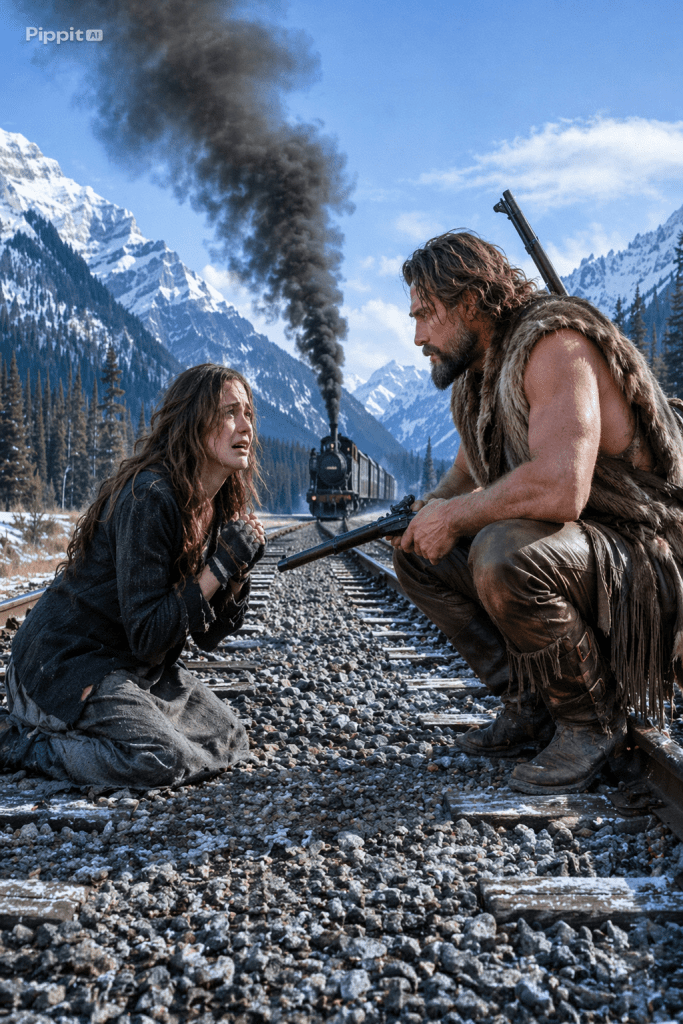
She wasn’t just stranded. She was erased. In a matter of seconds, the city girl became prey.
She hit the dirt hard. The breath left Abigail’s lungs in a pathetic wet weeze. For a long minute, she couldn’t move.
She just lay there, her cheek pressed against the freezing sharp gravel of the railway embankment, listening to the rhythmic chug of the Union Pacific fading into the vastness of the valley. The vibration in the earth died away. Then the silence rushed in.
It wasn’t a peaceful silence. It was heavy, oppressive, and utterly indifferent to the fact that she was currently bleeding into the frost hardened earth. Slowly, Abigail pushed herself up on her hands.
Her leather gloves, bought in a boutique on Tremont Street just 3 weeks ago, were shredded at the palms. Blood welled up, bright and warm against the biting chill of the late autumn air. She sat back on her heels, her heavy wool skirt soaked through with icy mud and spat a glob of saliva and grit onto the tracks.
She took stock. Her left knee throbbed with a dull, sickening heat. Her corset, laced tight for a society she was no longer a part of, dug into her ribs like a cage, restricting the oxygen she desperately needed.
She reached around to her lower back, wincing as her fingers brushed the bruise already blooming where Mr. Carmichael, the conductor, had planted his boot. No ticket, no ride, Missy.
Don’t care if you was the queen of England. Those had been his last words before he shoved her out the side door of the baggage car. She hadn’t screamed.
She hadn’t begged. She had just looked at his rotting teeth and accepted the violence because frankly it was less painful than the reality of the debts waiting for her back in Boston. Abigail forced herself to stand.
The wind hit her instantly. It smelled of crushed pine needles, damp earth, and impending snow. It sliced through her woolen coat as if it were made of cheap muslin.
She wrapped her arms around herself, shivering violently, and looked around. To her left, the iron tracks stretched out, disappearing around a jagged bend of gray granite. To her right, a sheer drop down to a roaring black river.
Ahead and behind lay nothing but towering claustrophobic walls of pine and spruce rising up to meet snowcapped peaks that looked like jagged teeth against the fading gray sky. The sun was dipping below the treeine. The shadows were lengthening, stretching across the tracks like skeletal fingers.
She had no luggage. She had no money. She had exactly one hair pin left, holding up her disheveled brown hair, and half a roll of peppermint drops in her coat pocket.
Panic, cold and sharp, finally began to claw at her throat. It wasn’t the dramatic, swooning panic of the dime novel she used to read. It was a purely biological terror.
The temperature was dropping fast. The sweat on her neck was turning icy. She started walking.
She didn’t know which way the nearest town was. Denver was days behind her. The next outpost could be 50 mi ahead.
But standing still meant freezing to death. And Abigail, despite the cynical apathy that had driven her to hop a freight train in the first place, found that she violently objected to dying in the mud. Her expensive narrow heeled boots crunched agonizingly on the railway ballast.
Every step sent a jolt of pain up her bruised spine. A mile passed. Then two.
The sky turned the color of a bruised plum. Then a deep bruised indigo. The noises started.
Then in the city night brought the clatter of carriages, the shout of drunks, the comforting hum of humanity. Here the night brought the snap of twigs under unseen heavy paws. It brought the haunting hollow hoot of an owl that sounded less like a bird and more like a warning.
Once a low, guttural cough echoed from the dense brush to her right, making her freeze, her heart hammering against her ribs in a frantic, irregular rhythm. She gripped the cold iron of the rail beside her, her knuckles white, holding her breath until her lungs burned. The rustling receded.
By the time the moon crested the mountains, casting a pale skeletal light over the tracks, Abigail couldn’t feel her toes. Her teeth chattered so violently her jaw achd. She stumbled, her heel catching on a railroad tie, and went down hard, scraping her chin on the rusty iron.
She didn’t get up immediately this time. The cold was seeping into her bones, numbing the pain, replacing it with a seductive, heavy lethargy. The ground wasn’t so uncomfortable anymore.
If she just closed her eyes for a minute, a twig snapped, loud, close. Abigail’s eyes snapped open. The lethargy vanished, replaced by a surge of pure adrenaline.
She rolled onto her back, scrambling backward like a crab, grabbing a fistful of sharp gravel. A shadow separated itself from the treeine. It was massive, too tall for a bear, too wide for a wolf.
It moved with a slow, deliberate, heavy-footed grace. As it stepped into the moonlight, Abigail saw the glint of blueed steel. “A rifle barrel.
You’re making a hell of a racket,” a voice grated out. It was a low, rough sound, like two stones grinding together. Abigail froze, her hand still clutching the gravel, her breath pluming in the freezing air.
He didn’t step forward to offer a hand. He just stood there at the edge of the embankment, a towering silhouette against the pines. Abigail squinted through the gloom.
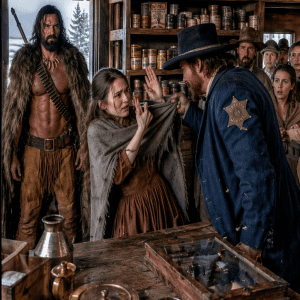
The man was wrapped in a heavy coat made of patched, mismatched animal hides. A thick, unruly beard obscured the lower half of his face, blending into dark, greasy hair that fell past his ears. He smelled strongly of wood smoke, old sweat, and the sharp coppery tang of raw meat.
He didn’t lower the rifle, its muzzle pointed vaguely in her direction, relaxed, but ready. “Who are you?” Abigail demanded, her voice cracking. She hated how small it sounded.
She tried to project the authority of a woman who commanded parlor’s back east, but it came out as a pathetic squeak of a cornered animal. The man let out a short, breathy exhale that might have been a laugh. He finally lowered the rifle, resting the butt against his thigh.
Name’s Jedadiah. Jed. And you’re trespassing on my hunting grounds, scaring off a perfectly good buck I’ve been tracking for 3 miles.
I apologize for inconveniencing your dinner. Abigail snapped, the sheer absurdity of the situation, igniting a spark of her usual temper. She pushed herself up to a sitting position, wrapping her arms tightly around her waist.
I was a bit preoccupied being thrown off a moving train. Jediah didn’t react to her sarcasm. He tilted his head, stepping closer.
The moonlight caught his eyes. They were the color of old flint, hard and unreadable. He looked her up and down, taking in the ruined silk of her skirt, the shredded gloves, the dirt smeared across her pale face.
Train dropped you, huh? It wasn’t a question. It was a flat statement of fact.
“You ain’t dressed for the mountains. You’re going to be dead by morning.” “Thank you for the optimistic prognosis,” Abigail muttered through chattering teeth. She tried to stand, but her left knee buckled.
She gasped, falling back onto the tracks. Jedodiah watched her struggle without moving a muscle to help. There was no pity in his face, only a grim calculation.
He reached into his coat and pulled out a small, dark object. He tossed it at her. It hit her in the chest and dropped into her lap.
It was a piece of dried meat, hard as a shingle and smelling strongly of salt and fat. Chew it, he ordered. Get some fat in your blood.
Helps with the cold. Abigail stared at the jerky. It looked like a piece of shoe leather.
Her stomach rolled, but she picked it up and bit into it. It tasted like ash and old blood. But the moment the salt hit her tongue, her mouth watered violently.
She chewed, her jaw aching against the toughness, forcing it down. Jedadiah watched her eat. “You got folks waiting for you somewhere?” “No,” Abigail said, chewing relentlessly.
“No folks, no money, nothing,” he grunted. He looked back toward the treeine, then down the tracks. “Narest town is Black Creek.
===== PART 2 =====
2 days walk that way.” He pointed down the tracks. You won’t make it 2 hours in those shoes before the frostbite takes your toes, assuming the cougars don’t find you first. I am aware of my precarious situation, Abigail said, her pride waring with her terror.
If you aren’t going to help me, then leave me be so I can freeze in peace. Jedodiah shifted his weight, the leather of his boots creaked. He rubbed a hand over his bearded jaw, a raspy sound in the quiet night.
He was looking at her not as a woman in distress, but as a problem. Or perhaps as a piece of raw material. Winter’s setting in, he said slowly, his voice losing some of its edge, replaced by a cold, pragmatic tone.
First heavy snow is due in a week, maybe two. I got a cabin up the ridge. It ain’t pretty, but it’s got a stove and a tight roof.
Abigail stopped chewing. She looked up at him, her eyes narrowing. She had lived in a city long enough to know that men didn’t offer things for free.
And what is the cost of this hospitality labor? Jediah said bluntly. I spent the last two weeks hauling traps and cutting wood.
I got two elk hanging in the shed that need butchering, smoking, and salting before they rot. I need my traps checked at. I need the fire kept burning while I’m out hunting.
Doing it all myself means I don’t sleep. And when I don’t sleep, I make mistakes. Mistakes out here mean you die.
He took a step closer. The smell of him was overwhelming. Earthy, raw, unwashed.
I don’t need a guest, he said, his flinty eyes locking onto hers. I need a wife. Not a pretty one.
Not a sweet one. A working one. Someone to tend the hearth so I don’t freeze when I come back empty-handed.
Someone to salt the meat. Abigail stared at him. The proposition hung in the freezing air.
Absurd and terrifying. A wife. He didn’t mean romance.
He meant an indentured servant with a ring on her finger for the sake of frontier propriety. Or perhaps just to ensure she couldn’t legally run off with his supplies. I don’t know how to butcher an elk, she whispered, her voice trembling.
From the cold or the shock she couldn’t tell. I’ll teach you, Jedodiah said. You got two choices, city girl.
You sit here and freeze, or you walk up that mountain with me. You learn to bleed an animal and you live to see the spring. Decide.
He turned his back on her, staring into the dark woods, giving her no space for negotiation, no room for tears. Abigail looked down at the dark, frozen tracks. She thought of the creditors in Boston.
She thought of Mr. Carmichael’s boot. She thought of the cold, heavy earth waiting to swallow her.
===== PART 3 =====
She placed her hands on her bruised knees and pushed herself up. Her joints screamed. She swayed, dizzy and nauseous, but she stayed upright.
“I require a heavy coat,” she said, her voice rasping. Jedadiah didn’t turn around. He just reached into his pack, pulled out a foul smelling, heavy woolen blanket, and tossed it over his shoulder without looking.
Abigail caught it. It was greasy and smelled like wet dog, but she wrapped it around her shivering shoulders like a royal cloak. “Lead the way,” she said.
The climb was a brutal physical torment that stripped away whatever remaining dignity Abigail possessed. Jedodiah didn’t walk. He stalked upward through the dense timber, pushing through scrub oak and thorny blackberry bushes with the ease of a man who belonged to the woods.
Abigail, wrapped in the suffocating heavy blanket, stumbled blindly behind him. Her thin leather boots were utterly destroyed within the first hour. The soles flapped loose, allowing the freezing mud and sharp pine needles to cut directly into her stockings.
Every step was a fresh agony, a sharp jolt that traveled up her shin to her already throbbing knee. She slipped constantly on the slick frostcovered rocks, catching herself on rough bark that scraped the skin from her palms. Jedodiah never offered a hand.
He never slowed down. He only stopped when he couldn’t hear her gasping breaths directly behind him. When she fell hard onto her stomach, the wind knocked out of her.
He simply stood 10 paces ahead, turning his head slightly, a dark shadow waiting for her to get back up. He didn’t offer encouragement. He didn’t offer pity.
“Keep moving,” was all he said, his voice cutting through the wind. “Sweat freezes if you stop.” Abigail hated him. With every agonizing step, she built a fortress of resentment against the broad, peltcovered back ahead of her.
She used the hatred as fuel, focusing her burning anger on his silence, on his crude smell, on the absurd transactional nature of her survival. I am Abigail Prescott, she chanted in her mind, a frantic mantra against the pain. I speak French.
I play the piano. I do not die in the mud behind a man who smells like rancid fat. Hours bled into a blur of black trees and silver moonlight.
Her legs felt like lead weights. The cold had moved past pain into a deep, terrifying numbness. She couldn’t feel her feet hitting the ground anymore.
She was moving purely on muscle memory and spite. Finally, the trees began to thin. The biting wind hit them with renewed force, carrying the sharp sting of ice crystals.
“We’re here,” Jedadiah grunted. Abigail forced her head up, blinking through eyelashes heavy with frost. “It wasn’t a cabin.
Not by the standards of anything she had ever seen. It was a shack, a squat, ugly structure built of rough hune, unpeeled logs, chinkedked with mud and dried moss. The roof was a low slope of sod and timber, heavy with a fresh dusting of snow.
There was no welcoming porch, no glass in the single small window, just a heavy wooden shutter barred from the inside. It looked less like a home and more like a bunker meant to withstand a siege. Jedodiah strode forward, pulling a heavy iron key from his pocket.
He unlocked the thick oak door and shoved it open. It creaked violently on leather hinges. He stepped inside, striking a match against the door frame.
The sudden flare of sulfur made Abigail flinch. He touched the flame to a kerosene lantern hanging from a low beam. Dull yellow light spilled out, revealing the interior.
Abigail stepped over the threshold, her legs trembling so violently she nearly collapsed. The cabin was a single claustrophobic room. The floor was packed dirt, swept clean but hard as cement.
A massive cast iron stove dominated the center of the space, its black surface dull and cold. To the left, a crude wooden table and two mismatched chairs. To the right, a low bed frame built directly into the wall, covered in a chaotic pile of heavy furs and gray wool blankets.
The smell was intense. The sharp tang of wood ash, the heavy musk of animal pelts, dried sage, and the metallic odor of blood from a pile of traps stacked in the corner. It was deeply, undeniably masculine.
It was an intrusion on her senses, claustrophobic and wild. Jedodiah didn’t look at her. He immediately went to the stove, kneeling before it, he moved with practiced efficiency, tossing in dry kindling and a handful of wood shavings.
Within seconds, a small, tentative fire crackled to life. “Shut the door,” he ordered, not looking back. “You’re letting the wind in,” Abigail turned heavily and pushed the heavy door closed, dropping the wooden latch into place.
The sound of the wind was instantly muffled, transformed from a roar to a low, angry whistle against the logs. She stood frozen by the door, the greasy blanket still clutched tightly around her. She felt entirely displaced.
An alien creature dropped onto a hostile planet. The warmth from the stove began to radiate into the small room. And as the air heated, the numbness in her hands and feet began to thaw, replaced by a vicious, stinging pain of blood rushing back into frozen capillaries.
She hissed, dropping the blanket and gripping her hands together, pressing them against her stomach. Jedodiah stood up, dusting his hands on his canvas trousers. He turned and looked at her.
In the lantern light, he looked even rougher than he had in the moonlight. Deep lines bracketed his mouth and eyes. His beard was wild, speckled with gray.
He looked exhausted, carrying a weariness that went deeper than just a day’s hunt. He walked over to a wooden bucket in the corner, broke a thin layer of ice on the top with his knuckles, and dipped a tin cup into it. He walked back and shoved the cup toward her.
Drink. It’s just water. Abigail took it with trembling hands, her fingers brushed against his for a fraction of a second.
His skin was rough as sandpaper, calloused and hot. She flinched away, bringing the cup to her lips. The water was agonizingly cold against her cracked lips, but she drank it greedily.
Jedodiah turned away, unbuttoning his heavy pelt coat and hanging it on a wooden peg by the door. Underneath he wore a faded flannel shirt, sweat stained at the collar. He walked over to a rough hune cupboard, pulled out a small metal tin, and set it on the table.
“Take your boots off,” he said, his back to her as he rummaged in a drawer for a knife. Abigail froze. Her heart gave a sudden panicked lurch.
I beg your pardon. Jedodiah turned, a long hunting knife in his hand. He saw her expression, the way she shrank back against the door and let out a heavy, irritated sigh.
He tossed the knife onto the table. It landed with a loud thack. Don’t flatter yourself.
City girl, he said, his voice laced with heavy disdain. I ain’t looking to bed a woman who looks like she just dragged herself out of a shallow grave. Your feet are frostnipped.
That tin is bare grease and willow bark. You rub it on your toes before the skin splits and turns black. Because if your feet rot off, you can’t stand at the salting table.
And if you can’t work, you’re useless to me. He walked over to the bed, grabbed a thick gray blanket, and threw it at her. You sleep by the stove tonight.
Tomorrow the work starts. Abigail caught the blanket. She stared at the man.
There was no gentleness in him. No chivalry, just raw, unvarnished survival. She looked at the tin of grease on the table, then down at her ruined, bleeding boots.
She swallowed hard, the dry click audible in the quiet cabin. She walked stiffly to the chair, sat down, and began to unlace her boots. The leather was stuck to her skin with dried blood.
She winced, tears finally pricking the corners of her eyes, not from sorrow, but from profound, exhausted humiliation. Jedodiah didn’t watch her. He had already moved to the corner, beginning to untangle a mess of steel traps.
His back turned to his new wife, leaving her alone in the dim light to tend to her own wounds. Morning did not arrive with a gentle sunrise. It came as a brutal gray sliver of light stabbing through the cracks in the wooden window shutter, accompanied by the metallic clang of a heavy cast iron pan hitting the stove.
Abigail bolted upright. The movement was a mistake. Her muscles, locked tight from sleeping on the packed dirt floor, with only a thin layer of furs between her and the frost, screamed in a chorus of sharp, tearing agonies.
Her left knee felt like it had been filled with ground glass. Her breath hitched, catching in her throat as she collapsed back onto the rough wool blanket. Jedodiah was already dressed, his back to her.
He was throwing chunks of dried fat into the hot pan. It popped and spat, filling the small cabin with a heavy, greasy smoke that made Abigail’s empty stomach clench violently. “Sons up,” he said.
The gravel in his voice hadn’t smoothed out overnight. “Eat.” Then we bleed the elk. He didn’t look at her.
He just shoved a tin plate onto the edge of the table. On it sat a charred lump of what looked like fried cornmeal and a sliver of the same salty, jaw-breaking jerky from the night before. Abigail stared at the ceiling.
The rough logs were black with years of soot. I could just lie here, she thought. I could close my eyes and let my heart stop.
It was a seductive, easy thought. The Boston aristocrat in her, the woman who had cried when a dress maker hemmed a silk gown an inch too high, wanted to surrender to the dirt, but her stomach let out a loud, hollow growl. Pride was a luxury for the warm.
Spite, however, burned entirely on its own. She forced herself up. She didn’t bother attempting to fix her hair, which hung in mattered, greasy tangles around her pale face.
Her silk skirt was ruined, stiff with dried mud and torn at the hem. She limped to the table, ignoring the tin of bear grease still sitting there, and forced the burnt cornmeal down her dry throat. It tasted like ash, but it was fuel outside, Jedodiah ordered, tossing her a pair of stiff canvas work gloves that were three sizes too big.
Put those on. The salt will eat the cuts on your hands right to the bone. The cold hit her the moment she stepped through the door, stealing the breath from her lungs.
The air was razor sharp, smelling of pine and ozone. Behind the cabin stood a crude leanto structure made of lashed poles. Hanging by its hind legs from the thickest crossbeam was a massive bull elk.
Its throat already cut, the blood frozen into dark icicles on the snowy ground beneath it. The copper smell was suffocating. Abigail gagged, slapping a gloved hand over her mouth.
She turned away, her shoulders heaving as she dry heaved into the snow. Nothing came up. Jedodiah walked past her unbothered.
He carried a heavy wooden bucket filled with coarse gray rock salt and a long, wickedl looking skinning knife. Spitting up won’t get the meat preserved, he said, setting the bucket down. He grabbed the elk’s hide near a massive incision on its belly.
With a sickening wet, tearing sound, he pulled. The muscle beneath was a vibrant, shocking red in the dull gray light. “Watch,” he instructed.
He didn’t explain the anatomy. He didn’t offer a gentle introduction to butchery. He simply showed her how to slice the heavy slabs of muscle away from the bone without piercing the stomach cavity, how to lay the meat on a flat, bloodstained wooden table, and how to pack the salt into every fiber of the flesh.
You rub it in hard, he said, pressing his calloused hands into the red meat, forcing the salt crystals deep. If you miss a spot, the rot starts there. The rot spreads.
The meat spoils. We starve in February. Understand?
He stepped back and held out the knife. Its bone handle was slick with grease. Abigail stared at the weapon.
Then she looked at the mountain man. His flinty eyes were fixed on her, waiting for the inevitable hysterical breakdown of a city woman. He expected her to weep.
He expected her to refuse. She snatched the knife from his hand. The blade was heavy.
She stepped up to the carcass, the smell of raw flesh and open boughels making her eyes water. She gripped the canvas gloves tight, aimed for the seam of muscle Jedodiah had pointed out, and pushed the blade in. It was harder than cutting roast beef.
The muscle fought back, tough and elastic. She soared clumsily, her bruised shoulders screaming with the effort. Blood smeared across her torn silk sleeves.
When a heavy slab finally gave way and slapped on to the salting table. She was panting, her breath pluming in the freezing air, she plunged her gloved hands into the salt bucket. She grabbed a fistful and slammed it onto the meat.
She rubbed, leaning her entire body weight into it. The coarse salt ground against the canvas, the friction transferring to the raw blisters on her palms beneath. It stung like fire.
She bit her lip until she tasted her own blood, focusing the pain entirely into her hands. I will not die here. She scrubbed the salt into the elk, her movements jerky and vicious.
I will not give you the satisfaction of watching me break. Jedodiah watched her for a long, silent minute. He didn’t offer praise.
He just nodded once, picked up a heavy cleaver, and went to work on the ribs. They worked for hours in silence. The only sounds, the wet tearing of flesh, the heavy thud of the cleaver, and the scrape of rock salt.
14 days. Abigail marked them not by a calendar, but by the slowly shrinking pile of firewood outside the door and the deepening ache in her lower back. The cabin was 12 ft x 16.
It was a prison of rough wood and trapped odor. The initial shock of survival had worn off, replaced by a grinding, monotonous routine that left no room for thought. Wake in the freezing dark.
Break the ice in the water bucket. Stoke the fire. Boil the oats.
Scrape the pelts. Mend the traps and the silence. In Boston, silence meant a pause in conversation.
Here, the silence had a physical weight. It pressed against the eardrums. Jedodiah was a man who only used words as tools.
If a thought did not directly pertain to survival, weather, or work, it remained unspoken. They moved around each other in the cramped space like two feral cats trapped in a box. There was no romance.
There was barely any humanity. They were gears in a machine designed to survive the encroaching winter. Yet, the proximity forced an uncomfortable awareness.
Abigail learned the exact sound his boots made on the dirt floor. A heavy dragging scuff that meant he was exhausted versus a sharp rhythmic thud that meant he had spotted tracks. She learned the smell of him.
No longer just raw meat and sweat, but the faint sharp scent of pine sap on his collar and the metallic tang of gun oil on his hands. One evening, the wind outside was howling a low, mournful note through the chinking in the logs. Abigail was at the table, a dull needle in her raw, split fingers, trying to stitch a tear in one of Jedodire’s heavy wool shirts.
Her own clothes were entirely unwarable. She was currently drowning in a spare pair of his canvas trousers belted tight with a length of rope and a heavy flannel shirt that smelled perpetually of wood smoke. Her fingers were stiff with cold.
She pushed the needle hard against the thick wool. The eye of this needle slipped and the sharp point drove directly under her thumbnail. “Damn it,” she hissed, the curse slipping out before she could stop it.
She dropped the shirt, instinctively shoving her bleeding thumb into her mouth, her eyes watering from the sudden sharp spike of pain from across the room where he was oiling a trap mechanism by the stove. Jedadiah stopped. Abigail froze, her thumb still in her mouth.
In her previous life, an outburst like that would earn a sharp reprimand from a governness or a cold, dismissive stare from her late father. She waited for Jedodiah to tell her to stop making noise, to stop bleeding on his shirt. He didn’t speak.
He set the trap down. He walked to the small wooden cupboard, his heavy boots silent for once. He pulled out a small cked glass vial containing a brown sludgy liquid.
He walked over to the table and set it down in front of her. Pine pitch and yarrow, he said, his voice low. Put it on the puncture.
It burns like hell, but it stops infection. You lose a thumb, you can’t grip a skinning knife. He turned and went back to his traps before she could say a word.
Abigail stared at the vial. She slowly took her thumb out of her mouth. The blood was welling up, dark and thick.
She unccorked the vial. The smell was sharp, medicinal, and aringent. She dabbed a drop onto the wound.
He hadn’t lied. It burned with a searing white hot intensity that made her gasp and squeeze her eyes shut. But as the pain subsided, a strange dull numbness took its place.
She looked across the room. Jedodiah’s broad back was to her. He was hunched over the steel jaws of the trap, his large hands working the mechanism with surprising delicate precision.
He hadn’t scolded her. He hadn’t patronized her. He had recognized an injury, provided a solution, and attached it to a practical necessity so she wouldn’t have to feel grateful.
“Thank you,” she said. The words felt strange in her mouth, stiff and unused. “Jediah didn’t turn around.
He just gave a short, dismissive grunt, pulling a rag through the trap’s spring. Don’t bleed on the wool. Took me a week to weave that shirt.” Abigail picked up the needle again.
The anger that usually fueled her felt suddenly thin, replaced by a confusing, reluctant respect. He was a brute, a scavenger, a man entirely devoid of grace. But he paid attention.
The sky did not turn gray. It turned the color of an old bruise, heavy and swollen. The atmospheric pressure plummeted, making Abigail’s ears pop as she hauled the morning’s firewood from the shed to the cabin door.
“Leave the rest,” Jedadiah barked from the doorway, his eyes fixed on the treeine. The usual flinty calmness in his gaze was gone, replaced by a sharp, urgent tension. “Get inside now.” There’s still half a cord.
I said, “Get inside.” His voice cracked like a whip. Abigail didn’t argue. The sheer volume of it shocked her into obedience.
She dropped the logs onto the dirt floor just as the first gust of wind hit the cabin. It wasn’t a breeze. It was a physical blow.
The heavy oak door was ripped from Jedodiah’s grasp, slamming back against the exterior logs with a sound like a cannon shot. The snow didn’t fall. It flew sideways.
a blinding wall of white grit that instantly coated everything in the room. Jedadiah cursed violently, lunging for the door. He grabbed the iron handle, his boots sliding on the snowslaked floorboards.
The wind screamed, fighting him, trying to tear the door off its leather hinges. He was strong, but the mountain was stronger. The door remained wedged open, the freezing air plunging the cabin’s temperature below freezing in seconds.
The lantern on the table blew out, plunging them into a chaotic, shrieking gloom, illuminated only by the frantic orange glow of the stove. “Help me!” he roared over the deafening howl. Abigail didn’t think.
The paralyzing terror she had felt on the train tracks was gone, burned away by two weeks of blood and salt. She threw her weight against the heavy oak wood, planting her boots onto the dirt floor for leverage. The wood was freezing, covered in a fast forming layer of ice.
She pressed her shoulder against the rough planks right next to Jedodia’s heavy arm. On three,” he yelled, his face inches from hers, his breath hot against her frozen cheek. “One, two, three,” they shoved.
Abigail pushed until she felt a muscle in her shoulder tear, a sharp popping sensation that made her cry out. But the door moved, inch by agonizing inch, fighting the gale, it swung inward. Jedodiah slammed his shoulder against it, throwing his entire body weight forward.
The door hit the frame with a solid thack. “The bar,” he gasped, holding the door with his back, his boots slipping. Abigail scrambled, grabbing the heavy iron bar from the floor.
Her hands were shaking uncontrollably, her fingers numb. She fumbled, dropping it once. “Hurry,” Jedodiah snarled, his face contorted in strain as the wind battered the wood behind him.
She grabbed it again, lifting it with a desperate groan, and slammed it down into the heavy iron brackets on either side of the frame. The wind instantly became a muffled, furious roar against the exterior walls. The silence inside the cabin was sudden and ringing.
Jediah collapsed against the door, sliding down the wood until he hit the dirt floor. He sat there, his knees pulled up, his chest heaving as he dragged air into his lungs. Snow was crusted in his dark beard, melting slowly into freezing water that dripped onto his chest.
Abigail slumped against the wall opposite him. Her shoulder throbbed with a sickening, heavy pulse. She was shivering violently.
The sudden adrenaline crash, leaving her weak and nauseous. In the dim light of the stove, they looked at each other across the small span of dirt floor. There was no superiority in Jedodiah’s eyes.
Now the mountain had just reminded him how small he was, and he knew it. He looked exhausted. He looked human.
He reached up, dragging a heavy, shaking hand down his wet face. He looked at Abigail at the way she was clutching her shoulder, her face pale in the gloom. You didn’t freeze,” he said quietly, his voice barely carrying over the muffled roar of the storm outside.
“It wasn’t a compliment. It was an observation, but coming from him, it felt massive.” “No,” Abigail rasped, pulling the collar of her oversized flannel shirt tighter around her neck. She met his flinty gaze, refusing to look away.
“I didn’t.” Jedodiah stared at her for a long moment. the lines around his eyes tightening. The dynamic in the room had shifted, subtle as a hairline fracture in solid ice.
She wasn’t just a scavenger’s prize anymore. She was the reason the snow wasn’t currently burying them both in their own home. He pushed himself up off the floor, wincing slightly as he put weight on his left leg.
He limped over to the stove, opened the iron door, and threw two heavy logs into the dying flames. The fire caught, casting dancing, erratic shadows across the soot stained walls. Storms going to blow for 3 days, he said, not looking at her.
He walked to the water bucket, found it frozen solid, and grabbed the heavy iron pan to melt snow. We’re trapped. Abigail looked around the x6 room.
The walls seemed closer now, pressing in. 3 days in a cage with a mountain man. The physical danger of the cold had been locked out.
But as Jedodiah turned back to look at her, the fire light catching the feral edge of his profile, she realized a different kind of tension was just beginning to thaw inside the cabin. By the second day of the white out, the cabin felt less like a sanctuary and more like a swallowed lung. The air was thick, choked with the smell of rendered animal fat, damp wool, and the metallic tang of wood ash.
Every breath Abigail took felt heavy, coating her throat in a fine, greasy film. Outside, the wind hadn’t stopped screaming. It was a physical, battering force that made the heavy log walls groan and shudder.
Inside, the silence between the two inhabitants had stretched so tight it threatened to snap. The adrenaline from securing the door had long since evaporated, leaving a vicious, creeping ache in Abigail’s bones. Her torn shoulder throbbed with a dull, rhythmic heat, sinking perfectly with her rising pulse.
She sat on the edge of the dirt floor, her knees pulled to her chest, shivering under the heavy gray blanket. She was trying to pretend she wasn’t sick. In Boston, illness was an inconvenience managed with lordinum, cool compresses, and a parade of expensive, useless doctors.
Here, illness was a death sentence. She knew Jedodiah’s pragmatic calculus perfectly by now. A sick wife was a useless wife.
A useless wife ate winter rations without replacing them. Stop shaking, Jedodiah grated. He was sitting cross-legged by the stove, methodically sharpening his skinning knife with a dark gray wet stone.
Sh. The sound was monotonous, rhythmic, and deeply irritating. I am merely adjusting to the draft, Abigail lied.
Her voice sounded thin, raspy. It felt like someone had rubbed crushed glass against her vocal cords. Jediah paused.
He lowered the wet stone and looked at her. In the erratic orange light of the open stove door, his eyes were sharp. He stood up, his heavy boots making no sound on the dirt floor, and crossed the small space in two strides.
Before she could pull back, he crouched in front of her. He reached out, his large, calloused hand, moving past the thick collar of her flannel shirt, and pressed the back of his knuckles against her neck. His skin was rough as tree bark, but it was freezing.
Or rather, Abigail realized with a sickening jolt. She was burning. The contrast was shocking.
She flinched, trying to pull away, but he dropped his hand to her good shoulder, holding her in place. “Draft my ass,” he muttered, his jaw tightening. “You’re burning up.
Exposure mixed with tearing that muscle yesterday. Your body’s eating itself. I can work, Abigail said immediately, panic spiking through the fever haze.
She tried to stand. I can mend the traps. I can He shoved her back down.
It wasn’t a gentle push, but it wasn’t violent either. It was the firm, immovable pressure of a man who dealt with cornered, panicking animals for a living. Sit down, city girl.
You pass out and crack your skull on the stove. I got to drag your body outside, and the ground’s too frozen to dig a grave.” He turned away, moving to the small cupboard. He rummaged through the sparse tins and dried bundles.
Abigail leaned her head back against the rough, chinkedked logs. The room was beginning to list dangerously to the left. The shadows cast by the fire seemed to detach themselves from the walls, creeping across the ceiling like black water.
She heard the splash of water, the clatter of a tin cup. Then Jedadiah was back. He knelt beside her again, holding out a steaming dark liquid.
Drink. Abigail stared at it. What is it?
Willow bark and dried elder berry. Tastes like mud. It’ll break the fever.
He pushed the cup closer to her mouth. Drink it before I hold your nose and pour it down your throat. She took the cup with trembling hands, her fingers brushed against his, and for the first time she didn’t feel the urge to pull away.
The tea was scolding, bitter, and thick with gritty sediment. She forced it down, gagging slightly, her eyes watering. “Good,” he grunted, taking the empty tin.
He didn’t return to his side of the room. He reached over to his bed, dragged the heavy pile of bear and wolf pelts onto the floor right next to the stove, and kicked them into a makeshift pallet. “Lie down,” he ordered.
Abigail didn’t have the strength to argue. The fever was pulling her under, wrapping her in a heavy, suffocating warmth. She crawled onto the furs.
They smelled aggressively of musk and wild dirt, but they were incredibly warm. She closed her eyes. The delirium set in quickly.
For hours, or maybe days, she bounced between the freezing embankment of the Union Pacific and the suffocating heat of the cabin. She heard the train whistle, but it morphed into the howling wind. She heard her creditors pounding on her oak door in Trammont, demanding payment, but it was just the ice snapping against the window shutter.
Throughout the haze, there was a constant grounding presence. When she shivered so violently her teeth chipped, a heavy hot weight pressed down on her. Jedodiah throwing his own coat over her shaking frame.
When she woke up gasping, her throat parched and cracking, a rough hand supported the back of her head, and the bitter rim of the tin cup was pressed to her lips. Once in the dead of the night she opened her eyes. The fire had died down to glowing red embers.
Jedodiah was sitting on the floor beside her, his back against the wall, his arms crossed over his chest. He wasn’t asleep. He was watching her, his face a mask of exhaustion and hard, unreadable thought.
Why? Abigail whispered, her voice barely a breath. He didn’t ask what she meant.
He knew. Why waste the medicine? Why give up the furs?
Why keep the stray dog alive when it couldn’t pull the sled? He stared at the red embers for a long time before he answered. Because out here, he said, his voice a low, grally rumble that seemed to vibrate in her own chest.
The only thing worse than starving is the quiet. He didn’t look at her when he said it. He just leaned his head back and closed his eyes.
Abigail watched his chest rise and fall until the fever pulled her back under, taking the word quiet. Down into the dark with her. The third morning, the screaming stopped.
Abigail woke to a silence so profound it felt like deafness. The oppressive vibrating roar of the wind was gone, replaced by a still, heavy quiet that pressed against her eardrums. The air in the cabin was freezing, the stove utterly dead.
She blinked, her eyes sticky. The fever had broken. She felt hollowed out, incredibly weak, and ravenously hungry, but her skin was cool, and the agonizing throbb shoulder had settled into a dull, manageable ache.
She pushed the heavy pelts off. The sudden cold made her gasp. She looked around.
Jedodiah was already at the door. He was wearing his heavy coat, his gloves strapped tight. He pulled the iron bar from the brackets.
It hit the dirt floor with a heavy dead thud. He grabbed the iron handle and pulled. The door didn’t budge.
He grunted, planting his boots and hauled backward with all his weight. “Nothing. We’re buried,” Abigail said, her voice croaking.
Jedodiah turned. He looked at her, his flinty eyes scanning her face, assessing the color of her cheeks, the steadiness of her gaze. He gave a single tight nod, a passing grade.
She had survived. “Drift must be 5 ft high against the wood,” he said practically. He walked to the corner, picked up a short, flatbladed iron shovel, and walked to the window.
He unlatched the heavy wooden shutter and pulled it inward. The light that spilled into the room was blinding, violent, and pure. It hit Abigail’s retiners like a physical blow, making her cry out and cover her eyes.
The entire window frame was packed solid with a wall of brilliant crystalline white snow. Jedodiah didn’t hesitate. He drove the shovel into the frozen wall.
Crunch. He worked with a brutal, steady rhythm, hacking away the hardpacked snow and tossing it onto the dirt floor of the cabin. The pile grew quickly, bringing the sharp, clean smell of winter, into the stale, sweaty room.
Abigail forced herself up, her legs wobbled, but they held. She found her oversized boots, stiff with cold, and forced her feet inside. She walked over to the stove, picked up the iron poker, and knelt beside the pile of snow Jedodiah was shoveling inward.
She began using the flat end of the poker to sweep the snow away from his feet, pushing it toward the center of the room to clear his workspace. He paused, glancing down at her. He didn’t tell her to go back to bed.
He just adjusted his stance and kept digging. It took an hour to break through. When the shovel finally pierced the outer crust, a shaft of impossibly bright sunlight pierced the gloom.
Jedodiah battered the hole wider until it was large enough to fit his shoulders. He climbed up, squeezing through the narrow window frame, and disappeared outside. Abigail stood at the window, waiting.
A moment later, the sound of heavy scraping echoed from the other side of the door. He was digging them out from the outside when the heavy oak door finally groaned open, revealing a trench cut through a 6-ft snow drift. Abigail stepped out onto the threshold.
The world had been entirely erased. The dark imposing pine trees were completely plastered in white. The jagged rocks, the dirt, the blood stains under the butchering lean too.
Everything was buried beneath a flawless, undulating ocean of blinding white. The sky was an aggressive, flawless blue. It was beautiful.
It was terrifying. Jedodiah stood at the end of the snow trench, leaning on the shovel. His breath plumemed in the freezing air.
He looked at the valley at the smooth trackless expanse that stretched out for miles. Games going to be starved, he muttered, not looking at her. Deer will be floundering in the in the deep powder.
Easy tracks. But wolves will be hungry, too. He turned back to her.
He took in the sight of her, wrapped in his oversized stained clothes, her hair greasy and knotted, her face pale but hardened. The Boston aristocrat was completely gone. The woman standing on the threshold was a scavenger’s wife.
“You didn’t break,” he said. “It was the same tone he used when inspecting a well- set trap. Pure objective respect.
I couldn’t afford to,” Abigail said, crossing her arms against the biting cold. “I owed you labor.” A small genuine smile, the first she had ever seen, cracked the hard lines of Jedodiah’s mouth beneath his beard. “It wasn’t warm.
It was sharp, a little cruel, and entirely fitting for the landscape. Get the fire started,” he said, turning back toward the woods. “I’m going to see if the storm killed the traps.
Tonight we eat fresh meat, not jerky.” As he trudged away, his heavy boots breaking the pristine crust of the snow, Abigail didn’t feel the urge to run. She turned back into the dark, foul smelling cabin, picked up the iron pan, and went to work. The winter was a grinding wheel, and it wore them down to their most essential parts.
Over the next four months, the cabin shrank and then somehow expanded. They developed a silent choreography. Abigail knew exactly when to step out of the way of the swinging axe.
Jedadiah knew exactly how much salt to leave on the table for the hides. She learned to bleed a rabbit without flinching. She learned that a gray sky meant heavy snow, but a yellow sky meant a biting lethal wind.
She learned that Jedodiah had a long, jagged scar running from his collarbone to his ribs. a gift from a grizzly bear three winters ago. She learned it not because he told her the story around a romantic fire, but because she had to stitch a torn seam on his shirt while he was wearing it, her knuckles brushing the raised white flesh.
He didn’t pull away. He just held his breath until she cut the thread. By the time the first drops of meltwater began to fall from the eaves of the sod roof, signaling the agonizingly slow arrival of spring, Abigail’s hands were ruined.
Her palms were heavily calloused, her fingernails cracked and permanently stained with sap and blood. She had lost 10 lb of city softness, replaced by lean, wiretight muscle. She was at the salting table behind the cabin, scraping the last of the winter fat from a beaver pelt when the sound of a horse snorting broke the afternoon silence.
Abigail froze. The bone scraper gripped tight in her fist. She hadn’t heard a sound from the outside world in 5 months.
She stepped out from under the leanto. Riding up the muddy, half-melted trail was a man leading a pack mule. He wore a heavy buffalo coat and a battered slouch hat.
He looked up, spotting her, and yanked the rains, bringing his horse to a halt. The man stared at her. He looked at her stained canvas trousers, the heavy hunting knife strapped to her thigh, the dirt smeared across her forehead.
“Well, I’ll be damned,” the man called out, his voice carrying an east coast twang that sent a sudden, jarring shock through Abigail’s chest. Jedodiah finally got himself a squore. Or did he kidnap you from a logging camp, Miss the cabin door opened.
Jedadiah stepped out, his rifle resting casually in the crook of his arm. He didn’t raise it, but his posture went utterly rigid. Boon, Jedodiah said flatly.
Jed. The man Boon spat a stream of tobacco juice into the melting snow. brought the flour, the coffee, and the gunpowder you ordered last fall, plus a few letters from Black Creek, though I didn’t expect you to have company.” Boon dismounted, his eyes lingering on Abigail with a mixture of pity and crude calculation.
“You look like you’ve been through a meat grinder, honey.” You blink twice if he’s keeping you chained to that stove. Abigail felt a cold spike of fury. It wasn’t directed at Jedodiah.
It was directed at the stranger in the clean hat, who dared to look at her like she was a victim. She had survived a white out. She had butchered an elk.
She had earned the dirt under her nails. “I assure you, Mr. Boon, I am quite capable of leaving whenever I choose,” Abigail said, her voice dropping into the cold, aristocratic register she hadn’t used since Boston.
It cut through the crisp mountain air like a scalpel. Boon blinked, taken aback by the refined accent coming from the feral looking woman. He glanced at Jedodiah, then back to her.
“Well, now’s your chance, then,” Boon said, recovering his swagger. “I’m heading back down to Black Creek tomorrow morning. From there, you can catch the stage coach to Denver.
I got room on the mule if you want to ride out of this hell hole.” No charge. Silence fell over the clearing. The only sound was the steady drip, drip, drip of melting snow from the pines.
Abigail looked at Boon. He offered civilization. He offered hot baths, clean sheets, and a world where meat arrived on fine china, not hanging from a wooden beam.
He offered the chance to be Abigail Prescott again. But Abigail Prescott was a woman who cowered before debt collectors. Abigail Prescott let a train conductor kick her into the mud.
She turned her head and looked at Jedodiah. He was standing perfectly still. His expression was completely blank, his flinty eyes locked onto the muddy ground between them.
He wasn’t going to ask her to stay. He wasn’t going to beg. He had made a bargain.
She worked. He kept her alive. The winter was over.
The contract was fulfilled. She was free to go. He slowly lowered the rifle, resting the butt on the toe of his boot.
He shifted his weight, preparing to turn around and walk back into the empty cabin. “Put the flower in the shed,” Boon, Abigail said, her voice loud and clear. Jedadiah froze.
Boon stopped midchw. “Excuse me?” Boon asked. “The flower and the coffee,” Abigail repeated, wiping her bloody hands on a scrap of burlap.
She she met Jedodiah’s eyes. They snapped up to hers. A sudden fierce intensity burning away the blank apathy.
Put them in the shed. I have to finish scraping this pelt before the sun goes down, and I don’t want the mule tracking mud near my salting table. Boon stared at her for a long, baffled moment.
He shook his head, muttered something about crazy mountain folk, and began untying the sacks from his mule. Abigail didn’t wait to watch him. She turned her back on the ticket out of the wilderness.
She walked over to Jedodiah, stopping inches away from him. He smelled of wood smoke, old sweat, and pine sap. It didn’t smell like a cage anymore.
It smelled like home. You didn’t shoot any rabbits today,” she said, her tone utterly pragmatic, masking the heavy, frantic beating of her heart. Jedodiah stared down at her, his jaw working as he processed the magnitude of what she had just done.
The deep lines around his eyes softened just a fraction. He reached out, his rough, calloused fingers briefly heavily grazing the side of her arm. No, he said, his grally voice dropping to a low, quiet rumble.
I guess I have to check the traps again. I’ll help you, she said. They stood there in the freezing mud, side by side as the last of the winter snow melted around their boots.
Two hard, jagged pieces of the wilderness finally locking into place. The ice has thawed, but the true journey for Abigail and Jedodiah is only just beginning. From a desperate bargain to a raw, undeniable partnership, they’ve proven that survival isn’t just about fighting the elements.
It’s about choosing who you stand beside in the cold. If you loved the grit, the tension, and the deeply grounded romance of this untamed wilderness, please leave a like, share your thoughts in the comments, and share this video with your fellow story lovers. Don’t forget to subscribe and hit the notification bell so you never miss our next rugged frontier tail.