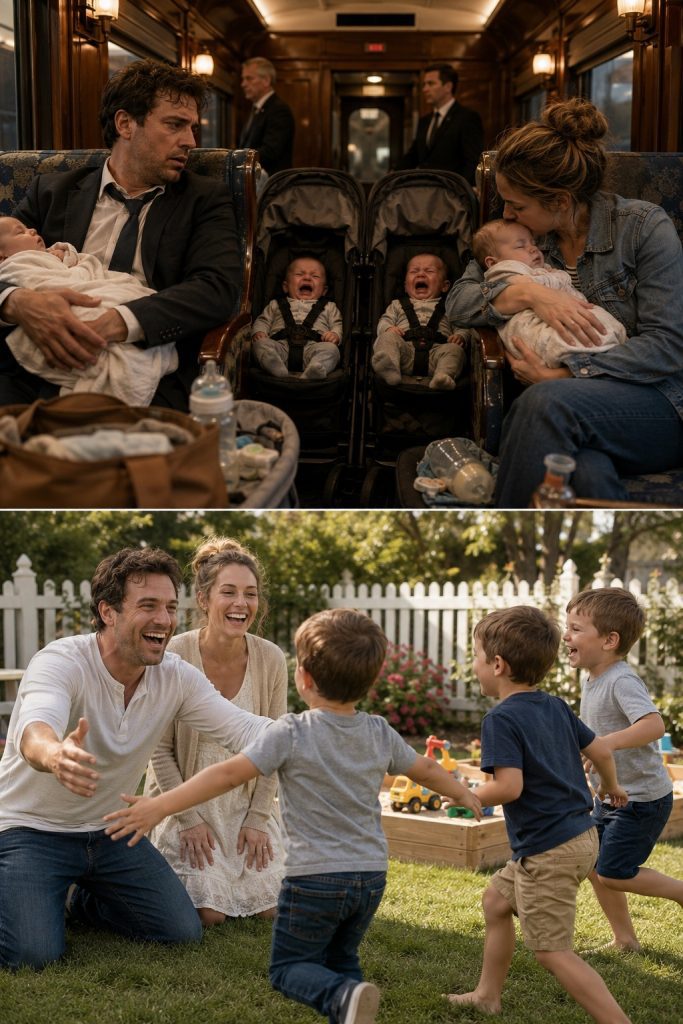
The syringe moved between Naomi’s fingers like an extension of her own grief. Drop by drop, Mason’s lips parted. His tongue curled. His throat worked. The tiny body that had been rigid with hunger and exhaustion began to soften, just a fraction, just enough for Naomi to feel the shift in her bones.
The first-class cabin of the Acela had become a pressure cooker of helplessness. The air was thick with the smell of formula, baby powder, sweat, and something else—fear, sharp and metallic, clinging to the leather seats and the polished wood trim. Outside the window, the New Jersey suburbs blurred past in a smear of gray and green, but inside that compartment, time had stopped.
Roman watched her hands with an intensity that made the compartment smaller. “Where did you learn that?”
“Two years ago,” Naomi said without looking up, “on a highway in rural Pennsylvania. My son Liam was three years old. He had a fever of 104. We were stranded with no cell service. I didn’t know about the syringe trick until it was too late.”
The words landed like stones in still water.
Roman said nothing. His jaw worked. His pale blue eyes stayed fixed on her hands as she moved to Cole, then to Jude, feeding each one the same way—slow, patient, deliberate. She did not rush. She did not flinch. She held each baby against her chest for a moment after the syringe was empty, letting them feel her heartbeat.
Naomi’s own heart hammered against her ribs. She could hear Liam’s cries in her memory, thin and fading, the same desperate whimper that Jude had just made. She could feel the heat of that July afternoon, the way the asphalt had shimmered, the way her throat had burned with screams no one heard. She had held Liam exactly like this—against her chest, whispering promises she could not keep. He had died in her arms two hours before a tow truck finally passed.
She blinked hard and forced herself back to the present.
The babies were quiet now. Mason’s eyes had fluttered closed. Cole’s tiny fist had unclenched. Jude was breathing evenly, his chest rising and falling against the fabric of her denim jacket.
Naomi finished with Jude and looked up. “They’ll need more in twenty minutes. Small amounts. Frequent. They’re not out of danger yet.”
Victor shifted near the door. “We arrive in fourteen.”
“Then we have six minutes to spare,” Naomi said. She turned to Roman. “I’m Naomi Bell. I’m a grief counselor. And I think your sons have been given something that’s making them sick.”
The compartment went cold.
Roman’s voice dropped. “Explain.”
“The formula. The bottles. They’re refusing all of them, not just one. That’s not normal for hungry babies. Something in the milk is wrong—either the taste or the effect. Has anyone else been handling the bottles?”
Victor’s face did not change, but his hand moved toward his pocket.
Roman noticed.
“Victor,” Roman said slowly, “show me the bottles you prepared.”
“Roman, we’ve been through this—”
“Show me.”
Victor’s hand came out of his pocket empty. He set the bottles on the table one by one. Goat milk. Hypoallergenic. Soy. The emergency blend. Four bottles, all untouched, all prepared by Victor’s own hands. The plastic gleamed under the overhead lights, each one lined up like evidence in a trial.
Naomi picked up the goat milk bottle. She sniffed it. The scent was faintly sour, but not spoiled—something chemical underneath, something that did not belong. She touched a drop to her tongue and immediately spat it into the sink.
“It’s bitter,” she said. “Not spoiled—laced. Something alkaline. It would make them vomit if they got enough down.”
Roman’s face turned to stone. “Victor.”
Victor’s hand went back to his pocket.
“Don’t,” Roman said.
Victor’s hand stopped. He looked at Roman with an expression that was not fear and not anger—something older, something carved by years of waiting. His gray eyes were flat, resigned, like a man who had already played this scene in his head a thousand times.
“You’ve been with me fifteen years,” Roman said quietly. “You carried my wife’s casket.”
“I know what I’ve done,” Victor said.
“Why?”
Victor looked at the babies. His gray eyes softened. For one terrible moment, he looked like a man about to confess to murder.
Then he said, “Because Silas Kincaid promised me something you never would.”
Roman waited.
“Freedom,” Victor said. “He promised me I could walk away. Retire. Die in a bed instead of a ditch. You never gave me that option, Roman. You took my son from me when I asked to leave. You said the organization came first.”
“Your son died of an overdose—”
“Because I wasn’t there!” Victor’s voice cracked. The sound was raw, jagged, the cry of a man who had been holding this in for years. “Because you kept me on the road, kept me in the life, kept me away from home. I didn’t even know he was using until the funeral. And you stood there in your black suit and told me to ‘stay focused.’”
The compartment was silent except for the babies’ soft breathing.
Roman stared at the man who had been his shadow for fifteen years. “You poisoned my sons.”
“Not to kill them,” Victor said quickly. “Just to weaken them. Kincaid wanted them sick enough that you’d be distracted during the exchange. He wanted you desperate. He wanted you to make mistakes.”
“You let Silas Kincaid touch my children.”
“Your children,” Victor repeated, and the word came out like broken glass. “Your children, Roman. Not mine. I never got to watch my son grow up. I never got to hold him when he was sick. I never got to choose him over the empire. But you—” Victor’s voice broke. “You get three. And you still chose the empire first.”
Roman’s hand went to his waist.
Naomi stepped between them. “No.”
“Get out of the way.”
“Your sons are alive, Roman. They’re alive because Victor didn’t dose them enough to kill. He could have. He didn’t. That means something.”
Victor’s eyes met Naomi’s. Something passed between them—recognition, perhaps. The grief of losing a child, worn differently but worn just the same. Naomi saw it in the set of his jaw, the tremor in his hands, the way he looked at the babies like they were ghosts of his own loss.
Roman’s hand stayed where it was.
“Victor,” Roman said, “you’re done.”
“I know.”
“You’re going to tell me everything about Kincaid’s plan.”
“I know.”
“And then you’re going to leave this city and never come back.”
Victor nodded. “If you let me see my son’s grave one more time, I’ll tell you everything.”
Roman’s hand lowered.
Naomi picked up Jude again, cradling him against her chest. The baby’s eyes fluttered open. For one moment, he looked at her with the clear, unfocused gaze of an infant who had just been fed and felt safe.
She had not seen that look since Liam.
She blinked hard.
The train began to slow.
“Four minutes,” Roman said. “Kincaid’s men are waiting. Victor’s going to tell me where the exchange is really happening. And you, Naomi Bell—you’re going to take my sons and walk through the station ahead of us.”
“What?”
“You know how to feed them. You know what they need. You’re the only person on this train who has nothing to gain from keeping them alive or letting them die. That makes you the safest person I know.”
Naomi stared at him. The words hit her like a physical blow. She had come here to help, not to become a pawn in a mafia war. But the babies were quiet in her arms, their tiny chests rising and falling, and she could not walk away.
“Take them to the hotel across from Union Station. Room 614. Reservation’s under Vale Holdings. I’ll meet you there when this is over.”
“And if you don’t come back?”
Roman looked at his sons. “Then you raise them better than I could.”
Naomi’s throat tightened. She looked down at Jude, at the dark hair that curled against his forehead, at the small fingers that had wrapped around her thumb. She thought of Liam, of the way his hand had gone limp in hers, of the silence that had followed.
She could not let that happen again.
“I’ll do it,” she said. “But not for you. For them.”
Roman’s pale blue eyes held hers for a long moment. Then he nodded once, sharp and final.
“Victor,” he said, “you’re coming with me. We have a meeting to reschedule.”
Victor’s hand was in his pocket again, and this time he pulled out a worn, folded photograph. Naomi caught a glimpse of it—a young man with dark hair and a wide smile, standing in front of a house with a white porch. Victor’s son. The boy who had died alone while his father was on the road.
Victor looked at the photograph for a long moment, then tucked it back into his pocket.
“Let’s go,” he said.
The train lurched as it pulled into Union Station. The fluorescent lights of the platform flickered through the window. Naomi could see the crowd outside, the faces of strangers, the men in dark suits who stood too still near the escalators.
Kincaid’s men.
Naomi strapped the triplets into the stroller with hands that did not shake, though her heart was pounding. Mason stirred but did not cry. Cole sucked his thumb. Jude slept, his lips slightly parted, his breathing steady.
She pushed the stroller toward the door.
Roman caught her arm. “One more thing.”
She turned.
“What’s your full name?”
“Naomi Bell.”
“Naomi Bell,” Roman repeated, as if memorizing it. “If you ever need anything—anything at all—you call me.”
He pressed a burner phone into her hand. The plastic was warm from his pocket. She looked at it, then at him.
“I don’t want anything from you,” she said.
“That’s why I’m giving it to you.”
The door slid open. The platform noise rushed in—footsteps, announcements, the rumble of luggage wheels. Naomi pushed the stroller into the crowd. She did not look back.
But she felt Roman’s eyes on her until she disappeared into the station.
The hotel was across the street, a glass tower that caught the afternoon sun. Naomi walked through the revolving doors with the triplets, her arms aching from the weight, her mind racing. The lobby was all marble and chrome, a fountain burbling in the center, businessmen and tourists crossing paths like ships in a harbor.
She took the elevator to the sixth floor. Room 614 was at the end of the hall, a heavy oak door with a brass number. She used the key card Roman had given her, and the lock clicked open.
The room was a suite—two bedrooms, a living area, floor-to-ceiling windows overlooking the city. The furniture was expensive but impersonal, the kind of luxury that came from catalogs. Naomi set the stroller in the corner and collapsed onto the sofa.
The babies were quiet. For now.
She pulled out the burner phone and stared at it. One number. One call. A lifeline to a world she had never wanted to enter.
She thought about Victor’s photograph, the way he had touched it like a talisman. She thought about Roman’s voice when he said, *You raise them better than I could.*
She thought about Liam.
And she made a decision.
She would stay until Roman came back. She would keep the babies safe. And then she would walk away, back to her quiet life, back to her grief counseling practice, back to the apartment where the silence still hurt.
But something in her had shifted.
The locket around her neck felt heavier.
And for the first time in two years, Naomi Bell did not feel like she was drowning.
She felt like she was learning to swim.
Two hours passed. The babies woke, fed, slept again. Naomi paced the room, watching the door, checking the windows. The city hummed below, indifferent to the drama unfolding in the glass tower.
Then the phone rang.
She answered without thinking.
“Naomi.” Roman’s voice was tight, controlled. “It’s done. Kincaid’s operation is finished. Victor is in federal custody. The FBI has enough evidence to put him away for twenty years.”
“And you?”
“I’m fine.”
“Your sons?”
“They’re safe because of you.”
Naomi closed her eyes. Relief washed through her, warm and unexpected. She had not realized how much tension she had been holding until it released.
“I’ll be at the hotel in thirty minutes,” Roman said. “We need to talk.”
“About what?”
“About the future.”
The line went dead.
Naomi looked at the babies, sleeping peacefully in the stroller. She touched the locket around her neck, the worn metal warm against her skin.
The future.
She had not thought about the future in two years. She had been surviving, not living. She had been mourning, not hoping.
But now, in a hotel room in Washington D.C., with three infants who needed her, Naomi Bell felt something she had forgotten was possible.
She felt like she had a reason to fight.
And she had no idea that the real battle was only beginning.
The hotel room felt smaller with Roman Vale standing in it.
He filled the doorway like a man who had been carved from stone and then set on fire. His black suit was rumpled, his shirt untucked, and there was a thin line of dried blood along his jaw where someone had caught him with something sharp. But his pale blue eyes were clear, and they fixed on Naomi the moment he stepped inside.
“You’re bleeding,” she said.
“It’s not mine.”
She did not ask whose it was. She did not want to know.
Roman looked past her at the triple stroller where Jude, Mason, and Cole slept in a tangle of small limbs and soft breaths. Something in his face cracked, just barely—a fissure in the stone that he sealed almost immediately.
“They’re alive,” he said. Not a question.
“They’re fine. I fed them twice more. They’re taking the formula now. Whatever Victor put in the bottles must have been a one-time dose—they haven’t rejected anything since we got here.”
Roman’s jaw tightened at Victor’s name. “He’s in a federal holding cell. The FBI picked him up at the station. He gave them everything—Kincaid’s routes, the exchange points, the names of every contact on the East Coast.”
“And Kincaid?”
“Running. He won’t get far.”
Naomi studied him. The man standing before her was not the same man who had sat frozen in the train compartment, holding his son like a man holding a grenade. This man was in motion, even when still. His mind was already three steps ahead, calculating angles, anticipating threats.
But she had seen his hands shake.
She had seen him beg a six-week-old to drink.
She knew something about Roman Vale that no one else in his world knew: he was afraid.
“You said we needed to talk about the future,” Naomi said. “So talk.”
Roman walked to the window. The city spread below him, a grid of lights and shadows. “I have a proposition.”
“I’m not working for you.”
“I’m not offering you a job.”
She waited.
“I’m offering you a partnership.”
The word hung in the air between them, strange and heavy. Naomi almost laughed. “Partnership? You run a criminal empire. I run a grief counseling practice out of a rented office above a laundromat. What kind of partnership could we possibly have?”
Roman turned. “The kind that saves my sons’ lives.”
“Your sons are fine.”
“For now.” He stepped closer. “Victor was my right hand for fifteen years. I trusted him with everything—my schedule, my security, my wife’s funeral arrangements. And he was Kincaid’s man the entire time. If he could betray me, anyone can. I need someone I can trust with the boys. Someone who has no stake in the empire. Someone who looks at them and sees children, not bargaining chips.”
Naomi’s hand went to her locket. “You’re asking me to be their nanny.”
“I’m asking you to be their guardian.”
“That’s the same thing.”
“No.” Roman’s voice dropped. “A nanny leaves at the end of her shift. A guardian stays. A nanny follows instructions. A guardian makes decisions. A nanny is replaceable.” He paused. “You are not.”
Naomi looked at the babies. They were so small. So fragile. She had held Liam at this size, had watched him grow, had memorized the curve of his ears and the pattern of his lashes. She had buried him at three years old.
She knew what it meant to love a child and lose them.
She also knew what it meant to hold someone else’s child and feel that love rise up again, unbidden, unwanted, impossible to stop.
“I can’t,” she said.
“Why?”
“Because I’m still grieving my own son.”
Roman did not flinch. “So am I.”
“Your wife died four months ago. That’s not the same.”
“No,” he agreed. “It’s worse. Because Elise is gone and I have to raise three boys alone, in a world that wants them dead, while running an empire that would eat them alive if I faltered for one second.” His voice cracked on the last word, and he stopped, pressing his palm against the window as if steadying himself.
Naomi watched him.
She had counseled dozens of grieving parents. She knew the stages, the patterns, the way grief contorted itself into anger, denial, bargaining. She had seen men cry, scream, break furniture. She had held mothers while they sobbed until their throats bled.
But she had never seen a man fight his own grief in real time, swallow it whole, and keep standing.
“I’ll stay for one month,” she said.
Roman turned.
“One month. I’ll help with the boys. I’ll teach you how to feed them, how to read their cries, how to soothe them when nothing else works. But I’m not moving into your world. I’m not becoming part of your operation. And the moment I feel like the boys are in danger because of who you are, I leave.”
“Agreed.”
“I mean it, Roman. I’m not your employee. I’m not your partner. I’m a mother who lost her son, and I don’t want to see another mother go through what I went through. That’s the only reason I’m staying.”
Roman held her gaze. “That’s the only reason I’m asking.”
The first week was chaos.
Roman’s penthouse in Georgetown was a fortress of glass and steel, with floor-to-ceiling windows overlooking the Potomac and security systems that would make a military base jealous. There were guards at every entrance, cameras in every room, and a panic room hidden behind a bookshelf in the master bedroom.
Naomi hated it.
She hated the way the guards watched her. She hated the way the elevator required a fingerprint scan. She hated the silence that filled the rooms when Roman was gone, a silence that pressed against her ears like water.
But she loved the babies.
Jude was the quietest, the one who studied faces with his mother’s dark eyes. Mason was the loudest, the one who screamed until he was held, then fell asleep the moment his cheek touched a shoulder. Cole was the middle child in temperament—content to watch, patient, but with a stubborn streak that emerged when he was hungry.
Naomi learned them the way she had learned Liam: by watching, by listening, by holding them until their rhythms became her own.
She set up a schedule. Feedings every three hours. Tummy time on a soft mat by the window. Baths in the late afternoon, when the light was golden and the boys were drowsy. She sang the same lullaby she had sung to Liam—a simple Irish tune her grandmother had taught her—and watched the triplets’ eyes flutter closed.
Roman watched her from doorways.
He never interrupted. He never criticized. He just stood in the shadows, his pale blue eyes tracking her movements, learning from her the way she was learning from the boys.
On the fifth night, he found her in the nursery at 2 a.m., holding Jude against her chest while the other two slept.
“He won’t settle,” she said without looking up.
“He does this. Every night. Elise used to walk him for hours.”
“He needs to be held upright. Reflux. He’ll sleep better if you keep him elevated after feeding.”
Roman moved into the room. He stood beside her, close enough that she could smell the coffee on his breath and the faint metallic scent of gun oil on his clothes.
“Can I try?”
She looked at him. His hands were open, palms up, waiting.
She placed Jude in his arms.
Roman adjusted the baby against his chest, remembering what she had shown him—the angle, the gentle pat on the back, the slow rhythm. Jude fussed for a moment, then settled, his tiny hand curling around Roman’s thumb.
“He’s got your grip,” Naomi said.
“He’s got his mother’s patience.”
“And his father’s stubbornness.”
Roman almost smiled. Almost. The corner of his mouth twitched, and for one second, he looked like a different man—younger, softer, the version of himself that existed before the empire and the blood and the endless war.
“Thank you,” he said quietly.
“You don’t have to keep thanking me.”
“I’m not thanking you for the boys. I’m thanking you for not looking at me like I’m a monster.”
Naomi considered that. “I’ve seen monsters. You’re not one.”
“You don’t know what I’ve done.”
“I don’t need to know. I know what you’re trying to do. That’s enough.”
They stood in the dim light of the nursery, a grieving father and a grieving mother, holding a baby who did not know he was the bridge between two broken worlds.
The second week brought trouble.
Naomi noticed it first in the way Roman’s guards shifted—tighter rotations, more frequent checks of the perimeter, hushed conversations that stopped when she entered a room. Then she noticed the phone calls. Roman took them in his study, behind a closed door, but she could hear the tension in his voice through the walls.
“They found Kincaid,” Roman said one evening, standing at the kitchen island with a glass of whiskey that he had not touched.
“Where?”
“Baltimore. He’s been hiding in a warehouse owned by a shell company. My men are watching him, but he’s got a network I didn’t know about. Judges. Cops. A senator’s aide. Victor only gave us half the picture.”
“What does that mean for us?”
Roman looked at her. The word “us” hung in the air, and neither of them corrected it.
“It means Kincaid is going to make a move. He knows Victor was arrested. He knows the FBI has his routes. He’s going to try to hit me where it hurts before I can consolidate power.”
“Where does it hurt?”
“The boys.”
Naomi’s blood went cold. “Then we leave.”
“We can’t.”
“Roman—”
“If I run, he wins. If I hide, he takes everything I’ve built. And then he comes for the boys anyway, because they’re the only loose end.” Roman’s hand tightened around the glass. “I have to end this. Permanently.”
“And what am I supposed to do with three infants while you go to war?”
“Stay here. The penthouse is a fortress. You’ll be safe.”
“Safe?” Naomi’s voice rose. “I was safe in my apartment in Newark. I was safe in my office above a laundromat. I was safe when I didn’t know your name or your face or the sound of your sons crying in the middle of the night. I’m not safe here, Roman. I’m a target.”
“Then let me protect you.”
“By locking me in a glass tower?”
“By giving you everything you need to keep my sons alive.”
They stared at each other across the kitchen island. The whiskey sat untouched. The city hummed below.
Naomi broke first.
“You’re going to get yourself killed,” she said.
“Probably.”
“And then what happens to the boys?”
Roman’s jaw tightened. “I’ve made arrangements. If I die, the boys go to a family in Maine. A couple I trust. They’re retired, no connection to the organization. The boys will grow up normal.”
“Normal? They’ll grow up without a father.”
“They’ll grow up alive.”
Naomi looked away. Her hand found the locket, the familiar warmth of the metal, the photograph of Liam that she had worn against her heart for two years.
“I’ll stay,” she said finally. “But not for you. For them.”
Roman nodded. “That’s all I’m asking.”
The third week was a nightmare.
Kincaid’s people hit three of Roman’s properties in one night—a warehouse in Alexandria, a trucking depot in Richmond, a private dock in Baltimore. The news reported them as “industrial accidents,” but Naomi knew better. She could see it in the way Roman’s guards moved, the way their hands stayed close to their weapons, the way they spoke in clipped, urgent tones.
Roman came home at dawn, his suit torn, his hands raw.
“Kincaid’s making a play for the East Coast corridor,” he said, pouring himself coffee with shaking hands. “He’s got backing I didn’t know about. A cartel out of Mexico. They’re flooding the ports with product, and he’s using the money to buy judges.”
“What are you going to do?”
“Fight.”
“That’s not a plan.”
“It’s the only plan I have.”
Naomi watched him. The man was exhausted, running on caffeine and adrenaline, his grief buried so deep she could barely see it anymore. He had become the machine he had built—efficient, cold, unstoppable.
But machines broke.
And when they broke, they shattered.
“You need help,” she said.
“I have help.”
“You need someone who isn’t scared of you.”
Roman looked up. “Are you scared of me?”
“No.”
“Why not?”
“Because I’ve seen you hold your son. I’ve seen you cry. I know what you look like when you’re afraid. And I know that the man who’s afraid is the real one—not the monster you pretend to be.”
Roman stared at her. The coffee cup trembled in his hands.
“You see too much,” he said.
“That’s my job.”
“No. Your job is grief counseling. My job is keeping my sons alive. Those are different worlds.”
“They’re the same world, Roman. Grief is grief. Fear is fear. Love is love. You don’t get to separate them just because you wear a suit and carry a gun.”
He set down the coffee cup. For a long moment, he did not speak.
Then he said, “Kincaid is planning a hit on the penthouse. My intelligence says he’s going to use a team of six men, ex-military, equipped with thermal imaging and breaching charges. They’re coming in three days.”
Naomi’s heart stopped. “Then we need to leave.”
“No.”
“Roman—”
“If we leave, he wins. If we hide, he wins. The only way to beat him is to let him come and be ready.”
“You’re going to use your sons as bait?”
“I’m going to use myself as bait. The boys will be in the panic room. You’ll be with them. No one gets in or out without my code.”
Naomi wanted to argue. She wanted to scream. She wanted to grab the triplets and run as far as her legs would carry her.
But she looked at Roman’s face, and she saw something she had not seen before.
He was not planning to survive.
He was planning to kill Kincaid, even if it cost him everything.
“You’re going to die,” she whispered.
“Maybe.”
“And then what? The boys grow up orphans? They grow up with strangers in Maine, never knowing who their father was, never knowing that you loved them enough to die for them?”
Roman’s composure cracked. Just barely. A hairline fracture in the mask.
“What do you want me to do, Naomi? Walk away? Let Kincaid take everything? Let him raise my sons in his world, turn them into soldiers, fill their heads with his poison?”
“I want you to live.”
The words came out before she could stop them.
Roman went still.
“I want you to live,” she repeated, “because those boys need a father. Because you’re the only one who can give them a life that isn’t defined by blood and violence. Because—” She stopped.
“Because?”
“Because I can’t watch another child lose a parent. I can’t.”
Roman crossed the kitchen. He stopped in front of her, close enough that she could feel the heat coming off his body, could see the exhaustion etched into the lines around his eyes.
“You lost your son,” he said quietly.
“Yes.”
“And you’re still here. Still fighting. Still trying to save everyone else.”
“It’s all I know how to do.”
He reached out. His hand hovered near her face, not quite touching.
“I don’t know how to do this,” he said. “The soft parts. The parts that aren’t about strategy and violence. I don’t know how to be the father those boys need.”
“You learn.”
“Teach me.”
The word hung between them, fragile and heavy.
Naomi looked at his hand. She looked at his eyes. She thought about Liam, about the locket, about the two years she had spent drowning in grief.
Then she took his hand and pressed it against her cheek.
“One day at a time,” she said. “That’s how you learn.”
Roman’s thumb traced a slow line along her cheekbone. His eyes were pale and unreadable, but his hand was warm, and it did not shake.
The morning of the hit dawned gray and cold.
Naomi woke before sunrise, her body already braced for the day ahead. She dressed in layers—jeans, a sweater, the denim jacket she had worn on the train. She put the locket around her neck and checked that the clasp was secure.
Then she went to the nursery.
The triplets were awake, cooing in their cribs, their small faces turning toward her as she entered. Jude lifted his arms. Mason kicked his legs. Cole watched her with his mother’s dark eyes.
“Hey, boys,” she whispered, lifting Jude first. “Today’s going to be scary. But I’m going to be with you the whole time. Okay?”
Jude grabbed her finger.
She held him for a long moment, feeling his heartbeat against hers, remembering the weight of Liam in her arms.
Then she heard the front door open.
Roman’s footsteps were heavy, deliberate. He appeared in the doorway, dressed in tactical gear—black shirt, ballistic vest, a holster at his hip. His face was stone.
“They’re coming.”
“How long?”
“Twenty minutes. Maybe less.”
Naomi nodded. She placed Jude back in the crib and turned to face him. “The panic room?”
“Through the master bedroom, behind the bookshelf. You remember the code?”
“Liam’s birthday. 0315.”
Roman’s eyes flickered. He had not asked what the code meant. He had not needed to.
“Good,” he said. “You take the boys. You lock the door. You don’t open it for anyone except me. Not the guards. Not the police. Not even if you hear gunfire right outside the door. You understand?”
“I understand.”
“Naomi.” He stepped closer. “If I don’t make it—”
“You will.”
“Listen to me. If I don’t make it, the code to the safe in my study is 1928. Inside is a file with the family in Maine’s contact information, a bank account with enough money to raise the boys to adulthood, and a letter for each of them. You take them. You disappear. You never look back.”
“Roman—”
“Promise me.”
She looked at him. The man who had built an empire on fear. The man who had held his son like a grenade. The man who had pressed her hand against his chest and asked her to teach him how to be soft.
“I promise,” she said.
He held her gaze for one long breath.
Then he turned and walked out of the nursery.
Naomi gathered the triplets, one by one, placing them in the reinforced stroller Roman had left for this exact moment. Jude fussed. Mason cried. Cole watched her with his mother’s eyes.
“It’s okay,” she whispered, her voice steady even as her hands trembled. “It’s okay. We’re going to be okay.”
She pushed the stroller through the penthouse, past the guards who nodded grimly, past the windows that overlooked a city that did not know what was coming.
The master bedroom was dark. She crossed to the bookshelf, pressed the hidden latch, and watched the wall slide open to reveal a steel door.
She entered the code: 0315.
The lock clicked.
She pushed the stroller inside.
The panic room was small—ten feet by ten feet, lined with steel, equipped with a ventilation system, a monitor showing the penthouse cameras, and a small cot. It smelled of metal and dust.
Naomi locked the door behind her.
She sat on the cot, the stroller beside her, the babies quiet for now.
She touched her locket.
And she waited.
The first gunshot came at 8:47 a.m.
Naomi flinched. The babies started crying—thin, sharp cries that echoed off the steel walls. She picked up Jude, pressed him against her chest, and began to sing.
*“Lá breá é inniu, a leanbh…”*
The Irish lullaby her grandmother had taught her. The one she had sung to Liam on his last night.
*“Ná bíodh eagla ort, táim anseo…”*
The gunfire intensified. She could hear shouts, breaking glass, the heavy thud of bodies hitting the floor. The monitor showed flashes of movement—men in black, Roman’s guards, chaos.
Naomi kept singing.
She held Jude. She rocked him. She let her voice fill the small room, wrapping the babies in sound, in warmth, in the only protection she could offer.
*“Tá grá agam duit, a stór…”*
“*I love you, my treasure…*”
The gunfire stopped.
Silence.
Naomi held her breath.
The monitor showed the penthouse living room, smoke curling through the air, furniture overturned. A body lay on the floor—one of the attackers, she thought. Another slumped against the wall.
Then Roman stepped into frame.
He was alive.
Blood streaked his face, his vest was torn, but he was standing. He moved through the room, checking bodies, speaking into a radio. His voice was low, controlled.
“Clear. All hostiles down.”
Naomi’s knees gave way. She slid to the floor, still holding Jude, her whole body shaking.
The babies were crying. She was crying. She did not know when she had started.
The lock on the panic room door clicked.
Roman opened it.
He stood in the doorway, silhouetted against the smoke-filled room behind him. His eyes found hers. He looked at her, at the babies, at the way she was holding them like they were the only things keeping her tethered to the earth.
“It’s over,” he said.
Naomi looked up at him.
And for the first time in two years, she believed that something could be.
Roman stood in the doorway of the panic room, blood drying on his face, his chest heaving beneath his torn vest. Behind him, the penthouse lay in ruins—shattered glass, overturned furniture, the acrid smell of gunpowder hanging in the air like a second ceiling.
Naomi did not move from the floor. Jude was still pressed against her chest, his tiny fingers curled around the collar of her denim jacket. Mason and Cole had fallen asleep in the stroller, exhausted from the crying, from the fear, from the vibration of violence they could not understand.
“You’re bleeding,” Naomi said.
Roman touched his temple. His fingers came away red. “It’s not mine.”
“The men outside?”
“Handled.”
She wanted to ask what that meant. She did not. She had seen enough of his world in the past hour to know that *handled* could mean arrested, hospitalized, or buried. She was not sure she wanted the answer.
Roman stepped into the panic room and knelt in front of her. His pale blue eyes moved over her face, over the baby she held, over the stroller where his other sons slept.
“You stayed,” he said.
“I promised.”
“You could have taken the code. Opened the safe. Left with the money and the boys before the first shot was fired.”
Naomi shook her head. “I don’t want your money, Roman.”
“Then what do you want?”
She looked down at Jude. The baby’s breathing had evened out. His lips were no longer dry. His color was returning—pink instead of gray, alive instead of fading.
“I want them to live,” she said quietly. “I want to know that I did something right this time.”
Roman’s jaw tightened. He understood. He did not need her to explain the weight of those words, the ghost of a three-year-old boy who haunted every quiet moment of her life.
“You did,” he said. “You did something right.”
A commotion from the living room made them both turn. The monitor showed men in tactical gear moving through the penthouse—not Roman’s men, but federal agents. Badges hung from chains around their necks. Guns were still raised.
“FBI,” Roman said. “They’ll have heard the shots.”
“Will they arrest you?”
“They’ll try.” He stood, offering her his hand. “Come on. I need you to tell them what happened. Everything. From the train to the panic room. Don’t leave anything out.”
Naomi took his hand. He pulled her to her feet.
“What about Victor?” she asked.
“Victor’s already in custody. I called the FBI before I called the hotel. He’s in a holding cell at the D.C. field office, telling them everything he knows about Silas Kincaid.”
“And Kincaid?”
Roman’s expression hardened. “Kincaid’s men are dead or running. The exchange at Union Station never happened. Victor’s testimony will bury what’s left of his operation. By this time next week, Silas Kincaid will be a man with no empire, no allies, and a target on his back.”
Naomi studied his face. “That’s not justice. That’s revenge.”
“In my world, they’re the same thing.”
She wanted to argue. She wanted to tell him that there was another way, that violence only bred more violence, that somewhere beneath the mafia boss there was a father who had held his son and cried.
But the babies were sleeping. The gunfire had stopped. Roman was alive.
She let the argument die in her throat.
The FBI agents swept through the penthouse, taking statements, photographing the scene, bagging weapons and shell casings. Naomi sat on the leather couch in the living room, Jude still in her arms, while a young agent with kind eyes asked her questions.
“You’re the woman from the train,” the agent said. “The grief counselor.”
“Yes.”
“Victor Rowe mentioned you. Said you saved the babies.”
Naomi looked at the agent. “Victor said that?”
“He said a lot of things. Most of them are going to put Silas Kincaid away for a very long time.” The agent paused. “He also said you were the only one who could save those boys. He was right.”
Naomi did not know what to say to that. She looked down at Jude, at his tiny chest rising and falling, at the peace on his face that she had not seen since the train.
“What happens to Victor now?” she asked.
“He’s cooperating. Full confession. He’ll be in witness protection if he testifies against Kincaid. It’s the best deal he’s going to get.”
“And Roman?”
The agent glanced across the room where Roman stood talking to the lead investigator, his hands cuffed in front of him, his voice low and measured.
“Roman Vale is a complicated man,” the agent said. “He’s got more blood on his hands than any of us will ever know. But today, he called us. He handed over Victor. He gave us Kincaid’s entire operation on a silver platter. The Bureau’s going to have to decide if that buys him anything.”
“Does it?”
The agent shrugged. “That’s above my pay grade.”
Naomi looked at Roman. He was watching her from across the room, his pale blue eyes unreadable. Even in handcuffs, even surrounded by federal agents, he had the stillness of a man who had already accepted whatever came next.
She held his gaze.
And for a moment, she saw something she had not seen before: not the mafia boss, not the king of the underworld, but a father who had been willing to trade everything for the safety of his sons.
The agents finally uncuffed Roman. They had no charges to hold him on—not tonight. The testimony of Victor Rowe, the captured weapons from Kincaid’s men, the security footage from the penthouse: all of it pointed to Roman as the victim of an attack, not the perpetrator.
“You’re lucky,” the lead investigator said, packing up his notebook. “If Victor hadn’t flipped, we’d be having a different conversation.”
Roman said nothing.
The investigator looked at Naomi. “Ma’am, we have your contact information if we need anything else.”
“I know.”
The agents filed out, leaving the penthouse in ruins and silence.
Roman walked to the nursery. Naomi followed, still holding Jude. Mason and Cole were awake now, fussing softly in their stroller, hungry but no longer desperate.
Naomi prepared the bottles herself this time. She checked the formula. She tasted it. She made sure it was clean.
She fed each baby in turn, her hands steady, her voice soft.
Roman stood in the doorway and watched.
“You don’t have to do that,” he said.
“I know.”
“You could leave. Right now. Walk out the door and never look back.”
Naomi finished feeding Cole and set the bottle down. She looked at Roman with tired hazel eyes that had seen too much and still refused to look away.
“I know,” she said again.
She stood, walked to the door, and stopped in front of him.
“But I’m not leaving tonight,” she said. “They need someone who knows how to feed them. They need someone who knows what it sounds like when they’re in trouble. They need someone who’s not afraid to hold them.”
Roman’s voice dropped. “You’re not afraid of anything, are you?”
“I’m afraid of everything,” Naomi said. “I’m afraid of losing another child. I’m afraid of waking up tomorrow and finding out today was a dream. I’m afraid of letting myself care about those boys because I know what it costs to lose someone you love.”
She paused.
“But I’m more afraid of walking away and finding out later that I could have helped and didn’t.”
Roman stared at her for a long moment.
Then he stepped aside.
Naomi walked into the nursery and sat in the rocking chair by the window. Jude was asleep in her arms. Mason and Cole were drifting off in their cribs, their cries finally quiet, their bellies full.
The city lights of Washington D.C. spread out below her, cold and distant and indifferent to everything that had happened in this room.
But in here, in this small space, three babies were breathing.
Three babies were safe.
Three babies were alive because a grieving mother had heard their cries and refused to look away.
She touched her locket. The metal was warm against her fingers.
“I did something right,” she whispered to no one.
And for the first time in two years, she believed it.
The days that followed passed in a strange, suspended haze.
Naomi stayed at the penthouse. She told herself it was temporary. She told herself she was just making sure the babies were stable, that their feeding schedule was normalized, that they had recovered from the dehydration and the trauma.
But each morning, she woke to the sound of Jude crying, and she walked to the nursery before she could talk herself out of it.
Each afternoon, she sat in the rocking chair with Mason against her chest, feeling his heartbeat slow as she sang the lullaby her grandmother had taught her.
Each evening, she watched Roman come home—tired, silent, his hands clean of blood but his eyes full of things he did not say—and she saw him stop in the nursery doorway and look at his sons with an expression she recognized.
It was the same expression she saw in her own mirror every night.
It was the look of a parent who had almost lost everything and did not know how to trust that it was real.
On the fifth day, Maeve O’Connell called.
“Naomi.” Her best friend’s voice was sharp with concern. “I’ve been calling for three days. The news said there was a shooting at some penthouse in D.C. Connected to a mafia thing. Please tell me you’re not involved.”
Naomi sat on the balcony, the spring air cool against her face, a cup of tea growing cold in her hands. “I’m involved.”
“What?”
“It’s a long story.”
“I have time.”
Naomi told her. She told her about the train, about the babies, about the formula and Victor and the gunfight and the FBI. She told her about Roman Vale and the panic room and the code 0315.
When she finished, Maeve was silent for a long moment.
“You’re living with a mafia boss,” Maeve said finally.
“I’m taking care of his babies.”
“Same thing.”
“Maeve.”
“Naomi.” Maeve’s voice softened. “I’m not judging you. I’m worried about you. You spent two years barely leaving your apartment. You spent two years saying you couldn’t be around children because it hurt too much. And now you’re living in a penthouse with triplets and a man who probably has more enemies than suits.”
Naomi looked through the glass door into the nursery. Roman was inside, holding Cole, his large hands awkward but gentle as he adjusted the baby’s blanket.
“I know,” she said quietly.
“What are you doing, Naomi?”
“I don’t know.” She paused. “But for the first time in two years, I’m not waking up wishing I hadn’t. Does that count for something?”
Maeve was quiet again. Then: “Yeah. I think it does.”
On the tenth day, Roman found her in the nursery at midnight.
She was sitting in the rocking chair, Jude asleep on her chest, the room lit only by the glow of a nightlight shaped like a crescent moon.
“You should sleep,” Roman said from the doorway.
“I should,” Naomi agreed. “But every time I close my eyes, I hear the gunfire.”
Roman walked into the room. He pulled up a wooden chair and sat across from her, close enough to see the rise and fall of Jude’s breathing.
“It gets easier,” he said.
“Does it?”
“No.” His voice was flat. “But you learn to carry it.”
Naomi looked at him. The moonlight caught the lines on his face, the shadows under his eyes, the weight he carried in his shoulders.
“Why did you call the FBI?” she asked.
Roman was quiet for a long moment. “Because Victor was right.”
“About what?”
“About me. About the empire. About the way I treated loyalty like a leash.” He looked at his hands. “I spent twenty years building an organization that ran on fear. I told myself it was for my family. I told myself it was to protect the people I loved. But when Elise was dying, I wasn’t there. I was at a meeting. A meeting I could have rescheduled. A meeting about money. And when Victor asked to leave, I told him no because I needed him.”
He looked up at her.
“I made my sons sick without touching a single bottle. I made Victor betray me. I made myself alone. And the only person who saw it clearly was a stranger on a train.”
Naomi held his gaze. “You’re not alone now.”
“I know.”
“You have three sons who need you.”
“I know.”
“And you have me. At least for now.”
Roman’s eyes flickered. “Why?”
Naomi looked down at Jude. She touched his tiny hand, felt his fingers curl around hers.
“Because I know what it’s like to lose someone and think you’ll never stop falling,” she said. “And I know what it’s like to have someone reach out and catch you when you least expect it.”
She looked up.
“You reached out to me on that train. You trusted me with your sons. You gave me a reason to believe I could still be a mother, even after Liam.”
Roman’s voice was barely a whisper. “You are a mother, Naomi. You always will be.”
She did not cry. She had cried enough.
But she held Jude a little closer, and she let the silence settle around them like a blanket.
On the fourteenth day, Victor Rowe’s testimony went public.
The news channels ran non-stop coverage. Silas Kincaid was arrested at his estate in Virginia, charged with conspiracy to commit murder, trafficking, and a dozen other counts that would keep him in prison for the rest of his life. His empire crumbled within hours—ports seized, accounts frozen, allies scattering like roaches in the light.
Victor’s full confession included details that implicated dozens of mid-level operators, corrupt officials, and silent partners. The FBI had enough evidence to keep the investigation running for years.
And at the center of it all was Roman Vale.
But the charges against Roman never came.
The FBI had made a deal: Victor’s testimony in exchange for witness protection. Roman’s cooperation in exchange for immunity on everything Victor had revealed. It was not a clean resolution. It was not justice, not the way ordinary people understood it.
But it was the end of a war that had been brewing for two decades.
Naomi watched the news coverage from the penthouse living room, the triplets sleeping in the nursery down the hall.
Roman stood by the window, his back to her, his silhouette sharp against the afternoon light.
“It’s over,” she said.
“It’s never over,” he replied. “But this chapter is.”
He turned to face her.
“I’m selling Vale Holdings.”
Naomi blinked. “What?”
“I’ve already started the process. The legitimate businesses will be sold to a trust. The rest will be dismantled, reported, buried. I’m walking away.”
“Roman—”
“I can’t raise my sons in this world.” His voice was steady, final. “I can’t be the man I was and still be the father they need. Elise asked me to keep them safe. I thought that meant building walls and buying guns. But it doesn’t. It means building something they can be proud of.”
Naomi stood. She walked to him, stopping a few feet away.
“What will you do?”
“I don’t know. Something quiet. Something that doesn’t require a panic room.” He almost smiled. “Maybe I’ll buy a farm.”
“You? A farm?”
“I’ve never tried it. Might be good for the boys. Fresh air. Animals. Space to run.”
Naomi shook her head, a small laugh escaping her. “I can’t picture you milking a cow.”
“Neither can I.” His smile faded. “But I can picture my sons growing up without hearing gunfire. I can picture them sleeping through the night without wondering if someone’s coming through the door. I can picture them knowing their father as a man who chose them over everything else.”
He looked at her.
“Come with us.”
Naomi’s breath caught.
“I’m not offering you a job,” he said quickly. “I’m not offering you anything except a choice. If you want to stay here, if you want to go back to your life, I’ll understand. I’ll set up a trust for you. You’ll never have to worry about money again. You can go anywhere, do anything.”
He paused.
“But if you want to come with us—if you want to be part of their lives, part of whatever I’m building next—the door is open. And it will stay open for as long as you want it to be.”
Naomi looked at him. At the man who had been a mafia boss, a king, a killer. At the father who had learned to hold his sons. At the stranger who had become the only person who understood her grief.
“I don’t know what I want,” she said honestly.
“That’s okay.”
“I need time.”
“Take all the time you need.”
She looked past him, through the window, at the city that had swallowed her whole and somehow spit her out alive.
“I need to go home first,” she said. “I need to see my apartment. I need to talk to Maeve. I need to sit with everything that’s happened and figure out who I am now.”
Roman nodded. “I understand.”
“But I’ll come back.”
He met her eyes. “You promise?”
“I promise.”
She did not say goodbye to the babies that night. She could not. She knew if she held Jude one more time, she would not be able to leave.
Instead, she stood in the nursery doorway for a long moment, watching them sleep, their tiny chests rising and falling in perfect rhythm.
She touched her locket.
“I’ll be back,” she whispered. “I promise.”
Then she walked out of the penthouse, through the lobby, and into the cold spring air of a city that did not know her name.
She rode the train home—not the Acela, but a slower line, one that stopped at every station between D.C. and Newark. She sat by the window and watched the world pass by: small towns, empty fields, the occasional river glinting in the fading light.
She thought about Liam. About his last day. About the heat of the highway and the sound of his crying and the helplessness that had hollowed her out for two years.
She thought about Jude, Mason, and Cole. About their tiny hands and their hungry mouths and the way they had stopped crying the moment she held them.
She thought about Roman. About the man who had built an empire and then burned it down for his sons. About the father who had learned to be soft.
She touched her locket.
“I did something right,” she said again.
And this time, she did not whisper it to no one.
She said it to herself.
The apartment was exactly as she had left it: small, quiet, filled with the ghosts of a life she had put on hold. The mail had piled up in the slot by the door. The plants on the windowsill were dead. The refrigerator held nothing but a jar of pickles and a carton of milk that had expired three weeks ago.
Naomi walked through the rooms slowly, touching the furniture, the photographs on the wall, the books on the shelf.
She stopped at the small table by the window where Liam’s picture sat in a silver frame. He was three years old in the photo, grinning at the camera with a gap-toothed smile, a smudge of chocolate on his cheek.
She picked up the frame and held it against her chest.
“I’m sorry I couldn’t save you,” she whispered. “I’m sorry I couldn’t get help in time. I’m sorry I’ve spent two years drowning in guilt instead of living.”
She set the frame down.
“But I’m not drowning anymore.”
She called Maeve.
“I’m home,” she said.
“For good?”
“I don’t know yet.” She sat on the edge of her bed. “But I think I’m going to go back.”
“To the mafia boss?”
“To the father. To the boys. To whatever comes next.”
Maeve was quiet for a moment. Then: “Are you sure?”
“No.”
“Then why are you going?”
Naomi looked at her reflection in the dark window. She looked tired. She looked older. She looked like someone who had been to war and come back with scars she did not know how to name.
But she also looked like someone who was still standing.
“Because I think I can be happy,” she said. “And I think I owe it to Liam to try.”
Maeve’s voice cracked. “That’s the first time you’ve said that in two years.”
“I know.”
“Okay.” Maeve took a breath. “Okay. Then go. And if it doesn’t work out, you call me, and I’ll come get you. No questions asked.”
“Thank you.”
“Always.”
Naomi hung up. She packed a single bag: clothes, toiletries, Liam’s picture, and the locket she never took off.
Then she called Roman.
“I’m coming back,” she said.
“When?”
“Tomorrow morning.”
There was a pause. When Roman spoke again, his voice was rough.
“I’ll be waiting.”
The next morning, Naomi Bell stood on the platform at Newark Penn Station, the spring sun warm on her face, a single bag at her feet.
She was not the same woman who had boarded the Acela three weeks ago. That woman had been hollow, broken, running from a grief she could not outpace.
This woman was still grieving. She would always grieve.
But she was also alive. She was also choosing to move forward.
The train arrived. She boarded.
And as the city slipped away behind her, she touched her locket one last time.
“This is for you, Liam,” she whispered. “This is for all of us.”
The train carried her south, toward a new life she could not yet imagine.
And for the first time in two years, Naomi Bell did not look back.