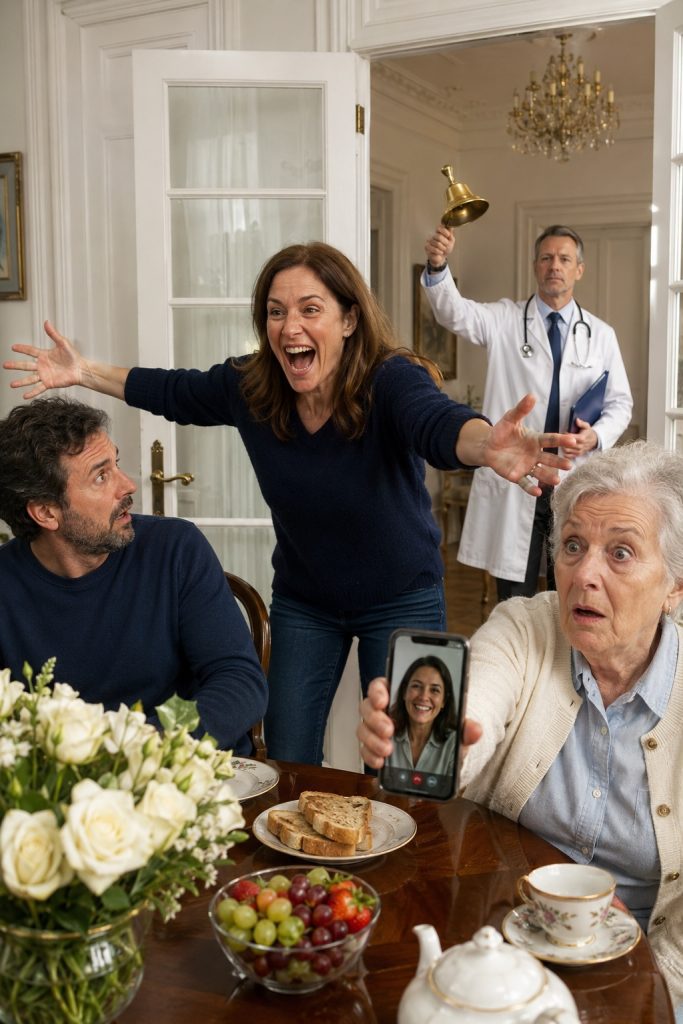
The steam from the teacup curled upward, delicate and white, catching the pale January light through the kitchen window. Linda Miller’s hand hovered over the porcelain rim for a long moment—long enough for her daughter Emily to lean forward, blonde ponytail swinging, sharp blue eyes narrowing with impatience.
“Drink up, Mom,” Emily said, her voice honeyed with false patience. “It’s getting cold.”
Linda’s fingers curled away from the cup. She folded both hands flat on the oak table. The wood was worn smooth from decades of Sunday dinners, homework assignments, and the weight of Michael’s elbows as he read the newspaper. Now it felt like the only solid thing left in the room.
“I heard you last night,” Linda said.
The silence that followed was so complete she could hear the refrigerator hum, the wall clock ticking, the faint creak of the old house settling around them. Daniel, Emily’s husband, dropped his fork against his plate with a clatter that echoed like a gunshot.
Emily’s smile flickered but held. “She’s having another episode, Daniel. Call Dr. Patel.”
“No,” Linda said softly. “I’m not.”
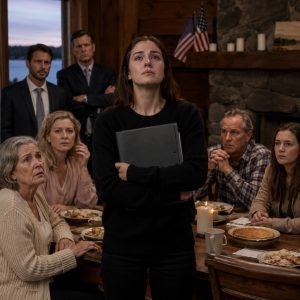
She was seventy-two years old. Her hair was silver-gray, pulled into a tidy bun at the nape of her neck. She wore a pearl necklace and a cream cardigan that Michael had bought her twenty years ago. She looked like every grandmother in every white-columned colonial home on every quiet suburban street in America.
But for thirty-five years, she had taught criminal law at a university where young prosecutors learned how to break liars apart on the witness stand.
And her daughter had forgotten this.
Emily straightened, her designer blouse pulling tight across her shoulders. “Mom, you’re confused. You didn’t hear anything last night. You were asleep by eight o’clock. Remember? I tucked you in myself.”
“You tucked me in after you checked my phone,” Linda said. “After you went through my nightstand drawer. After you stood in the hallway and whispered to Daniel that the paperwork was ready.”
Daniel’s face went pale. He was thin, nervous, a man who avoided eye contact the way other people avoided puddles. He pushed his chair back an inch, then stopped, as if afraid the movement would betray him.
“Emily,” he said, his voice barely above a whisper. “What is she talking about?”
“Nothing,” Emily snapped. “She’s confused. It’s the dementia. Dr. Patel warned us this would happen. The agitation phase.”
Linda did not raise her voice. She had never needed to. Thirty-five years of standing in front of lecture halls full of arrogant law students had taught her that volume was the tool of the weak. She simply reached into her cardigan pocket and pulled out her phone.
“Before you take me anywhere,” she said, “there’s something you and Daniel need to watch.”
The screen was dark. But the phone was warm in her hand. She had been holding it all morning, waiting for this moment, rehearsing the words in her mind until they felt like armor.
Emily’s eyes fixed on the phone. Something flickered behind them—not confusion, not concern, but the cold calculation of a woman who had just realized her trap might have teeth.
“What is that?” Emily asked.
“A recording,” Linda said. “From October. You and Daniel in the kitchen. You thought I was asleep on the couch.”
Daniel stood up. His chair scraped against the hardwood floor. “Emily, I need to talk to you. Privately. Right now.”
“Sit down, Daniel,” Linda said.
He did not sit.
But he also did not leave.
Emily reached across the table, her fingers stretching toward the phone. “Give me that, Mom. You don’t know what you’re doing.”
Linda pulled the phone back. “I know exactly what I’m doing. I taught criminal law for thirty-five years. Do you remember that, Emily? Do you remember sitting in my office as a teenager, watching me grade exams, listening to me explain how people get caught? Not because they’re stupid. But because they get comfortable.”
Emily’s hand hovered in the air between them. Her nails were perfectly manicured. Her wedding ring caught the light. She looked like every photograph of every successful daughter—except for the tremor at the corner of her mouth.
“You’re having an episode,” Emily said again. But this time, the words sounded hollow. Like she was reading from a script she no longer believed in.
“I’m not,” Linda said. “And you know I’m not. You know because you’ve been putting sedatives in my tea for months. You know because you’ve been telling doctors I have dementia. You know because you signed a contract to sell this house before you even had the legal right to do so.”
Daniel made a sound. It was not a word. It was the noise a man makes when the floor drops out from under him.
“What?” he said. “What did you say?”
Emily’s head snapped toward him. “Don’t listen to her. She’s making things up. It’s the medication—she’s confused.”
“I’m not confused,” Linda said. “I’m the clearest I’ve been in months. Because I stopped drinking your tea in October.”
The words landed like stones in still water.
Emily stared at her.
Daniel stared at her.
The clock on the wall ticked. The refrigerator hummed. Somewhere outside, a car drove past on the quiet suburban street, and the sound of it was so ordinary, so peaceful, that it felt like a lie.
“You stopped drinking the tea,” Emily repeated.
“I poured it into the planter by my window every morning,” Linda said. “The plant is dead. I am not.”
Emily’s face went through a series of changes that Linda had seen before—not on her daughter, but on defendants in the courtroom. First disbelief. Then calculation. Then the desperate scramble for an exit.
“You can’t prove anything,” Emily said quietly.
Linda smiled. It was not a warm smile. It was the smile of a woman who had been underestimated her entire life and had learned to use that underestimation like a weapon.
“I have the tea samples,” she said. “I have the lab reports from Dr. Evans. I have recordings of every conversation you and Daniel had in this house for the past three months. I have the folder you keep in your nightstand drawer with the conservatorship timeline and the beachfront condo receipt.”
Emily’s breath caught.
Linda continued. “I have the real estate listing agreement you signed with Mr. Carter on November fifteenth. Before the conservatorship was even filed. Before you had any legal right to sell a single brick of this house.”
“You went through my things,” Emily whispered. Her voice was no longer honeyed. It was flat and cold, the voice of a woman who had been caught and knew it.
“You went through mine first,” Linda said. “You just forgot who taught you how to search.”
The doorbell rang.
Emily flinched.
Daniel’s hands were shaking so badly he had to grip the edge of the table to stay upright. “Who is that?” he asked. “Emily, who did you call?”
“Dr. Patel,” Emily said. “I told her to come this morning. To evaluate Mom before we filed the paperwork.”
“You called Dr. Patel to certify me,” Linda said. “To put the final stamp on your story. To make sure that when you told the court I was incompetent, there would be a doctor’s note to back it up.”
Emily did not deny it.
The doorbell rang again. Longer this time. Insistent.
Linda pressed play on her phone.
The audio crackled first. Then Emily’s voice filled the kitchen, tinny and distant through the phone’s small speaker, but unmistakable.
*“After New Year’s, we put her in the home. Once she’s there, nobody will believe a word she says.”*
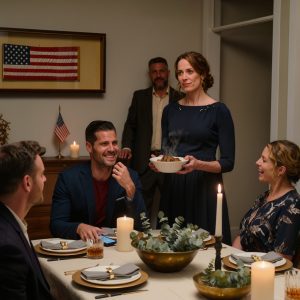
Daniel’s chair scraped backward. He stood up, knocking his coffee cup over, the brown liquid spreading across the white tablecloth like a stain that could never be washed out. “Emily,” he whispered. “Emily, what is this?”
Emily did not answer him. She was staring at the phone. At her own voice. At the trap that had been closing around her for months without her ever noticing.
The recording continued.
*“The realtor confirmed the listing goes live February first,”* Emily’s voice said cheerfully. *“Mr. Carter said we can close by March if we move fast.”*
Daniel’s hands were shaking so badly he gripped the back of his chair to steady himself. “You told me it was just… just a few months of medication. You said she’d forget things, not that we were selling her house from under her.”
*“Daniel, grow up. You think we can afford that condo on your salary? This is the only way.”*
The doorbell rang a third time. Then a knock. Hard.
“Emily Miller,” a voice called from outside, “this is the police. Open the door.”
Emily’s head snapped toward the front hallway. Her ponytail swung. For one terrible moment, she looked exactly like she had as a child—caught with her hand in the cookie jar, scrambling for an excuse that would never come.
“Don’t answer that,” she said.
“Emily.” Daniel’s voice cracked. “The police are at the door.”
“It’s not the police. It’s Dr. Patel. I called her this morning to come evaluate Mom before the paperwork.”
Linda reached into her cardigan pocket and pulled out a manila envelope. She slid it across the table toward her daughter. The envelope was thick, heavy with paper.
“What is that?” Emily asked.
“Open it.”
Emily did not move.
So Linda opened it herself. She pulled out the contents one by one: three small glass jars labeled with dates, a stack of lab reports from Dr. Evans, and a single photograph of Michael from their wedding day, his face young and hopeful in black and white.
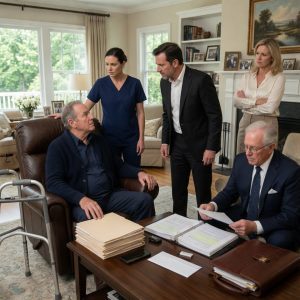
“The jars contain tea samples from October, November, and December,” Linda said, her voice steady as the old clock ticking on the wall. “Dr. Evans tested them. Each one contains trace amounts of lorazepam. Enough to sedate a seventy-two-year-old woman into appearing cognitively impaired. The medical records from your visits to Dr. Patel show the same drug in my blood tests—administered without my knowledge or consent.”
Emily’s face went from pale to gray.
“You kept the tea,” she breathed.
“I kept everything.”
The doorbell rang a third time. Then a knock. Hard.
“Emily Miller,” the voice called again, “this is the police. Open the door.”
Daniel moved before Emily could stop him. He walked to the front door, his footsteps echoing in the sudden silence of the house. Linda heard the deadbolt slide open. She heard the door swing inward. She heard a man’s voice say, “Daniel Vance, we have a warrant for your arrest.”
Emily turned to her mother.
For a long moment, neither of them spoke.
Then Emily whispered, “You were never confused, were you?”
Linda adjusted her pearl necklace. “I taught criminal law for thirty-five years, Emily. The first thing students learn is that the best defense is not having to defend at all. I built this case before you ever finished your first sentence. I collected every sample. I recorded every conversation. I let Dr. Evans document every medical visit. And when you thought I was sleeping on that couch in October, I was listening to you plan my erasure.”
Emily’s mouth opened. Closed. Opened again.
Two officers appeared in the kitchen doorway. One of them held a piece of paper.
“Emily Miller, you are under arrest for elder abuse, fraud, and attempted murder by poisoning.”
The handcuffs clicked around Emily’s wrists. She did not struggle. She did not scream. She stood there in her designer blouse and pressed slacks, her blonde ponytail still perfect, her sharp blue eyes finally, finally empty of everything but shock.
But here is what nobody noticed.
What nobody noticed was the manila envelope’s last page—the one Linda had not pulled out.
When the police led Emily and Daniel out of the house, and the front door closed behind them, Linda sat down alone at the oak table. She picked up the white roses from the vase Michael had planted. She touched the petals gently.
Then she reached into the envelope and pulled out the final document.
It was a real estate listing agreement.
Dated November 15th.
Signed by Emily.
Listing the house with Mr. Carter, a realtor Emily had been working with in secret. But the listing date was the key—because November 15th was before the formal conservatorship proceedings had even been filed. Before any court had approved anything. Before Emily had any legal right to sell a single brick of her mother’s home.
Linda had found the agreement tucked inside Emily’s folder, underneath the beachfront condo receipt.
Her daughter had been so confident that she would win that she had started spending the money before the deal was done. She had signed a contract to sell the house before she had the legal authority to do so. She had planned every detail of Linda’s erasure months in advance, right down to the realtor’s commission.
Linda folded the paper and placed it back in the envelope.
She would give it to the police tomorrow.
But for now, she sat in the quiet of her home—the home Michael had built, the home she had raised Emily in, the home her daughter had tried to steal—and she smiled.
Not because she had won.
But because she had never lost.
It had started so quietly. That was the cruel part. Not with a fight or a door slamming or a dramatic confrontation. It started with a cup of tea and a daughter who said she wanted to help.
Three days after Michael’s funeral, Emily had appeared at the front door with a suitcase. Linda remembered standing in the doorway, still wearing the black dress from the service, her eyes raw and hollow, her hands empty.
“Mom,” Emily had said, her voice soft and gentle, “I’m staying with you for a while. You shouldn’t be alone right now.”
And Linda had believed her.
She had believed her because grief makes you desperate for kindness. Because when you have just buried the man you loved for forty years, you will take comfort from anyone who offers it. Because Emily was her daughter, and daughters do not lie to their mothers about things like this.
Or so Linda had thought.
The first month had been bearable. Emily cooked dinners, organized the mail, sat with Linda in the evenings and talked about old photographs. She brought tea every morning at eight o’clock—chamomile with honey, served in the same blue ceramic mug Michael had used.
“It’ll help your nerves, Mom,” she’d say, sitting on the edge of the bed. “Grief can mess with your sleep.”
Linda drank it because she trusted her.
And then the fog began.
It started small. Forgetting where she put her keys. Walking into a room and not remembering why. Struggling to find the word for something as simple as “refrigerator” or “newspaper” or “daughter.”
“It’s your age, Mom,” Emily said, her voice patient and kind. “You’re seventy-two. We need to be realistic.”
Linda nodded. She did not want to be a burden. She did not want to be the kind of old woman who fought reality.
So she let Emily take her to the doctor.
“My mother leaves the stove on,” Emily told Dr. Patel, her hand resting gently on Linda’s arm. “She gets confused in her own house. I’m worried about her safety.”
Linda tried to argue. She opened her mouth to say that she had never left the stove on, that she had been cooking for sixty years without incident, that the fog in her head was new and wrong and terrifying.
But her tongue felt heavy. Her thoughts would not form into sentences. She sat in the chair and stared at the doctor’s kind face and felt herself slipping away.
“We’ll run some tests,” Dr. Patel said. “It could be early-stage dementia. We’ll monitor her closely.”
The word “dementia” hung in the air like a sentence.
Emily squeezed her hand. “We’ll get through this together, Mom.”
And Linda had believed her.
She had believed her for months.
She had believed her while Emily answered her phone, pushed away her friends, told her brother David that she was “too fragile” to visit. She had believed her while the fog grew thicker and her world shrank smaller, until she was confined to the living room, the bedroom, the bathroom, and the morning tea.
She had believed her until October.
Until the afternoon she pretended to sleep on the couch.
Emily had thought she was napping. She had been in the kitchen with Daniel on speakerphone, her voice low and excited, the way she had sounded as a child when she was planning a birthday party.
“The realtor said the house is worth at least three and a half million,” Emily had whispered. “Once we have power of attorney, we sell it. Then we move the money before anyone starts asking questions.”
Linda kept her eyes closed.
Her heart did not race.
It went still.
Because in that moment, the fog lifted. Not completely—but enough. Enough for her to hear the numbers, the plan, the casual cruelty of a daughter who saw her mother not as a person but as an obstacle.
That night, Linda did not drink the tea.
She lifted the cup, smiled, let Emily think she had swallowed, and then poured every drop into the planter by her window.
The next morning, her mind was clearer than it had been in months.
So she did it again.
And again.
Within a week, she knew.
Her daughter was not caring for her.
Her daughter was preparing to erase her.
Linda bought a small recorder from an electronics store across town. She hid it in the pocket of her robe. She began collecting samples of the tea in tiny jars she had saved from Michael’s medication bottles.
She called Dr. Evans.
Dr. Helen Evans was an oncologist, not a geriatric specialist. But she had been Michael’s doctor for years, and she was the one person Emily had never been able to charm. Dr. Evans had a kind face, short gray hair, and the steady hands of a woman who had spent decades delivering bad news with compassion.
“Linda,” she said when she answered the phone. “It’s been a long time. How are you?”
“I need your help,” Linda said. “And I need you to keep this between us.”
She told Dr. Evans everything. The tea. The fog. The whispered conversations. The folder in Emily’s nightstand. The beachfront condo receipt.
There was a long silence on the other end of the line.
“Bring me the tea samples,” Dr. Evans said finally. “And come in for blood work. Quietly. I’ll run the tests myself.”
Linda did.
She took a bus to the hospital, telling Emily she needed fresh air. She handed over the jars and sat in the examination room while Dr. Evans drew her blood. She waited three days for the results.
When they came, Dr. Evans called her personally.
“Lorazepam,” she said. “Consistent low doses over a prolonged period. Enough to cause confusion, memory loss, and cognitive impairment in an older patient. Linda, this wasn’t an accident. Someone has been administering this to you deliberately.”
Linda sat in the armchair in her bedroom, holding the phone, staring at the planter by the window. The plant was nearly dead. Its leaves were brown and curled.
“I know,” she said. “It’s my daughter.”
Dr. Evans was silent for a moment. Then she said, “What are you going to do?”
Linda looked at the phone in her hand. At the recorder in her robe pocket. At the jars of tea she had hidden at the back of her closet, underneath a stack of old sweaters.
“What I taught my students to do,” she said. “Build a case.”
And that was exactly what she did.
She let Emily believe she was winning.
She dropped things on purpose. She stared blankly at calendars. She called Daniel by the wrong name. She watched Emily write down fake “incidents” in a folder labeled with Linda’s name.
She recorded every conversation.
She collected every receipt.
She let Dr. Evans document every medical visit.
And when Emily thought she was asleep on the couch in October, Linda was listening to her plan her own erasure.
She heard every word.
She wrote down every date.
And she waited.
Because the best defense, she had taught her students for thirty-five years, was not having to defend at all.
The best defense was a case so airtight that the other side never even got to speak.
And now, as the police car pulled away from the curb, carrying Emily and Daniel to a future they had never planned for, Linda sat at the oak table with the white roses in her hand.
She had won.
But she did not feel victorious.
She felt something older and heavier—the grief of a mother who had lost her daughter long before the handcuffs clicked shut.
She looked at the photograph of Michael that she had pulled from the envelope. His face smiled back at her, young and hopeful, frozen in a moment before everything went wrong.
“I’m sorry,” she whispered to his image. “I raised her. I loved her. And I didn’t see what she was becoming until it was too late to stop it.”
The house was quiet now.
The kettle was cold.
The white roses smelled like the garden Michael had planted forty years ago, when they were young and the future was a road they would walk together.
Linda touched a petal.
Then she stood up, walked to the window, and looked out at the street where her daughter had just been taken away.
The sun was rising over the neighbor’s rooftops, pale and gold.
It was the first day of a new year.
And Linda Miller, retired professor of criminal law, was still standing in her own home, on her own terms, with her own evidence in her hands.
She had survived.
But more than that—she had been ready.
And that, she thought, was the difference between a victim and a woman who refused to become one.
The sun was rising over the neighbor’s rooftops, pale and gold, but Linda did not stay to watch it. She had work to do.
The police had taken Emily and Daniel away in the back of a cruiser, their faces frozen in identical masks of disbelief. The neighbors had come out to watch, their coffee mugs steaming in the cold January air. Linda had stood on the porch and watched until the taillights disappeared around the corner.
Then she had closed the door, locked it, and walked back to the kitchen.
The tea was still on the table. Cold now. The white roses still stood in their vase, untouched and beautiful. The manila envelope sat beside her plate, thick with the weight of everything her daughter had tried to take from her.
Linda picked up the phone and dialed the number she had saved in her contacts under a false name.
“David,” she said when her brother answered. “It’s done.”
There was a long pause on the other end. Then David’s voice, rough with sleep and worry, said, “Are you okay?”
“I will be,” she said. “But I need you to come home. I need you to see the house before they—” She stopped. Before they take it, she had almost said. But they hadn’t. She had stopped them. “Before anything else happens. I need you here.”
“I’ll be on the next flight,” David said. “Linda, I’m so sorry I believed her. She called me every week. She said you were forgetting things, that you didn’t recognize me anymore. She sounded so—”
“Convincing,” Linda finished. “Yes. She’s very good at that.”
She hung up and sat in the quiet of the kitchen, listening to the house settle around her. The refrigerator hummed. The clock ticked. Somewhere upstairs, a floorboard creaked, the same floorboard that had creaked for forty years, the same sound that had woken Michael up on nights when she couldn’t sleep.
She had taught criminal law for thirty-five years. She had watched hundreds of students learn how to build cases, how to dismantle alibis, how to find the single thread that would unravel an entire story.
But she had never taught them how to feel when the criminal was your own child.
The thought sat in her chest like a stone.
She stood up, poured the cold tea down the sink, and began to clean the kitchen. It was what she had always done when the world felt too heavy. She scrubbed the counters. She washed the dishes. She dried the white roses and put them in fresh water.
By the time the sun was fully up, the house was spotless.
And Linda was ready to begin again.
The first thing she did was call Dr. Evans.
“Helen,” she said, her voice steady despite the exhaustion settling into her bones. “I need you to send the full medical report to the district attorney’s office. Every test. Every result. Every documentation of the lorazepam in my system.”
“Already done,” Dr. Evans said. “I sent it this morning, along with a letter confirming that the sedation was administered without your knowledge or consent. Linda, I have to ask—are you safe? Is there anyone in the house with you?”
“I’m alone,” Linda said. “And I’m safe.”
There was a pause. Then Dr. Evans said, softly, “You know, when you first came to me, I didn’t want to believe it. I thought maybe it was a misunderstanding. But the tests—they don’t lie. She was poisoning you, Linda. For months. Do you understand what that means?”
Linda looked at the photograph of Michael on the mantelpiece. He was smiling at her from their wedding day, young and hopeful, his arm around her waist, her white dress trailing in the grass.
“I understand exactly what it means,” she said. “It means my daughter tried to kill me for money. And I caught her.”
She hung up and walked to the study.
The study had been Michael’s favorite room. It was small, lined with bookshelves, with a single window that looked out at the garden. The garden was dead now, winter-bare, but in spring it would bloom again. The roses would come back. The hydrangeas would turn blue. The world would keep turning.
Linda sat at the desk and opened the drawer where she had kept her notes.
There were dozens of pages. Handwritten. Dated. Every conversation she had recorded, every suspicion she had noted, every piece of evidence she had collected. She had been building this case for months, and now it was time to deliver it to the people who would finish it.
She pulled out the real estate listing agreement dated November 15th.
Emily’s signature was at the bottom. Clean. Confident. The signature of a woman who believed she had already won.
Linda folded the paper and placed it in a new envelope. She would give it to the police tomorrow, along with the recording of Emily discussing Mr. Carter and the beachfront condo.
But for now, she needed to rest.
She walked upstairs to her bedroom, the same bedroom she had shared with Michael for forty years. The bed was made. The curtains were drawn. The planter by the window was empty now, the dead plant thrown away, the soil replaced with fresh earth.
She lay down on the bed and closed her eyes.
For the first time in months, she slept without dreaming.
The next morning, the doorbell rang at seven o’clock.
Linda opened the door to find David standing on the porch, his suitcase at his feet, his face lined with worry. He was sixty-eight years old, tall and kind, with the same gray hair as Linda and the same steady eyes.
“Sis,” he said, and pulled her into a hug.
She held him tightly, breathing in the familiar smell of his coat, the same coat he had worn for years, the same coat that smelled like the airport and coffee and home.
“Thank you for coming,” she said.
“I should have come sooner,” he said. “I should have seen through her. She told me you were losing your mind, Linda. She told me you didn’t remember me. And I—” He stopped, his voice cracking. “I believed her. I’m so sorry.”
Linda took his hand. “You’re here now. That’s what matters.”
They walked into the kitchen together. Linda made coffee, the way she had done every morning for as long as she could remember. She set out toast and fruit, just as she had done on New Year’s morning, but this time there was no tea. There was no Emily. There was no fear.
“I need to tell you everything,” Linda said. “From the beginning.”
And she did.
She told him about Michael’s funeral. About Emily arriving with her suitcase. About the tea that made her feel foggy. About the doctors who believed Emily’s stories about dementia. About the whispered conversation she had heard in October. About the recorder, the tea samples, the medical tests, the manila envelope full of evidence.
David listened without interrupting. When she finished, he sat back in his chair and stared at the table.
“She was going to put you in a home,” he said slowly. “She was going to sell the house and take everything. And then she was going to leave you there to rot.”
“Yes,” Linda said.
“And you caught her. You built a case against your own daughter and you caught her.”
Linda nodded.
David was silent for a long moment. Then he said, “You’re the strongest person I’ve ever known.”
Linda shook her head. “I’m just a woman who didn’t want to be erased.”
The next few days passed in a blur of meetings and phone calls.
Linda met with the district attorney, a young woman named Sarah Chen who had graduated from the same law school where Linda had taught for thirty-five years. Sarah was sharp and thorough, with dark eyes that missed nothing.
“Professor Miller,” Sarah said, shaking her hand. “I read your file. This is one of the most comprehensive cases I’ve ever seen. You documented everything.”
“I had a good teacher,” Linda said.
Sarah smiled. “I know. I took your criminal law class in 2008. I still remember what you said on the first day: ‘The best defense is not having to defend at all.'”
Linda felt a warmth spread through her chest. “You remembered that.”
“I remember everything you taught us,” Sarah said. “And I’m going to use it to make sure your daughter faces the full consequences of what she did.”
The meeting lasted two hours. Linda handed over every piece of evidence: the tea samples, the medical reports, the recorded conversations, the real estate listing agreement, the beachfront condo receipt, the folder filled with Emily’s handwritten timeline of the conservatorship.
Sarah looked at each document carefully. When she reached the listing agreement dated November 15th, she paused.
“Your daughter signed this before the conservatorship was even filed,” she said.
“Yes,” Linda said.
“This is premeditation. This shows intent. This is the difference between a crime of opportunity and a calculated plan.” Sarah looked up. “Professor Miller, you’ve given us everything we need to put her away for a very long time.”
Linda felt the weight of those words settle on her shoulders. She had done what she set out to do. She had built a case that could not be broken.
But she had also lost her daughter.
And that loss was something no amount of evidence could ever fix.
The trial began six months later, in the heat of July.
Linda sat in the front row of the courtroom, wearing the same pearl necklace and cream cardigan she had worn on New Year’s morning. David sat beside her, his hand resting on hers. Dr. Evans sat two rows behind them, her glasses glinting in the fluorescent light.
Emily sat at the defense table, her blonde hair pulled into a sleek ponytail, her sharp blue eyes fixed on the judge. She wore a gray suit that looked expensive, the same suit she had worn to Michael’s funeral. Beside her, Daniel sat with his head bowed, his hands trembling in his lap.
The prosecution called Linda to the stand first.
“Professor Miller,” Sarah Chen said, “can you describe the morning of January first of this year?”
Linda took a breath. The courtroom was silent. Every eye was on her.
“I set the table,” she said. “White roses in the center. Coffee, toast, fruit. And a cup of chamomile tea that my daughter had prepared for me.”
“And did you drink that tea?”
“No.”
“Why not?”
“Because I knew it contained sedatives. I had been collecting samples of the tea for months. I had a medical report from Dr. Helen Evans confirming the presence of lorazepam in my system. I had recordings of my daughter discussing her plan to gain power of attorney, sell my house, and place me in a care home against my will.”
The courtroom erupted in whispers. The judge banged her gavel.
Emily’s face remained perfectly still, but her hands were gripping the table so tightly that her knuckles had turned white.
“Professor Miller,” Sarah said, “what did you do when your daughter placed the tea in front of you?”
“I pushed it away,” Linda said. “And I told her that I had heard her last night.”
“Did she respond?”
“She told Daniel to call Dr. Patel. She said I was having another episode.”
“And what did you do?”
Linda looked directly at her daughter. “I pulled out my phone and played the video I had recorded.”
The courtroom went silent again.
Sarah Chen walked to the prosecution table and picked up a tablet. “Your Honor, the prosecution would like to enter Exhibit A into evidence: a video recording dated October 12th of last year, showing the defendant Emily Miller and her husband Daniel Vance discussing their plan to drug, confine, and financially exploit the victim.”
The judge nodded. “Exhibit A is admitted.”
The video began to play on the courtroom monitors.
Emily’s voice filled the room, clear and confident, the same voice Linda had heard in the kitchen that October night.
*”After New Year’s, we put her in the home. Once she’s there, nobody will believe a word she says.”*
Daniel’s voice followed, shaky and hesitant. *”Are you sure this is going to work? What if she fights it?”*
*”She won’t fight it. She’s seventy-two years old and she’s been on sedatives for months. By January, she won’t even remember her own name.”*
The courtroom was deathly still.
Linda watched her daughter’s face as the video played. Emily’s expression was frozen, her jaw tight, her eyes fixed on some point in the middle distance. She did not look at the screen. She did not look at the judge. She did not look at her mother.
When the video ended, the silence that followed was so complete that Linda could hear the air conditioning humming overhead.
“Your witness,” Sarah Chen said, and sat down.
Emily’s lawyer stood up, a man in an expensive suit with a practiced smile. “Professor Miller, you claim that you were collecting evidence against your daughter for months. Is that correct?”
“Yes.”
“And during those months, you continued to live in the same house as her. You continued to eat her food. You continued to let her believe that you trusted her.”
“Yes.”
“Doesn’t that seem like the behavior of someone who was setting a trap, rather than someone who was genuinely afraid?”
Linda met his eyes. “I was a criminal law professor for thirty-five years. I knew that if I confronted her without evidence, she would deny everything and destroy the proof. I waited until I had a case that could not be broken.”
“And you don’t think that’s manipulative?”
“I think it’s survival.”
The lawyer tried to press her further, but Linda did not waver. She answered every question with the same steady voice, the same calm certainty, the same steel that had carried her through the darkest months of her life.
By the time she stepped down from the witness stand, the jury was looking at her with something like awe.
The trial lasted two weeks.
The prosecution called Dr. Evans, who testified about the tea samples and the medical tests. They called the realtor Mr. Carter, who confirmed that Emily had approached him about listing the house before the conservatorship was approved. They played the recordings Linda had made, one after another, each one showing a different piece of the conspiracy.
Emily did not testify in her own defense.
Daniel did.
He took the stand on the tenth day, his face pale, his hands shaking, his voice barely audible.
“Did you know your wife was poisoning her mother?” the prosecutor asked.
Daniel looked at Emily. She stared back at him, her eyes cold and unblinking.
“I—” He stopped. Swallowed. “I knew she was giving her something. She said it was just to help her sleep. She said it was temporary.”
“And when did you realize it wasn’t temporary?”
“When Linda started forgetting things. When Emily started talking about power of attorney and selling the house. I knew it was wrong. I should have stopped it. I should have—”
“What should you have done?”
“I should have called the police.” His voice cracked. “I should have told someone. But I was afraid of Emily. I was afraid of losing her. I was a coward.”
The courtroom was silent.
Emily’s face did not change.
The jury deliberated for six hours.
They returned with a verdict of guilty on all counts: elder abuse, fraud, conspiracy to commit kidnapping, and attempted murder by poisoning.
Emily was sentenced to twenty-five years to life.
Daniel was sentenced to eight years for his role in the conspiracy.
Linda sat in the front row as the judge read the sentence. She did not cry. She did not cheer. She sat perfectly still, her hands folded in her lap, her pearl necklace catching the light.
When the bailiff led Emily out of the courtroom, she turned and looked at her mother one last time.
There was no anger in her eyes. No regret. No love.
Just emptiness.
And Linda understood, in that moment, that the daughter she had raised had been gone for a long time. Maybe she had never really existed at all.
After the trial, Linda went home.
The house was the same as she had left it. The white columns. The oak table. The planter by the window, now filled with fresh soil and a new plant—a small rose bush that David had bought for her.
She walked through every room, touching the furniture, remembering the life she had built here with Michael. She stopped in the study, where his books still lined the shelves. She stopped in the bedroom, where his side of the bed was still made.
And then she walked to the garden.
The garden was in full bloom now, July roses climbing the trellis, hydrangeas turning blue in the afternoon sun. Michael had planted every flower himself, years ago, when they were young and the future stretched out before them like a road with no end.
Linda knelt down and touched the soil.
It was warm. Alive. Full of possibility.
She had survived.
More than that, she had won.
But winning, she had learned, was not the same as healing.
She sat in the garden for a long time, watching the sun move across the sky, listening to the birds and the distant sound of traffic and the quiet hum of a world that had kept turning even when hers had stopped.
And when the sun began to set, painting the sky in shades of gold and pink, she stood up, brushed the dirt from her knees, and walked back inside.
There was a pot of tea waiting for her on the stove.
She poured herself a cup, sat down at the oak table, and drank it.
It was just chamomile.
And it tasted like freedom.
They did not take her that day.
The arresting officers stood in the kitchen doorway, watching Emily’s face drain of color as the recording played on. Daniel had already been led outside, his shoulders slumped, his hands cuffed behind his back. He did not look back. He could not.
Emily stood frozen, her designer blouse still crisp, her ponytail still perfect, her blue eyes fixed on the phone screen where her own voice kept talking.
“—and once she’s in the facility, we file the conservatorship. The house goes on the market by February. Mr. Carter already has three buyers lined up.”
The officer cleared his throat. “Ms. Miller. We need you to come with us.”
Emily turned to her mother.
“Mom. Please.”
Linda adjusted her pearl necklace. “You brought me tea every morning for three hundred and sixty-four days. You watched me forget my own name. You told my brother I was losing my mind. You signed a contract to sell my home before you had the legal right to do so. And now you want me to save you?”
“I’m your daughter.”
“No,” Linda said softly. “You were my daughter. I don’t know who you are now.”
The officer took Emily’s arm. She did not resist. She walked out of the kitchen, past the white roses, past the oak table where she had sat every morning pretending to be a caregiver. She did not say goodbye.
The front door closed behind her.
Linda stood alone in the kitchen.
The house was quiet.
The tea sat untouched on the table, steam still rising from the porcelain cup.
She walked to the window and watched the police car pull away, its lights flashing silently through the morning fog. Neighbors had started to gather on the sidewalk, drawn by the commotion. Mrs. Patterson from three doors down was holding her robe closed with one hand and her phone with the other, already dialing someone to spread the news.
Linda pulled the curtain closed.
She sat down at the oak table. She picked up the white roses, touched the petals gently, and set them back down.
Then she reached for her phone.
She called David.
He answered on the second ring, his voice rough with sleep. “Linda? It’s—it’s seven in the morning. What’s wrong?”
“Nothing,” she said. “Everything is right. Can you come home?”
There was a pause. Then, softly: “I’ll be on the next flight.”
She hung up and looked around the kitchen.
The coffee had gone cold. The toast was still on the plate, uneaten. The fruit was untouched. The white tablecloth was stained brown from Daniel’s overturned cup.
It looked like a crime scene.
In a way, it was.
The investigation took six months.
Linda sat through every hearing, every deposition, every meeting with the district attorney’s office. She handed over the manila envelope with the tea samples, the lab reports, the recordings, the real estate listing agreement dated November fifteenth. She answered every question the same way: calmly, precisely, without emotion.
“Were you aware that your daughter was planning to place you in a care facility?”
“I was.”
“When did you become aware?”
“In October. I pretended to be asleep on the couch, and I heard her discussing it with her husband.”
“Why didn’t you confront her immediately?”
“Because I needed evidence. I needed proof that would hold up in court. I taught criminal law for thirty-five years. I knew that an accusation without evidence would only make me look like the confused old woman she was trying to convince everyone I was.”
“And you collected that evidence yourself?”
“Yes.”
“Without help?”
“Yes.”
“How?”
Linda smiled. “I bought a voice recorder from an electronics store across town. I collected tea samples in small glass jars. I visited Dr. Evans, the oncologist who treated my husband, and asked her to test them confidentially. I documented every symptom Emily claimed I had and compared them to the times I actually drank the tea versus the times I pretended to.”
The prosecutor leaned forward. “You pretended to drink the tea?”
“For months. I poured it into the planter by my window every morning. The plant died. I didn’t.”
A ripple of murmurs went through the courtroom.
Emily sat at the defense table, her face carefully blank. She wore a pressed black blazer and a white blouse. Her hair was still in a perfect ponytail. She looked like she was attending a business meeting, not her own trial.
Her lawyer, a thin man with expensive glasses, stood up.
“Dr. Evans, you say you tested the tea samples. Can you confirm the chain of custody?”
Dr. Evans adjusted her glasses. “Linda handed them to me personally. I logged them into our system immediately. They were never out of my sight.”
“And the results?”
“Each sample contained trace amounts of lorazepam. A benzodiazepine used to treat anxiety and insomnia. At the doses found in the tea, a seventy-two-year-old woman would experience significant cognitive impairment—confusion, memory loss, disorientation. Exactly the symptoms Emily Miller reported to multiple doctors.”
“So the symptoms were chemically induced?”
“Without question.”
The courtroom erupted.
Emily’s lawyer tried to argue that the medication was prescribed, that Linda had a history of anxiety, that the lorazepam was meant to help her sleep. But the prosecution had an answer for every claim.
“Then why,” the prosecutor asked, “did Emily Miller never tell any doctor that she was adding the medication to her mother’s tea? Why did she never provide a prescription? Why did she tell Dr. Patel that her mother had dementia—a diagnosis that was never confirmed by any specialist?”
Emily’s lawyer had no answer.
The trial lasted three weeks.
Linda testified on the second day. She walked to the witness stand slowly, deliberately, her pearl necklace catching the light, her gray hair in its tidy bun. She looked exactly like what she was: a retired professor who had spent her life studying how criminals hide the truth.
“Ms. Miller,” the prosecutor said, “can you describe the moment you realized your daughter was poisoning you?”
Linda paused.
“I didn’t realize it all at once,” she said. “It was gradual. The fog in my head. The missed appointments. The way Emily started answering questions for me at the doctor’s office. I thought I was getting old. I thought I was losing my mind.”
“And when did you stop believing that?”
“When I pretended to sleep on the couch in October. I heard her on the phone with Daniel. She said—” Linda’s voice caught for the first time. “She said, ‘After New Year’s, we put her in the home. Once she’s there, nobody will believe a word she says.'”
“And what did you do?”
“I stopped drinking the tea.”
“Just like that?”
“Just like that. The next morning, I poured it down the sink. Within three days, my mind was clear. Within a week, I knew exactly what was happening.”
“And you didn’t confront her?”
“No. I collected evidence. I recorded conversations. I saved tea samples. I went to Dr. Evans. I built a case.”
“You built a case against your own daughter.”
“Yes.”
“How did that feel?”
Linda looked at Emily.
For a long moment, mother and daughter stared at each other across the courtroom.
“Like dying,” Linda said softly. “And being born again at the same time.”
Emily looked away first.
The jury deliberated for two days.
They returned with a verdict of guilty on all counts: elder abuse, fraud, conspiracy, and attempted murder.
Emily was sentenced to twenty-five years to life.
Daniel, who had cooperated with the prosecution and testified against his wife, received eight years.
Mr. Carter, the realtor, was investigated for his role in the scheme. The court found that he had knowingly participated in a fraudulent real estate transaction. His license was revoked. He faced civil penalties and criminal charges.
Linda’s money was returned. The house remained hers. The beachfront condo Emily had put a down payment on was seized and sold, the proceeds donated to a local elder abuse prevention charity.
The news coverage was extensive.
Local papers ran headlines like “Retired Professor Foils Daughter’s Poison Plot” and “Tea Time Turned Toxic: The Linda Miller Case.” National outlets picked it up. Linda received letters from strangers—other older adults who had been gaslit, manipulated, and robbed by the people they trusted most.
She answered every letter.
She wrote back to a woman in Ohio whose son had forged her signature on a deed. She called a man in Florida whose daughter had drained his bank account. She sat on the phone for hours with a retired teacher in California whose niece had convinced her she had dementia.
“I’m not a hero,” Linda told one reporter. “I’m just a woman who spent thirty-five years teaching people how to spot lies. And then I had to use those skills to save my own life.”
The reporter asked, “Do you forgive your daughter?”
Linda was quiet for a long time.
“I don’t know if forgive is the right word,” she said finally. “I think what I’ve done is accept that the daughter I raised never really existed. The woman who tried to erase me was someone else entirely. And I don’t owe her forgiveness. I owe myself the right to move forward without carrying her weight.”
The article ran the next day.
Linda clipped it and put it in a drawer.
She did not read it again.
David arrived the week after the trial ended.
He was sixty-eight years old, tall and kind, with gray hair and the same steady eyes as Linda. He had flown across the country the moment she called, and he had stayed in a hotel near the courthouse for the duration of the trial, sitting in the front row every day.
“I should have been here sooner,” he said the first night. He was sitting at the oak table, a cup of coffee in his hands, his face shadowed with guilt. “I should have known something was wrong. I should have—”
“David.” Linda reached across the table and took his hand. “She convinced everyone. She convinced doctors. She convinced neighbors. She convinced you. That was the point.”
“I believed her when she said you were losing your mind.”
“And I believed her when she said she loved me.”
They sat in silence for a long time.
The house was warm. The kettle whistled on the stove. The white roses were still in the vase, though they had started to wilt, their petals curling at the edges.
“I don’t know how to start over,” Linda said quietly.
David squeezed her hand. “You don’t start over. You just keep going. One day at a time.”
“What if I don’t know how to do that anymore?”
“Then you learn. The same way you taught yourself to survive. One day at a time.”
Linda looked at her brother.
He was the only family she had left now.
And for the first time in months, she felt something other than fear or anger or grief.
She felt gratitude.
The next morning, David made breakfast.
He burned the toast and undercooked the eggs and spilled coffee on the counter. Linda laughed for the first time in a year—a real laugh, the kind that came from somewhere deep and unexpected.
“You’re a terrible cook,” she said.
“I’m a great brother,” he replied. “That’s the only job I need.”
They spent the day cleaning the house.
They opened windows that had been closed since Michael died. They aired out the living room, the study, the bedroom. They washed dishes that had been sitting in the sink for weeks. They swept the hardwood floors. They polished the oak table until it gleamed.
Linda found Michael’s old gardening gloves in the garage and put them on.
She walked to the garden.
The roses were overgrown. The hydrangeas had gone wild. The plant by the window—the one she had been pouring tea into—was dead, its leaves brown and brittle.
She pulled it out by the roots and threw it in the compost bin.
Then she knelt down and planted a new one.
A small rose bush, the same kind Michael had planted years ago.
The same kind that grew along the trellis by the porch.
The same kind that would bloom in the spring.
“Starting over,” she said to herself.
And she meant it.
The day after the garden was replanted, Linda drove to the cemetery.
She had not visited Michael’s grave since the funeral. She had been too afraid. Too ashamed. Too broken.
But now she stood in front of the headstone, holding a single white rose from the garden he had planted.
The stone read: *Michael Miller. Beloved Husband, Father, and Friend. 1948–2023.*
She knelt down and placed the rose at the base.
“I’m sorry I didn’t come sooner,” she said. “I was saving the house. Our house. The one we built together.”
The wind moved through the trees, carrying the sound of birds and distant traffic.
“She tried to take it from me,” Linda continued. “She tried to take everything. But I stopped her. I stopped her the way you would have wanted me to. With evidence. With patience. With the law.”
She touched the headstone.
“I don’t know if I’ll ever forgive her. But I know I’m not going to let her destroy the rest of my life. I’m going to keep living. I’m going to keep fighting. I’m going to keep planting roses.”
She stood up and brushed the dirt from her knees.
“I love you, Michael. I always will.”
She walked back to her car and drove home.
The house was waiting for her.
The windows were open. The curtains were moving in the breeze. David was in the kitchen, making another attempt at breakfast, and the smell of burnt toast filled the air.
Linda smiled.
She walked inside, closed the door behind her, and sat down at the oak table.
The white roses were still in the vase, their petals curling at the edges, their scent soft and sweet.
She picked one up and held it to her nose.
Then she set it down and poured herself a cup of tea.
Just chamomile.
Just tea.
Just a woman who had survived.
And that was enough.
*The end.*