That spring, before any of it, Wesley Carr had said it plain over supper. A thing don’t have to be pretty to be worth keeping. It only has to be good at the one thing nobody else can do.
His wife, Juny, had smiled at him across the lamp. She believed it, too, though the valley did not. Out here a creature earned its feed, or it didn’t.
Beauty was nothing. Use was everything, and use, she had learned, often wore a strange and ugly face. The car place sat at the cold end of the valley, 40 acres of stubborn ground that the previous owner had nearly starved on before selling cheap.
Wesley and Juny had bought it the autumn before with the last of his wages from the lumber camp and a small sum Juny had saved sewing shirts. It was not much. A low house, a leaning barn, a creek that ran thin in dry years, but it was theirs, and they meant to make it pay.
Their neighbors were older men with established farms, and they regarded the young couple with the patient amusement people reserve for those they expect to fail. Chief among them was Garrett Puit, who farmed the largest spread in the valley, and sold seed potatoes to half the county. Puit was not unkind, exactly.
He simply could not imagine that anyone might know something he did not. When Wesley asked his advice that first winter, Puit told him to plant potatoes like everyone else and not get clever about it. So they planted potatoes.
Three acres of them rose straight as Juny could pull a string because potatoes kept through winter and sold steady and a young farm needed a sure thing more than a dream. Juny was the one who noticed things. She had grown up the daughter of a man who kept bees and read the weather in the way swallows flew.
And she had inherited his habit of looking closely at small matters others walked past. Where Wesley saw a field, Juny saw the fields 10,000 small lives. The way the soil crumbled, the insects that crossed a leaf, the birds that came and what they were eating when they came.
Wesley was steadier, slower, a big, quiet man who trusted his wife’s eye more than his own. They made a good pair that way. He supplied the labor and the patience.
She supplied the noticing. Between them they had built in one short year, the bones of something that might one day be a real farm. What they did not have was money or margin for a bad season.
A single ruined crop would set them back two years, maybe end them. And so when Juny began that May to crouch among the young potato plants and turn the leaves over in her fingers, frowning at what she found on their unders sides, the matter was not idle. It was survival.
She found clustered along the veins tiny clutches of orange eggs, and she did not like them at all. Word came through the valley like a cold draft. A farm two days east had been overrun the year before.
beetles, striped and small, hatching by the thousand, and stripping every potato field to bare stalks within a fortnight. The man had lost everything and walked off his land. Now the same eggs were appearing on leaves all across the county, and no one knew a sure way to stop them.
That same week, a notice was tacked to the post outside the feed store. A failed duck farm at the valley’s far edge was selling off its flock before the bank took the place. The ducks, the notice admitted, were near blind.
Some sickness of the eyes had run through them, and good for little. 63 birds, the whole lot for almost nothing. Juny read the two facts side by side.
Eggs on the leaves, blind ducks, cheap, and something in her went still and certain. “Ducks,” Wesley said that night, not quite a question. “Ducks,” Juny agreed.
He turned his coffee cup slowly on the table. He was not a man who said no to his wife, but he was a man who needed to understand a thing before he committed his back and his money to it. Blind ducks, he said, that can’t see to forage.
That we’d have to feed all summer for nothing. Not for nothing. Juny pulled a potato leaf from her apron pocket and laid it on the table, the underside up, the orange egg small but unmistakable in the lamplight.
You know what hatches out of these? I heard about the place east of here. Then you know there’s no poison cheap enough to dust three acres and no two hands fast enough to pick the bugs off by themselves.
Puit himself doesn’t have an answer. Nobody does. She tapped the leaf.
Ducks eat beetles. Eat them by the hundred. A duck doesn’t care if a bug is striped or pretty.
It just eats. A duck that can see maybe. Wesley rubbed his jaw.
These can’t. They’ll wander into the creek and drown. They’ll trample the plants worse than the beetles.
They’ll stray off and the foxes will have them. It was a fair worry, and Juny had already chewed on it for 2 days. That’s the part that makes them cheap, she said.
And that’s the part I think we can fix. A duck that can’t see far won’t wander far. It stays close to what’s right under its nose.
If we make the close by part of the field exactly where we need it, between the rows, right at the plants, then a blind duck is better than a seeing one. It won’t go roaming. It’ll work the ground it’s standing on.
Wesley was quiet a long moment. He could feel the shape of the idea, the way you feel the grain in a board before the saw confirms it, but he could also feel the laughter waiting at the fence line. The whole valley will think we’ve lost our minds, he said.
The whole valley thought we’d lost our minds buying this place. That’s not comfort, Juny. No, she admitted and reached across the table to put her hand over his.
But if those eggs hatch and we’ve done nothing, we lose the crop. We lose the year, maybe the farm. I’d rather look foolish and keep the farm than look sensible and lose it.
She held his eyes. 63 ducks almost free. If I’m wrong, we’ve spent next to nothing.
If I’m right, we save everything. Wesley looked at the leaf a long time. Then he looked at his wife.
All right, he said. They went the next morning, the wagon rattling out to the failed farm at the valley’s edge. The ducks were worse than the notice had led on, dull- feathered, clumsy, bumping into fence posts, tilting their heads at sounds they could not place.
The man selling them would barely meet their eyes. Ashamed of the sorry lot, Wesley counted out the small handful of coins. They loaded the birds into slatted crates, 63 of them murmuring and shuffling, and drove home with the strangest cargo the valley had seen.
By the time they turned up their own lane, two neighbors had already spotted the load and stopped to stare. Juny lifted her chin and did not explain. The thing was begun now.
There was no road back to before. It was Jun’s father who’d given her the way of seeing that made all this possible, though he’d been gone three years now. He had kept bees, and he used to set her on his knee and say that most folks looked at the world to be done with looking.
A glance, a name, move on. But you, he’d tell her, you look to find something. He taught her that the answer to a hard problem was almost always sitting in plain view, ignored because it was humble or homely or strange.
She thought of him often that spring, turning leaves over in her hands the way he once had. The first job was to build a world a blind duck could succeed in. Juny had thought it through in the dark for two nights running, and now she walked the potato field with Wesley, laying it out.
===== PART 2 =====
The trouble with the ducks, she explained, was not that they were useless. It was that they were useless when left to wander. A blind bird in an open field was a lost bird.
But a blind bird in a narrow space, where everything it needed was within a step or two of its bill, was a different creature entirely. It would work that narrow space all day, snapping at whatever stirred, because it had nowhere else to go and nothing else to do. So we don’t let them have the whole field, she said.
We give them lanes, one between every couple of rows, just wide enough for a duck and walled so they can’t drift. Wesley saw it at once, the carpenter in him already measuring. They had no money for lumber, but a farm accumulates discards the way a creek gathers driftwood, and they put all of it to use.
There were scrapboards behind the barn, gray and warped, but sound enough laid on edge. There was a stand of willow down by the creek, and Wesley cut armloads of the long, supple wids, while Juny wo them into low fences, the way her father had once shown her to weave a hive scap. There were old barrel hoops rusting in a pile, and these they worked into the bends and corners, bending the willow around them to hold a shape.
It was slow work, and it filled the better part of two weeks. They rose before light and worked until they could no longer see. And the field slowly filled with a strange architecture.
Shallow lanes running the length of the rose, knee high walls of board and woven willow. The whole thing looking less like a farm than like some patient child’s enormous game laid out in the dirt. The lanes were narrow enough that a duck sat down in one could not turn around easily and could not climb out at all.
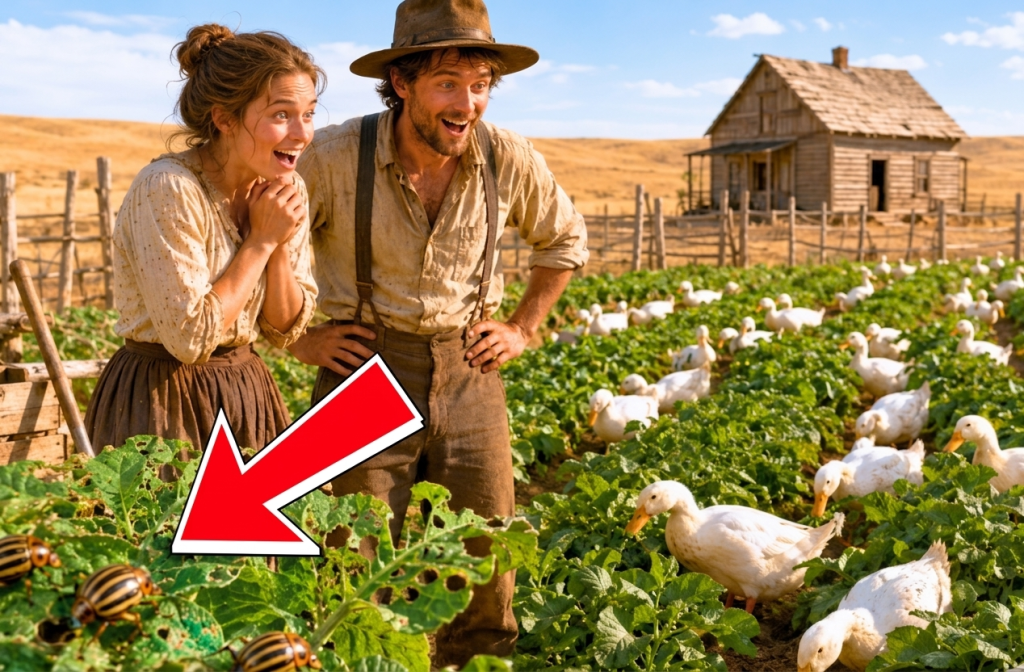
It could only walk forward, nose to the ground, through a corridor that ran directly along the base of the potato plants, exactly where the beetle eggs were laid, exactly where the young beetles would crawl when they hatched. Juny added refinements as they went. At intervals she sank shallow pans of water into the lanes, dug level with the ground, so the ducks could drink and rinsed their bills without straying to the creek.
She angled the lanes so they all drained the same way after rain. She left gaps at the ends, closed with little gates of hoop and willow, so the birds could be moved from lane to lane or led out to the pen at night. When the lanes were ready, they brought the ducks.
===== PART 3 =====
This was the part Juny had worried over most, and the first hour nearly broke her nerve. The birds set loose into the lanes, did exactly what she had feared, bumped the walls, sat down in confusion, complained loudly. A few pressed their breasts to the willow, and pushed as though they might walk through it.
Wesley watched with his arms folded and said nothing, which was his way of not saying, “I told you so.” But Juny had spent her childhood watching creatures learn. And she knew the difference between a thing that cannot be done and a thing that merely takes time. She walked the lanes slowly, scattering a little grain ahead of each bird, drawing it forward.
A duck that cannot see far still has a fine nose and quick ears. And these ducks, once they understood that good things lay just ahead at ground level, began to move. One by one they put their bills down and started forward, snuffling along the dirt, and the snuffling was the whole point.
By the end of the first day, the ducks had stopped fighting the walls. By the end of the third, they had learned the lanes so thoroughly that they walked them like familiar halls, turning at the gates, finding the water pans, settling at dusk, where Wesley funneled them into the pen. They could not see the world, but they had learned this small one entirely, and within it they were not clumsy at all, they were sure.
Juny stood at the field’s edge that third evening, and watched 63 half-blind ducks, moving steadily up and down the lanes, bills to the earth, working the very ground where the trouble would come. It looked absurd. It looked, she would admit, completely ridiculous, but it also looked, to her eye, exactly like a machine that had just switched on and found to run.
The laughter started before the Beatles did. The first to see it was a neighbor named Hollis, who farmed the next place over, and was not a mean man, but could not keep a joke to himself. He rode past the car field on his way to town, slowed, stopped, and sat his horse at the fence for a full 5 minutes with his mouth open.
Then he rode on to the feed store and told everyone, and by the next day, the car field had visitors. They came in twos and threes, leaning on the willow fence, watching the ducks waddle their lanes. The sight was undeniably comic.
Dozens of dull, clumsy birds shuffling slowly down narrow corridors. Heads bobbing, occasionally walking bill first into a wall and sitting down hard. A blind duck has no dignity to begin with, and 63 of them at once, penned in a contraption of barrel hoops and creek willow, made for the best entertainment the valley had seen all year.
What is it you’re farming over there, Carr? Hollis called one morning, grinning. ducks or fences?
Bit of both, Wesley said, and kept working. Garrett Puit came too eventually. He did not lean on the fence and laugh like the younger men.
He stood back a little with his thumbs in his vest and looked at the lanes a long while with an expression Juni could not quite read. Then he shook his head slow, the way a man shakes his head at a child who has glued feathers to his arms to fly. You spent good money on blind ducks, he said.
It was not a question. Spent very little money on them, Juny said. That was rather the point.
And built all this. He nodded at the lanes. All this work for birds that can’t see their own feet.
He let out a breath through his nose. There’s a right way to farm potatoes, and your husband knows it because I told him myself. Dust the rose if the beetles come bad.
Pick by hand if you’ve got the hands. This,” he gestured. “This is a circus, not a farm.” “It may be,” Juny aloud.
“Well know by August.” Puit looked at her, and something flickered behind his eyes. “Not quite respect, but the weariness a settled man feels towards someone who refuses to be embarrassed.” “August,” he said, and rode off. It stung, all of it, more than Juny let show.
There is a particular loneliness in being laughed at by everyone you know. in working yourself to exhaustion at a thing the whole world has agreed is foolish. Some evenings she lay awake running the logic again, checking it like a sum she feared she’d added wrong.
Beetles eat potato leaves. Ducks eat beetles. Blind ducks confined where the beetles will be will eat them where they hatch.
It was sound. She knew it was sound. But sound reasoning is a thin blanket on a cold night when 63 witnesses to your folly are quacking in the yard.
And the whole valley calls your farm the circus. Wesley felt it too, though he carried it differently. He simply put his head down and worked, mending a lane wall here, deepening a water pan there, and when a neighbor called something over the fence, he answered easy and mild, and never rose to it.
But Juny saw how his jaw set when the wagons rolled past, and she knew the patience was a thing he was choosing, not a thing he had to spare. They kept on. They tended the ducks morning and night, moving them lane to lane, so no stretch of field went unworked.
They learned the birds ways, which ones led and which followed, which would come to a particular whistle, which sat down and sulked if moved too soon after eating. The ducks, for their part, grew sleek and content on the steady forage, and the grain Juny scattered, and they began to lay. Eggs appeared in the corners of the pen each morning, more than the two of them could eat, and Juny set the extra in straw, and traded them in town.
It was not much, but it was the first money the strange experiment had returned, and it meant the birds were no longer pure cost. Still, the real test had not come. The eggs on the leaves had not yet hatched.
The fields stood green and whole. The ducks worked their lanes. The neighbors laughed, and the whole valley waited.
Some idly, some hopefully, all certain for the young cars to be proven fools. Juny turned a leaf over every single morning. The clutches of orange were darkening now, the tiny lives inside them coming on.
She counted the days the way her father had taught her to count toward a swarm. Soon, she thought. Soon we will all find out together.
She was not afraid, but she was very, very ready. They hatched all at once, the way her father had said such things do. Juny went out one warm morning, and the underside of every leaf was alive.
Tiny soft-bodied larve just emerged, beginning their slow climb up the stalks to feed. By noon, the first of them had reached the leaves and begun to chew. It was the moment the whole county had been waiting for.
The moment the beetles took the field, except in the car field, the ducks were already there, already low, already snuffling. A larvae that hatched and dropped to the dirt or crawled the base of a stalk met a bill. Juny stood and watched a duck work 6 in of row and clear it of every moving thing.
It was working. It was actually working. For a few days, Juny let herself believe it was one.
Then the trouble began to crowd in from every side at once, the way trouble does when it has been waiting. The first enemy was the beetle’s own numbers. Juny had reckoned on the eggs she could see, but a potato field is wide, and a beetle is patient.
And the hatch, when it came in full, was vaster than anything she had braced for. The larve came not in hundreds, but in thousands on every plant. And though the ducks worked steadily, they could only work the ground beneath their bills.
A larvae high on an upper leaf was beyond a blind duck’s reach. For everyone snapped up at the base, another fed on safely above, growing, and would soon drop to lay eggs of its own. The ducks were winning at the bottom and losing at the top.
And Juny stood in the field with her heart going fast, doing the arithmetic of it, and the arithmetic was not yet on her side. She and Wesley took to walking the rose themselves in the heat of the day, shaking the plants so the larae fell to the ground where the ducks could reach them. It was brutal, endless work, bent double under the sun, and it had to be done every single day, or the upper leaves would carry the infestation past saving.
They rose earlier, they slept less. Jun’s hands cramped, and Wesley’s broad back achd, and still the beetles came on. The second enemy was the weather.
A run of hard rain came through in the second week, turning the lanes to slop. The wa water pans overflowed, and the careful drainage Wesley had angled could not carry at all. Some of the older boards swelled and split.
A whole stretch of willow wall sagged and let three ducks wander loose into the open field, where, unable to see, they blundered toward the creek. Wesley waited out and brought them back muddy to the knees. But it was a long, frightening hour, and it showed how thin the margin was.
The contraption that made the blind ducks useful, was itself fragile, and weather alone could undo it. The third enemy, and the one that hurt worst, was the valley itself. The neighbors had laughed all spring.
But laughter is a kind of attention, and attention can sour. As word spread that the car field was against all sense holding that the beetles had hatched there same as everywhere and yet the plant stood green. The tone at the fence line changed.
The younger men still joked but uneasily now and Garrett Prut stopped coming to look at all which Juny noticed and did not like because a man who has staked his standing on your failure does not enjoy watching you succeed. It was Puit’s seed potatoes after all that half the county had planted. It was Puit’s advice, dust the rose, pick by hand, don’t get clever.
That the whole valley was now watching fail before their eyes. Their own fields going to lace while the circus farm stayed whole. Every green leaf on the car place was a small public argument against the most respected man in the valley.
And Puit was not a man who lost arguments quietly. He began to talk, not unkindly to their faces. He was too careful for that.
But in the feed store and at the mill, in the easy authoritative way of a man whose word carried weight. The Carfields luck would not hold, he said. Blind ducks were no plan.
They’d gotten a lucky few days and would lose the crop yet. Same as everyone, only later and after more foolishness. And anyway, he added, a man who fenced his field into a maze and starved good birds of their sight had no business calling himself a farmer.
It was cruelty dressed as cleverness. That last part traveled because it was the kind of thing people half want to believe. By the third week of summer, Juny heard it come back to her in town, that the cars were mistreating their flock, that there was something not right in what they were doing out there.
and she understood with a cold drop in her stomach that winning the field might not be enough. They might save the potatoes and still lose the valley. The pressure found its way under the door of the little house.
It came first as worry, then as quarrel, the only real quarrel of that whole long summer. They were both worn to the bone. And one night, after a day of shaking larve in the heat, Wesley set down his fork and said carefully that maybe they ought to think about cutting their losses.
Sell off the ducks while they could still get something for the eggs the birds laid, dust what was left of the field the way had said, and stop being the thing the whole valley talked about. Juny stared at him. You think I’m wrong?
I think we’re killing ourselves, Wesley said. I think it might be working. And I think we still might not be able to keep up with it.
And I think he stopped and made himself go on. I think I’m tired of folks saying were cruel. That one I didn’t reckon on.
That one’s hard. It was hard. It was the hardest part because it was the one charge that was not true and could not be argued against since the people repeating it had decided not to come and see.
Juny felt tears come up hot and pushed them down. We are not cruel to those birds, she said low. Those birds are fatter and safer than they’ve been in their lives.
Anyone could come and look. Nobody will because they’d rather believe it. I know, Wesley said.
I know it. I’m only telling you what’s being said and what it’s costing. He rubbed his face.
I trust your eye, Juny. I’ve trusted it since the day I met you. But I need to know you’ve still got it.
That you’re not just digging in because they laughed. That stung worse than anything the valley had said. Because there was a sliver of fairness in it.
Juny sat with it. Was she being stubborn? Was she keeping on out of spite, out of the need to be proven right past the point where sense said stop?
She made herself look at it honestly, the way her father had taught her to look at a hard thing straight rather than around. “Come with me,” she said finally, and rose, and took the lamp. They went out into the warm dark to the field.
Juny walked him down a lane, holding the light low, and turned over leaf after leaf. “Look,” she said. “Look at the base of these plants.
Clean. The ducks have it clean. The trouble’s all up top now, and the up top is what we’re shaking down each day.
She moved the lamp. Three weeks ago, there were eggs on every leaf, top and bottom. Now there’s none below.
We are winning it, Wesley. Slow and hard and barely. But we’re winning the bottom and gaining on the top.
Another 10 days and the worst of the hatch is passed, and there’s nothing left to feed them. We just have to last 10 more days. Wesley looked a long time, turning leaves himself in the lamplight, his big, careful hands gentle on the plants.
Juny watched him do the arithmetic she had been doing for weeks, watched him find the same answer. 10 days, he said. 10 days, he blew out a slow breath.
Then we last 10 days. He looked at her and the quarrel went out of him all at once, the way weather breaks. I’m sorry.
I shouldn’t have said. I was tired and I let them in my head. You’re allowed to be tired, she said.
Just don’t be tired and quit. Be tired and keep on. They stood together in the duck smelling dark, the lamp throwing their two shadows long across the green rose, and somewhere down the lane a bird stirred and snuffled in its sleep.
They had not won. The Beatles were not beaten. The valley still talked, and Puit still smiled his careful smile in the feed store, and 10 days of bentback labor stood between them and proof.
But they were together again, pointed the same way, and that, Juny thought, taking her husband’s tired hand, was the only thing she had truly been afraid of losing, the field they could fight for. Each other she could not have done without. On the eighth day, the foxes came.
Something got into the pen in the night. A fox by the prince, drawn by the easy promise of birds that could not see it coming. By the gray light of morning, Juny found the pengate torn loose, and the flock scattered in panic across the wet field, blind and balling, blundering every direction at once.
Some had gone into the lanes and jammed there. Some had reached the open and stood lost. Worst of all, in the chaos, a long stretch of willow wall had been trampled flat, and the careful lanes, the whole engine of the thing, lay broken open across a third of the field, two days from the finish, and the machine they’d built lay in pieces.
Juny sat down right there in the mud, and could not, for a moment, get up. It was not the loss of a bird or two. They found, counting later, that the fox had taken only one and frightened the rest.
It was the timing of it, the sheer unfairness, the way Ruan had waited until the very edge of winning to come in the night and pull the thing apart. 8 days of holding, two days left, and now a third of the lanes lay flat, and the flock was scattered, and there was not, she thought, enough left in her arms or her back to build it all again in time. The upper leaves would carry the last of the hatch.
Without the lanes, the ducks could not work. Two days was not enough to rebuild and recover and still beat the Beatles to the finish. They had come all this way to lose it at the door.
She thought of her father then hard. Thought of him saying the answer was always sitting in plain view, humble and ignored. She had believed that she had staked the whole farm on it, and it had been true the ducks had worked.
The leaves below were clean, and still here she sat in the mud with it falling apart in the last two days. Wesley crouched down beside her in the wet. He did not say anything.
He just put his arm around her and let her be undone for a minute, which was exactly the right thing and the only thing. Then Juny wiped her face and looked at the broken field, and her father’s voice came again. Not the part about plain view, but the other part, the part she’d half forgotten.
You looked to find something. She looked, and she saw that the lanes were not the thing. The lanes had only ever been a way to keep the ducks where the work was.
The ducks themselves had learned the work now. They knew the rows, knew the snuffling, knew the whistle that called them. They didn’t need the whole maze anymore.
They needed only to be kept close and pointed right. and that she could still do. Juny got up out of the mud.
We don’t rebuild it, she told Wesley. And there was something new in her voice. The flat certainty of a person who has stopped being afraid because she has already lost and found there is still a way forward.
There isn’t time, and we don’t need to. Help me gather them. They gathered the scattered flock through the gray morning, walking the wet field, calling the birds in with the low whistle Juny had used all summer to move them.
And here the long, patient work of June paid back in a way neither of them had quite foreseen. The ducks knew that whistle to a blind bird frightened and lost in an open field. A familiar sound is a rope thrown in dark water.
And they came to it wobbling, complaining, but coming, drawn out of the lanes and up from the creek edge and in from the open ground until the whole flock stood clustered and shivering around Juny’s skirts in the middle of the broken field. Now, she said, we heard them. It was the plainest idea in the world, and it was the thing she had been too tired and too frightened to see until the fox forced it on her.
The lanes had taught the ducks what to do. Now the ducks knew it, and a person walking slowly behind them with a long willow switch and a steady whistle could keep them bunched, and move them down a row exactly as the lanes had, only without the lanes. The maze had been training wheels.
The birds had learned to ride, so that was how they spent the last two days. Wesley took the willow he’d cut for fences and made instead two long light switches, and the couple walked the rows on foot, from first light to last, driving the flock slowly ahead of them, 63 half-blind ducks moving in a loose snuffling raft down one row and up the next, bills to the earth, clearing every base as they came. where the larve clung to upper leaves.
Wesley walked ahead and shook the plants so they rained down into the path of the advancing birds. It was, if anything, faster than the lanes had been, for the couple could steer the whole flock to wherever the beetles were thickest, concentrating the force of 63 appetites on the worst stretches, and then moving on, they worked until they could not feel their feet. The sun came out hot on the second day and dried the field, and the upper leaves, shaken and stripped of their last larae, stood whole.
By the evening of the th day, the day Juny had marked weeks before as the far edge of the hatch. She walked the rose one final time in the falling light, turning leaves top and bottom, and found nothing. No eggs, no larve, no stripe backs at the joints of the stalks.
The plants stood green from soil to crown. Three acres of them, untouched and whole, while the duck flock settled drowsy and gorged in the mended pen. The Beatles had run their whole course, and the field had held.
It was Garrett Puit in the end, who made it public, though he did not mean to. The county fair fell in late August that year, as it always did, and the talk there was all of the Beatles. Field after field had gone to ruin.
Men stood about with the stunned look of those who have done everything they know how to do and watched it fail anyway. Puit’s own fields had been hit as hard as any, and his standing built on selling the seed and giving the advice that had not worked, had taken a quiet blow he could feel. And then someone said it that the car place, the circus, the blind ducks had come through hole, not half saved.
Hole. Three acres green in a valley of ruin. The men did not believe it.
So they did the thing they should have done all summer, the thing Juny had begged them to do. They went and looked. A whole crowd of them rode out from the fair to the cold end of the valley and stood at the willow fence, and there it was, plain and undeniable in the afternoon sun.
The green field, the fat content flock, the only standing potato crop for miles. For a long moment, nobody said anything. Then Puit climbed down off his horse and walked to the fence and stood looking at the field he had called a circus all summer long.
Juny came out and stood on her side of it, mud to her elbows, too tired to be triumphant. “I owe you an apology, Mrs. Carr,” Puit said at last, and to his credit, he said it loud enough for the crowd to hear, in the same authoritative voice he had used all summer to doubt her.
“I called this a circus.” I said, “You were cruel to the birds and clever for nothing.” He looked at the sleek settled flock and then at the green rose running clean to the fence. I was wrong on every count. These are the bestkept ducks in the valley and the only whole field in it.
You saw a thing the rest of us walked past. He took off his hat. And I told the whole county otherwise.
I’ll be telling them this now just as loud. He did too. By the next spring half the valley wanted blind ducks and a maze of willow lanes.
And Juny spent the slow part of the winter explaining the trick of it to the same men who had laughed her down. The lanes, the training, the whistle, the steady hering when the lanes broke. She did not gloat.
She remembered her father, and she taught it freely because a thing worth knowing was worth passing on. The eggs sold all winter. The potatoes sold high in a year when potatoes were scarce scarce because everyone else’s had been eaten.
And the cars got the best price the valley had seen in a decade for the only crop that came through. They paid off what they owed on the place and had enough left to buy lumber, real lumber to build proper lanes for the next year, and a tighter pen the foxes could not breach. But the birds that made it all happen, the 63 clumsy half-blind ducks nobody else had wanted, lived out their days fat and famous at the cold end of the valley, working their rows each summer, the strangest and shest hands the car farm ever hired.
The following spring, Juny stood at the fence in the early light with a child of the valley beside her. Hollis’s youngest biz boy sent over to learn the duck trick his father had laughed at the year before. The lanes ran fresh and straight down the green rose proper lumber now and the flock moved through them snuffling and sure.
They can’t hardly see the boys said doubtful the way the whole valley had once been doubtful. No, Juny agreed watching her ducks work the ground no one else could. They can’t see far at all.
She smiled and put a hand on the boy’s shoulder and gave him her father’s words to carry forward. But a thing doesn’t have to be pretty to be worth keeping. It only has to be good at the one thing nobody else can