She approached the table.
“What can I get you?”
“Coffee,” Lincoln said without looking at her. “Black.”
“For the boy?”
“Milk. Pie.”
Mara turned toward Noah. He stared at the dessert case, his hands folded on the table.
“Hi, sweetheart,” she said softly.
Lincoln’s head snapped toward her.
“He’s deaf,” he said. “He can’t hear you.”
His tone was not explanation. It was warning.
Mara felt heat rise in her face, but she kept her voice calm. “I figured.”
Lincoln’s eyes narrowed.
Mara set down her order pad. Then she crouched beside Noah, waited until he noticed her, and lifted her hands.
Hello.
Noah stared.
Mara pointed to herself and fingerspelled her name slowly.
M-A-R-A.
Then she pointed toward the dessert case, made the sign for pie, and raised her eyebrows.
Cherry?
Noah’s mouth fell open.
His small hands flew up, clumsy with excitement.
Yes. Cherry. Please.
The sign for please was uneven, but Mara understood it. She understood the explosion of relief on his face even better.
Someone had opened a door.
Mara smiled. “You got it.”
She reached out and gave his shoulder one gentle squeeze.
That was when Lincoln’s voice cut through the diner.
“Take your hand off my son.”
Now, crouched beside Noah with every weapon in the room pointed at the future of her breathing, Mara knew she should apologize.
Instead, she said, “I was saying hello. The only way he can hear it.”
Lincoln stared at her as if she had pulled a key from inside his ribs.
“Sit down,” he said.
Mara rose slowly. “I’m working.”
“Sit.”
His men moved closer.
Noah watched them with confusion, reading faces if not words. Mara’s anger overcame her fear. She slid into the booth beside Noah, leaving enough space not to frighten him.
Lincoln leaned forward.
“Who sent you?”
Mara blinked. “Excuse me?”
“Don’t play stupid. Who told you to learn sign language? Who told you my son would be here?”
“Nobody told me anything. I work here.”
“People do not just happen to know how to speak to my son.”
That sentence struck Mara harder than his threat.
“People don’t happen to?” she repeated. “Maybe not in your world. In mine, people learn what they have to learn because someone they love needs them to.”
Lincoln’s expression did not change, but something in his eyes shifted.
“My sister was deaf,” Mara said. “Hazel. Fever took her hearing when she was little. We didn’t have your kind of money, so nobody flew in experts from Europe. We had a library card and a church basement class on Wednesday nights. I learned because she was lonely. I learned because doctors talked over her like she was furniture. I learned because I wanted my sister to know she mattered.”
Lincoln’s hand came slowly away from his coat.
Mara swallowed, then added, “Your son doesn’t need everyone to shout louder. He needs someone to stop acting like his silence is a wall.”
Lincoln looked at Noah.
His son was watching Mara’s hands with a hunger Lincoln had never seen before. Not for pie. Not for toys. For connection.
The waitress brought Noah cherry pie and hot chocolate. She signed each word as she set the plate down. Noah thanked her with shining eyes.
Lincoln watched, and jealousy moved through him like poison.
His son had said thank you to a stranger.
His son had never said thank you to him.
Not because Noah was ungrateful. Because Lincoln had never learned how to receive it.
Mara noticed his face.
“Has he ever felt music?” she asked.
Lincoln looked up. “He cannot hear.”
“I didn’t ask if he could hear it.”
Mara stood and held out her hand to Noah. He glanced at Lincoln for permission.
That small glance hurt more than any bullet Lincoln had ever taken. His son trusted him for permission, but not for language.
Lincoln nodded once.
Mara led Noah to the old jukebox in the corner. She slipped in a quarter from her apron pocket and chose a blues record with a heavy bass line. The machine groaned, clicked, and came alive.
The sound filled the diner, low and rolling.
Mara placed Noah’s palms against the wooden side of the jukebox. The bass vibrated through the frame.
Noah gasped.
His eyes widened. His whole body went still, then brightened. Mara tapped the rhythm against his knuckles. She signed music, then feel.
Noah began to laugh.
It was nearly silent, breathy and broken, but it shook his whole body. He bounced on his toes, palms pressed to the jukebox, grinning as if the world had suddenly grown another sun.
Lincoln sat motionless.
He had spent millions trying to give his son sound.
A waitress with a quarter had given him music.
The moment might have changed Lincoln forever if violence had not found him first.
A black SUV rolled to a stop outside the diner.
Its headlights went dark.
Lincoln saw it through the rain-streaked window one second before the first muzzle flash.
“Down!” he roared.
The front window exploded.
Gunfire tore through the diner. Glass burst inward. Coffee pots shattered. The jukebox screamed as bullets ripped through chrome and wood. Lincoln dove from the booth, pistol in hand, while his men returned fire.
“Noah!”
He crawled across broken glass, heart hammering, eyes searching the corner.
The space in front of the jukebox was empty.
For one impossible second, Lincoln’s world ended.
Then he saw movement behind the oak counter.
Mara had Noah wrapped beneath her body, shielding him with her back. Her shoulder was bleeding badly, blue uniform soaked dark red. Dust covered her hair and cheeks. Her eyes stayed locked on Noah’s face.
Her hands moved.
Look at me. Breathe. Safe. I am here.
Noah trembled, but he followed her hands. He breathed with her.
Lincoln slid behind the counter and pulled them both close as tires screamed outside. The SUV vanished into the rain.
His men shouted that the street was clear.
Lincoln did not care.
He touched Noah’s face. No blood.
He looked at Mara.
Blood ran down her arm and dripped onto the tile.
“You’re hurt,” he said.
Mara blinked, dazed. “Is he okay?”
The question broke something in him.
“He’s okay.”
“Good,” she whispered.
Then she tried to stand.
“I need to clean this up,” she murmured. “My manager will fire me.”
Lincoln stared at her.
She had just taken shrapnel for his child and was worried about a minimum-wage job.
Without asking, he lifted her carefully into his arms.
Mara gasped in pain. “Put me down.”
“No.”
“I can’t afford a hospital.”
“You’re not going to a hospital,” Lincoln said. “You’re going to my doctor.”
“That sounds worse.”
Despite everything, one of Lincoln’s guards gave a startled laugh.
Lincoln looked down at her, rain and broken neon reflecting across his face.
“You saved my son,” he said. “From this moment on, nobody who wants to hurt you gets near you.”
Mara’s eyes fluttered.
“That’s not comforting from a man with a gun.”
“For tonight,” Lincoln said, carrying her toward the rear exit, “it will have to do.”
The Rourke estate sat behind iron gates on the North Shore, hidden by old trees and watched by cameras Mara could not see but felt everywhere.
She woke in a guest room larger than her apartment.
A private doctor had stitched her shoulder while she drifted in and out of sleep. Clean bandages wrapped her upper arm. Fresh clothes lay folded on a chair. A glass of water sat beside pain medication on the nightstand.
Mara stared at the ceiling, trying to decide whether she had survived danger or been moved into a more expensive version of it.
The door opened.
Lincoln entered carrying a tray.
Without his blood-stained coat, he looked different. Still dangerous, but also tired in a way that had nothing to do with sleep.
“The doctor says you’ll heal,” he said. “No permanent damage.”
“I’m relieved your illegal doctor approves.”
“He is licensed.”
“Comforting.”
Lincoln almost smiled. Then he set a cashier’s check on the blanket.
Mara looked down.
The number made no sense at first. Too many zeros. Enough to erase every debt. Enough to give her a new life.
“That is for saving Noah,” Lincoln said. “And for staying.”
Mara lifted her eyes.
“Staying?”
“As his tutor. Full-time. You’ll have your own suite. A salary. Security. Anything you need. Teach him sign language.” His voice dropped. “Be his voice.”
Mara picked up the check.
Lincoln watched, expecting gratitude, tears, maybe bargaining.
Instead, Mara tore it in half.
Then she tore it again.
The pieces fell across the blanket.
Lincoln’s face hardened. “Do you understand what you just did?”
“Yes.”
“People have died for less money.”
“That may be the saddest thing you’ve said so far.”
His eyes flashed.
Mara leaned forward despite the pain in her shoulder.
“I will not be your son’s voice,” she said. “He has a voice. You just refused to learn how to hear it.”
Lincoln went still.
Mara pointed toward the torn check. “You cannot outsource fatherhood. You cannot pay a poor woman to build a bridge while you stand on your side feeling noble. If you want Noah to stop being alone, learn his language.”
The room became dangerously quiet.
For a moment, Mara thought she had gone too far.
Then Lincoln lowered himself into the chair beside the bed. He put his head in his hands. His shoulders moved once, barely.
“I don’t know how,” he said.
The words were rough, almost broken.
Mara’s anger softened.
“Then start badly,” she said. “That’s how everyone starts.”
For three weeks, the most feared man in Chicago learned to speak with shaking hands.
It was not graceful.
Lincoln’s fingers were scarred, stiff, and too used to fists. He confused hungry with angry, milk with sorry, and once accidentally told Noah that his shoes were sad. Noah laughed so hard he fell backward onto the library rug.
Mara laughed too, then winced at her healing shoulder.
Lincoln scowled. “This language is cruel.”
“No,” Mara said. “It’s honest. Your hands can’t hide as easily as your mouth.”
He looked at her for a long moment after that.
The library became their classroom. Flashcards covered the mahogany table. Children’s books sat beside dictionaries. Mara wrote labels and stuck them to doors, lamps, chairs, windows.
At first, Lincoln treated every lesson like a war he intended to win. He demanded structure, drills, progress. He became angry when his hands failed him. He walked out twice.
Both times, he returned.
Because Noah watched from the doorway.
Hope made the boy brave. He began signing more each day, first to Mara, then to the housekeeper, then cautiously to his father. He signed colors, food, rain, car, sleep, more, finished, funny.
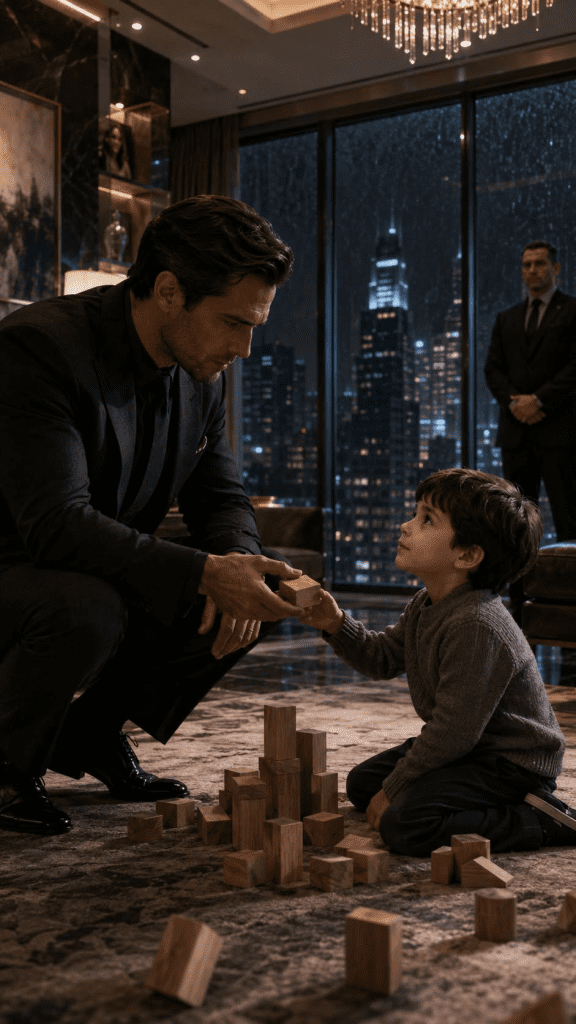
One evening, Lincoln sat on the edge of Noah’s bed under a ceiling full of projected stars. Mara stood in the hallway, unseen.
Lincoln raised his hands.
They trembled.
I love you, he signed slowly.
He pointed to Noah.
My son.
The signs were clumsy.
The meaning was not.
Noah stared at him, lip quivering. Then the child sat up and signed back with both hands flying.
I love you, Dad.
Lincoln pulled him into his arms.
For the first time since Caroline’s death, he cried without turning away.
Mara stepped back from the doorway and wiped her own eyes.
She thought that was the breakthrough.
She did not know it was also the beginning of the war.
The change in Lincoln did not go unnoticed.
Men who had once feared his temper now watched him leave meetings early for lessons. Enemies heard rumors that the Rourke boss had let a waitress into his house. His right-hand man, Marcus Vale, heard more than rumors.
Marcus had been with Lincoln since they were teenagers running collections for men who were now dead. He wore silver cufflinks, spoke softly, and never raised his pulse unless someone else’s life depended on it. He had organized Caroline’s funeral. He had arranged Noah’s doctors. He had chosen the speech specialist who told Lincoln that signing would “delay verbal development.”
One afternoon, Marcus found Mara in the hallway outside Noah’s playroom.
“You’ve made yourself important,” he said.
Mara turned. “Noah made communication important. I just showed up.”
Marcus smiled without warmth. “Lincoln has enemies. People close to him get used.”
“Is that advice or a threat?”
“It depends on whether you’re smart.”
Mara held his gaze. “I’ve been poor my whole life, Mr. Vale. Don’t confuse that with being stupid.”
His smile thinned.
Inside the playroom, Noah suddenly appeared in the doorway. When he saw Marcus, his small body stiffened.
Mara noticed.
Noah lifted his hands and signed something quickly.
Wolf.
Then he pointed at Marcus.
Mara frowned.
“Sweetheart, why did you sign wolf?”
Noah looked nervous and dropped his hands.
Marcus glanced between them. “What did he say?”
“Nothing,” Mara replied.
But that night, Noah signed it again when Marcus passed the dining room.
Wolf. Light. Bad car.
Mara’s stomach tightened.
She asked Noah to explain, but his signs grew uncertain. He was four. He had language now, but not yet enough to tell a complicated story. He became upset and buried his face in her side.
Mara decided to tell Lincoln after his meeting.
She never got the chance.
At ten that night, the estate went into lockdown.
A Rourke warehouse had been attacked. Two men were dead. A shipment had vanished. Only three people had known the changed route: Lincoln, Marcus, and Mara, because she had been in the library when Lincoln received the call.
Marcus arrived with proof.
An envelope had been found in Mara’s room.
Inside were ten thousand dollars in cash, a burner phone, and a note with the warehouse route written in block letters.
Lincoln stood in his office, staring at the items on his desk.
Mara stood across from him, pale with fury.
“You think I did this?”
Lincoln did not answer fast enough.
That was answer enough.
Mara laughed once, bitterly. “I took a piece of metal in my shoulder for your son.”
“And someone may have paid you to get close enough to do worse.”
The words came out like he hated them, but they came out anyway.
Mara’s face changed. The hurt was worse than anger.
“You learned signs,” she said quietly. “But you still don’t know how to listen.”
Lincoln’s jaw tightened.
Marcus stood near the window. “Boss, she needs to be removed before—”
Noah ran into the room.
The nanny followed, breathless, but stopped at the door.
Noah looked at the cash, the phone, Mara’s face, then Marcus.
His eyes filled with terror.
He rushed to Lincoln and grabbed his sleeve. His hands moved frantically.
Wolf. Wolf. Bad. Light. Car. Phone.
Lincoln stared, struggling to follow.
“Slow,” he signed back, his hands awkward but determined. “Tell me slow.”
Marcus stepped forward. “The child is upset. This is not—”
Lincoln raised one hand.
Marcus stopped.
Noah took a shaky breath. He pointed at Marcus.
Wolf.
Then he mimed holding up a phone. He pointed toward the window. He flashed his fingers open and shut, like headlights. Then he struck one fist into his palm.
Bad car. Diner. Wolf told bad car.
Mara felt the air leave her lungs.
Lincoln’s eyes moved slowly to Marcus.
Marcus’s expression remained calm, but a muscle jumped in his cheek.
“Noah saw you,” Mara said.
Marcus sighed. “He is a deaf child describing shadows after trauma.”
Lincoln looked at his son.
For four years, he had trusted men who spoke clearly and ignored the boy who could not speak aloud.
Not again.
“Noah,” Lincoln signed. “Truth?”
Noah nodded fiercely, tears running down his cheeks.
Truth.
Lincoln turned to Marcus. “Open your jacket.”
Marcus smiled. “Lincoln.”
“Open it.”
The room changed.
The guards near the wall looked uncertain. Their loyalty had always flowed through Marcus as much as Lincoln.
Marcus noticed. His smile widened.
“You’re going to take the word of a child who can’t hear and a waitress who walked in from nowhere?”
Lincoln stepped toward him. “I am going to take the word of my son.”
Marcus’s hand moved.
Fast.
But Lincoln had survived too many rooms to miss it. He struck Marcus’s wrist before the gun cleared his jacket. The weapon hit the floor. Guards shouted. Noah screamed without sound.
Marcus lunged toward the desk, but Mara grabbed the heavy brass lamp and swung with everything she had.
The lamp cracked against Marcus’s shoulder. He stumbled. Lincoln drove him into the wall and pinned him there with his forearm across his throat.
“Why?” Lincoln growled.
Marcus’s calm finally broke. Hatred poured through.
“Because Caroline was going to ruin us,” he spat. “She wanted you out. She wanted the docks clean, the accounts closed, the money moved into some charity for children like him.” He jerked his chin toward Noah. “She made you weak before she even died.”
Lincoln’s face went white.
Marcus laughed, breathless under the pressure. “You never even read her letter, did you?”
Lincoln’s grip loosened for half a second.
Marcus saw the wound land.
“What letter?” Lincoln whispered.
Marcus’s eyes glittered. “The one she gave the nurse. The one I saved you from. She knew the baby might be deaf. Her family had history. She was learning sign before he was born. She made videos for him. For you.” His mouth twisted. “I burned some. Kept one. Insurance, in case I ever needed to remind myself how sentimental powerful men become right before they fall.”
Lincoln hit him once.
Not enough to kill him.
Enough to end the conversation.
The guards moved in. This time, they followed Lincoln.
They found the evidence in Marcus’s private safe before dawn: offshore payments, messages to rival crews, the diner attack plan, the planted phone records, and a small digital drive labeled C.R. Personal.
Lincoln did not watch it immediately.
He sat in Noah’s playroom until sunrise with his son asleep against his chest and Mara beside them, her bandaged shoulder aching, her face still pale from betrayal narrowly avoided.
When the sky turned gray over Lake Michigan, Lincoln finally inserted the drive into a laptop.
Caroline appeared on the screen.
Alive. Pregnant. Smiling through tired eyes.
Lincoln stopped breathing.
“Linc,” she said in the recording, “if you’re watching this, then either I got scared and gave it to you, or something went wrong and someone else had to.”
Her hands rested over her belly.
“The doctor says there’s a chance our baby may be deaf. I know you. You’ll try to fight it. You’ll call the best people in the world. You’ll think love means winning. But if our son lives in silence, don’t make silence his prison. Meet him there. Learn him. Let him teach you.”
On the screen, Caroline lifted her hands.
Slowly, carefully, she signed.
I love you.
Then she laughed softly. “I’m terrible at it. You’ll probably be worse. But start badly, okay?”
Mara covered her mouth.
Lincoln bowed his head.
For years, he had believed Caroline’s final wish was protection.
It had been connection.
Marcus had not only betrayed his business. He had stolen a mother’s voice from her son.
Noah woke and saw his mother on the screen. He had seen photographs, but never moving images. He crawled closer, eyes wide.
Caroline signed again.
I love you.
Noah looked at Lincoln.
Lincoln, crying openly now, signed the words back to his son.
Your mother loves you.
Noah pressed both hands to the screen.
The grief in the room was enormous, but it was not empty. For the first time, it had language.
The fallout could have become another blood war.
The old Lincoln might have made it one. He might have filled the streets with revenge and called it justice.
But Mara had changed the question he asked himself.
Not, Who must pay?
But, What kind of world will my son inherit if I keep answering pain with violence?
Marcus was handed to federal authorities through a lawyer who knew where every legal body was buried. The evidence was enough to dismantle half the network Marcus had built under Lincoln’s name. Lincoln did not pretend innocence. He made a deal that cost him money, power, properties, and men who had followed him only because fear paid well.
Some people said he had gone soft.
Lincoln let them.
Soft, he learned, was not the opposite of strong.
It was the opposite of dead.
Six months later, the old Starline Diner reopened under a new name.
Hazel House Community Café.
The front windows were new. The booths were repaired. The jukebox, rebuilt by a retired mechanic who refused payment twice before accepting free pie for life, stood in the corner with polished wood and a stronger bass speaker than before.
By day, the café served coffee, breakfast, and pie. In the evenings, the back room offered free American Sign Language classes. On Saturdays, deaf children and hearing parents came together to learn how to meet in the middle.
Mara refused to let Lincoln put her name on the building.
So he named it after Hazel.
On opening night, the café was packed. Social workers came. Nurses came. Former diner regulars came. Parents came with children who wore hearing aids, cochlear implants, or no devices at all. Some communicated through speech, some through signs, some through tablets, some through touch.
Noah stood beside the jukebox in a little navy suit, looking solemn and proud.
Lincoln stood next to him, uncomfortable in a room where nobody feared him.
Mara walked over carrying a slice of cherry pie.
“You look terrified,” she said.
“I have negotiated with senators with less anxiety.”
“That’s because senators don’t expect you to be emotionally honest.”
“I would rather be shot at again.”
“No, you wouldn’t.”
Lincoln glanced down at Noah. “No. I wouldn’t.”
A little girl approached Noah and signed, Do you want to dance?
Noah looked up at Lincoln, asking permission out of habit.
Lincoln signed back, Your choice.
Noah smiled and ran to the jukebox.
The bass began. Children placed their hands against the wood, laughing as the vibrations moved through them. Parents watched with tears in their eyes. Some tried to copy the rhythm. Some simply held their children closer than before.
Lincoln stood beside Mara.
“I found the rest of Caroline’s files,” he said quietly. “Marcus didn’t burn them all. There are more videos.”
Mara looked at him. “For Noah?”
“For Noah. For me. For birthdays. First day of school. Bad days.” His voice thickened. “She planned to stay with us even if she couldn’t.”
Mara’s expression softened. “That sounds like a mother.”
Lincoln nodded.
Across the room, Noah turned and waved both hands to get his father’s attention.
Dad! Dance!
Lincoln stiffened.
Mara smiled. “Go on.”
“I don’t dance.”
“You run a community café now. Your reputation is already ruined.”
Lincoln gave her a look, but there was warmth in it.
Then the most feared man in Chicago walked to the jukebox, knelt beside his son, and placed his scarred hands on the vibrating wood.
Noah took one of his hands and tapped the rhythm against his knuckles, the way Mara had done that first night.
Lincoln followed.
Badly at first.
Then better.
The room watched, but Lincoln did not care. For once, he was not performing power. He was receiving joy.
Noah laughed silently, shoulders bouncing.
Lincoln laughed with him, awkward and surprised by the sound of himself.
Mara stood near the counter, one hand resting over the scar on her shoulder. It still ached when rain came. It probably always would. But some scars were not just reminders of pain. Some were proof that a life had turned at exactly the right terrible moment.
Lincoln looked back at her across the room.
He signed carefully, so everyone could see.
Thank you.
Mara shook her head.
Then she signed back.
Keep learning.
He nodded.
Noah grabbed his father’s face between both small hands, forcing Lincoln’s attention back where it belonged. His fingers moved fast.
I love you, Dad.
Lincoln answered without hesitation now.
I love you, my son.
The words made no sound.
But everyone who needed to hear them did.
THE END