The smoke alarm didn’t beep. It *screamed*.
A high, mechanical wail that ripped me out of sleep and slammed me into a wall of black smoke so thick I couldn’t see my own hands. The sound was everywhere—inside my skull, vibrating through my chest, bouncing off the walls of my small apartment like a trapped animal. I hit the floor coughing, the carpet rough and hot against my palms, the air so acrid it felt like swallowing glass.
Through the haze, I saw the orange glow bleeding under my bedroom door.
Not a flicker. A steady, hungry light that moved like it was alive.
“No, no, no—”
I scrambled backward, my shoulder blades hitting the wall. The smoke was already curling under the doorframe in lazy gray ribbons, climbing up toward the ceiling where it pooled like dirty water. My lungs burned with every breath. The heat pressed against my skin like an invisible hand.
The guitar.
David’s guitar.
It was propped against the far wall of the living room, the old Gibson with the cracked finish and the worn fretboard. My first stepfather had given it to me when I was fourteen, three years before he died. He had sat me down in his garage, surrounded by tools and sawdust, and placed it in my hands like it was a sacred object.
*“This was my father’s,”* he had said. *“Now it’s yours. Don’t ever let anyone tell you you’re not worth keeping.”*
I couldn’t see it through the smoke.
I couldn’t see anything.
The guitar was gone. The diploma was gone. The photos of my grandmother Margaret June—the only woman who had ever made me feel safe—were gone. All of it, already burning on the other side of that door, turning to ash while I sat on the floor and choked on the remains.
I grabbed my phone from the nightstand.
That was all I took.
Bare feet on hot carpet. The stairwell door slamming behind me. Four flights of concrete stairs that felt like a hundred, each step jarring my spine, the smoke following me down like a shadow. My lungs screamed. My eyes streamed. My legs moved on instinct, carrying me toward the cold air I could smell but not yet feel.
The lobby doors burst open and I stumbled onto the sidewalk, gasping.
February air hit my face like a slap.
I fell to my knees on the frozen concrete, the cold searing through my thin cotton pajama pants. My hands were shaking so hard I couldn’t grip my phone. I could only stare up at the third floor of my building, where orange flames licked out of the window of Unit 4B like a hungry mouth.
My home.
My life.
Everything I had built in the ten years since I walked out of my mother’s house and swore I would never come back.
A firefighter appeared beside me, his face ruddy and streaked with sweat beneath his helmet. He crouched down to my level and put a gloved hand on my shoulder.
“Ma’am, are you the resident of 4B?”
I nodded. I couldn’t speak.
“I’m sorry,” he said. “Your unit is fully involved. There’s nothing we can do.”
Fully involved.
That was the polite way of saying *gone*.
I watched the flames climb higher, watched the glass in my living room window shatter and rain down onto the sidewalk in glittering shards. I thought about the framed photo of my grandmother on the dresser. The stack of books I had been meaning to read. The coat I had saved three months to buy.
All of it.
Gone.
Someone draped a blanket over my shoulders. I don’t remember who. A neighbor, maybe. The woman from 3C who always smiled at me in the hallway. Or the man from 2A who complained about my music. I couldn’t see their faces. Everything was blurry, distant, like I was watching myself from far away.
My hands moved on their own, pulling up my mother’s number.
She would come.
She had to come.
The phone rang once. Twice. Three times. Four. Five. Six. Seven. Eight.
On the ninth ring, she answered.
“Evelyn?” Her voice was thick with sleep, edged with irritation. “Do you know what time it is?”
“Mom,” I gasped. The word came out broken, barely a whisper. “There was a fire. My apartment burned. I lost everything. I don’t have anywhere to go.”
Silence.
Long enough for the flames to crackle behind me. Long enough for the sirens to fade into a low hum.
Then she said, “Oh.”
Just that.
*Oh.*
Like I had told her I broke a plate.
I heard movement on her end of the line. The rustle of sheets. A muffled voice—Richard’s voice—asking what was going on. Then the sound of the phone being passed.
My stepfather’s voice came on, flat and cold as the concrete beneath my knees.
“What’s going on?”
I told him again. The smoke. The firefighters. The sidewalk. The fact that I had nothing but the clothes I was wearing and a phone that was about to die.
He didn’t ask if I was hurt.
He didn’t ask if I needed a ride.
He said, “Not our problem. You should have been more careful. You’re an adult now.”
Then the line went dead.
I sat on the curb with the phone still pressed to my ear, listening to the dial tone hum in the silence. The February wind cut through my thin shirt. The blanket slipped off my shoulder and I didn’t bother to pull it back up.
My mother did not call back.
Richard did not text.
No one came.
The sky turned from black to gray as the firefighters slowly brought the flames under control. The sun rose pale and weak over Crestwood, illuminating the wreckage of my building like a crime scene. I watched the smoke curl up into the clouds, carrying the last traces of my old life into the wind.
That was the moment I realized something I had known for years but never let myself feel:
My mother had stopped being my mother the day I left her house at eighteen.
She had been waiting for me to fail ever since.
And now I had.
Three days later, I sat on the edge of Jason Torres’s pullout couch, wearing his old college hoodie and staring at a folder in my hands.
The insurance office had called me that morning. Not with a payout date or a claim number. With a request.
*“Ms. Carter, can you come into the office this afternoon? There’s something we need to discuss in person.”*
The man on the phone had sounded nervous. The kind of nervous that makes your stomach drop before you know why.
Jason had offered to drive me. He sat in the waiting room while I walked into a small conference room with beige walls and a fake plant in the corner. A man in his late sixties sat across the table, his hands folded over a manila folder.
Harold Finch.
He introduced himself as the senior claims adjuster, but his eyes didn’t meet mine when he said it.
“Ms. Carter,” he began, “I’ve reviewed your policy and the beneficiary designation on file.”
He slid the folder toward me.
I opened it.
My policy. My name. My apartment. My coverage. Standard renter’s insurance through ApexGuard, the same company I had been with since I moved into that building three years ago.
Then I reached the last page.
Beneficiary designation: Richard Carter and Patricia Carter, 100%.
I stared at the page.
“This is wrong.”
Harold Finch swallowed. “That form was submitted six months ago.”
“I never signed this.”
He pointed to the bottom of the page.
There it was.
My signature.
Or something that looked close enough to fool a casual glance. The letters were there, the loops and curves, the way I always angled my *E* slightly to the right. But I knew. I had never put pen to that paper. I had never seen it in my life.
“The payout is $150,000,” Harold said quietly. “We’ve placed a hold on the funds pending investigation.”
$150,000.
That number sat on the page like a loaded gun.
Six months ago.
*Six months ago.*
I did the math in my head. Six months ago was August. August of last year. I had been working overtime, covering for a coworker on maternity leave, coming home exhausted every night. I had barely had time to do laundry, let alone visit an insurance office and sign a beneficiary form.
But my mother had visited my apartment in August.
She had shown up unannounced on a Saturday afternoon, carrying a black bag, smiling like she had missed me. I had been so surprised—so desperate for her approval—that I had let her in. She had walked through every room, touching my bookshelves, asking about my electronics, complimenting my furniture.
*“You’ve done so well for yourself, Evelyn,”* she had said. *“I’m proud of you.”*
I had believed her.
I had been stupidly, pathetically happy to hear those words.
Now I knew why she had come.
She hadn’t been proud. She had been *taking inventory*.
I closed the folder and looked at Harold Finch. “You didn’t verify the signature?”
His face went pale. “The form was submitted in person. A clerk processed it. There was no reason to—”
“There was every reason,” I said. “I have never signed a document changing my beneficiary. Ever.”
He didn’t answer.
I stood up, the folder clutched against my chest. “I want a full investigation. Every piece of paper. Every timestamp. Every signature.”
“Ms. Carter, I assure you—”
“No,” I said. “You don’t get to assure me of anything. You let someone forge my name and you didn’t check. That’s not an accident. That’s negligence.”
I walked out of the conference room with my heart pounding so hard I could feel it in my throat.
Jason stood up when he saw my face.
“What happened?”
I handed him the folder.
He read the beneficiary page. His jaw tightened.
“Your mother?”
“My mother.”
He didn’t say *I’m sorry*. He just put a hand on my shoulder and said, “What do you need?”
“A lawyer.”
That night, I sat on Jason’s couch with my laptop open, searching for attorneys who specialized in insurance fraud. The cursor blinked on the screen while I tried to focus, but my mind kept drifting back to the same memory.
The day I left home.
I had been eighteen years old, standing in the doorway of my mother’s house with a duffel bag in one hand and my guitar case in the other. The sky had been gray, spitting rain, the same February cold that had hit me on the sidewalk two days ago.
My mother had stood in the kitchen, arms crossed, watching me with cold green eyes.
*“You’ll be back,”* she had said. *“You don’t know how the real world works. You think you’re so smart, but you’re just a child playing dress-up.”*
I had wanted to say something. Something sharp and final that would wound her the way she had wounded me a thousand times before. But the words wouldn’t come. They were stuck in my throat, buried under years of silent resentment.
So I had just walked out.
The door had clicked shut behind me, and I had felt a strange mix of terror and relief. Terror at the unknown. Relief that I would never have to hear her voice in my ears every night.
But she had found a way back in.
She had always found a way back in.
I closed my laptop and pressed my palms against my eyes.
The fire investigator, Marcus Webb, had called me earlier that day. He had a calm, steady voice that made me feel like someone was finally on my side.
*“Ms. Carter, I’d like to meet with you tomorrow. I have some findings I’d like to discuss.”*
“Findings?”
*“The fire patterns don’t match a simple electrical failure. I believe this was set intentionally.”*
I had known it. Somewhere deep in my gut, I had known it the moment I saw the flames moving too fast, too hungry. But hearing someone say it out loud made it real.
Made it *crime*.
I met Marcus at a coffee shop on Main Street the next morning. He was a solid man in his early forties, with tired eyes and a calm demeanor that came from years of looking at the worst of human behavior. He didn’t waste time on pleasantries.
“Ms. Carter,” he said, sliding a tablet across the table, “I pulled the building entry logs for the week before the fire.”
The screen showed a list of names and timestamps.
Mine. My neighbor from 3C. The mail carrier. The building manager.
And one more.
*Visitor: Patricia Carter. Entry: 2:07 p.m. Exit: 5:12 p.m. Date: February 7th.*
“She was in my apartment for three hours,” I said.
“Yes.”
“She told me she only stayed for twenty minutes.”
Marcus nodded slowly. “The cameras also show her carrying a black bag when she entered. She was not carrying it when she left.”
I stared at the screen.
Three hours.
A bag that went in full and came out empty.
Two days later, my apartment burned down.
“I need to show you something else,” Marcus said. He pulled up another file. “Surveillance footage from the parking lot. February 12th, 11:34 p.m.”
The video played.
Grainy, dark, lit only by a single streetlight. But clear enough to make out two figures standing next to a rusted sedan. One of them was a man I didn’t recognize—thin, gaunt, wearing a jacket too large for his frame. The other was my mother.
She handed him a thick envelope.
He counted something inside it.
Then he nodded and walked away.
“That’s Tommy Vance,” Marcus said. “Known arsonist. Three prior convictions.”
My hands were shaking.
“I’m going to get a warrant,” Marcus continued. “But I wanted to show you first. You deserve to know what you’re walking into.”
I looked at the frozen frame on the screen. My mother’s face, half-lit by the streetlight, calm and purposeful.
She had planned this.
She had walked through my apartment, taken note of everything I owned, forged my signature, and then paid a man to burn it all down.
For $150,000.
That was the price of my mother’s love.
I looked up at Marcus. “What do I do now?”
“You wait for the warrant,” he said. “And you stay away from her until then.”
That evening, my aunt Lillian called.
“Honey,” she said softly, “your mother is telling everyone you’re having a breakdown. She says you’re accusing her of terrible things.”
Of course she was.
She was building her defense before I could even speak.
“She forged my signature, Aunt Lillian. She paid someone to set my apartment on fire.”
My aunt went quiet. Then she said, “I believe you.”
Those three words hit me harder than I expected.
“But you need to be careful,” she continued. “She’s already called your HR department. She told them you’ve been unstable since the fire.”
I closed my eyes.
My mother wasn’t just trying to steal my money.
She was trying to destroy my life so that no one would believe me when I told the truth.
“I will be careful,” I said.
“I know you will.”
I hung up and sat in the dark of Jason’s living room, watching the rain streak down the window.
The family gathering was in two days.
My mother had called me personally to invite me.
*“Everyone wants to see you, Evelyn. They’re all so worried about you.”*
She wanted an audience.
She wanted to play the grieving mother in front of a room full of witnesses.
And I was going to give her exactly that.
But I wasn’t coming to break.
I was coming to watch her fall.
The morning of the gathering arrived gray and cold, the kind of February day that made the Pacific Northwest feel like it was holding its breath. I stood in front of Jason’s bathroom mirror, staring at my reflection. The woman looking back at me was thinner than she had been three weeks ago. Dark circles carved hollows under her eyes. Her ash-blonde hair hung limp and unwashed.
But her eyes were clear.
I had spent the last forty-eight hours doing something my mother never expected me to do.
I had prepared.
Not with anger. Not with tears. Not with desperate phone calls to relatives who would take her side because she had spent decades perfecting the art of being the victim.
I had prepared with evidence.
Diana Reeves had called me three times since our first meeting. Each call added another layer to the case she was building. She had subpoenaed the security footage from my apartment building’s parking lot. She had obtained the entry logs from the front desk. She had even tracked down the clerk who remembered my mother submitting the insurance form in person six months ago.
“She wore a floral blouse,” the clerk had told Diana during a recorded interview. “I remember because I thought it was strange. Most people don’t dress up to file insurance paperwork. She was very specific about the details. Said she was handling it for her daughter because her daughter was too busy with work.”
Too busy.
My mother had walked into that office and played the role of the helpful parent while she stole my future.
I pulled on a simple black sweater and jeans. No makeup. No jewelry except the silver chain around my neck with the small key pendant—the only thing I had been wearing when I escaped the fire.
The key had been my grandmother’s.
Margaret June had given it to me on my sixteenth birthday, a few months before she died. “This opens the lockbox in my closet,” she had whispered. “There are things in there you’ll need one day. Not money. Something better. The truth.”
I had never opened the lockbox.
After she died, I had been too grief-stricken to go through her belongings. My mother had handled the estate. I had assumed everything was taken care of.
Now I wondered what else my mother had taken.
Jason knocked on the bathroom door. “You ready?”
I opened the door. He stood there in his usual hoodie, his brown eyes soft with concern.
“I don’t know if ready is the right word,” I said. “But I’m going.”
“I’ll drive you.”
“You don’t have to—”
“Evelyn.” He put a hand on my shoulder. “I’m not letting you walk into that house alone.”
I nodded, grateful for the steadiness of his presence.
On the drive to my parents’ house, I watched Crestwood pass by through the window. The town I had grown up in. The streets I had walked as a child, believing my mother loved me. The school where I had learned to read, to write, to dream of a future that didn’t include her.
I had left at eighteen with nothing but a duffel bag and a bus ticket.
I had built a life.
A career at ApexGuard Insurance, where I had worked my way up from a temp position to a full-time claims adjuster. A small apartment that I had furnished with secondhand furniture and photographs. A network of friends who had become my real family.
And my mother had tried to burn it all down.
Literally.
Jason pulled up to the curb a block away from my parents’ house. The street was lined with cars—relatives who had driven from across the state to attend this gathering.
“You sure about this?” Jason asked.
“No,” I admitted. “But I’m doing it anyway.”
I stepped out of the car. The cold air hit my face, carrying the scent of wet leaves and chimney smoke. I walked toward the house where I had spent the first eighteen years of my life, and I felt nothing.
No nostalgia.
No warmth.
Just the cold, hard certainty that I was about to end something that should have ended ten years ago.
The front door was unlocked.
I stepped inside.
The house smelled like cinnamon candles and baked bread—the same smell that had greeted me every holiday, every birthday, every time I had walked through this door as a child. The living room was full of faces I recognized. Aunts, uncles, cousins. People who had watched me grow up. People who had never once asked why I left.
They all turned to look at me.
And then my mother appeared.
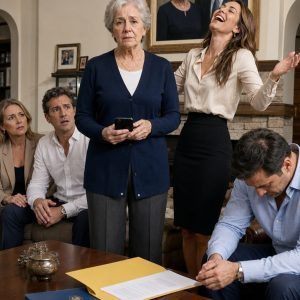
Patricia Marianne Carter emerged from the kitchen, wiping her hands on a floral apron, her dark auburn hair perfectly curled, her green eyes bright with practiced warmth.
“Evelyn,” she said, opening her arms. “There you are, honey.”
She hugged me.
Her arms wrapped around me like she had missed me, like she had been worried, like she hadn’t paid a man to destroy everything I owned.
I stood still and let her hug me.
When she pulled back, her eyes were wet with tears that looked almost real.
“We’ve all been so worried about you,” she said loudly, for the benefit of the room. “After the fire, I just—I couldn’t sleep. I kept thinking about my baby girl, all alone, with nothing.”
The room murmured sympathetically.
Richard appeared beside her, his hand on her shoulder, his thin lips pressed into a frown.
“We tried to help,” he said. “But Evelyn hasn’t been returning our calls.”
I looked at him.
“You hung up on me,” I said quietly. “The night of the fire. You said, ‘Not our problem.’”
The room went still.
Richard’s face reddened. “That’s not what happened.”
“I have the phone records,” I said.
My mother’s smile flickered.
“Evelyn, sweetheart, you’re under so much stress. The trauma of the fire has been hard on all of us. Maybe you should sit down and have some tea.”
“I don’t want tea, Mom.”
I let the silence stretch.
My aunt Lillian stepped forward, her face pale. “Patricia, is that true? Did Richard really say that?”
My mother laughed, a light, tinkling sound. “Of course not. Richard has been nothing but worried about Evelyn. He’s been asking me every day if she’s okay.”
“He didn’t ask once,” I said. “Not one phone call. Not one text. I had to stay with a coworker because my own parents wouldn’t even let me sleep on their couch.”
My cousin Sarah shifted uncomfortably. Uncle Mark looked at the floor.
My mother’s eyes hardened for just a fraction of a second.
Then she smiled again.
“Evelyn, why don’t we go into the kitchen and talk privately? I think you’re confused about some things.”
“I’m not confused,” I said. “I’m not having a breakdown. I’m not unstable. And I’m not going to let you gaslight me in front of our entire family.”
The room was completely silent now.
My mother’s smile froze.
Richard stepped forward. “That’s enough. You come into our house, you accuse us of things we didn’t do, you disrupt this gathering—“
“I haven’t accused you of anything yet,” I said. “But I will.”
I reached into my pocket and pulled out my phone.
“Mom, why did you stay in my apartment for three hours on February 7th?”
Her face went pale.
“I—I don’t know what you’re talking about.”
“The building entry logs show you entered my apartment at 2:07 p.m. and left at 5:12 p.m. You told me you only stayed for twenty minutes. But the cameras say otherwise.”
“Those cameras are wrong.”
“I watched the footage myself,” I said. “It’s you. Clear as day.”
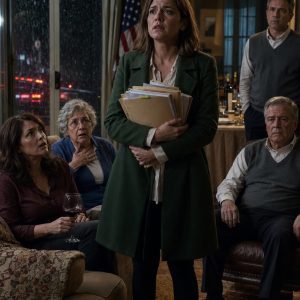
The room erupted in whispers.
My mother’s hands were shaking now. She pressed them against her floral blouse, trying to steady them.
“I just—I wanted to spend time in your space,” she said, her voice cracking. “I missed you. I was looking at your things, remembering when you were little.”
“Then why did you bring a black bag?”
Her mouth opened. Closed.
“And why did you leave without it?”
Richard grabbed my arm. “You need to leave. Now.”
I pulled my arm free. “I’m not leaving until the truth comes out.”
My mother’s face crumpled. Tears streamed down her cheeks—real tears this time, but not from sadness. From rage.
“You’ve always been like this,” she hissed, her voice dropping to a whisper that only I could hear. “Always the victim. Always accusing me of things I never did. You left me, Evelyn. You left me and you never looked back. And now you come into my house and try to destroy me?”
“I didn’t destroy you, Mom. You did that yourself.”
“I gave you everything,” she said, her voice rising. “I gave you a home, food, clothes. I sacrificed everything for you. And you threw it back in my face.”
“You gave me nothing,” I said. “You controlled me. You manipulated me. And when I finally broke free, you couldn’t stand it. So you tried to take everything I built.”
Her face twisted.
“You think you’re so smart,” she spat. “You think you have it all figured out. But you don’t know anything.”
“I know you forged my signature on an insurance form.”
The room gasped.
“I know you submitted a beneficiary change six months ago, naming yourself and Richard as the recipients of my renter’s insurance policy.”
My mother’s face was white now. Bone white.
“I know you walked into an ApexGuard Insurance office and told the clerk you were handling paperwork for your busy daughter.”
“That’s a lie,” she whispered.
“And I know you paid a man named Tommy Vance $5,000 in cash to set my apartment on fire.”
The room exploded.
My aunt Lillian screamed. My cousin Sarah started crying. Uncle Mark grabbed Richard by the collar and demanded to know what he had done.
My mother stood frozen in the center of the chaos, her mouth open, her eyes wide, her hands trembling at her sides.
“I didn’t—I never—“
“I have the footage,” I said. “The parking lot camera. February 12th, 11:34 p.m. You met him by the dumpster. You handed him an envelope. He counted the money and walked away.”
My mother shook her head. “That’s not me. That’s someone who looks like me.”
“The warrant has already been signed,” I said.
Her head snapped up.
“What?”
“Marcus Webb, the fire investigator. He got a warrant this morning. The police are on their way.”
My mother’s legs gave out.
She collapsed onto the couch, her hands covering her face, her shoulders shaking with sobs that sounded like they were being ripped out of her chest.
Richard stood frozen by the fireplace, his face ashen.
And then the doorbell rang.
The sound cut through the chaos like a knife.
Every head turned toward the front door.
I walked over and opened it.
Marcus Webb stood on the porch, flanked by two uniformed officers. His face was calm, professional. He held up a folded document.
“Patricia Marianne Carter,” he said, his voice carrying into the living room. “We have a warrant for your arrest in connection with arson, insurance fraud, and conspiracy to commit a felony.”
My mother stood up from the couch, her face a mask of horror.
“No,” she whispered. “No, no, no.”
But the officers were already stepping past me, their boots heavy on the hardwood floor, their hands reaching for her.
“Patricia Carter, you have the right to remain silent,” one of them began.
My mother looked at me.
Her green eyes, the same eyes I had looked into my entire life, filled with something I had never seen before.
Hatred.
Pure, unfiltered hatred.
“You did this,” she hissed. “You ruined me.”
I looked back at her.
And for the first time in twenty-eight years, I felt nothing.
No guilt.
No pity.
No love.
Just the cold, clean emptiness of a daughter who had finally stopped hoping.
“No, Mom,” I said quietly. “You did this to yourself.”
The officers cuffed her wrists behind her back. The metal clicked shut, and my mother let out a sound I had never heard from her before—a low, animal moan of defeat.
They led her past me, past the relatives who had watched her cry fake tears just minutes ago, past the family photos on the wall that showed a woman I no longer recognized.
Richard stood frozen by the fireplace.
“You’re next,” Marcus said quietly, looking at him. “We have questions about your involvement.”
Richard didn’t answer. He just stared at the floor.
The front door closed behind the officers.
The living room was silent.
I stood in the middle of it, surrounded by relatives who didn’t know what to say, who didn’t know how to look at me now that the truth had shattered the carefully constructed lie of my mother’s perfect life.
My aunt Lillian approached me slowly.
“Evelyn,” she whispered. “I’m so sorry.”
I looked at her.
“I know,” I said.
And I walked out the door.
The cold air hit my face as I stepped onto the porch. I saw the patrol car pulling away from the curb, my mother’s face pressed against the back window, her eyes locked on mine until the car turned the corner and disappeared.
I stood there for a long moment, my breath forming clouds in the February air.
Then I pulled out my phone and texted Jason.
*It’s over.*
His reply came instantly.
*I’m here. Same spot.*
I walked down the driveway, past the cars of relatives who would spend the next hour whispering and crying and pretending they had known all along.
I didn’t look back.
I got into Jason’s car, and he drove me away from that house, away from the street where I had grown up, away from the woman who had given me life and then tried to take everything else.
“Where to?” Jason asked.
I thought about it.
My apartment was gone. My parents’ house was no longer a place I could enter. My grandmother’s lockbox was still out there somewhere, waiting for me to open it.
“The office,” I said. “Diana wants to meet.”
Jason nodded and turned onto the main road.
I leaned my head against the window and watched Crestwood pass by.
The town looked different now.
Smaller.
Less threatening.
Like a cage whose door had finally been left open.
Diana’s office was in a converted Victorian house on Elm Street, with dark wood paneling and shelves full of law books that smelled like old paper and ambition. She was waiting for me at her desk, her silver-streaked hair pulled back, her reading glasses perched on her nose.
“Evelyn,” she said as I walked in. “I heard. The arrest went smoothly?”
“As smoothly as watching your mother get handcuffed can go.”
Diana nodded, unsurprised by the dark humor. She gestured for me to sit.
“The warrant was clean. Marcus did good work. The footage is solid. She won’t be able to talk her way out of this one.”
“And Richard?”
“He’s being brought in for questioning tonight. I don’t think he knew about the arsonist, but he definitely knew about the insurance form. He’s going to have to answer for that.”
I sat down across from her desk.
“There’s something else,” she said.
I looked up.
“I got a call from the bank this morning. Your mother has been making large deposits into a separate account for the last six months. We’re tracing the origin, but preliminary evidence suggests it’s connected to your grandmother’s estate.”
I felt the blood drain from my face.
“My grandmother’s estate?”
“Margaret June’s will left you $200,000. That money was supposed to be transferred to you when you turned twenty-five. It never was.”
I stared at her.
“My grandmother left me money?”
“A significant amount. Your mother forged the trust documents to redirect the funds to herself.”
I couldn’t breathe.
The betrayal had layers I hadn’t even begun to uncover.
“We’ll recover it,” Diana said firmly. “I’ve already filed the motion. The court will freeze her assets pending the trial. You’ll get what’s yours.”
I nodded, but I wasn’t really listening.
I was thinking about my grandmother.
Margaret June, who had held my hand at my first stepfather’s funeral. Who had slipped me twenty-dollar bills when my mother wasn’t looking. Who had told me, on her deathbed, “You’re stronger than you know, Evelyn. Don’t let anyone make you forget that.”
She had tried to give me one last gift.
And my mother had stolen it.
“Evelyn?”
I looked up.
Diana was watching me with concern.
“Are you okay?”
I took a deep breath.
“No,” I said honestly. “But I will be.”
Diana nodded slowly. “I know you will.”
I left her office an hour later with a stack of documents and a head full of plans.
The trial was set for next month.
My mother was out on bail, living in Richard’s sister’s basement, waiting for a jury to decide her fate.
Harold Finch, the insurance agent who had processed the forged form, had been arrested that same afternoon. He was singing like a bird, offering testimony against my mother in exchange for a reduced sentence.
And me?
I was standing in Jason’s apartment, wearing his hoodie, drinking his coffee, watching the rain fall on Crestwood streets I had never expected to walk again.
The insurance company had finally released my payout.
All $150,000, plus interest.
It was sitting in an account with my name alone.
But the money from my grandmother’s estate was still tangled in legal battles.
Diana was confident we would win.
I believed her.
Because I had learned something these last few weeks.
The truth doesn’t need to scream.
It just needs to wait.
And when the moment comes, it will destroy everything the lies built.
I set down my coffee and picked up my phone.
I had one more call to make.
To my aunt Lillian.
To ask about the lockbox.
Because my grandmother had told me there was something in there I would need.
And I was finally ready to find out what it was.
The arrest was the beginning, but the fallout was a storm I had to walk through barefoot.
The news spread through Crestwood like fire through dry grass.
By Monday morning, everyone knew.
My mother’s face was on the local news, her mugshot framed beside the words “CRESTWOOD WOMAN CHARGED WITH ARSON AND INSURANCE FRAUD.” The footage from the parking lot played on a loop—Patricia Carter in her tan trench coat, handing a thick envelope to a man with hollow eyes and a criminal record as long as my arm.
Tommy Vance.
The arsonist.
He had been arrested the same night as my mother, picked up at a motel six miles outside town with $4,200 still in his pocket. He confessed within two hours. Said my mother had approached him at a bar, asked if he knew anyone who could “handle a problem.” Said she paid him $5,000 in cash to set the fire in my apartment building, specifically targeting Unit 4B.
He didn’t know my name. He didn’t care.
He just wanted the money.
I watched the press conference from Jason’s couch, my knees pulled to my chest, a cold cup of coffee growing stale in my hands. Marcus Webb stood at the podium, his voice measured and calm, explaining how the investigation had unfolded. He mentioned the building entry logs. The security footage. The warrant.
He did not mention me by name.
But the reporters found me anyway.
By Tuesday, my phone would not stop ringing. Local news. A true crime podcast. A woman from a national magazine who said she wanted to tell my story. I ignored every call until my voicemail filled up, then I turned my phone off entirely and let the world spin without me.
Jason brought me food I didn’t eat and tea I let go cold.
“You don’t have to talk to them,” he said, sitting down beside me on the couch. “You don’t owe anyone an explanation.”
“I know.”
“But you’re thinking about it.”
I looked at him. His kind brown eyes held no judgment, only patience.
“I keep thinking about what my grandmother said,” I told him. “On her deathbed. She told me I was stronger than I knew. I thought she was just being kind. But she knew. She knew what my mother was capable of. She tried to warn me.”
Jason was quiet for a moment. Then he said, “Maybe she did warn you. Maybe you just weren’t ready to hear it yet.”
I let that settle.
He was right.
I hadn’t been ready.
But I was ready now.
On Wednesday, Diana called with an update.
“Your mother’s attorney reached out. They’re trying to negotiate a plea deal.”
“What kind of deal?”
“She’s willing to plead guilty to the fraud charges in exchange for dropping the arson charge.”
I felt something cold move through my chest. “She set my apartment on fire. She could have killed me. She could have killed my neighbors.”
“I know. And I’m not recommending we accept. But I wanted you to be aware of the offer before I respond.”
“Tell them no.”
Diana paused. “Are you sure? A trial is risky. Juries are unpredictable.”
“I’m sure.”
“Okay. I’ll let them know.”
She paused again, and I heard her exhale slowly. “Evelyn, I have to ask. Are you prepared to testify?”
The question hung in the air like smoke.
I thought about standing in a courtroom, looking at my mother across the gallery. I thought about describing the fire. The smoke. The sidewalk. The phone call. The moment Richard said “Not our problem” and hung up.
I thought about watching her face as I told the truth.
“Yes,” I said. “I’m ready.”
The trial was set for April 14th.
Six weeks away.
Six weeks to prepare.
Six weeks to keep myself from falling apart.
I spent the first week in a fog. I went through the motions of living—eating, sleeping, showering—but nothing felt real. The world had shifted on its axis, and I was still trying to find my footing.
Then, on Friday, my aunt Lillian called.
“Evelyn, honey. I found something.”
“What do you mean?”
“Your grandmother’s lockbox. It was in the attic of the old house. I thought Patricia had gotten rid of it, but it was behind a stack of boxes. I have it here.”
I drove to her house that afternoon.
Lillian lived in a small cottage on the edge of town, with a garden full of overgrown roses and a porch swing that creaked in the wind. She met me at the door with a metal lockbox in her hands, the same one I remembered seeing in my grandmother’s closet when I was a child.
“I haven’t opened it,” Lillian said. “It’s locked. I figured you’d want to do it yourself.”
I took the box from her hands. It was heavier than I expected.
“Do you know what’s inside?”
Lillian shook her head. “Your grandmother was private about some things. But she loved you, Evelyn. Whatever’s in there, she wanted you to have it.”
I sat on her porch swing and stared at the lockbox for a long time.
The key.
I had worn it around my neck for years, a small silver key on a chain that I had never known belonged to anything. My grandmother had given it to me on my sixteenth birthday, the same year my first stepfather died. She had said, “Keep this close. One day, you’ll know what it opens.”
I had almost thrown it away a dozen times.
Now I slipped it into the lock and turned.
The mechanism clicked open.
Inside the box was a stack of letters tied with twine, a faded photograph of my grandmother as a young woman, and a bank book.
I opened the bank book first.
The numbers made my breath catch.
Margaret June had opened a savings account in my name when I was born. She had deposited money into it every year—birthdays, Christmases, holidays—until she died. The account had grown to $47,000.
But that wasn’t all.
The last entry, dated three months before her death, was a withdrawal of $200,000.
Transferred to a joint account.
Patricia Marianne Carter.
My mother had emptied my grandmother’s account before the body was cold.
I sat on the porch swing with the bank book in my hands and let the tears come.
Not for the money.
For the proof.
The proof that my grandmother had loved me. That she had planned for me. That she had tried to give me a future, even after she was gone.
And my mother had stolen it.
I called Diana that evening.
“I found something. My grandmother’s bank records. She had an account for me. My mother emptied it.”
Diana was quiet for a moment. “That changes things. Do you have the documents?”
“Yes.”
“Bring them to my office tomorrow. We’ll add them to the evidence.”
I hung up and sat in the dark, the lockbox open on my lap, the letters still untouched.
I would read them later.
When I was ready.
The next week passed in a blur of meetings and paperwork.
Diana filed a motion to add the bank records to the case. The prosecution expanded the charges against my mother to include elder financial abuse and grand larceny. Richard was formally questioned and released pending further investigation—he claimed he knew nothing about the forged trust documents, and the evidence was inconclusive.
He was still living in the house on Maple Street.
Alone now.
The family had scattered.
My cousin stopped returning my calls. My aunt Lillian was the only relative who still spoke to me, and even she admitted the situation had torn the family apart.
“Your mother poisoned everyone,” Lillian said one afternoon. “She controlled the narrative for so long that people didn’t know what was real anymore. Now they’re embarrassed. They don’t want to admit they were fooled.”
“Do you think they’ll ever come around?”
Lillian sighed. “Some will. Some won’t. That’s the thing about lies, Evelyn. They don’t just hurt the person they’re aimed at. They infect everyone around them.”
I thought about that a lot in the weeks that followed.
The trial was approaching fast. The prosecution had built a strong case. Tommy Vance was cooperating. Harold Finch had confessed to his role in the insurance fraud. The footage was irrefutable.
But I still had to testify.
And that terrified me more than the fire ever had.
On the morning of April 14th, I stood in front of Jason’s bathroom mirror and looked at myself.
Ash-blonde hair, sharp cheekbones, the silver key pendant still hanging around my neck.
I had worn that key for twelve years without knowing what it meant.
Now I knew.
It meant my grandmother had believed in me.
It meant she had seen something in me that my mother never could.
It meant I was not alone.
Jason drove me to the courthouse. The building was old and gray, with granite steps worn smooth by decades of footsteps. Reporters were gathered at the entrance, their cameras flashing, their voices calling my name.
I walked past them without stopping.
Inside, the courtroom was quiet.
The gallery was half-full—my aunt Lillian sat in the front row, her hands clasped in her lap. A few distant relatives I hadn’t seen in years. A woman from the local newspaper. Marcus Webb, sitting in the back, his arms crossed.
And my mother.
She sat at the defense table in a plain blue dress, her auburn hair pulled back, her green eyes fixed on me as I walked in.
She did not look sorry.
She looked angry.
The judge entered. The bailiff called the court to order. The prosecutor stood and delivered her opening statement, describing the fire, the forgery, the arsonist, the betrayal.
Then she called me to the stand.
I walked up the steps with my heart pounding in my throat. I raised my right hand and swore to tell the truth.
And I did.
I told them about the smoke alarm that didn’t beep but screamed. I told them about the black smoke and the orange glow and the freezing February air. I told them about the phone call and the words “Not our problem.” I told them about the insurance form and the forged signature and the three hours my mother spent alone in my apartment.
I told them about the lockbox and the bank book and the $200,000.
By the time I finished, the courtroom was silent.
The prosecutor showed the jury the footage of my mother meeting Tommy Vance in the parking lot. She showed them the building entry logs. She showed them the forged documents.
My mother’s attorney tried to cross-examine me.
“Isn’t it true, Ms. Carter, that you and your mother have a strained relationship?”
“Yes.”
“Isn’t it true that you left home at eighteen and rarely contacted her afterward?”
“Yes.”
“Isn’t it possible that you are motivated by resentment rather than justice?”
I looked at my mother.
She was watching me with cold, hard eyes.
“No,” I said. “I’m motivated by the truth. And the truth is that my mother tried to destroy my life. Not because I did anything wrong. But because she couldn’t control me anymore.”
The attorney had no further questions.
The trial lasted four days.
The jury deliberated for six hours.
They found Patricia Marianne Carter guilty on all counts.
Arson in the first degree.
Insurance fraud.
Forgery.
Elder financial abuse.
Grand larceny.
The judge sentenced her to twelve to fifteen years in state prison.
I watched them handcuff her again and lead her out of the courtroom. She did not look at me this time. She stared straight ahead, her jaw tight, her eyes empty.
Richard was in the hallway when I walked out.
He looked older than I remembered. His graying temples were thinner, his face lined with something that might have been shame.
“Evelyn,” he said.
I stopped.
“I didn’t know,” he said quietly. “About the fire. About the arsonist. I swear to you, I didn’t know.”
I believed him.
But it didn’t change anything.
“You knew about the insurance form,” I said.
He didn’t deny it.
“I’m sorry,” he said.
It was the first time I had ever heard him say those words.
“So am I,” I said.
And I walked away.
The weeks after the trial were strange.
The world kept turning, but I felt like I was watching it from a distance. The insurance company released my payout. Diana filed the paperwork to recover my grandmother’s money. The house on Maple Street went up for sale.
I didn’t go back.
I didn’t need to.
I spent my evenings at Jason’s apartment, watching movies I didn’t pay attention to, eating takeout that tasted like cardboard. He didn’t push me to talk. He just stayed.
One night, I finally opened the letters from the lockbox.
They were from my grandmother.
Dozens of them, written over the course of my childhood, never sent. She had written them on birthdays and holidays, on ordinary Tuesdays and quiet Sundays, filling pages with her hopes for me, her fears for me, her love.
The last letter was dated three days before she died.
*Evelyn,*
*If you’re reading this, I’m gone. I’m sorry I couldn’t tell you these things while I was still alive. Your mother made that difficult. But I want you to know that I saw you. I saw the girl who carried her grief in silence and kept walking anyway. I saw the woman you would become.*
*There is money in an account for you. I hope it helps. But more than that, I hope you find people who see you the way I did. People who love you without conditions.*
*You are stronger than you know. Don’t let anyone make you forget that.*
*All my love,*
*Grandma Margaret*
I read the letter three times.
Then I folded it carefully and tucked it into the pocket of Jason’s hoodie, close to my heart.
The last thing I did before leaving Crestwood was visit my grandmother’s grave.
The cemetery was quiet in the April afternoon, the grass still wet from the morning rain. I walked to her headstone and knelt down, placing a single white rose against the marble.
“I found the lockbox,” I said softly. “Thank you.”
The wind moved through the trees.
I stayed there for a long time.
When I finally stood up, I felt lighter than I had in months.
I drove back to Jason’s apartment, packed my bag, and left Crestwood for the last time.
I didn’t know where I was going yet.
But for the first time in my life, I wasn’t afraid to find out.
The end.