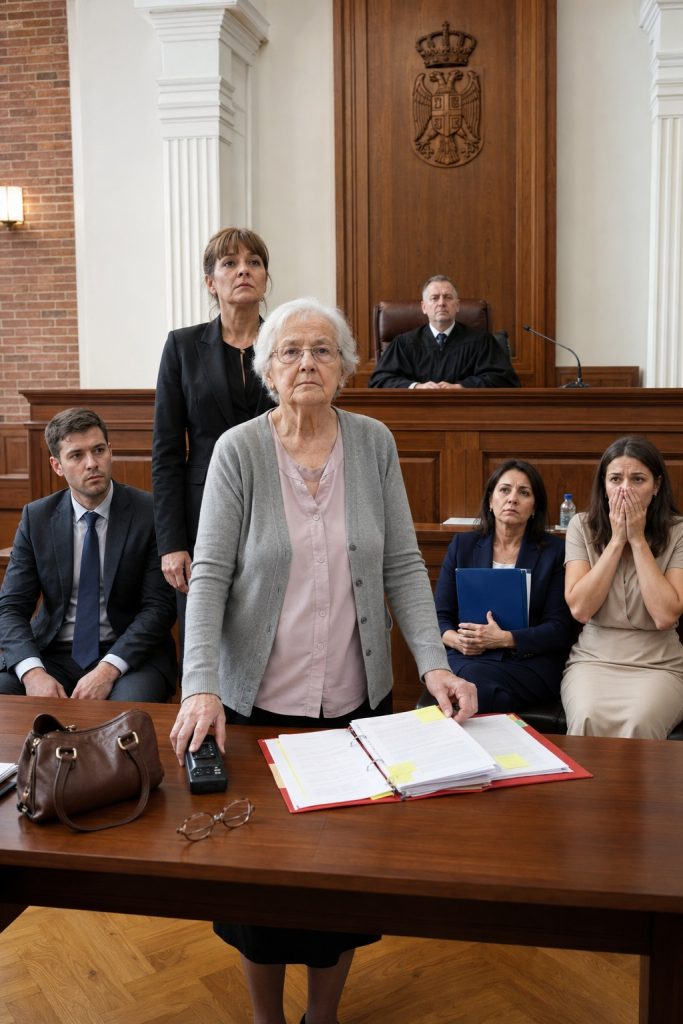
The tea was still spreading across the power of attorney document, seeping into the signature line like a slow brown stain of defiance. The courthouse hallway smelled like floor wax and old paper, the fluorescent lights buzzing overhead in that thin, institutional hum that made everything feel temporary. Margaret Eleanor Bellamy watched the amber liquid crawl across the page and did not move to stop it.
“Oh dear,” she whispered, her voice thin and wavering.
Nolan Bellamy-Rourke leaned forward, his tailored suit brushing against the cheap wood of the bench. His wire-rimmed glasses caught the light, and behind them, his eyes went cold. “Mom,” he said, his voice coated in that practiced patience she had learned to recognize six months ago, “you just need to sign here. We talked about this yesterday.”
Margaret looked up at him. Fifty-five years. She had known this man since he was a screaming infant in her arms, since he took his first steps on the hardwood floor of the Alderwick Lane house, since he cried at his father’s funeral and promised to take care of her. And now he sat here, in a courthouse hallway, watching her fail on purpose.
“Did we?” she asked.
Celeste Bellamy-Farrow appeared at her elbow, a folder clutched against her chest. Her sharp features were arranged into an expression of concern that Margaret had seen a thousand times in the past six months. “Mom, you said you agreed. You said you needed help with the bills. Remember?”
Margaret blinked slowly. Her hands, spotted with age, trembled slightly against the wood of the table. But the trembling was not from confusion. It was from focus. From the effort of holding herself still while every instinct screamed at her to stand up and walk away.
“I… I don’t recall,” she said.
Brianna Bellamy-Holt, the youngest, placed a soft hand on Margaret’s shoulder. Her eyes were already wet, ready to spill tears at the right moment. “It’s okay, Mom. That’s why we’re here. To help.”
Three faces. Three rehearsed expressions of concern. Three children who had spent six months methodically dismantling her memory, her dignity, her right to exist in the house she had lived in for fifty-one years. Margaret felt the weight of the small black recorder in her cardigan pocket, pressed against her ribs like a second heartbeat.
She picked up the pen. Her fingers closed around it. The ink was cold. The paper was slick. The trap was almost perfect.
And then she moved her hand, not toward the line, but toward the cup of tea sitting beside the document. Her wrist turned. The cup tipped. Amber liquid flooded across the paper, soaking the signature line, turning the ink into pale brown ghosts of letters.
“Oh dear,” she whispered.
Nolan’s mask slipped. For one half-second, his jaw tightened and his eyes went hard. “Unbelievable.”
Celeste grabbed napkins from somewhere. Brianna made soothing sounds. But Margaret watched Nolan. She watched him calculate. She watched him realize that the document was ruined and that he would have to start over. She watched the anger flicker behind his eyes before he buried it under that patient smile he had been practicing for six months.
And in that moment, Margaret knew exactly what she was doing.
She had known for six months.
The forgetting started small. A comment from Nolan about a cold burner she had supposedly left on. He had come over on a Tuesday evening, let himself in with the key she had given him for emergencies, and found her standing in the kitchen with nothing on the stove.
“Mom,” he had said, his voice gentle, “did you leave the burner on again?”
Margaret had looked at the stove. The burner was cold. She had not cooked anything. She had been sitting in Walter’s chair, reading an old book, when he walked in. “No,” she said. “I didn’t.”
Nolan had frowned. “I could have sworn I smelled gas when I came in. Are you sure?”
“Positive.”
But the next week, Celeste came over and found the burner on. Not hot. Not lit. Just turned to low, with nothing on top of it. Margaret did not remember turning it. She had been in the garden all morning.
“Mom,” Celeste had said, her voice trembling with concern, “you don’t remember doing this?”
Margaret stared at the burner. She stared at her daughter’s face. And for the first time, she felt a cold knot form in her stomach.
“I must have forgotten,” she said.
A week later, her glasses were found in the freezer. Between a bag of peas and a box of frozen waffles. Celeste had opened the freezer door and gasped like she had discovered something tragic.
“Mom,” she said softly, holding up the glasses, “you don’t remember putting these here?”
Margaret looked at the glasses. Then at Celeste. Then at the stove, where Nolan had stood just two days earlier, insisting she had left a burner on.
The burner had been cold.
Margaret knew that too.
She knew because she still knew her house. Every creak in the porch. Every drawer that stuck in damp weather. Every floorboard Walter promised to fix and never did because life got busy, then short, then gone.
But suddenly, her three grown children were seeing “signs.”
Nolan said she forgot the stove.
Celeste said she misplaced things.
Brianna told the neighbor Margaret had gotten confused coming back from the mailbox.
The mailbox was twenty-eight steps from the porch.
Margaret had counted them for forty years.
At first, she corrected them.
Calmly.
Firmly.
Then she saw the looks.
Not worry.
Not sadness.
Something worse.
Coordination.
The way Nolan lowered his voice at just the right moment. The way Celeste arrived with folders and printed articles. The way Brianna touched Margaret’s arm, all sweetness and soft eyes, while quietly watching every move she made.
That was when Margaret stopped defending herself.
Not because she believed them.
Because she finally understood they needed her to look confused.
So she gave them exactly what they wanted.
The next morning, Nolan came over with groceries she had not asked for and placed them on her counter like he was already in charge. “Mom,” he said, “maybe it’s time we help with the bills. Just a little. Nothing serious.”
Margaret folded her hands over her cardigan. “Of course,” she said. “I forget things now.”
The relief on his face told her more than any confession could have.
That afternoon, Margaret walked alone to Gresham’s Hardware, the same store Walter used to visit every Saturday whether he needed anything or not. The street was quiet, the autumn air carrying the smell of fallen leaves and woodsmoke from someone’s chimney. She passed the old church, the post office, the diner where she and Walter had eaten breakfast every Sunday for thirty years.
The bell over the door of Gresham’s jangled too loudly. The air inside smelled like oil, sawdust, and old men with good stories. Marcus Gresham looked up from behind the counter, his weathered hands resting on a stack of invoices. He had known Walter for forty years. He had known Margaret for longer.
“Margaret,” he said, his voice gruff but warm. “Need anything?”
Margaret walked to the counter. She did not browse. She did not pretend to look at anything else. She placed her hands on the wood and met his eyes.
“Two recorders,” she said.
Marcus did not ask questions. He studied her face for a long moment, his eyes narrowing slightly. Then he reached under the counter and pulled out two small black devices, still in their packaging. He wrapped them in brown paper and handed them over.
“These are on the house,” he said quietly.
Margaret shook her head. “No. I pay for everything now.”
She slid a twenty-dollar bill across the counter. Marcus took it without argument. He knew a woman who had made up her mind when he saw one.
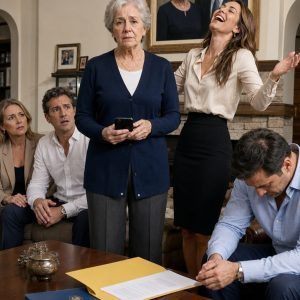
That evening, all three children came over. They sat in the living room of the Alderwick Lane house, the same room where Walter had died six years ago, the same room where Margaret had held his hand and watched him go. The light from the old lamp cast shadows across the walls. The floorboards creaked under their feet.
They asked her the date.
The president.
Her birthday.
What she had eaten for lunch.
Margaret answered slowly. Sometimes correctly. Sometimes not. Every time she paused, they exchanged those little looks.
Not frightened.
Satisfied.
Later, when they thought she had dozed off in Walter’s armchair, Nolan’s voice dropped low.
“It’s progressing faster than I expected.”
Celeste answered, “We need documentation. A doctor. Something official.”
And then Brianna, her voice soft as a blade, said the words that sealed everything.
“And the house. We should start thinking about the house.”
Margaret did not open her eyes. She did not move. But her fingers tightened around the recorder hidden in her sleeve, and she felt something cold settle in her chest.
The house.
There it was.
Not her health.
Not her safety.
Not whether she was lonely in rooms full of Walter’s memories.
The house.
Alderwick Lane. Original wood floors. Narrow staircase. Brick fireplace. A yard Walter had planted by hand. A life paid for in mortgage checks, overtime shifts, Sunday repairs, and fifty years of marriage.
They were not trying to help Margaret remember.
They were trying to make her disappear while she was still breathing.
Six months. That was how long Margaret played the game. Six months of pretending to forget. Six months of letting them think they were winning. Six months of recording every conversation, every whisper, every plan they made while she was “asleep” in Walter’s chair.
She learned their rhythms. Nolan came on Tuesdays and Thursdays, always with a document to sign. Celeste came on Wednesdays with folders full of “incidents.” Brianna came on weekends with baked goods and soft questions about jewelry, old bonds, silver coins—anything Walter might have left behind.
Margaret gave them bait. A fake memory about a box in the attic. A mention of a certificate in a tea tin. A quiet comment about “old valuables” she could not quite place. And every time, they chased it. Upstairs. Through drawers. Into cupboards. Through the pieces of a woman’s life they thought she no longer had the strength to protect.
She watched them grow careless. Nolan searched drawers like the house already belonged to him. Celeste brought a man through the living room who pretended to be a friend but looked at the windows, walls, and structure like a buyer. Brianna asked little questions about Walter’s tools, his coin collection, the safe in the study.
Margaret recorded it all.
Then came the document.
Durable power of attorney.
Nolan slid it across the kitchen table with a pen. “You don’t need to understand everything, Mom,” he said gently. “That’s why we’re here.”
Margaret looked at the signature line. “Have I already agreed to this?”
He did not hesitate. “Yes. Last week. You just don’t remember.”
The recorder in her pocket caught every word.
Margaret picked up the pen. Paused. Then knocked over her tea. Amber-colored liquid spread across the papers, soaking the signature line, ruining the page.
“Oh dear,” she whispered.
Nolan stared at the ruined document, and for the first time, the mask slipped. “Unbelievable,” he muttered.
Margaret almost smiled. Not because it was funny. Because it was useful.
By the sixth month, they stopped asking. They filed for guardianship. The petition arrived in a plain envelope with her full name printed across the front.
Margaret Eleanor Bellamy.
Progressive cognitive decline.
Unable to manage finances.
Risk to personal safety.
Her children had put her life into legal language and tried to hand it to a judge.
So Margaret called Beatrice Vale, the family attorney. Beatrice was seventy years old, with silver hair pinned in a tight bun and a worn leather briefcase that had seen more courtrooms than most judges. She had written Walter’s will. She had watched Margaret’s children grow up. She knew exactly what kind of case this was.
“Beatrice,” Margaret said into the phone, her voice steady, “I need you to come to the courthouse tomorrow. And I need you to bring a recorder.”
Beatrice paused. “Margaret, what have you been doing?”
“Listening,” Margaret said. “For six months, I’ve been listening.”
The courtroom was smaller than Margaret expected. Bright. Quiet. Too clean for something so ugly. The walls were paneled in light wood, and the fluorescent lights hummed overhead. The air smelled like floor polish and stale coffee, mixed with the faint chemical scent of cleaning products.
Judge Harriet Moncrief sat behind a heavy wooden bench, her glasses perched low on her nose. She was sixty-two, with sharp eyes and a no-nonsense expression that suggested she had seen every kind of deception in her career.
Nolan stood at the petitioner’s table, his tailored suit pressed and perfect. Celeste sat beside him, folders stacked neatly in front of her. Brianna sat on the other side, her eyes already wet, ready to cry on cue.
They spoke first.
Nolan stood and addressed the court. He spoke of his mother’s decline with the right mix of sadness and authority. He described the burner left on, the glasses in the freezer, the confusion about the date. He listed the incidents like a prosecutor listing charges.
“She doesn’t remember what she ate for lunch,” he said, his voice trembling with manufactured emotion. “She doesn’t know the day of the week. She left the front door open last month, and we only found out when a neighbor called.”
Celeste stood next. She pointed to a folder of “incidents”—dates, times, descriptions of forgetfulness. She had typed them all up, organized by category. Cognitive decline. Memory loss. Safety concerns.
“We love our mother,” she said, her voice cracking. “That’s why we’re here. We want to protect her.”
Then Brianna stood. She wiped her eyes with a tissue. “She’s not the woman she used to be,” she whispered. “She would want us to do this.”
They were good. They had practiced.
Then Beatrice Vale stood up. Her silver hair was pinned tight. Her worn leather briefcase sat open on the table. “Your Honor,” she said, “Mrs. Bellamy would like to respond.”
Nolan stiffened.
Margaret rose slowly. She walked to the table. She did not shuffle. She did not look confused. Her hand went into her cardigan pocket and emerged holding a small black recorder.
“I have something to say,” Margaret said, her voice clear and steady, “and I have proof.”
She placed the recorder on the table.
Beatrice pressed play.
A voice filled the room. It was Celeste’s.
“Once she signs the guardianship, we sell the house. The market is good right now.”
Another recording. Nolan’s voice, sharp and impatient.
“We just need one more doctor to agree. I’ll find one.”
Another. Brianna, crying on cue.
“She doesn’t know what she’s agreeing to. That’s the point.”
Another. Nolan, talking to Celeste in the living room.
“The house is worth at least three hundred thousand. Split three ways, that’s a hundred each. More than enough.”
Another. Celeste, her voice cold.
“She’s seventy-four. How much longer does she really need it?”
The room was silent. Nolan’s face drained of color. Celeste reached for the table, steadying herself. Brianna’s tears dried instantly.
Judge Moncrief removed her glasses and looked at the recordings. Then at the children. Then at Margaret, who stood calm and upright, her hand still resting on the second recorder in her other pocket.
“These recordings,” the judge said slowly, “cover a period of six months. Is that correct, Mrs. Bellamy?”
“Six months and four days,” Margaret said. “I was never confused. I was listening.”
The gavel came down, and for a long, terrible moment, nothing moved.
Then Judge Moncrief spoke, and her voice was cold enough to freeze the air.
“I have heard enough.”
Nolan’s hand was still frozen in the air, halfway to reaching for the recorder as if he could snatch the words back into the machine. Celeste had gone completely still, her face the color of old paper. Brianna’s tears had dried into two dark streaks down her cheeks, and she looked less like a grieving daughter and more like a woman who had just watched her future collapse.
“This court,” Judge Moncrief continued, “is in receipt of evidence that suggests a coordinated effort to defraud an elderly woman of her property through psychological manipulation and legal coercion.”
Celeste found her voice first. “Your Honor, that’s not—those recordings were taken illegally—”
“Were you aware,” the judge interrupted, her eyes fixed on Celeste like twin points of steel, “that Pennsylvania is a one-party consent state for audio recordings?”
Celeste’s mouth opened. Closed. Opened again.
“Mrs. Bellamy,” the judge said, turning her attention to Margaret, “did you consent to these recordings?”
“Yes, Your Honor,” Margaret said clearly. “I recorded every single one myself.”
“And did any of your children know you were recording them?”
“No, Your Honor.”
The judge nodded slowly. “Then the recordings are admissible.”
Nolan slammed his hand on the table. “This is absurd. She’s clearly being manipulated by that lawyer—”
“Sit down, Mr. Bellamy-Rourke.”
The command was quiet, but it carried the full weight of the bench. Nolan sat.
Margaret watched him. She watched the way his jaw worked, the way his eyes darted around the room, the way he was already calculating his next move even as the current one crumbled around him. She had seen that look on his face before. When he was seven years old and she caught him stealing change from Walter’s dresser. When he was sixteen and crashed the family car and tried to blame the neighbor’s kid. When he was thirty and Walter caught him forging a signature on a loan document.
He had never changed. He had only gotten better at hiding it.
And now, at fifty-five, with his tailored suit and his wire-rimmed glasses and his practiced voice of concern, he was still the same boy who thought he could talk his way out of anything.
But Margaret was not the same woman.
Judge Moncrief adjusted her glasses and looked at the stack of recordings Beatrice had submitted. “Mrs. Vale, how many recordings are we talking about?”
Beatrice stood, her leather briefcase open on the table. “Ninety-seven separate recordings, Your Honor, spanning six months and four days. Each one time-stamped and dated. I have submitted a full transcript for the court’s review.”
“Ninety-seven,” the judge repeated.
“Ninety-seven,” Beatrice confirmed. “And I would direct the court’s attention to Recording 47, dated approximately three months ago, in which Mr. Bellamy-Rourke explicitly discusses planting evidence to make his mother appear incompetent.”
The courtroom erupted.
Nolan was on his feet again. “That’s a lie! That’s—”
“Recording 47,” Beatrice said calmly, “contains the following exchange.”
She pressed play on the recorder.
Nolan’s voice filled the room, sharp and impatient.
*”We need something concrete. A doctor’s report, an incident, something that proves she can’t manage her own affairs.”*
Celeste’s voice answered. *”I found a doctor. He’ll write whatever we need for five hundred dollars.”*
*”Good. And the burner story—did you make sure the neighbor saw it?”*
*”Yes. I told Mrs. Patterson that Mom left the stove on overnight. She was horrified.”*
*”Perfect. People believe what they see. And what they see is a woman who can’t take care of herself.”*
The recording stopped.
The silence that followed was absolute.
Judge Moncrief removed her glasses and set them down on the bench with deliberate care. She looked at Nolan, and her expression was no longer cold. It was something worse.
It was pity.
“Mr. Bellamy-Rourke,” she said quietly, “did you pay a doctor to falsify a report about your mother’s mental state?”
Nolan’s face was gray. “I… that’s not what it sounds like. We were worried. We wanted to make sure she was safe. The doctor was just… a second opinion.”
“A second opinion you paid for.”
“A consultation fee. That’s normal.”
“And the neighbor? Did you tell Mrs. Patterson to spread the story about the burner?”
Nolan said nothing.
“I’ll take your silence as a confession,” the judge said. She turned to Celeste. “Miss Bellamy-Farrow, did you participate in this scheme?”
Celeste’s composure cracked. “I was trying to protect my mother!”
“By lying to her? By planting evidence? By conspiring to have her declared incompetent so you could sell her house?”
“We didn’t—it wasn’t—”
“Recording 52,” Beatrice said quietly.
She pressed play again.
Celeste’s voice, sharp and businesslike.
*”The house is worth at least three hundred thousand. Split three ways, that’s a hundred each. More than enough to cover the debts.”*
Nolan’s voice. *”And the rest?”*
*”We can say we invested it for her care. She’ll never know the difference.”*
*”She won’t remember anyway.”*
The courtroom was no longer silent. A low murmur rippled through the gallery. Margaret could see people shifting in their seats, exchanging looks of disgust. She saw a woman in the third row shake her head slowly. She saw a man in a suit pull out his phone and start typing.
She saw her children’s empire of lies collapse in real time.
Brianna was crying now, but the tears were real. Ugly. Uncontrolled. “I didn’t want to,” she sobbed. “They made me do it. Nolan said if I didn’t help, they’d cut me out of the inheritance. I didn’t want to hurt Mom—”
“Shut up,” Nolan hissed.
“No! I’m tired of lying! I’m tired of pretending!” Brianna turned to the judge, her face wet and red. “Your Honor, I have documents. Bank statements. Text messages. I can prove everything.”
Nolan lunged for her.
Two bailiffs intercepted him before he reached the table. They pulled him back, and for a moment, Margaret saw her son as he truly was—a desperate, angry man who had just lost everything.
“Get your hands off me!”
“Sit down, Mr. Bellamy-Rourke,” one of the bailiffs said.
“THIS IS MY FAMILY! YOU HAVE NO RIGHT—”
“Sit. Down.”
Nolan was forced back into his chair. His suit was rumpled. His tie was crooked. His wire-rimmed glasses sat askew on his face.
He looked nothing like the man who had walked into the courtroom that morning.
Judge Moncrief waited for the room to settle. Then she turned to Brianna.
“Miss Bellamy-Holt, you said you have documents.”
“Yes, Your Honor.” Brianna’s voice was shaking, but she was pulling papers from her bag. “I have bank statements showing Nolan transferred money from Mom’s account. I have text messages where Celeste talks about which doctor to pay. I have everything.”
She held them up like an offering.
Beatrice crossed to the table and took the documents. She glanced through them, then nodded at the judge.
“These appear to be authentic, Your Honor.”
Judge Moncrief looked at the papers. Then at Nolan. Then at Celeste.
“I am ordering a full investigation into elder fraud, conspiracy, and attempted theft,” she said. “The guardianship petition is denied. Mr. Bellamy-Rourke, Miss Bellamy-Farrow—you are both remanded into custody pending the investigation.”
Celeste screamed.
It was not a word. It was a sound—a raw, animal noise of disbelief. She grabbed the edge of the table, her knuckles white. “You can’t do this! We’re her children! We have rights!”
“You had a mother,” the judge said quietly. “And you chose to exploit her.”
The bailiffs moved forward.
Celeste went limp. She had to be carried out, her heels dragging against the floor. Nolan went rigid, his eyes locked on Margaret until the very last second. He did not speak. He did not plead.
He just stared.
And Margaret stared back.
She thought about the day he was born. The way he had looked up at her with those dark, curious eyes. The way she had held him and promised to protect him from everything.
She had kept that promise.
For fifty-five years.
But somewhere along the way, he had stopped being the boy she raised and started being a stranger who wore her son’s face.
The bailiffs closed the doors behind them.
The courtroom exhaled.
Judge Moncrief turned to Margaret, and her voice softened. “Mrs. Bellamy, I want to personally apologize for what you have been through. This court will do everything in its power to ensure justice is served.”
Margaret nodded. “Thank you, Your Honor.”
“You are free to go. The house on Alderwick Lane remains yours, and I will issue a protective order barring your children from contacting you until the investigation is complete.”
Margaret picked up the recorder from the table. She held it for a moment, feeling its weight, remembering all the nights she had hidden it in her cardigan pocket.
Then she placed it in her bag and walked out of the courtroom.
The autumn air hit her face like a blessing.
The courthouse steps stretched down to the street, where the leaves were beginning to turn gold and red. A few reporters had gathered, but they did not approach her. They did not shout questions.
They just watched.
Margaret walked down the steps slowly. Not because she was tired. Not because she was unsteady.
Because she was savoring every single one.
At the bottom of the steps, a familiar figure stood waiting.
Marcus Gresham.
He was leaning against his old pickup truck, his arms crossed, his weathered face unreadable. He had been at the hardware store when she called him that morning.
“Margaret,” he had said. “What do you need?”
“I need you to witness something,” she had told him.
And he had come.
He had sat in the back of the courtroom, silent and watchful, through every recording, every accusation, every collapse.
“How do you feel?” he asked now.
Margaret considered the question.
“I feel like I’ve been holding my breath for six months,” she said. “And I just let it go.”
Marcus nodded. “Want a ride home?”
“I’d like that.”
They drove through the streets of the small Pennsylvania town Margaret had called home for nearly sixty years. Past Gresham’s Hardware. Past the church where she and Walter had been married. Past the park where she used to push her children on the swings.
Past all the places where her life had happened.
The truck pulled up in front of the brick house on Alderwick Lane.
Margaret climbed out slowly. She stood at the bottom of the porch steps and looked up at the house.
It was the same house.
Same narrow windows. Same faded red door. Same crack in the porch step that Walter had been meaning to fix for fifteen years.
But it felt different now.
It felt like hers again.
She walked up the steps. She unlocked the door. She stepped inside.
The house was quiet.
No whispers from the living room. No footsteps upstairs. No rehearsed concern.
Just silence.
Margaret walked through the living room. She ran her hand over the back of Walter’s old armchair. She touched the lace runner on the table where the second recorder still sat.
She did not need it anymore.
She sat down in Walter’s chair. The leather creaked beneath her. The cushion molded to her shape, as if it had been waiting for her to return.
She closed her eyes.
And for the first time in six months, Margaret Eleanor Bellamy let herself feel everything she had been holding back.
The fear. The anger. The sorrow. The loneliness.
And then, slowly, the relief.
She had won.
But winning did not feel like victory. It felt like exhaling. Like setting down a weight she had been carrying for so long she had forgotten it was there.
She reached into her cardigan pocket to pull out a handkerchief.
Her fingers touched something else.
Paper.
She pulled it out slowly. It was an envelope. Yellowed with age. The handwriting on the front was unmistakable.
It was Walter’s.
She stared at it for a long moment. Her heart began to beat faster.
She had never seen this envelope before.
She turned it over. The flap was sealed with a small piece of yellowing tape. She broke the seal with trembling fingers and pulled out a single sheet of paper, folded four times.
The date at the top was from six years ago.
Three weeks before he died.
She began to read.
*Margaret,*
*If you are reading this, I am gone. And I am sorry.*
*I knew what the children were planning. I heard them talking when they thought I was asleep. They wanted the house. They wanted everything we built.*
*I did not tell you because I did not want to break your heart. But I left this letter because I knew you would figure it out yourself. You were always smarter than me. Smarter than all of us.*
*Do not trust them. Not for a second. They will try to make you feel small, confused, forgotten. But you are not any of those things.*
*You are Margaret Eleanor Bellamy. You are the strongest woman I have ever known.*
*Fight for our home.*
*And when it is over, sit in my chair, close your eyes, and remember that I loved you first.*
*Forever,*
*Walter*
Margaret read the letter once.
Then again.
Then a third time.
Her hands were shaking. Her vision blurred. A tear slid down her cheek and landed on the paper, smudging the ink.
He had known.
Six years ago, Walter had known what their children would do. And he had left her a letter, hidden in the armchair that had been his for forty years.
The same armchair she had been sitting in every night for six months.
The same armchair where she had recorded every conversation.
He had been with her the whole time.
She pressed the letter to her chest and let herself cry.
Not for the children she had lost.
Not for the years of betrayal.
For Walter. For the man who had loved her first, loved her longest, and trusted her to find the truth even after he was gone.
She sat in his chair, holding his letter, and let the silence wrap around her like his old coat.
And for the first time in six months, Margaret Eleanor Bellamy felt whole.
She read the letter four times.
The first time, she could barely see the words through the tears.
The second time, she read it aloud, her voice cracking on Walter’s name.
The third time, she memorized it.
The fourth time, she folded it carefully, pressed it to her heart, and placed it inside her cardigan pocket, right next to the recorder she no longer needed.
She sat in Walter’s chair for a long time.
The house settled around her. The old furnace clicked on in the basement. The refrigerator hummed in the kitchen. A branch scraped against the window like it always did when the wind picked up.
She had lived in this house for fifty-one years.
She had raised three children here.
She had loved a man here.
And she had nearly lost everything to the very people she had taught to walk, to read, to tell the truth.
But she had not lost.
She had won.
And winning meant she got to stay.
The next morning, Margaret woke up in her own bed for the first time in six months without the weight of surveillance pressing down on her chest. The sunlight came through the lace curtains the same way it had for decades. The floorboards creaked in the same places. The kettle whistled the same note.
She made coffee. She sat at the kitchen table. She ate a piece of toast with butter, the way Walter used to make it for her on Saturday mornings when the newspaper was still fresh and the world felt manageable.
The phone rang at nine o’clock.
It was Beatrice Vale.
“Margaret,” the old lawyer said, her voice crisp and satisfied, “I wanted to call you myself. The investigation is moving faster than I expected. Judge Moncrief has already issued a preliminary order freezing all assets jointly held by Nolan, Celeste, and Brianna pending the full hearing.”
Margaret set down her coffee cup. “What does that mean?”
“It means they cannot touch any funds associated with you or your property. No withdrawals. No transfers. No sales. The house is locked down tighter than a vault.”
Margaret closed her eyes. “And the guardianship petition?”
“Void. Expunged. The judge wrote a very pointed opinion about the misuse of legal proceedings for personal gain. I have a copy here. Would you like me to read you the best part?”
“Please.”
Beatrice cleared her throat. “Quote: ‘The court finds that the petitioners engaged in a deliberate and sustained pattern of psychological manipulation, gaslighting, and legal harassment against their own mother for the purpose of acquiring her property. This behavior represents a fundamental betrayal of the fiduciary duty owed by adult children to an aging parent. The petition is denied with prejudice. The court further recommends that the district attorney’s office review these proceedings for potential criminal charges of elder abuse, fraud, and attempted theft by deception.’ End quote.”
Margaret was silent for a long moment.
“Margaret?” Beatrice asked. “Are you still there?”
“I’m here,” Margaret said quietly. “I’m just… I don’t know what to say.”
“You don’t have to say anything. You did the hard part. I just read the paperwork.”
Margaret laughed. It was a small sound, dry and surprised, like she had forgotten she was capable of making it. “When is the hearing?”
“Three weeks. But you won’t need to testify. The recordings are enough. The judge has already ruled on the guardianship. The criminal investigation is separate. You are no longer a party to the proceedings. You are a witness.”
“A witness,” Margaret repeated.
“To your own life,” Beatrice said. “Which you defended. Brilliantly.”
Margaret thanked her, hung up, and sat in the quiet kitchen.
Then she did something she had not done in six months.
She cried.
Not from sadness. Not from relief. From something deeper, something she could not name. It was the release of a tension she had been holding for so long that her body did not know how to let it go. It came out in shuddering breaths and wet cheeks and hands that trembled against the table.
She let herself feel it.
All of it.
The fear she had carried through every dinner. The anger she had swallowed every time Nolan looked at her like she was already gone. The loneliness of being surrounded by her own children and knowing they were waiting for her to die.
She let it wash through her.
And then she let it go.
By noon, the news had spread through the small town.
Margaret heard it from Marcus Gresham, who called to check on her.
“Whole town’s talking,” he said. “My phone’s been ringing off the hook. People at the diner won’t shut up about it.”
Margaret smiled. “What are they saying?”
“That Nolan Bellamy-Rourke finally got what was coming to him. That Celeste always had a mean streak. That Brianna was the worst kind of snake because she looked innocent while she did it.”
Margaret did not defend them.
She did not defend herself.
She simply listened.
“I told them all the same thing,” Marcus said. “I told them that Margaret Bellamy is the toughest woman in this county, and anyone who forgot that made a very expensive mistake.”
“Thank you, Marcus.”
“For what?”
“For the recorders. For not asking questions. For being a good neighbor when I needed one.”
Marcus was quiet for a moment. Then he said, “Walter would have been proud of you.”
Margaret’s throat tightened. “I know.”
“And Margaret?”
“Yes?”
“He knew. Walter knew. He told me once, about a year before he passed. He said, ‘Marcus, if anything happens to me, keep an eye on my Margaret. She’s going to need someone who believes her.'”
Margaret pressed her hand to her mouth.
“I didn’t understand what he meant at the time,” Marcus continued. “But I think I do now.”
“He left me a letter,” Margaret whispered. “I found it last night. In his chair.”
Marcus let out a long breath. “Of course he did. That man never stopped watching out for you.”
They said their goodbyes. Margaret hung up and walked to the living room.
She stood in front of Walter’s armchair.
The same chair where she had sat every night for six months, recording her children’s betrayal.
The same chair where Walter had sat for forty years, reading the newspaper, fixing his glasses, telling her about his day.
The same chair where he had hidden a letter, trusting her to find it when she was ready.
She ran her hand over the worn leather.
Then she lowered herself into it.
And she felt, for the first time since he died, that she was not alone.
The three weeks before the hearing passed quietly.
Margaret did not go to court. She did not have to. Beatrice called her after each session with updates.
Nolan had hired a lawyer. A expensive one from Philadelphia. He argued that the recordings were obtained illegally, that Margaret had violated Pennsylvania’s wiretapping laws.
Judge Moncrief ruled against him in less than ten minutes.
“Mrs. Bellamy was in her own home,” the judge said. “She was recording conversations she was a party to. That is legal under Pennsylvania state law, provided there is no criminal or tortious intent. And given that the purpose of these recordings was to defend herself against a fraudulent guardianship petition, this court finds no violation. Motion denied.”
Celeste tried to argue that she had been coerced by Nolan, that she had only gone along with the plan because she was afraid of him.
The recordings told a different story.
Celeste’s voice, clear and cold, planning the sale of the house.
Celeste’s voice, discussing how to get Margaret declared incompetent.
Celeste’s voice, laughing about how easy it was.
Brianna tried the same defense. She wept in court. She said she had only wanted to help. She said she had been misled.
The judge played a recording of Brianna saying, “Once she signs, we’re done. She doesn’t remember agreeing to it. That’s the point.”
Brianna’s tears stopped.
The courtroom went silent.
“These recordings,” Judge Moncrief said slowly, “paint a very clear picture of three adults who systematically manipulated an elderly woman for financial gain. I am referring this case to the district attorney for criminal charges. All three of you are ordered to surrender your passports. You are not to leave the state. You are not to contact Mrs. Bellamy.”
Nolan stood up. “Your Honor, this is outrageous—”
“Sit down, Mr. Bellamy-Rourke.”
“Sit down, Mr. Bellamy-Rourke.”
The bailiff stepped forward. Nolan sat.
Margaret heard about all of it from Beatrice, who called her that evening with a satisfied tone in her voice.
“Nolan tried to argue. He actually tried to argue with Judge Moncrief. The man has no instinct for self-preservation.”
Margaret was sitting in the kitchen, a cup of tea cooling in front of her. “What happens now?”
“The district attorney will file charges within the week. Elder abuse, fraud, attempted theft by deception. They’re looking at serious jail time, especially Nolan. He was the ringleader.”
“And the house?”
“The house is yours. Unencumbered. The judge also ordered Nolan, Celeste, and Brianna to pay your legal fees. All of them. Including Beatrice’s retainer.”
Margaret let out a slow breath. “I don’t know what to do with that.”
“You don’t have to do anything with it. Just keep living. That’s the best revenge.”
Margaret smiled. “You sound like Walter.”
“I’ll take that as a compliment.”
They talked for a few more minutes. Then Margaret said goodnight, hung up, and sat in the quiet kitchen.
She looked around the room.
The same cabinets she had painted yellow in 1987.
The same faucet Walter had fixed three times.
The same window where she had watched her children walk to the bus stop, small backpacks bouncing, hands waving goodbye.
She had built a life here.
And she had defended it.
Now she had to decide what came next.
The answer came to her the next morning.
She drove to the county courthouse and asked to speak with the district attorney’s office. A young woman named Sarah—young enough to be her granddaughter—led her into a small conference room.
“Mrs. Bellamy,” Sarah said, “I have to be honest. We don’t usually have victims come in to thank us before the trial.”
Margaret sat down slowly. “I’m not here to thank you. I’m here to ask a favor.”
Sarah raised an eyebrow. “Go on.”
“I want to be there. When they’re sentenced.”
Sarah hesitated. “That’s… unusual. The court usually prefers victims not to attend sentencing hearings. It can be emotionally difficult.”
“I know,” Margaret said. “But I sat in my living room for six months while my children planned to take everything I have. I listened to them lie about me. I watched them smile at me while they were destroying me. I think I’ve earned the right to watch them face the consequences.”
Sarah studied her for a long moment. Then she nodded slowly.
“I’ll talk to Judge Moncrief. I can’t promise anything.”
“Thank you.”
The judge approved the request.
Three months later, Margaret Eleanor Bellamy walked into the same courtroom where her children had tried to take her freedom. She wore the same worn cardigan. The same horn-rimmed glasses. The same quiet dignity she had carried through every moment of the past year.
She sat in the back row.
Nolan was brought in first. He had lost weight. His tailored suit was gone, replaced by a plain gray county-issued outfit. His wire-rimmed glasses were gone too. Without them, his eyes looked smaller. Less dangerous.
He did not see her.
Celeste came next. She looked older. The sharp features had softened into something tired. She kept her eyes on the floor.
Brianna came last. She was crying. Real tears this time. She looked around the room, searching for someone to pity her.
Her eyes landed on Margaret.
Margaret did not look away.
She did not smile.
She did not nod.
She simply met her youngest daughter’s gaze with steady, clear eyes.
Brianna looked down first.
The sentencing took two hours.
Nolan received eight to twelve years for elder abuse and fraud. Celeste received five to eight. Brianna, who had cooperated with the prosecution, received three to five.
Margaret listened to each sentence without flinching.
When the judge asked if any victim wished to speak, Margaret stood up.
She walked to the front of the courtroom. She turned to face her children.
For a long moment, she said nothing.
Then she spoke.
“I am not here to hate you,” she said quietly. “I am not here to shame you. I am here because I needed you to see me. Not the woman you pretended I was. Not the woman you needed me to be. Me.”
She paused.
“I carried each of you. I fed you. I clothed you. I stayed up all night when you were sick. I taught you to ride bikes and read books and tell the truth.”
She looked at Nolan.
“You were my firstborn. I held you in my arms and promised to protect you forever.”
She looked at Celeste.
“You were my quiet one. I thought you understood loyalty.”
She looked at Brianna.
“You were my baby. I thought you loved me.”
Her voice did not break.
“But I was wrong about all of you. And that is the hardest thing I have ever had to admit.”
She turned back to the judge.
“Your Honor, I have nothing more to say. The law has spoken. I accept its judgment.”
She walked back to her seat.
The courtroom was silent.
Nolan did not look at her. Celeste buried her face in her hands. Brianna’s tears had stopped.
The bailiff led them away.
Margaret sat alone in the back row for a long time after everyone else had left.
Then she stood up, adjusted her cardigan, and walked out of the courthouse into the Pennsylvania autumn.
The air was cold. The leaves were falling. The sky was the color of clean slate.
She got into her car and drove home.
She parked in front of the brick house on Alderwick Lane.
She climbed the porch steps.
She unlocked the door.
She stepped inside.
The house was quiet.
No whispers. No footsteps. No rehearsed concern.
She walked to the living room. She touched the lace runner on the table. She ran her hand over the back of Walter’s armchair.
She sat down.
The leather creaked.
The house settled around her.
She reached into her cardigan pocket and pulled out Walter’s letter, now creased and soft from being read so many times.
She unfolded it.
She read it one more time.
*Fight for our home.*
*And when it is over, sit in my chair, close your eyes, and remember that I loved you first.*
She closed her eyes.
The house was still.
The silence was not empty.
It was full.
Full of fifty-one years. Full of breakfasts and dinners and birthday parties and Christmas mornings. Full of arguments and apologies and laughter and tears. Full of Walter’s voice, even though he was gone.
Full of her own voice, still speaking, still here.
She pressed the letter to her chest.
And she smiled.
Margaret Eleanor Bellamy was eighty years old.
She had lost her husband.
She had lost her children.
But she had not lost herself.
And that, she realized, was everything.
She opened her eyes.
The afternoon light was slanting through the lace curtains, casting patterns on the floor. She could hear a bird singing somewhere outside. The refrigerator hummed in the kitchen. The old house breathed around her.
She sat in Walter’s chair.
And she was home.
*The end.*