The scream ripped through Harrove Hall like a siren, and for one terrible second, Ernestine Ashford thought she had imagined the whole thing. The chandelier above her swayed slightly, scattering fractured light across the walls. A woman in the third row dropped her champagne flute, and the glass shattered against the marble floor with a sound like a gunshot.
The bride had frozen.
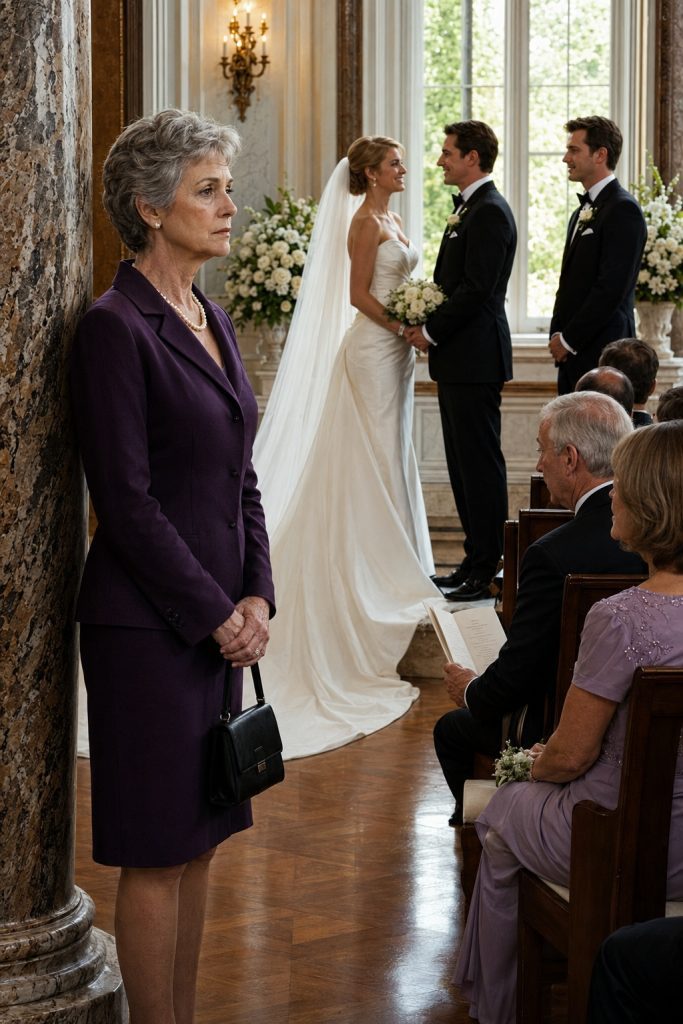
Ardanine Covington stood in the center of the aisle, her pale blue dress pooling around her feet like a collapsed cloud. Her bouquet lay crumpled on the floor, ivory petals scattering across the polished stone. Her hands were pressed against her mouth, and her eyes—Roosevelt’s eyes, the same warm brown with that slight tilt at the corners—were locked on Ernestine with an expression of pure, unfiltered horror.
“No,” Ardanine whispered. Her voice was barely audible over the rising tide of murmurs and gasps, but Ernestine heard it. She heard it because she had been hearing variations of that word all her life, from the moment Clifton had first looked at her with shame instead of love. “No, that’s not true. That’s not true. Mom, tell her that’s not true.”
Gwendalyn Covington did not speak.
She stood in the fourth row, her hands still folded in her lap, her face a careful mask of composure. But her knuckles were white. Her shoulders were rigid. And her eyes—her eyes were not composed at all. They were the eyes of a woman who had just watched the floor collapse beneath her feet.
“Gwendalyn,” Ernestine said, her voice carrying across the hall like a bell. “Tell her the truth. Tell your daughter who her father is.”
The guests had risen to their feet now. Chairs scraped backward. A man near the back pulled out his phone, and the glow of the screen illuminated his face with the cold blue light of a documentarian. Someone else was already filming. The cameras were rolling.
Gwendalyn’s jaw tightened. She turned her head slowly, deliberately, and fixed Ernestine with a look that had destroyed careers, silenced rivals, and made lesser women shrink. But Ernestine was not a lesser woman. She had raised a son alone. She had buried a husband. She had sat at a kitchen table and watched her coffee go cold while her own child told her she was not educated enough to stand in the same room as him.
She was done shrinking.
“I don’t know what you think you saw,” Gwendalyn said, her voice smooth as polished marble, “but you are mistaken. My daughter’s father was a man I dated briefly. He passed away years ago. There is no connection to your family.”
“Then why did you turn away from me in the grocery store parking lot twenty-three years ago?”
The question hung in the air like smoke.
Gwendalyn’s mask cracked for half a second.
The groom stepped forward.
Clifton Ashford was forty years old, a man who had spent the last year building a new identity, a new life, a new version of himself that did not include a mother who embarrassed him. He had rehearsed this wedding down to the smallest detail. He had memorized his vows. He had chosen the flowers, the music, the seating arrangement. He had done everything his fiancée’s mother had asked, because Gwendalyn Covington was a woman who got what she wanted, and what she wanted was a son-in-law who understood his place.
But he had not rehearsed this.
“Ma,” he said, and his voice cracked on the single syllable. “Please. Whatever you think you know, this is not the place. This is not the time.”
Ernestine looked at her son.
She saw the anger in his eyes. The humiliation. The desperate, clawing need to make her disappear so his perfect life could continue uninterrupted.
“When is the time, Clifton?” she asked. “You hid your fiancée from me for a year. You told me this wedding was only for educated people. You made me feel like I was not good enough to watch you get married.”
She took a step forward.
“And now I understand why. Because if I had seen her face, I would have known the truth. And you would have married your own sister without ever knowing.”
The hall erupted.
“That’s enough.” Gwendalyn’s voice cut through the noise like a blade. She had stepped out of the fourth row and was walking toward the altar, her heels clicking against the marble with the precision of a metronome. “I will not stand here and let some bitter, jealous woman destroy my daughter’s wedding with lies.”
“They are not lies.”
Every head turned.
Kelvin Marks had stepped forward from the back of the hall. His stocky frame was silhouetted against the doorway, his kind eyes hard with determination. He was holding his phone in his hand, the screen glowing.
“I have a recording,” he said. “Of my mother. From three days ago.”
Gwendalyn’s face went white.
“My mother was a nurse at Mercy Hospital twenty-three years ago,” Kelvin continued. “She worked the night shift on the maternity ward. And on the night of March fourteenth, she assisted in a delivery that nobody was supposed to remember.”
The words fell like stones into still water.
“A woman came in alone. No husband. No partner. No family. Just a tight smile and a bag with no name tag. She gave birth to a healthy baby girl with a full head of curly hair. She filled out the birth certificate with only her own name. The father’s line was left blank.”
Kelvin’s voice was steady, but his hands were shaking.
“But my mother saw the man who visited the next morning. Early. Before visiting hours officially started. He stood at the nursery window for fifteen minutes, his hands pressed against the glass, his face carrying an expression she had never forgotten.”
He looked at Ernestine.
“Recognition. Longing. Grief. She knew who he was. Everyone in the hospital knew Roosevelt Ashford.”
The name landed like a bomb.
Clifton staggered backward. His face had gone the color of old ash. “No,” he whispered. “No, that’s not possible. My father would never—”
“Your father was a good man,” Ernestine said, and her voice broke for the first time. “But good men make mistakes. And he never knew about this mistake. He died without knowing he had a daughter.”
She turned to Ardanine, who had sunk to her knees in the aisle, her pale blue dress pooling around her like water.
“I am sorry,” Ernestine said. “I am sorry you had to find out this way. I am sorry you have been lied to your entire life. But I could not let you marry your brother. I could not let that sin happen in a church.”
Ardanine looked up.
Her face was streaked with tears. Her mascara had run in dark lines down her cheeks. She looked young, so young, younger than her twenty-five years.
“I hate you,” she whispered. “I hate you for destroying my life.”
Ernestine felt the words like a physical blow.
But she did not look away.
“You have every right to hate me,” she said. “But you do not have the right to marry my son.”
The police arrived seven minutes later.
They came through the side doors, two officers in dark uniforms, their faces professionally blank. They walked past the horrified guests, past the overturned chairs, past the shattered champagne glass, and stopped in front of Gwendalyn Covington.
“Gwendalyn Covington,” one of them said, “you are under arrest for fraud, for concealing a child’s paternity, and for attempting to facilitate a marriage between blood relatives.”
Gwendalyn did not resist.
She stood perfectly still as the handcuffs clicked around her wrists. Her face was a mask of cold fury, but her eyes—her eyes were something else. They were the eyes of a woman who had spent twenty-three years building a fortress of lies, only to watch it crumble in a single afternoon.
“This is not over,” she said, looking directly at Ernestine. “This is not over.”
Ernestine did not answer.
She watched as Gwendalyn was led away, her designer heels clicking against the marble one last time before she disappeared through the doors.
And then she turned to look at her son.
Clifton was standing at the altar, his hands gripping the edge of the wooden podium so hard that his knuckles were white. He was staring at the spot where Ardanine had been sitting before one of the bridesmaids helped her to a chair in the corner.
“Ma,” he said. His voice was hollow. “Did you know? Before today?”
Ernestine shook her head.
“I suspected something was wrong when you started pulling away. When you stopped calling. When you told me I wasn’t educated enough to come to your wedding. But I didn’t know the truth until I saw her face.”
She took a step toward him.
“I saw your father in her, Clifton. The same nervous expression. The same tilt of the head. The same eyes. I knew the moment she walked down the aisle.”
Clifton’s face crumpled.
“I didn’t know,” he said. “I swear, I didn’t know. If I had known—”
“You would have what?” Ernestine asked. “Would you have told me the truth? Or would you have hidden it, the way you hid everything else?”
He had no answer.
The hall was emptying now. Guests were filing out in small clusters, their voices hushed, their phones already buzzing with the news. The string quartet had packed up their instruments and left without a word. The caterers were standing in the kitchen doorway, unsure whether to keep the food warm or throw it away.
Ernestine stood alone in the center of the aisle, Roosevelt’s pearls heavy against her throat.
She reached up and touched them.
He had given them to her on their fifteenth anniversary, years before the affair. He had placed the box on the table at the small Italian restaurant and said, “You are the only woman who has truly seen me.”
He had meant it.
But he had not been faithful.
And now his secret had destroyed two families.
Kelvin walked up beside her.
“Miss Ernestine,” he said softly. “Are you okay?”
She looked at him.
“I don’t know,” she said. “I don’t know what I am.”
He nodded.
“I should have told you sooner,” he said. “My mother called me three days ago. She told me everything. And I waited until the wedding to say something because I wanted to make sure the truth came out in front of everyone who needed to hear it.”
Ernestine looked at him.
“You did the right thing,” she said. “The truth needed to come out. But I wish it didn’t have to hurt so many people.”
Kelvin’s eyes were wet.
“I’m sorry,” he said. “I’m sorry I couldn’t protect you from this.”
Ernestine shook her head.
“You did protect me,” she said. “You protected me from watching my son marry his sister. You protected me from a lifetime of guilt and shame. You protected me from a sin that would have haunted me forever.”
She looked around the empty hall.
“I don’t know what happens next. I don’t know if Clifton will ever forgive me. I don’t know if Ardanine will ever recover from this. But I know one thing.”
She touched the pearls again.
“The truth is out. And for the first time in twenty-three years, I am free.”
She turned and walked toward the doors.
Behind her, Clifton called out.
“Ma. Please. Don’t leave.”
She stopped.
She did not turn around.
“You asked me not to come,” she said. “You told me the wedding was only for educated people. You hid your fiancée from me for a year.”
Silence.
“I will always be your mother,” she said. “But I will not be your secret anymore.”
She walked out into the evening air.
The sun was setting over Montlair Avenue, painting the sky in shades of orange and pink. The police cars were gone. The guests had dispersed. The street was quiet.
Ernestine stood at the edge of the parking lot and looked up at the sky.
She thought about Roosevelt. The man she had loved for thirty years. The man who had given her a son. The man who had given her a necklace and a lifetime of memories.
She thought about the secret he had carried to his grave.
And she thought about the daughter he had never known.
“I forgive you,” she whispered to the sky. “I forgive you for not being perfect. I forgive you for making mistakes. I forgive you for leaving me alone to clean up the mess.”
She touched the pearls one last time.
“But I will not let your mistakes destroy our son.”
She walked to her car, got in, and drove away.
Behind her, Harrove Hall stood empty, its doors open, its flowers wilting, its secrets finally exposed to the light.
And somewhere in the city, Gwendalyn Covington sat in the back of a police car, her designer suit rumpled, her hair disheveled, her reputation in ruins.
The truth had come out.
And nothing would ever be the same.
But here is what nobody noticed during the chaos.
Kelvin Marks had known the truth for years.
His mother, Evelyn Marks, had been a nurse at Mercy Hospital twenty-three years ago. She had worked the night shift on the maternity ward. And on the night of March 14th, she had assisted in a delivery that nobody was supposed to remember.
A woman had come in alone. No husband. No partner. No family. Just a tight smile and a bag with no name tag.
The woman had given birth to a healthy baby girl with a full head of curly hair. She had filled out the birth certificate with only her own name. The father’s line was left blank.
But Evelyn Marks had seen the man who visited the next morning. Early. Before visiting hours officially started. He had stood at the nursery window for fifteen minutes, his hands pressed against the glass, his face carrying an expression that Evelyn had never forgotten.
Recognition.
Longing.
Grief.
She had known who he was. Everyone in the hospital knew Roosevelt Ashford. He was a deacon at the big church downtown. He had a wife. He had a son.
And here he was, staring at a baby girl he could never claim.
Evelyn had kept the secret for twenty-three years.
But when she heard that Clifton Ashford was engaged to a woman named Ardanine Covington, she had called her son.
“Kelvin,” she had said, “you need to stop that wedding.”
He had asked why.
She had told him everything.
And Kelvin, who had grown up eating Sunday dinners at Ernestine’s table, who had called her Miss Ernestine since he was seventeen, who had watched her work double shifts and never complain, who had seen her pray for Clifton every single night—Kelvin had made a choice.
He had called Ernestine with the address.
Not because he was loyal to Clifton.
Because he was loyal to the truth.
The air outside Harrove Hall was cool and still. Ernestine stood by her car for a long moment, her hand resting on the door handle, her breath misting in the evening air. The pearls felt heavy against her chest, and she could still hear the echo of her own voice in the hall, the word “No” bouncing off the walls like a stone dropped into still water.
She did not cry.
She had not cried in years. Not since Roosevelt’s funeral, when she had stood at the graveside in the rain and watched them lower him into the ground while Clifton held her hand and pretended to be strong. That was eleven years ago. She had been fifty-two then, a widow with a son who was still figuring out how to be a man.
Now she was sixty-three, and her son had figured out how to be someone else entirely.
She got into the car and sat there with the engine off, staring at the dashboard. The clock read 2:47 PM. The wedding should have been over by now. The reception should have started. The champagne should have been poured.
Instead, there was silence.
Her phone buzzed. A text from Kelvin.
*You okay?*
She typed back: *I’m driving home.*
He replied immediately: *I’m right behind you.*
Ernestine started the engine and pulled out of the parking lot.
The next three days passed like water through a sieve.
Ernestine stayed home. She did not answer her phone. She did not open the door when reporters showed up, which they did, twice, because someone at the wedding had recorded everything and posted it online. The video had gone viral by Sunday evening. By Monday morning, it had been viewed over two million times.
*Mother Crashes Son’s Wedding — Reveals Bride Is Her Husband’s Daughter*
Ernestine watched the video once, then turned off her phone and went to water her roses.
She did not need to see it again.
She had been there.
She had lived it.
On Tuesday, a certified letter arrived. It was from Gwendalyn Covington’s law firm. The letter threatened a defamation lawsuit, demanded a retraction, and warned of “severe legal consequences.”
Ernestine read it standing at her kitchen counter, then placed it in the drawer where she kept her old checkbooks and utility bills.
She did not respond.
She did not call a lawyer.
She just waited.
On Wednesday morning, the doorbell rang at 8:47 AM.
Ernestine opened the door to find Kelvin standing on her porch, holding a paper bag that smelled like fresh pastries and a manila envelope that looked thick enough to change everything.
“Miss Ernestine,” he said, “you need to see this.”
They sat at her kitchen table.
The same table where she had sat on the night Clifton told her the wedding was “only for educated people.” The same table where she had left the scrap of paper with Harrove Hall’s address. The same table where she had prayed for her son every night since he was born.
Kelvin opened the envelope.
Inside were documents. Photocopies. Hospital records. Birth certificates. A statement typed on letterhead from Mercy Hospital, signed and notarized.
His mother’s statement.
Evelyn Marks had written down everything she remembered. The night of March 14th, twenty-three years ago. The woman who came in alone. The baby girl with curly hair. The man who visited the next morning, before visiting hours, his hands pressed against the nursery glass.
She had named Roosevelt Ashford.
She had described his face, his posture, the way he had whispered something to the baby through the glass before walking away.
She had kept the secret for two decades.
But she had not kept the evidence.
Attached to the statement was a photocopy of the hospital’s intake log from that night. The mother’s name was listed as Gwendalyn Covington. The father’s line was blank. But in the margin, in a different handwriting, someone had written a single word in pencil:
*Roosevelt?*
The question mark had been added later. Someone had seen something. Someone had suspected.
Kelvin pointed at the penciled note. “My mother says she didn’t write that. Someone else did. But she never found out who.”
Ernestine stared at the page.
She felt something shift inside her chest. Not anger. Not grief. Something colder. Something sharper.
Evidence.
She had walked into that wedding with nothing but the truth in her own eyes. She had spoken because she had seen Roosevelt’s face in Ardanine’s features. She had risked everything on the memory of a man who had loved her and betrayed her in equal measure.
But now she had proof.
“Where did you get this?” she asked.
“From my mother’s safe,” Kelvin said. “She gave it to me the night I called you with the address. She said, ‘If everything goes wrong, at least the truth will be on paper.’ “
Ernestine looked up at him.
“Why didn’t you give this to me before the wedding?”
Kelvin met her eyes.
“Because I was hoping you wouldn’t need it.”
On Thursday morning, Ernestine called a lawyer.
She did not find a fancy one. She found a woman named Delia Hargrove, who ran a small practice out of a converted house near the courthouse. Delia was sixty-one, white-haired, sharp-eyed, and had a reputation for taking cases nobody else wanted.
Ernestine sat in Delia’s cluttered office and laid out the documents on the desk.
Delia read through them in silence. When she finished, she looked up.
“You know what you’re holding, right?”
“Yes,” Ernestine said. “The truth.”
Delia shook her head slowly.
“You’re holding a loaded weapon. This doesn’t just prove Gwendalyn Covington lied about her daughter’s paternity. It proves she committed fraud. It proves she knowingly allowed her daughter to enter into an incestuous relationship. It proves she manipulated your son, your family’s legacy, and the legal system for over two decades.”
She paused.
“If you release this, Gwendalyn will lose everything. Her law license. Her reputation. Her freedom. But you need to know—this will also destroy Ardanine. And it will destroy Clifton.”
Ernestine sat very still.
“I know.”
“Are you prepared for that?”
Ernestine was quiet for a long moment.
Then she said, “I prepared for it the moment I walked into that hall.”
The next two weeks were a blur of legal filings, media appearances, and sleepless nights.
Delia filed a petition with the court, requesting a formal declaration of paternity based on the evidence. The petition named Roosevelt Ashford as Ardanine Covington’s biological father and requested that the marriage license for Clifton Ashford and Ardanine Covington be voided on grounds of consanguinity.
The news exploded.
Every major outlet picked up the story. The video from the wedding was replayed endlessly. Commentators debated the legal and moral implications. People who had never heard of Ernestine Ashford were suddenly talking about her as if she were a character in a novel.
But Ernestine did not watch the coverage.
She spent her days at Delia’s office, reviewing documents, making lists, preparing for the hearing. She spent her nights at home, sitting on her porch, looking at the stars, thinking about Roosevelt.
She had loved him.
She still loved him.
But love and truth were not the same thing.
On the morning of the hearing, Ernestine put on a simple black dress, fastened Roosevelt’s pearls around her neck, and drove to the courthouse.
The courtroom was packed.
Reporters filled the back rows. Family members sat in the front. Clifton was there, sitting on the left side, his face hollow and gray. Ardanine was there, sitting beside a woman Ernestine did not recognize—a friend, perhaps, or a cousin. And Gwendalyn was there, sitting at the defendant’s table, her sleek bob immaculate, her expression carved from stone.
When Ernestine walked in, every head turned.
Clifton stood up halfway, then sat back down.
Ardanine looked at her with eyes that were wet and bewildered.
And Gwendalyn—
Gwendalyn stared straight ahead, refusing to acknowledge her.
Ernestine took her seat at the plaintiff’s table beside Delia.
The judge entered.
The hearing began.
The first hour was procedural. Delia presented the evidence. The hospital records. The intake log. The notarized statement from Evelyn Marks.
Gwendalyn’s lawyer, a thin man with a sharp voice, objected to everything.
“Your Honor, this evidence is hearsay. The witness is not present in court. The intake log is not verified. The penciled notation in the margin is unidentifiable and inadmissible.”
The judge, a woman named Chen with silver hair and tired eyes, listened patiently.
Then she said, “Mr. Aldridge, do you have evidence to the contrary? A birth certificate naming a different father? A witness who can testify that Roosevelt Ashford was not the father?”
Gwendalyn’s lawyer hesitated.
“We—we have not yet obtained such evidence, Your Honor. But we request time to do so.”
The judge looked at Delia.
“Ms. Hargrove?”
Delia stood up.
“Your Honor, we have a witness who can testify directly to the events of March 14th, twenty-three years ago. She is in the hallway. She is prepared to speak.”
The judge nodded.
“Call her in.”
The door opened.
Evelyn Marks walked in.
She was seventy-one years old, small and sturdy, with gray hair pulled back in a bun and hands that trembled slightly as she took the oath. She wore a simple blue dress and a cross around her neck.
Ernestine had never met her before.
But she knew her.
She knew the shape of her kindness. She knew the weight of her silence. She knew the cost of the truth she had carried for twenty-three years.
Evelyn sat down in the witness chair.
The judge leaned forward.
“Mrs. Marks, can you tell us what you saw on the night of March 14th, twenty-three years ago?”
Evelyn took a breath.
“I was working the night shift on the maternity ward at Mercy Hospital. It was a quiet night. Only two deliveries scheduled. The first one was routine. The second one came in around eleven PM.”
She paused.
“A woman arrived alone. No husband. No partner. No family. She was in labor, but she was very calm. Almost too calm. Like she had been preparing for this moment for a long time.”
“Did she give you her name?” the judge asked.
“She said her name was Gwendalyn Covington.”
“And did you assist in the delivery?”
“Yes. I was the attending nurse. She gave birth to a healthy baby girl at 2:17 AM on March 15th.”
Evelyn’s voice wavered slightly.
“The baby had a full head of curly hair. She was beautiful.”
“Did the mother list a father on the birth certificate?”
“No. She left the line blank.”
The judge nodded.
“And you say you saw a man visit the next morning?”
Evelyn’s hands tightened on the rail of the witness box.
“Yes. He came in early. Before visiting hours officially started. He stood at the nursery window for about fifteen minutes. He didn’t ask to hold the baby. He didn’t ask to see the mother. He just stood there, with his hands pressed against the glass, looking at that little girl like she was the most precious thing he had ever seen.”
“Did you recognize him?”
Evelyn’s voice dropped.
“Everyone in the hospital knew Roosevelt Ashford. He was a deacon at First Baptist. He volunteered at the charity clinic. He was a good man. A kind man.”
She looked at Ernestine.
“He was married to a woman named Ernestine.”
The courtroom went silent.
The judge looked at Gwendalyn.
“Mrs. Covington, do you have anything to say?”
Gwendalyn stood up.
Her face was pale. Her hands were shaking.
But her voice was steady.
“Your Honor, I have never denied that Roosevelt Ashford was the father of my daughter. I have never confirmed it either. I left the line blank because I was protecting my child. I was protecting my reputation. I was protecting myself.”
She turned to look at Ernestine.
“I was thirty-five years old. I was a young attorney. I had an affair with a married man. I was ashamed. I was terrified. I did what I thought was best.”
Her voice cracked.
“I know it was wrong. I know I hurt people. But I did not do it out of malice. I did it out of fear.”
Ernestine stared at her.
She remembered the grocery store parking lot. The baby with pink ribbons. The way Gwendalyn had turned away, pretending not to see her.
She remembered the scholarship banquet. The teenage girl in the pale blue dress. The cold feeling in her chest.
She remembered all of it.
And she understood.
But understanding did not erase what had been done.
The judge took a moment to consider.
Then she said, “Based on the evidence presented, including the hospital records, the notarized statement from Evelyn Marks, and the testimony given today, this court finds that Roosevelt Ashford is the biological father of Ardanine Covington.”
She paused.
“The marriage license between Clifton Ashford and Ardanine Covington is hereby voided on grounds of consanguinity. The court further finds that Gwendalyn Covington knowingly concealed the paternity of her daughter, committed fraud in the procurement of the marriage license, and engaged in a pattern of deception that caused significant emotional and legal harm to the plaintiff and her family.”
She looked at Gwendalyn.
“The defendant is remanded into custody pending further investigation. Bail is denied.”
Gwendalyn’s lawyer leapt to his feet.
“Your Honor, this is—”
“Sit down, Mr. Aldridge.”
Gwendalyn’s face went white.
Two bailiffs approached her.
She did not resist.
She looked at Ernestine one last time, and there was something in her eyes that Ernestine could not quite name.
Not hatred.
Not regret.
Something else.
Something that looked almost like relief.
The courtroom erupted.
Reporters surged toward the doors. Family members cried out. Clifton stood frozen, his hands gripping the back of the chair in front of him, his face a mask of shock and grief.
Ardanine had not moved.
She sat in her seat, staring at the judge’s bench as if the words were still echoing in the air.
Ernestine stood up slowly.
She walked toward the exit.
But before she reached the door, a hand touched her arm.
She turned.
It was Clifton.
He looked older than she had ever seen him. His eyes were red. His tie was loose. His shoulders were slumped.
“Ma,” he said. His voice was barely a whisper.
Ernestine looked at him.
She saw the boy who had learned to ride a bike in their driveway. She saw the teenager who had stayed up late studying for his exams. She saw the man who had stood at his father’s funeral and promised to take care of her.
She also saw the man who had hidden his fiancée for a year.
The man who had told her the wedding was only for educated people.
The man who had let Gwendalyn Covington turn him into a stranger.
“Clifton,” she said.
“I’m sorry,” he said. “I’m so sorry. I didn’t know. I didn’t know any of it. She told me you were difficult. She told me you wouldn’t understand. She told me—”
“Clifton.”
He stopped.
Ernestine reached up and touched his face.
“I will always be your mother,” she said. “But I will not be your secret anymore.”
She let her hand fall.
“If you want to be my son again, you will have to earn it. Not by apologizing. Not by explaining. But by becoming the man I raised you to be.”
She turned and walked out the door.
Behind her, the courtroom doors swung shut.
And somewhere in the distance, a siren began to wail.
Kelvin was waiting for her on the courthouse steps.
“Miss Ernestine,” he said.
She walked past him, down the steps, toward the street.
He followed.
“Miss Ernestine, wait.”
She stopped.
She turned.
He looked at her with the same expression he had worn since he was seventeen—that mixture of loyalty and tenderness that had never wavered, not once, in all those years.
“I need to tell you something,” he said.
She waited.
“I knew,” he said. “I knew before the wedding. My mother told me everything when she heard about the engagement. I knew Ardanine was your husband’s daughter.”
Ernestine’s breath caught.
“You knew?”
“Yes.”
“And you didn’t tell me sooner?”
He shook his head.
“I wanted to. But I thought—I thought if I told you before the wedding, you would have to carry the weight of that secret alone. I thought you deserved to see the truth with your own eyes. I thought you deserved to be the one to stop it.”
He stepped closer.
“You are the strongest person I have ever known, Miss Ernestine. And I knew—I knew that if you walked into that hall and saw what I had seen, you would know what to do.”
Ernestine stared at him.
Then she reached out and took his hand.
“Thank you,” she said.
He smiled.
“Always, Miss Ernestine. Always.”
They stood together on the courthouse steps, watching the evening light fade over the city.
The siren had stopped.
The reporters had scattered.
The truth was out.
And for the first time in twenty-three years, Ernestine Ashford felt the weight of Roosevelt’s pearls against her chest and knew—truly knew—that she was finally free.
The courtroom doors had barely finished swinging shut when the first reporter caught up to Ernestine on the courthouse steps.
“Mrs. Ashford! Mrs. Ashford, can you confirm that your husband fathered a child with Gwendalyn Covington?”
Ernestine did not break stride.
“Mrs. Ashford, how does it feel to have exposed a twenty-three-year secret?”
She kept walking.
“Mrs. Ashford, do you believe justice has been served?”
She stopped then.
Not because she wanted to answer.
Because a woman in a beige suit had stepped directly into her path, holding a phone up like a shield.
“One question,” the woman said. “Just one. Did you know before today?”
Ernestine looked at the phone. At the red recording light. At the dozen other phones now pointed at her face like small hungry mouths.
“No,” she said. “I did not know until I saw her face.”
“And if you had known sooner?”
Ernestine considered the question.
The truth was complicated.
If she had known sooner, she might have confronted Gwendalyn in private. She might have let the secret stay buried for the sake of her son’s happiness. She might have carried it alone, the way she had carried everything else.
But she had not known sooner.
And now the truth was out, blazing in the open for everyone to see.
“If I had known sooner,” she said, “I would have come sooner. And I would have brought more witnesses.”
She turned and walked down the steps.
Kelvin followed, his hand on her elbow, guiding her past the chaos.
The headlines came fast.
By six o’clock that evening, every major news outlet had picked up the story. “Attorney Arrested for Concealing Paternity at Son’s Wedding.” “Bride Learns Fiancé Is Her Half-Brother Mid-Ceremony.” “Socialite Gwendalyn Covington Faces Fraud Charges After Decades-Long Lie.”
The comments were brutal.
They dissected Gwendalyn’s life like a specimen. They found old photographs, old interviews, old articles about her charity work and her legal career. They compared the dates. They did the math. They discovered that Ardanine had been born exactly seven months after Roosevelt Ashford had been seen leaving Gwendalyn’s apartment building late at night.
They found the grocery store parking lot.
They found the scholarship banquet.
They found everything.
By nine o’clock, Gwendalyn Covington had been formally charged with fraud, perjury, and concealing the biological parentage of a child. The district attorney’s office had issued a statement confirming that the investigation would extend to possible financial crimes, including the misuse of trust funds that had been set up in Ardanine’s name.
The Covington family home was surrounded by reporters.
The law firm where Gwendalyn had worked for twenty years announced that she was “no longer associated with the firm.”
Her social media accounts were deleted within hours.
Her friends stopped answering their phones.
The life she had built—the reputation, the influence, the carefully maintained image of a respectable attorney and devoted mother—crumbled in a single afternoon.
Ernestine watched it all from the small brick house on Maple Street.
She sat in her living room with the television muted, watching the footage of Gwendalyn being led into the courthouse in handcuffs. The same woman who had once looked at Ernestine with such contempt, who had coached Clifton to hide his own mother, who had built a wall of education and status to keep Ernestine out.
Now she was nothing.
And Ernestine felt nothing.
No satisfaction.
No triumph.
Just a deep, quiet exhaustion.
Kelvin brought her tea.
“You should eat something, Miss Ernestine.”
She shook her head.
“Not hungry.”
He sat down beside her.
“Clifton has been calling. Every hour. He wants to talk to you.”
She looked at the phone on the coffee table. It had buzzed seventeen times in the last three hours.
“I know.”
“Are you going to answer?”
She picked up the phone.
Looked at the screen.
Set it back down.
“Not tonight.”
Kelvin nodded.
He did not push.
He had learned long ago that Ernestine Ashford moved at her own pace.
She had raised a son alone after her husband died. She had worked double shifts. She had prayed through grief. She had held her head high while people whispered that she was not good enough for her own son’s wedding.
She had walked into Harrove Hall with nothing but a plum dress and a string of pearls, and she had stopped a wedding between siblings with nothing but the truth.
She had earned the right to rest.
The next morning, Ernestine woke before dawn.
She made coffee.
She sat at the kitchen table and looked at the framed photograph of Roosevelt on the shelf.
He was smiling in the photo. Young. Handsome. Unburdened.
She had loved him.
She still loved him.
But she was angry at him.
Angry that he had kept a secret that had almost destroyed their son. Angry that he had died without telling her. Angry that she had to be the one to clean up the mess he had left behind.
She picked up the photograph.
Studied his face.
The curve of his jaw.
The shape of his smile.
The same shape she had seen on Ardanine’s face in the aisle of Harrove Hall.
“You should have told me,” she said aloud.
The photograph did not answer.
She set it down.
At 8:15, the doorbell rang.
Ernestine opened the door to find Clifton standing on her porch.
He looked terrible.
His eyes were swollen. His shirt was wrinkled. He had not shaved. He looked like a man who had not slept in days.
“Ma,” he said.
She stepped aside.
He walked into the living room and stood there, looking around at the familiar furniture, the familiar walls, the familiar smell of coffee and old books.
“I don’t know where to start,” he said.
Ernestine sat down.
He sat across from her.
Silence.
Then he said, “I didn’t know. I swear to you, Ma. I didn’t know.”
“I know.”
“I thought—I thought she was the one. I thought we were building a life together. I thought—I thought her mother was just protective. I didn’t know she was hiding something.”
“Clifton.”
He looked up.
“I know you didn’t know,” she said. “But I need you to understand something.”
She leaned forward.
“You hid her from me. For a year. You let Gwendalyn Covington tell you that your own mother was not welcome at your wedding. You let her convince you that I was not educated enough, not polished enough, not good enough to stand in the same room as her guests.”
Clifton’s face crumpled.
“I know.”
“Do you?”
“Yes.”
He wiped his eyes.
“I was ashamed, Ma. I was ashamed of where I came from. I was ashamed that I hadn’t become what I thought I was supposed to be. I was ashamed that I still needed you. And Gwendalyn—she made me feel like I had to choose. Between you and the life I wanted.”
“And you chose her.”
He nodded.
“I did.”
He looked at her.
“And I was wrong.”
The words hung in the air.
Ernestine looked at her son.
The boy she had raised.
The man he had become.
The stranger he had turned into.
And the stranger who was now sitting in her living room, asking to be known again.
“I don’t know if I can forgive you yet,” she said. “But I can start by listening.”
Clifton nodded.
And for the first time in a year, he talked.
He told her about Ardanine. How they had met at a charity event. How she had been kind, funny, warm. How he had fallen in love with her before he knew who her mother was.
He told her about Gwendalyn. How she had taken him aside after the engagement and told him that his mother would “never fit in” with their circle. How she had suggested that it would be “easier for everyone” if Ernestine was not involved.
He told her about the wedding planning. How Gwendalyn had controlled everything. The venue. The guest list. The menu. The flowers. How she had made sure that Ernestine’s name never appeared on any invitation.
He told her about the guilt.
The shame.
The voice in his head that had whispered, “She’s your mother. You can’t do this to her.”
And how he had silenced that voice by telling himself that he was doing what was best for everyone.
He told her everything.
And Ernestine listened.
When he was done, he was crying.
She reached across the table and took his hand.
“Clifton,” she said.
He looked up.
“You are going to have to live with what you did for the rest of your life,” she said. “That is your cross to carry. I cannot carry it for you.”
He nodded.
“But I can tell you this. You are still my son. And I will always love you. But love does not mean forgetting. It means choosing to move forward even when you remember.”
She squeezed his hand.
“So let us move forward.”
He nodded again.
They sat there for a long time, holding hands across the kitchen table, the morning light filtering through the curtains.
The phone buzzed.
Clifton looked at it.
“It’s Ardanine,” he said.
Ernestine let go of his hand.
“Answer it.”
He picked up the phone.
“Hello?”
He listened.
His face changed.
“Where are you?”
He listened again.
“I’m coming. Stay there.”
He hung up.
“She’s at the hospital. She—she collapsed this morning. They think it’s a panic attack.”
Ernestine stood up.
“I’ll drive you.”
“Ma, you don’t have to—”
“I know I don’t have to. I’m choosing to.”
They drove to the hospital in silence.
The hospital was busy.
Nurses moved quickly through the hallways. Patients sat in waiting rooms with blank expressions. The smell of antiseptic hung in the air like a curtain.
Ardanine was in a private room on the third floor.
She looked small in the hospital bed.
Her curly hair was spread across the pillow. Her face was pale. Her eyes were red.
She looked up when Clifton walked in.
“Cliff.”
He went to her side.
“I’m here.”
She started crying.
“I didn’t know. I swear I didn’t know.”
“I know.”
“She told me my father was dead. She told me he died before I was born. She told me his name was something else. She told me—she told me everything was a lie.”
Ernestine stood in the doorway.
Ardanine looked at her.
“Mrs. Ashford.”
“Yes.”
“I’m sorry.”
Ernestine walked into the room.
She stood at the foot of the bed.
“You have nothing to be sorry for,” she said. “You were a child. You were lied to. You are a victim of your mother’s choices, just like my son.”
Ardanine wiped her eyes.
“What do I do now?”
Ernestine thought about it.
“You grieve,” she said. “You grieve the mother you thought you had. You grieve the father you never knew. You grieve the future you thought you were going to have.”
She paused.
“And then you decide who you want to be. Not who your mother wanted you to be. Not who anyone else expects you to be. You decide.”
Ardanine nodded slowly.
“I don’t know who that is.”
“That’s okay,” Ernestine said. “You have time to find out.”
She reached into her purse and pulled out a small envelope.
“This is for you.”
Ardanine opened it.
Inside was a photograph.
A man in his fifties, standing in a garden, smiling at the camera.
Roosevelt.
“That was taken a year before he died,” Ernestine said. “He loved gardens. He used to say that the best things in life grew slowly, with patience and care.”
Ardanine looked at the photograph.
Her hand trembled.
“He looks kind.”
“He was,” Ernestine said. “He was not perfect. He made mistakes. But he was kind.”
Ardanine pressed the photograph to her chest.
“Thank you,” she whispered.
Ernestine nodded.
She turned to leave.
“Mrs. Ashford?”
She looked back.
“Will you—will you tell me more about him? Someday?”
Ernestine considered the question.
She thought about the affair. The secret. The pain.
She thought about Roosevelt’s smile. His laugh. The way he had held her hand during their last anniversary dinner.
She thought about the daughter he had never known.
The daughter who was now asking to know him.
“Someday,” she said. “When you are ready.”
She walked out of the room.
Clifton followed her into the hallway.
“Ma.”
She turned.
“Thank you,” he said.
“For what?”
“For being the person you are.”
She looked at him.
“I didn’t have a choice,” she said. “I had to be strong. For you. For myself. For the truth.”
She touched his face.
“But now you have a choice, Clifton. You can be the man I raised you to be. Or you can keep being the man Gwendalyn tried to make you.”
She let her hand fall.
“Choose wisely.”
She walked away.
The evening air was cool.
Ernestine stood on the hospital steps, looking up at the sky.
The stars were beginning to appear.
One by one.
Small and steady.
She thought about Roosevelt.
She thought about the secrets he had carried.
She thought about the weight of the truth she now carried.
And she realized something.
She was tired.
But she was not broken.
She had walked into Harrove Hall alone.
She had stopped a wedding.
She had exposed a lie.
She had faced her son.
She had offered grace to a girl who had been lied to her entire life.
She had done all of it while wearing a plum dress and a string of pearls.
She had done all of it with her head held high.
Kelvin appeared beside her.
“Miss Ernestine.”
“Yes.”
“Are you okay?”
She looked at him.
“I will be.”
He smiled.
“I know you will.”
They stood together in the quiet evening.
The hospital lights glowed behind them.
The streetlights flickered on along the road.
And somewhere in the distance, a train whistle blew.
“What do you want to do now?” Kelvin asked.
Ernestine thought about it.
“I want to go home,” she said. “I want to make a cup of tea. I want to sit on my porch and watch the night come.”
“That sounds like a good plan.”
“It is.”
She started walking toward the car.
Then she stopped.
“Kelvin.”
“Yes.”
“Thank you.”
“For what?”
“For telling me the truth. For not letting me stay in the dark.”
He nodded.
“I should have told you sooner.”
“Maybe,” she said. “But you told me when it mattered. That is what counts.”
She got into the car.
He got into the driver’s seat.
They drove home in comfortable silence.
The house was dark when they arrived.
Ernestine walked inside, turned on the kitchen light, and put the kettle on.
She made tea.
She sat on the porch.
She watched the stars.
She thought about Roosevelt.
She thought about Clifton.
She thought about Ardanine.
She thought about the girl in the grocery store parking lot, twenty-three years ago, with pink ribbons in her hair.
She thought about how different things might have been if she had asked questions then.
But she had not.
And she could not change the past.
All she could do was move forward.
She took a sip of tea.
The night was quiet.
The pearls were warm against her chest.
She looked up at the sky.
And for the first time in twenty-three years, she felt at peace.