The engine of my new silver sedan was still warm when my son Matthew closed his hand around the keys on my kitchen table. The fluorescent light above the stove hummed its low, buzzing frequency, a sound I had heard every morning for twenty-three years but never noticed until now. My coffee sat untouched on the counter, growing cold in the ceramic mug Robert had bought me fifteen years ago from a little shop on our anniversary trip to the coast. The mug was chipped on the rim, faded blue with a painted anchor, and I had drunk from it every single day since he handed it to me. Now the coffee was going to waste.
Matthew’s fingers curled around the key fob like it belonged to him. Like he had walked into his own house to collect his own property.
“Mom,” he said, not looking at me, “you don’t need this car.”
Behind him, his wife Vanessa leaned against the kitchen doorframe, inspecting her manicured nails. Her blonde bob caught the light. Her designer blouse was crisp, unwrinkled, expensive. She was not looking at me either. She was looking at the kitchen cabinets, the countertops, the layout of the room, the way I had arranged Robert’s old recipe books on the shelf by the window. She was evaluating. She had been evaluating since the day she married my son twelve years ago, and I had never once seen her find anything she approved of.
The hardwood floor creaked under my bare feet as I took a step toward him. The floorboards had always creaked in that exact spot, right where the hallway met the kitchen. Robert had meant to fix it for years. He never got around to it. I had learned to step over it, to avoid the sound. But right now, I did not care about the creak.
“Put those keys down, Matthew.”
He finally met my eyes. His were cold. Not angry. Not even frustrated. Just cold. Like he was looking at a problem he needed to solve, not a mother he needed to protect.
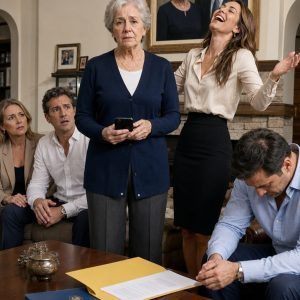
“Vanessa and I have been talking,” he said. “After our trip, we’re going to look at nursing homes for you.”
The words landed like stones dropped into still water. I felt them hit one by one. Nursing. Homes. For you.
He said it like he was discussing grocery shopping. Like I was a chore he needed to check off a list before lunch.
“A good one,” he continued. “You’ll be cared for. You’ll have people around. Honestly, I can drop you off on the way tomorrow if you’d just be reasonable.”
Vanessa finally looked at me. Her lips curled into something that was not quite a smile. “It’s really the best option, Edith. This house is too big for one person. And you’re not getting any younger.”
I felt the air leave my lungs. Not dramatically. Not with a gasp. Just slowly, like someone had pulled a plug and all the warmth was draining out of my chest.
“I’m your mother,” I whispered.
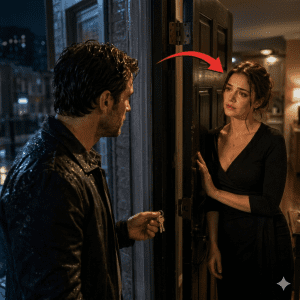
Matthew’s jaw tightened. He did not respond. He just turned and walked toward the front door, the keys jingling in his hand like loose change.
I followed him. My slippers scuffed against the floor. The hallway stretched longer than it ever had before. I passed the framed photo of Robert and me on our wedding day. I passed the small table where I kept the mail. I passed the coat rack where Robert’s old jacket still hung, the one I could not bring myself to move.
“Matthew, stop. That car is mine.”
He did not stop. He reached the front door, pulled it open, and stepped onto the porch. The June morning hit my face — warm, bright, the kind of day that should have felt hopeful.
Vanessa walked past me without a word. She opened the passenger door of my silver sedan and slid inside. She smoothed her skirt. She adjusted the mirror. She acted like she owned the seat she was sitting in.
Matthew got in behind the wheel.
The engine started.
The car rolled backward down the driveway.
I stood on my front porch, barefoot, my floral-print blouse hanging loose over my shoulders, my silver-gray hair still messy from sleep. I watched my car reverse onto the street. I watched my son shift into drive. I watched the taillights grow smaller as they drove away.
And then they were gone.
I stood there for a long time. Long enough that a neighbor’s dog barked twice down the street. Long enough that a mail truck rumbled past. Long enough that the morning sun climbed higher and began to warm the concrete under my feet.
I did not cry. Not yet. I was too stunned to cry. I was too busy trying to understand how the boy I had raised — the boy I had nursed through chickenpox, the boy I had driven to soccer practice in the rain, the boy I had stayed up all night with when he had nightmares about monsters under his bed — had become a man who could look at his own mother and see nothing but an obstacle.
I went back inside. I closed the door. I locked it, though I did not know why. The house felt different now. Smaller. Colder. The same silence that had haunted me since Robert died had returned, but it was worse now. Because this silence had a name. It was the silence of a son who had driven away with my keys and my car and my dignity, and had not looked back even once.
I walked to the kitchen. I picked up my cold coffee. I stared at the chipped blue mug in my hands. Robert’s mug. The last thing he had given me before the hospital.
And then I remembered.
Three months ago, Robert had died in a hospital room that smelled of antiseptic and grief. The machines had beeped. The fluorescent lights had hummed. The sheets had been stiff and white and smelled like bleach. I had sat in a plastic chair beside his bed for seventeen nights straight, sleeping in fits, waking every time he coughed or shifted or called my name in a voice so thin it barely existed.
Two days before he died, Robert had done something I did not understand at the time.
He had called Arthur Sterling, our family attorney, to the hospital.
I remember the confusion I felt when Arthur walked through the door, his briefcase in hand, his face professional but kind. I remember Robert struggling to sit up, the oxygen tubes pulling at his nose, his hands shaking from the medication that was supposed to keep him comfortable.
“I need a codicil,” Robert had whispered.
Arthur had pulled out a recorder. He had placed it on the bedside table, next to the half-empty cup of water and the plastic basin they used for his medication.
“Edith,” Robert had said, turning his head to look at me, “I need you to trust me.”
I had held his hand. I had squeezed it. I had not asked questions because I was too scared of the answers. I was too focused on the beeping machines and the paper gown that crinkled every time he moved and the way his skin had turned that pale, waxy color that told me he was slipping away.
So I had just nodded.
Arthur had recorded Robert’s instructions. He had typed something on a laptop. He had printed a document and placed it on the rolling tray in front of Robert. Robert had signed it with a trembling hand, the pen scratching against the paper. Arthur had notarized it right there, between the IV stand and the chair I had slept in for seventeen nights straight.
After Robert died, Arthur had found me at the funeral. He had handed me a sealed envelope.
“Keep this in a safe place,” he had said. “Your husband wanted you to have options.”
I had tucked the envelope into the glove box of my new car two days ago, when I bought it. I had not opened it. I had not known why Robert wanted it there. I had just felt, somehow, that he had wanted it in that car, close to me, within reach.
And now, standing in my empty kitchen with cold coffee in my hand and the memory of my son’s cold eyes burning in my mind, I finally understood.
Robert had known.
He had known what Matthew would become. He had seen the signs that I had been too blind to see. The way Matthew had grown distant after Vanessa entered his life. The way he had stopped calling. The way he had shown up at the hospital only twice during Robert’s final weeks, and both times he had spent more time on his phone than at his father’s bedside.
Robert had seen it all. And he had prepared.
I set the mug down. I walked to the kitchen table. I picked up my phone. The screen was dark. My reflection stared back at me — a tired woman with silver-gray hair pulled into a messy bun, deep circles under her eyes, a floral-print blouse that was starting to look as worn as she felt.
But I was not the woman Matthew thought I was.
My husband had made sure of that.
I opened Matthew’s contact. My thumb hovered over the keyboard. Outside, a car passed by, its engine humming against the quiet suburban street. The kettle on my counter had boiled dry and clicked off. The only sound was my own breathing, steady now, no longer broken.
I thought about the moment Matthew had taken the keys. I thought about the way he had said “nursing home” like it was a reasonable suggestion. I thought about Vanessa’s smirk, her designer clothes, her entitlement.
And I thought about Robert. In that hospital bed. Fighting to stay alive long enough to protect me.
I typed three words.
No emotion. No threat. Just truth.
*Check the glove box.*
I pressed send.
The message switched to delivered. Then to read.
For a long minute, nothing happened. I counted the cracks in the ceiling — there were seven, running from the light fixture to the corner above the refrigerator. I listened to the dishwasher cycle through its final rinse. I watched a fly land on the windowsill and then fly away.
Then my phone lit up.
Matthew calling.
I let it ring.
He called again.
Then a third time.
Then the texts started flooding in.
*Mom, what is this?*
Another one followed.
*Mom, call me right now.*
Then a third.
*Please. Don’t do anything yet.*
I sat at my kitchen table, staring at those words while the late morning sun spilled across the floor. The light caught the dust motes floating in the air. It caught the chip in Robert’s coffee mug. It caught the photo on the wall of Robert and me at the beach, wind-ruined hair, laughing, alive.
And for the first time since my husband died, I did not feel helpless.
Because my son had finally opened that glove box.
And whatever he had just found inside my car had made him understand one thing.
He had not taken keys from a weak old woman.
He had taken them from someone who had been ready.
I had bought that car exactly twenty-four hours earlier.
It was the first decision I had made for myself since Robert died.
I remember standing in the dealership, staring at the row of sedans, feeling overwhelmed by the choices. The salesman had been patient. He had asked what I was looking for, and I had said, “Something reliable. Something safe. Something that’s just mine.”
He had shown me the silver sedan. It was not flashy. It was not expensive. It was a simple four-door with cloth seats and a decent sound system and a glove box big enough to hold a legal document.
I had taken it for a test drive. I had rolled down the windows and felt the June air on my face. I had driven down streets I had known for forty years, past the park where Matthew had learned to ride a bike, past the coffee shop where Robert and I used to go on Saturday mornings, past the elementary school where Matthew had cried on his first day of kindergarten.
And I had felt something I had not felt in months.
I had felt hope.
I had signed the papers with trembling hands. Edith Miller. Sole owner. Those two words had made me cry harder than I expected.
I had driven home with the windows down. I had parked in the driveway and sat there for a minute, looking at the car like it was more than metal and tires. It was freedom. It was proof I was still here. It was the first step toward learning to live again.
I had called Matthew that afternoon. I had left a message.
“Sweetheart, I bought a car today. I’d love for you to come see it. I think your dad would be proud.”
I had hung up feeling foolishly hopeful.
I should have known better.
Matthew had not come to see the car. He had come to take it.
And now, forty miles away, he was sitting on the shoulder of the highway, holding a legal document that had just turned his world upside down.
I did not answer his calls. I let them ring until they went to voicemail, and I did not listen to the messages. I did not need to hear him beg. I needed to act.
I called Arthur Sterling.
He answered on the second ring. “Edith. I was wondering when you’d call.”
“Did you know?” I asked. “Did you know what Matthew would do?”
Arthur was quiet for a moment. I could hear him breathing, could hear the rustle of papers in his office.
“Robert knew,” he said finally. “He told me, in that hospital room. ‘Arthur, my son is going to try to put my wife away. I need to stop him before I’m gone.’”
I closed my eyes. I could see Robert’s face so clearly. The oxygen tubes. The pale skin. The stubborn fire still burning in his eyes. Even dying, he had been fighting for me.
“He made me write the codicil that same day,” Arthur continued. “He signed it with a hand that could barely hold a pen. He wanted you to have a weapon, Edith. He just hoped you’d never need to use it.”
“Enforce it,” I said.
“All of it?”
“All of it.”
Arthur arrived at my house within the hour. He brought two copies of the codicil, already notarized, already filed with the county clerk’s office that morning. He set them on my kitchen table, next to Robert’s coffee mug.
“I’ve been holding this for three months,” he said, handing me a pen. “Robert’s instructions were clear. The moment Matthew tried anything, I was to activate it immediately.”
I signed my name. Edith Margaret Miller. The same name I had signed on the car paperwork the day before. But this time, I was not trembling. My hand was steady. My heart was calm.
Arthur took the signed copies and made a phone call. Within ninety minutes, a process server had tracked Matthew down at a gas station forty miles away. Arthur showed me the photo on his phone — Matthew standing next to my silver sedan, his face white as paper, holding the legal notice like it had burned him. Vanessa was in the passenger seat, her designer sunglasses hiding nothing.
By three in the afternoon, my car was back in my driveway.
Matthew had driven it back himself. He had parked it exactly where I had left it the day before. Then he had stood on my front porch for twenty minutes, knocking, calling my name, asking to be let in.
I watched him through the living room blinds.
I did not open the door.
Eventually, he left.
Vanessa’s car idled at the curb. She did not get out. She just stared at the house through her windshield, her expression unreadable. And then they drove away.
I made myself a cup of tea. I sat in Robert’s recliner. The house was quiet, but it was not the heavy silence of grief anymore. It was the quiet of a battlefield after the fighting was done.
Then my phone buzzed. A text from Eleanor.
*You okay, hon?*
Eleanor ‘Ellie’ Miller. My best friend for forty years. The woman who had sat with me through Robert’s funeral, who had brought me casseroles I could not eat, who had told me, “One day, you’re going to find your feet again.”
I typed back: *I found my feet.*
Her reply came instantly: *Come over. I have Robert’s favorite cookies. We’re going to celebrate.*
I smiled for the first time in months. A real smile. One that reached my eyes.
I grabbed my keys. My keys. For my car. And I drove to Eleanor’s house with the windows down and the June air on my face, and I knew, deep in my bones, that Robert was smiling somewhere too.
But here is what nobody noticed.
Here is the detail that Matthew missed, that Vanessa missed, that even Arthur did not fully understand until he reviewed the codicil file that afternoon.
When Arthur Sterling drafted that document in the hospital room, Robert had added one more clause. A clause so specific, so carefully hidden in legal language, that no one saw it until Arthur reviewed the file three months later.
It was buried on page three, paragraph seven, subsection C.
*In the event that Matthew Thomas Miller attempts to place Edith Margaret Miller into any assisted living or nursing facility without her written, notarized consent, said attempt shall constitute automatic and irrevocable forfeiture of all inheritance rights, including but not limited to any residual estate, personal property, or financial holdings previously designated to him under the original will.*
Robert had known.
He had known exactly what Matthew would try.
And he had not only given me the house and the car.
He had made sure that if Matthew ever tried to lock me away, he would walk away with nothing.
Not a dime.
Not a single piece of furniture.
Not even a photograph.
Arthur called me at six that evening. “Edith, I need to tell you something.”
“What is it?”
“I was reviewing the full codicil file. Robert’s original notes. Do you know what I found?”
“Tell me.”
“Matthew had already contacted a nursing home. Two weeks ago. He filled out a pre-registration form. He listed you as the incoming resident and himself as the power of attorney.”
My blood went cold.
“He was planning to move you in within thirty days. He had already picked the room. He had already signed the preliminary paperwork.”
Arthur paused.
“The nursing home called my office this afternoon to verify the codicil’s legal standing. They had your file open. Matthew’s signature was on the admission request. Dated June 5th.”
June 5th.
Thirteen days ago.
My son had been planning to put me away before I even bought the car.
I sat down slowly. The tea had gone cold in my hand.
“Arthur,” I whispered, “what happens now?”
“With the codicil active, the pre-registration is void. Matthew has no legal standing to act on your behalf. And because he attempted to institutionalize you without consent, the forfeiture clause has been triggered.”
“He gets nothing?”
“Nothing.”
I looked out the window. My silver sedan sat in the driveway, catching the last light of the evening sun. It was just a car. Metal and tires and fabric seats. But it was mine. And it had carried me back to myself.
“Arthur,” I said, “thank you.”
“No. Thank Robert. He saw this coming. He loved you enough to prepare.”
I hung up. I sat in the quiet of my living room. Robert’s recliner. Robert’s coffee mug. Robert’s voice in my memory, shaky but determined: *If Matthew ever tries to control you, you fight back. And you will have everything you need to win.*
He had given me everything.
And I had used it.
The phone went dark in my hand, and for a long moment, I just sat there in Robert’s recliner, staring at the wall.
The house was so quiet I could hear the refrigerator hum.
I thought about June 5th.
Thirteen days before I bought that car, my son had already signed the papers to put me away.
He had picked out my room.
He had scheduled my move-in date.
He had done all of this while I was still sleeping in the same bed I had shared with his father, still waking up every morning reaching for a man who was no longer there.
And he had never told me.
Not once.
Not when he called to check on me.
Not when he came over for Sunday dinner.
Not when he sat across from me at the kitchen table and told me he loved me.
I closed my eyes.
When I opened them, I did not feel sad anymore.
I felt something harder.
Something colder.
Something that had been sleeping inside me since the day Robert died, waiting for permission to wake up.
I stood up.
I walked to the kitchen and poured my cold tea down the sink.
Then I called Arthur Sterling.
He answered on the second ring. “Edith. I was wondering when you’d call back.”
“Arthur,” I said, “I want to see the full codicil file. Everything. The original notes. The drafts. The correspondence.”
A pause. “That’s a lot of paper.”
“I don’t care.”
“Alright. I’ll have my assistant scan everything and email it to you within the hour.”
“Thank you.”
“Edith.” His voice softened. “Are you doing okay?”
I looked at my reflection in the kitchen window. An old woman with silver-gray hair and tired eyes. But the woman staring back at me was not the same one who had stood in this kitchen this morning, begging her son not to take her car.
“I’m doing what I should have done three months ago,” I said. “I’m paying attention.”
The email arrived at 6:47 PM.
I sat at the kitchen table with a cup of fresh tea and Robert’s old reading glasses, and I read every single page of the codicil file.
The original document, signed by Robert on March 13th, his signature barely legible, the pen having slipped twice.
The notarization stamp, dated and witnessed by Arthur Sterling and a hospital nurse named Miriam Howard.
Yes.
That Miriam Howard.
Miriam Howard, the probate judge who had been assigned to oversee Robert’s estate.
She had been in the room.
She had watched Robert sign.
She had placed her seal on the document while the machines beeped and the oxygen flowed through the tubes in his nose.
I had not known she was there.
I had been in the cafeteria, buying a coffee I never drank, staring at the wall and wondering how much longer I had with my husband.
But Miriam Howard had been in that room.
She had witnessed my husband’s final act of love.
And she had never said a word.
I found her number in Robert’s old address book, still sitting in the drawer where he had kept it for thirty years.
I called her at 7:22 PM.
“Edith.” Her voice was warm, familiar, the voice of someone who had known me for decades. “I was wondering when you’d call.”
“You were in the room,” I said. “When Robert signed the codicil.”
A long pause. “Yes.”
“Why didn’t you tell me?”
“Because Robert asked me not to. He said, ‘Miriam, if Edith knows what I’m doing, she’ll try to stop me. She’ll say I’m too sick to worry about paperwork. But I need to do this. I need to protect her.’ So I stayed quiet.”
I felt tears prick my eyes.
“He was dying,” I whispered. “And he was still thinking about me.”
“Robert loved you more than any man I have ever known,” Miriam said quietly. “And he knew Matthew. He knew what his son was capable of. He just hoped he was wrong.”
“He wasn’t wrong.”
“I know. Arthur told me what happened today.”
I wiped my eyes with the back of my hand. “Miriam, I need to ask you something.”
“Anything.”
“The codicil is solid. But Matthew is going to fight it. He’s going to hire lawyers. He’s going to drag this through the courts. He’s going to try to paint me as incompetent, as a grieving widow who doesn’t know what she’s doing.”
“I know.”
“Can you help me?”
Another pause. Then Miriam Howard, probate judge for thirty-two years, said five words that made me breathe again.
“I’ve been waiting for you to ask.”
The next morning, I woke up at 6:00 AM.
I made coffee. I fed the birds in the backyard, the way Robert used to. I watered the plants on the windowsill.
Then I got dressed.
Not in my floral-print blouse and comfortable slippers.
I put on a navy blue dress I had not worn since Robert’s funeral. I put on proper shoes. I pinned my hair back tighter than usual.
I looked in the mirror and saw someone I had not seen in a long time.
Someone who was ready to fight.
At 8:00 AM, Arthur Sterling arrived at my house with a thick manila folder.
“The complete legal package,” he said, setting it on my kitchen table. “Including the original codicil, the notarization records, Miriam Howard’s witness affidavit, and a formal demand letter to Matthew.”
“A demand letter?”
“Return of the vehicle. Cessation of all contact. Acknowledgment of the codicil’s validity. He has seventy-two hours to respond before we file for a restraining order.”
“A restraining order?”
Arthur met my eyes. “Edith, your son tried to put you in a nursing home without your consent. He stole your car. He threatened your autonomy. If you want to be safe, we need to draw a line he cannot cross.”
I looked at the folder.
Robert’s handwriting on the signature line.
Robert’s last gift to me.
“Do it,” I said.
Arthur nodded. He pulled out his phone and made a call. Within thirty minutes, a process server was on his way to Matthew’s house with the demand letter.
I spent the rest of the morning cleaning the house.
Not because I had to.
Because it gave my hands something to do while my mind raced.
I dusted the shelves. I vacuumed the living room rug. I washed the dishes by hand, even though I had a dishwasher.
I was wiping down the kitchen counter when my phone buzzed.
Matthew.
I let it ring.
He called again.
And again.
Then the texts started.
*Mom, what is this?*
*Mom, you can’t be serious.*
*You’re actually trying to get a restraining order against me? I’m your son.*
*Mom, call me. Please.*
I read each message.
Then I put the phone down and went back to cleaning.
At noon, Eleanor arrived.
She let herself in through the back door, carrying a casserole dish and a bottle of wine.
“I heard you’ve been busy,” she said, setting the dish on the stove.
“Word travels fast.”
“Arthur called me. He said you’re a force of nature.”
I almost laughed. “I don’t feel like a force of nature. I feel like I’m barely keeping my head above water.”
Eleanor walked over and took my hands in hers. Her skin was warm, her grip firm.
“Edith, listen to me. You buried your husband three months ago. You bought a car to feel alive again. Your son stole it and told you he was putting you in a home. And instead of falling apart, you picked up the phone and fought back.”
She squeezed my hands.
“That’s not barely keeping your head above water. That’s swimming.”
I looked at my oldest friend.
Her white hair in its usual ponytail. Her faded denim jacket. Her reading glasses hanging from a chain around her neck.
She had been with me through everything.
Robert’s illness.
Robert’s funeral.
The long, dark months after.
And now, she was standing in my kitchen, telling me I was not alone.
“I don’t know what comes next,” I admitted.
“That’s okay,” Eleanor said. “You don’t have to know. You just have to keep moving.”
I nodded.
And for the first time in hours, I felt my shoulders relax.
The demand letter was served at 2:15 PM.
Arthur sent me a photo of the service confirmation.
Matthew had been at home. He had answered the door in sweatpants, looking like he hadn’t slept. The process server had handed him the envelope, and Matthew had stood there, holding it, his face pale.
Vanessa had been visible in the background, standing in the hallway, her arms crossed.
I looked at the photo for a long time.
Then I closed it and put my phone away.
At 3:30 PM, I drove to the supermarket.
Not because I needed groceries.
Because I needed to prove to myself that I could.
I parked my silver sedan in the lot. I walked through the aisles. I picked up a carton of milk, a loaf of bread, a box of tea.
A woman I recognized from the neighborhood stopped me near the produce section.
“Edith? Is that you?”
“Hello, Margaret.”
“I heard about Matthew,” she said, lowering her voice. “Is it true? He took your car?”
I looked at her.
Margaret was a good woman. She meant well. But she was also the kind of person who collected gossip the way other people collected stamps.
“It’s been handled,” I said.
“Handled? How?”
I smiled.
It was not a warm smile.
“Let’s just say my husband was smarter than my son gave him credit for.”
I left Margaret standing in the produce aisle, her mouth slightly open.
I walked back to my car.
I drove home.
And I realized, as I pulled into my driveway, that I was not afraid anymore.
I was angry.
And I was ready.
The next forty-eight hours passed in a blur.
Arthur filed the restraining order.
Miriam Howard submitted her witness affidavit to the probate court.
The nursing home called twice, confirming that Matthew’s pre-registration had been voided and that my file had been closed.
And Matthew called me seventeen times.
I did not answer a single call.
On the third day, at 9:00 AM, Arthur called me with news.
“He’s hired a lawyer.”
“Who?”
“A man named Harold Vance. He specializes in elder law. Which tells me Matthew is going to try to paint you as incompetent.”
I felt my jaw tighten. “He’s going to say I’m not fit to make my own decisions.”
“Yes.”
“On what grounds?”
“Grief. Age. Isolation. He’s going to claim that your recent behavior—buying a car, cutting him off—is evidence of declining mental capacity.”
I closed my eyes.
So this was how my son would fight.
Not by apologizing.
Not by admitting what he had done.
But by trying to convince a judge that I was too old and too broken to know my own mind.
“Arthur,” I said, “can he win?”
“No,” Arthur said. “Because we have the codicil. We have Miriam’s affidavit. We have the nursing home’s records showing Matthew acted without your consent. And we have the text messages he sent you—where he admitted he was looking at nursing homes.”
I opened my eyes.
“But most importantly,” Arthur continued, “we have you. A woman who, in the face of her son’s betrayal, did not crumble. A woman who called her attorney, enforced her legal rights, and refused to be a victim.”
His voice was steady.
“Matthew can hire the best lawyer in the state. It won’t matter. Because the law is on your side.”
I took a breath.
“What do I need to do?”
“Nothing. For now. Let Matthew’s lawyer file their motion. Let them make their case. And when they do, we will bury them with evidence.”
I looked at my reflection in the kitchen window.
A woman in a navy blue dress.
A woman who had stopped crying.
A woman who was not going to lose.
“Alright,” I said. “We wait.”
The waiting was the hardest part.
I spent the next week doing normal things.
I went to the grocery store.
I had dinner at Eleanor’s house.
I sat in my backyard and watched the birds.
But underneath the normalcy, I was coiled tight, waiting for the other shoe to drop.
It dropped on a Tuesday.
Arthur called me at 4:30 PM.
“The motion has been filed. Matthew’s lawyer is requesting a competency evaluation. They want a court-appointed psychiatrist to assess your mental state.”
I sat down slowly.
“When?”
“The hearing is scheduled for next Thursday. Judge Warren will preside.”
“Not Miriam?”
“No. Miriam recused herself because of her involvement in the codicil. Judge Warren is a fair man. He won’t be easily swayed.”
I nodded, even though Arthur couldn’t see me.
“What do I need to do?”
“Show up. Answer the psychiatrist’s questions honestly. Let the truth speak for itself.”
“And if the psychiatrist decides I’m incompetent?”
“He won’t.”
“How do you know?”
“Because I know you, Edith. And because Robert knew you. He didn’t leave you a weapon because he thought you were weak. He left it because he knew you were strong enough to use it.”
I closed my eyes.
Robert.
Even now, his voice guided me.
The night before the hearing, I could not sleep.
I lay in bed, staring at the ceiling, listening to the house settle around me.
At 2:00 AM, I got up.
I walked to the living room and sat in Robert’s recliner.
I picked up his coffee mug from the side table and held it in my hands.
It was cold.
It had been cold for three months.
But holding it made me feel close to him.
“I don’t know if I can do this,” I whispered into the dark.
The house did not answer.
But I felt something.
A warmth in my chest.
A quiet certainty.
Robert’s voice, in my memory, from the hospital bed.
“You can do anything, Edith. You just have to remember who you are.”
I sat there until the sun came up.
Then I got dressed.
I put on the same navy blue dress.
I pinned my hair back.
I looked at myself in the mirror and saw a woman who had survived grief, betrayal, and loss.
A woman who was still standing.
“I remember who I am,” I said aloud.
Then I walked out the door.
The courthouse was a gray stone building with tall columns and a flag flapping in the June wind.
I parked my silver sedan in the lot.
I walked up the steps alone.
Eleanor had offered to come, but I had told her no.
This was my fight.
I needed to face it on my own.
The courtroom was quiet when I walked in.
Judge Warren sat at the bench, a man in his sixties with silver hair and kind eyes.
Matthew sat at the defendant’s table, Vanessa beside him.
Their lawyer, Harold Vance, stood and adjusted his tie.
And across the aisle, at the plaintiff’s table, sat Arthur Sterling.
He nodded at me as I took my seat.
“All rise,” the bailiff said. “The Honorable Judge Warren presiding.”
We sat.
Judge Warren looked at me first.
“Mrs. Miller. I understand this has been a difficult time for you.”
“Yes, Your Honor.”
“I’ve reviewed the filings. Mr. Vance has requested a competency evaluation based on concerns about your mental state following your husband’s death.”
I kept my voice steady.
“I understand, Your Honor.”
“The court-appointed psychiatrist, Dr. Helen Marsh, has submitted her preliminary report.” He picked up a piece of paper. “Would you like to hear her conclusion?”
My heart pounded.
But I did not look away.
“Yes, Your Honor.”
Judge Warren adjusted his glasses.
“Dr. Marsh writes: ‘After a thorough evaluation, I find Edith Margaret Miller to be of sound mind, fully competent to manage her own affairs, and in no need of guardianship or institutional care. The concerns raised by her son appear to be rooted in financial motivation rather than genuine medical necessity.’”
The words hung in the air.
I heard Matthew shift in his seat.
I heard Vanessa whisper something sharp.
But I did not look at them.
I kept my eyes on Judge Warren.
“Furthermore,” he continued, “Dr. Marsh notes that Mrs. Miller displayed clear understanding of her legal rights, her financial situation, and her future plans. She recommends the court dismiss the motion for competency evaluation with prejudice.”
Judge Warren set the paper down.
He looked at Harold Vance.
“Mr. Vance, do you have any evidence to contradict Dr. Marsh’s findings?”
Vance stood slowly. “Your Honor, we believe the evaluation was conducted too quickly. We request additional time for a second opinion.”
“On what grounds?”
“Mrs. Miller recently purchased a vehicle without consulting her family. She has cut off communication with her son. These are not the actions of a stable individual.”
Judge Warren turned to me.
“Mrs. Miller, would you like to respond?”
I stood.
My legs felt steady.
My voice was clear.
“Your Honor, I bought a car with money that belonged to me. I cut off communication with my son after he stole that car and told me he was planning to put me in a nursing home without my consent. If those actions make me unstable, then I am proud to be unstable.”
A murmur ran through the courtroom.
Judge Warren’s lips twitched.
“Thank you, Mrs. Miller.”
He turned to Harold Vance.
“Mr. Vance, your motion is denied. The court accepts Dr. Marsh’s findings in full. Mrs. Miller is competent, and she retains full control over her person, her property, and her finances.”
He banged his gavel.
“Case dismissed.”
I walked out of the courthouse into the June sunshine.
The air was warm.
The sky was blue.
And I was free.
My phone buzzed as I reached my car.
A text from Eleanor.
*Well?*
I typed back three words.
*I won.*
Her reply came instantly.
*I knew you would. Come over. I have cake.*
I smiled.
I got into my silver sedan.
I started the engine.
And I drove away from the courthouse, leaving behind a courtroom full of people who had underestimated me.
But the story was not over.
Because as I turned onto the main road, my phone buzzed again.
Matthew.
I almost ignored it.
But something made me answer.
“Mom.” His voice was raw. Broken. “Mom, please. I need to talk to you.”
“There’s nothing to talk about, Matthew.”
“There is. There’s something you don’t know. Something Dad never told you.”
I felt my grip tighten on the steering wheel.
“What are you talking about?”
“The codicil. It’s not what you think. Dad hid something in it. Something he never wanted anyone to find.”
My heart stopped.
“What are you saying?”
“Meet me,” he said. “Just once. And I’ll show you what Dad really did.”
I pulled the car to the side of the road.
The engine idled.
The world outside was still and quiet.
“Where?” I said.
“The old diner. The one Dad used to take us to.”
I closed my eyes.
Robert’s diner.
The place we had gone every Sunday for pancakes and coffee and laughter.
“One hour,” I said.
“I’ll be there.”
I hung up.
I sat in my car, staring at the road ahead.
Robert had hidden something in the codicil.
Something Matthew was afraid of.
Something he had never wanted anyone to find.
And I knew, with a certainty that made my blood run cold, that whatever it was, it would change everything.
I sat in my silver sedan for a long moment, my hands still gripping the steering wheel.
The diner.
Robert’s diner.
The place where we had celebrated anniversaries and birthdays and quiet Sundays that felt like nothing special until they became everything I missed.
I had not been there since the funeral.
I had not been able to face the booth where Robert used to sit, the one by the window where the morning light hit his face just right, where he would reach across the table and hold my hand while we waited for our pancakes.
But Matthew had chosen that place for a reason.
He knew I would come.
I started the engine and pulled back onto the road.
The drive took twenty minutes. I spent every second of it trying to prepare myself for whatever my son was about to reveal. Part of me wanted to believe he was telling the truth — that Robert had hidden something in the codicil, something that would explain why Matthew had been so desperate, so cruel.
But another part of me, the part that had learned to trust my instincts again, knew better.
Matthew was not calling me to reveal a secret.
He was calling me because he had run out of options.
The diner parking lot was nearly empty when I arrived. A single pickup truck sat near the entrance. And there, in the far corner, Matthew’s car.
He was already here.
I parked my silver sedan two spaces away. I turned off the engine. I sat for a moment, looking at the diner’s familiar red awning, the cracked neon sign that had read “OPEN” for as long as I could remember.
Then I got out and walked inside.
The bell above the door chimed.
The diner smelled like coffee and bacon and old memories.
And there, in the booth by the window, sat my son.
He looked different than he had that morning.
His shirt was untucked. His hair was disheveled. His eyes were red-rimmed, like he had been crying, or maybe like he hadn’t slept.
I slid into the booth across from him.
The waitress appeared. I ordered black coffee. Matthew didn’t order anything.
We sat in silence until the coffee arrived.
Then I spoke.
“What did you want to tell me?”
Matthew looked at his hands. They were trembling.
“Mom, I need you to understand something.”
“I’m listening.”
“I didn’t want to do it. The nursing home. The car. All of it.” He looked up, and his eyes were wet. “Vanessa pushed me. She kept saying we needed the house, we needed the money, we needed to get you out of the way before you wasted everything Dad left.”
I said nothing.
“She told me you were a burden. She told me you were never going to move on, that you were just going to sit in that house and cry until the money ran out. She said we had to act fast.”
“And you believed her.”
He didn’t answer.
“Matthew,” I said quietly, “I am your mother. I carried you for nine months. I held you when you had nightmares. I sat through every school play, every baseball game, every parent-teacher conference. I loved you with everything I had. And you let your wife convince you that I was something to discard.”
He broke.
The tears came freely now, streaming down his face.
“I know. I know, Mom. I’m sorry. I’m so sorry.”
“Sorry doesn’t bring back what you took.”
“What can I do? Tell me what to do. I’ll do anything.”
I took a sip of my coffee.
It was bitter.
Just like I remembered.
“There’s nothing you can do, Matthew. The codicil is active. Arthur has already filed it with the county. You have no legal standing over my life, my house, or my money.”
“I know.”
“And I have no intention of reversing it.”
He nodded slowly, like he had expected that answer.
“There’s something else,” he said.
I waited.
“The nursing home. I did pre-register you. Two weeks before you bought the car.”
“I know.”
His eyes widened. “How?”
“Arthur found out. The nursing home called his office to verify the codicil.”
Matthew’s face went pale.
“Mom, I never signed the final papers. I swear. I was going to. But I never did.”
“That doesn’t matter. The attempt was enough.”
He lowered his head.
“I know.”
We sat in silence for a long moment. The diner was quiet. The only sounds were the hum of the refrigerator and the distant clatter of dishes from the kitchen.
Then Matthew spoke again, his voice barely a whisper.
“Dad knew.”
“Yes.”
“He knew what I was going to do. He planned for it. He left you that codicil before he died.”
“Yes.”
Matthew looked at me, and for the first time, I saw something in his eyes that I had not seen in years.
Shame.
“I thought I was smarter than him,” he said. “I thought I could get away with it. But he was three steps ahead the whole time.”
“Your father loved you, Matthew. But he loved me more. And he was not going to let you destroy me.”
Matthew wiped his face with the back of his hand.
“What happens now?”
I finished my coffee.
“Now, you go home. You figure out your life. You deal with the consequences of your choices.”
“And us?”
I looked at my son.
The boy I had raised.
The man he had become.
“I don’t know yet,” I said honestly. “I need time. I need space. And I need to know that you are capable of change.”
“I am.”
“Prove it.”
I stood up.
Matthew reached for my hand.
“Mom, please. Don’t leave like this.”
I looked down at him.
“I’m not leaving forever, Matthew. I’m leaving for now. And maybe, one day, when you have shown me that you are worthy of trust again, we can try to rebuild.”
I walked toward the door.
“Mom?”
I stopped.
“I love you.”
I closed my eyes.
I did not turn around.
“I love you too, Matthew. But love is not enough.”
And I walked out.
The June sun was warm on my face as I crossed the parking lot.
I got into my silver sedan.
I started the engine.
And I drove.
Not home.
Not yet.
I drove to the one place I knew I would find clarity.
Eleanor’s house sat at the end of a quiet street lined with oak trees. She had lived there for thirty years, ever since her husband passed. We had spent countless afternoons on her porch, drinking tea, talking about our children, our husbands, our lives.
I parked in her driveway and walked up the familiar path.
She opened the door before I could knock.
“I saw you pull up,” she said. “Come in. I have the kettle on.”
I followed her inside.
Her kitchen was small and cluttered, covered in photographs and recipe books and the kind of cozy chaos that made it feel alive.
She poured me a cup of tea and set a plate of cookies on the table.
Robert’s favorite.
Chocolate chip with walnuts.
I picked one up and took a bite.
It tasted like home.
“Well?” Eleanor said, sitting across from me. “How did it go?”
I told her everything.
The diner. Matthew’s tears. His confession. The shame in his eyes.
Eleanor listened without interrupting.
When I finished, she nodded slowly.
“You did the right thing.”
“Did I?”
“Edith, you gave him a chance. You told him to prove himself. That’s more than most people would have done.”
“But I walked away.”
“You set a boundary. That’s not the same as abandonment.”
I stared at my tea.
“I keep thinking about Robert,” I said. “I keep wondering what he would think of all this.”
Eleanor smiled.
“He would be proud of you.”
“You think so?”
“I know so. Robert loved you more than anything in this world. He spent his last days making sure you would be protected. And you used that protection exactly the way he hoped you would.”
I felt tears prick at my eyes.
“I miss him so much.”
“I know, honey.”
“Every morning, I wake up and reach for him. And he’s not there.”
Eleanor reached across the table and took my hand.
“He’s still with you, Edith. In that car. In that house. In every decision you make. He made sure of that.”
I squeezed her hand.
“Thank you, Ellie.”
“For what?”
“For being here. For not giving up on me.”
She laughed.
“Edith, we’ve been friends for forty years. I’m not going anywhere.”
We sat in comfortable silence, eating cookies and drinking tea, the way we had done a hundred times before.
And for the first time since Robert died, I felt something I had almost forgotten.
Peace.
That evening, I drove home.
The sun was setting, painting the sky in shades of orange and pink.
I pulled into my driveway and sat in the car for a moment, looking at the house.
It was the same house I had lived in for thirty-five years.
But it felt different now.
It felt like mine.
I walked inside.
The kitchen was quiet. The coffee mug from this morning was still on the counter. I picked it up, rinsed it, and placed it in the drying rack.
Then I walked to the living room and sat in Robert’s recliner.
I closed my eyes.
I listened to the silence.
And for the first time, it did not feel heavy.
It felt peaceful.
I reached into my pocket and pulled out my phone.
There was a text from Arthur.
*Everything is filed. The house, the car, the accounts — all in your name. The forfeiture clause is active. Matthew has been legally removed from all inheritance rights. You are free.*
I typed back: *Thank you, Arthur.*
His reply came quickly: *Thank Robert. He did the hard part.*
I smiled.
I set the phone down.
And I looked around the room.
Robert’s recliner. Robert’s coffee mug. Robert’s boots by the door.
But also my books on the shelf. My knitting basket in the corner. My photograph of Robert and me on our wedding day, hanging above the fireplace.
It was not a museum anymore.
It was a home.
And I was the one who would fill it with life again.
The next morning, I woke up early.
The sun was streaming through the curtains.
I made myself a cup of tea.
I sat at the kitchen table and opened my notebook.
And I began to write.
A list.
Not of things I needed to do.
But of things I wanted to do.
*Visit the beach.*
*Take a painting class.*
*Volunteer at the library.*
*Travel somewhere I’ve never been.*
For the first time in months, I had plans.
I had dreams.
I had a future.
And as I sat there, sipping my tea, watching the morning light spill across the kitchen floor, I felt something I had not felt in so long.
Hope.
I finished my tea.
I stood up.
I grabbed my keys.
And I walked out the door, into a world that was waiting for me.
That afternoon, I drove to the cemetery.
I had not been there since the funeral.
I parked my silver sedan and walked the familiar path to Robert’s grave.
The grass was green.
The headstone was simple.
*Robert James Miller*
*Beloved Husband, Father, Friend*
*1953–2023*
I knelt down and placed my hand on the cool stone.
“I did it, Robert,” I whispered. “I won.”
The wind rustled the leaves above me.
“He tried to take everything from me. But you gave me the weapon I needed. You knew. You always knew.”
I felt tears slide down my cheeks.
“I miss you every single day. But I’m going to be okay. Because you made sure I would be.”
I sat there for a long time.
The sun moved across the sky.
The shadows shifted.
And when I finally stood up, I felt lighter.
I walked back to my car.
I got in.
I started the engine.
And I drove away, not looking back.
Because Robert was not in that grave.
He was in my heart.
He was in my car.
He was in every decision I made from that day forward.
That evening, Eleanor called.
“How are you feeling?”
“Better,” I said. “Better than I have in months.”
“Good. Because I have a proposition.”
“What kind of proposition?”
“Next Saturday. Road trip. Just the two of us. We drive to the coast, find a beach, and sit there until we forget what day it is.”
I laughed.
“That sounds perfect.”
“I’ll pack the snacks. You drive.”
“Deal.”
I hung up.
I looked at my silver sedan sitting in the driveway.
It was just a car.
Metal and tires and fabric seats.
But it had carried me through grief.
It had carried me to victory.
And now, it would carry me to the ocean.
I smiled.
And for the first time in a very long time, I felt ready for whatever came next.
The morning of the road trip, I woke up before the sun.
I packed a bag.
I made a thermos of coffee.
I grabbed Robert’s old camera, the one he had used to take photos of every vacation we ever took.
Then I got into my silver sedan and drove to Eleanor’s house.
She was waiting on her porch, a cooler in hand, a wide grin on her face.
“Ready?” she asked.
“Ready.”
We drove east.
The sun rose behind us, painting the sky in gold and pink.
The road stretched ahead, open and endless.
And I drove.
Not running from anything.
But moving toward everything.
By the time we reached the coast, the sky was a brilliant blue.
We parked the car and walked down to the beach.
The sand was warm beneath my feet.
The waves crashed against the shore.
And I stood there, looking out at the endless ocean, feeling the salt spray on my face.
Eleanor stood beside me.
“Well,” she said. “Here we are.”
I took a deep breath.
“Here we are.”
“What are you thinking?”
I thought about Robert.
I thought about Matthew.
I thought about the codicil, the car, the courtroom, the victory.
I thought about all the pain I had carried and all the strength I had found.
“I’m thinking,” I said slowly, “that I’m going to be okay.”
Eleanor put her arm around me.
“I know you are.”
We stood there for a long time, watching the waves, feeling the sun, breathing the salt air.
And I knew, with a certainty that settled deep in my bones, that Robert was right.
As long as there was air in my lungs, I was not going to sit around waiting for life to end.
I was going to live.
I bent down and picked up a small, smooth stone from the sand.
I slipped it into my pocket.
A reminder of this moment.
A reminder of who I had become.
Then I turned to Eleanor.
“Let’s go get lunch. I’m starving.”
She laughed.
“Now you sound like yourself.”
I smiled.
“I am myself.”
And I walked back toward my silver sedan, my best friend by my side, the ocean at my back, and the rest of my life stretching out ahead of me.
*The end.*