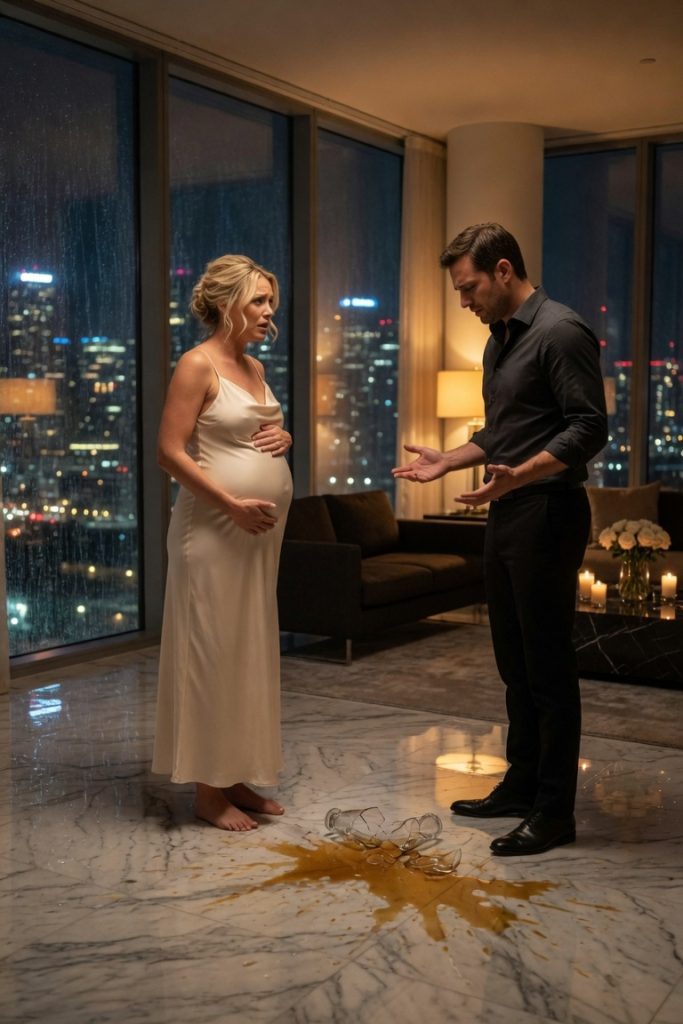
The crystal tumbler hit the black marble and exploded between them.
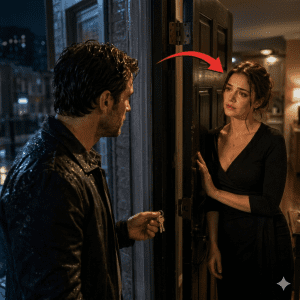
Mara Ellis stood frozen as whiskey pooled around her heels, the sharp scent of aged bourbon rising in the cold air of the penthouse. Shards of glass glittered at her feet like tiny stars against the polished stone, and she could feel the vibration of the impact still humming through the floor. The rain hammered against the floor-to-ceiling windows, streaking the Boston skyline into watercolor smears of gold and gray. Declan Rourke stood three feet from her, his hand still frozen in the shape of the glass he had been holding, his gray eyes fixed on the wreckage like he expected it to reassemble itself and prove her wrong.
“I’m pregnant,” she said again, though the words felt smaller now, swallowed by the vast silence of the room. “Nine weeks. Dr. Evelyn Lawson confirmed it yesterday. There’s a heartbeat.”
Declan’s gaze rose slowly from the floor to her face. Then it dropped to her stomach, and the look in his eyes made her want to cover herself. Not with shame, but with protection. He was looking at her like she was carrying a bomb instead of a baby.
“That is not possible,” he said.
His voice was not loud. It never was when he was truly dangerous. Mara had learned that in the thirteen months she had known him—the quieter his voice, the closer he was to breaking something. She had seen him silence a room of thirty men with a single murmured word. She had watched him reduce a federal prosecutor to stammering with nothing but a lifted eyebrow.
Now that quiet was aimed at her.
“It is possible,” she said, forcing her voice to stay steady. “It happened. We happened.”
“No.” He shook his head once, a sharp, almost violent motion. “I was tested. Three clinics. Two specialists. My father’s physician. They all said the same thing.”
Mara’s heart was beating so hard she could feel it in her throat. She had known this would be difficult. She had rehearsed a dozen versions of this conversation in the mirror, in the shower, in the car on the way here. She had imagined him surprised, shocked, even angry. She had not imagined him looking at her like she was a stranger.
“I know what you were told,” she said carefully. “But I also know what my body is telling me. And I know I have not been with anyone else.”
His jaw tightened. The scar that ran along his jawline, a pale line of tissue from the bombing that had nearly killed him, pulled white against his skin. “You’re asking me to believe that every doctor who treated me was wrong.”
“I’m asking you to believe that someone might have lied to you.”
“Who would lie about something like that?”
She did not have an answer. Not yet. But she could feel the shape of the question forming in her chest, a splinter she would have to dig out later. “I don’t know. But I am going to find out.”
Declan stared at her for a long moment, his gray eyes unreadable, his body perfectly still. Then he turned toward the window, pressing his palm flat against the cold glass, and the rain blurred the reflection of his face.
“I need a DNA test,” he said.
The words landed like a slap.
Mara felt her throat tighten, felt the sting of tears she refused to let fall. “You don’t trust me.”
“I trust the medical records I have carried for twenty years.”
“That’s not the same thing.”
“It’s all I have.”
She nodded slowly, swallowing the hurt that threatened to rise and choke her. “Then show me those records, Declan. Show me every file. Let me look at what you have been carrying all these years.”
He turned, his eyes narrowing. “Why?”
“Because I am a forensic accountant.” She lifted her chin, letting the steel creep into her voice. “I find what people hide. And someone hid something from you. I can feel it.”
The rain hammered harder against the glass. Declan stared at her for a long, terrible moment, his breath fogging the window. Then he walked to his office safe, spun the lock, and pulled out a yellowed folder tied with black string.
“Twenty years,” he said, holding it out. “I have never let anyone touch this.”
Mara took it from his hands. The paper was warm from being kept close to his body, and the black string was frayed from years of handling. She could feel the weight of it, not just in grams and ounces, but in years. In lost hope. In a man who had built his entire life around a lie.
She untied the string and opened the first page.
The fluorescent light from the monitor above his desk caught on the faded hospital letterhead. A name printed in black ink: Soren Rourke. A date from two decades ago: October 12, 2004. And beneath it, a result that should have been simple.
But Mara’s trained eyes caught it immediately. The slight misalignment of the font. The inconsistent spacing between the letters. The evidence numbers at the bottom that did not match the hospital’s standard format—she had seen enough forged documents in her career to recognize the hallmarks of a tampered file.
Someone had changed this.
Her blood turned cold.
“Declan,” she said, her voice barely a whisper. “These results were tampered with.”
He went completely still.
The folder smelled like old paper and secrets.
Mara Ellis held it in both hands, the black string still loose around her fingers, the fluorescent light from Declan’s office catching on the faded hospital letterhead. Twenty years of dust clung to the edges. Twenty years of certainty, locked in a yellowed manila envelope that someone had touched with trembling hands.
She set it down on his desk without opening it further.
“Not here,” she said quietly. “Not like this.”
Declan stood across from her, his arms crossed, his gray eyes fixed on the folder like it might burst into flames. The rain had not stopped. It lashed against the penthouse windows in sheets, the city below reduced to blurred lights and shadow. He had not moved since she said the words.
*These results were tampered with.*
“I need to take this to someone I trust,” Mara said. “A forensic document examiner. Someone neutral.”
“You don’t trust me with it.”
“I trust you with my life.” She met his eyes and held them. “But someone already tampered with this once, Declan. I need to make sure it does not happen again.”
His jaw worked. The scar along his jawline pulled white. For a moment, she thought he would refuse. He had never let anyone touch this file. Not his attorneys. Not his security team. Not the private investigators he had hired over the years to look into other things. This file was the one truth he had carried since he was twenty-one years old, the one wound he had never let anyone see.
But he nodded.
“Three days,” he said. “You have three days.”
She did not go home.
She went straight to Lydia Chen’s office, a fourth-floor walk-up in the Financial District with exposed brick and a kettle that never stopped boiling. The building was old, the kind of pre-war construction that had survived a century of Boston winters, and the radiators hissed and clanked as she climbed the stairs. The smell of coffee and printer toner hung in the air, familiar and grounding.
Lydia was still there at eleven o’clock at night, her sharp black bob tucked behind one ear, her reading glasses pushed up into her hair. She looked up when Mara walked in and took one look at her face.
“Whose blood do I need to spill?”
“Yours, if you are not careful.”
Lydia set down her pen. “What happened?”
Mara placed the folder on the desk between them. “I need you to look at this and tell me if I am losing my mind.”
Lydia opened it. She read for thirty seconds. Then she read it again, slower, her eyes narrowing. When she looked up, her face had gone pale.
“Mara. This is a fertility test result from twenty years ago.”
“I know.”
“From after the South End bombing.”
“I know.”
“And someone doctored it.” Lydia tapped the bottom of the page. “The hospital code here does not match their format. They changed their system in 2005. This was typed on an old printer, but the font is off by two points. And the signature—” She squinted. “This is not Dr. Lawson’s signature. It is close. But it is wrong.”
Mara’s chest tightened. “You see it too.”
“I see it. The question is who did it.”
Mara sank into the chair across from Lydia’s desk. The adrenaline that had carried her through the penthouse and the elevator and the rain-slicked streets had drained away, leaving her hollow and shaking. “Declan has been carrying this for twenty years. He built his whole life around the belief that he could not have children. He never remarried after his first wife left. He never—” Her voice cracked. “He never let himself want a family because he thought it was impossible.”
Lydia was quiet for a long moment. Then she said, “Who had access to the hospital records after the bombing?”
“His father. His brother.” Mara’s mind was racing. “The family doctor. Maybe the nursing staff. But the signature is the key. If we can trace who signed this, we can trace who paid them.”
“You think it was family.”
“I think the person who did this wanted to destroy Declan’s future.”
Lydia’s eyes sharpened. “Then they wanted the empire.”
The next forty-eight hours were a blur of phone calls and photocopies and late-night texts that Mara sent from a burner phone she had bought at a convenience store two blocks from her apartment. She told herself she was being paranoid. But the folder had been tampered with once, and she was not going to let the same thing happen again.
She called Dr. Evelyn Lawson on the second morning.
“Dr. Lawson, this is Mara Ellis. I need to ask you something about a fertility test from twenty years ago.”
The silence on the other end was too long.
“Dr. Lawson?”
“I remember that test,” the doctor said slowly. “I did not perform it. But I remember it. The results came across my desk and I thought—” She paused. “I thought they did not look right.”
“Why did not you say something?”
“Because I was a junior resident. And the man who signed that report was my supervising physician. Dr. Harrison. He told me the results had been verified by three specialists. I had no reason to doubt him.”
Mara’s hand tightened on the phone. “Where is Dr. Harrison now?”
“Retired. Living in a condo on the Cape. But Mara—” Dr. Lawson’s voice dropped. “He did not retire willingly. He left under pressure. There were rumors he had taken money from someone. A lot of money.”
“From whom?”
“I never knew. But I remember the year it happened. 2004. The same year Declan Rourke’s brother died.”
Mara went still.
*Declan Rourke’s brother.*
*Declan.*
She looked at the folder on her kitchen table. At the signature that did not match. At the font that was off by two points. At the date stamp that had been placed over another date stamp, faint but visible if you held the paper to the light.
She had assumed the person who tampered with the test was an enemy. A rival. Someone from outside.
But the signature was close. Too close.
Someone had practiced writing that name.
Someone who had seen it a thousand times.
Mara walked into Declan’s penthouse on the third day with the folder in one hand and a single piece of paper in the other.
He was waiting for her by the window, exactly where he had been standing when she told him she was pregnant. The broken glass was gone. The whiskey had been cleaned. But the tension in his shoulders was still there, wound tight as a wire.
“You found something,” he said.
“I found everything.”
She placed the folder on the table between them. Then she laid the single piece of paper beside it.
“This is a handwriting comparison,” she said. “The signature on your fertility test was written by someone who knew your father’s physician well. Someone who had seen his signature enough times to mimic it almost perfectly.”
Declan’s eyes did not leave her face. “Who?”
Mara took a breath. She had practiced this speech in the mirror. She had rehearsed it a dozen times. But now that the moment was here, the words felt like stones in her throat.
“Your brother,” she said. “Declan.”
He went completely still.
“Declan Rourke,” she repeated. “Your brother paid Dr. Harrison to falsify the results. He wanted you to believe you were infertile. He wanted to destroy your chance at an heir so he could seize control of Rourke Holdings after your father died.”
The silence stretched so long she thought the room would shatter.
Then Declan laughed.
It was not a happy sound. It was raw and broken and terrible, the laugh of a man who had been carrying a lie for two decades and had just learned that the person he trusted most had been the one to put it there.
“My brother,” he said. “My own blood.”
“He died five years ago. He could not have known this would come out.”
“He did not need to.” Declan’s voice was gravel and steel. “He got what he wanted. He controlled the company for three years before he died. He had the power. He had the legacy. And I—” He stopped. “I spent twenty years believing I was broken.”
Mara stepped toward him. “You are not broken.”
“I know that now.”
“Because of this.” She touched her stomach. “Because of our baby.”
He looked at her then, really looked at her, and something in his face softened. The armor cracked. The walls fell.
“Dr. Harrison is still alive,” she said. “He lives on the Cape. We can have him arrested. We can have his license revoked. We can—”
“We will.” Declan took her hand. “But first, I need to see his face.”
The confrontation happened two days later.
Declan Rourke walked into a seaside condo in Chatham with two federal marshals, a warrant for fraud and conspiracy, and a folder that held twenty years of lies.
Dr. Harrison was sitting in a wicker chair on his porch, watching the tide go out, when the first marshal put a hand on his shoulder.
“Dr. Harrison, you are under arrest for falsification of medical records, fraud, and conspiracy to commit fraud.”
The old man’s face went gray.
Declan stepped forward. “Do you remember me?”
The doctor looked up. His eyes were pale and watery, and they widened when he recognized the man standing over him.
“Mr. Rourke—”
“You took money from my brother to tell me I could not have children.” Declan’s voice was calm. Too calm. “You destroyed twenty years of my life. You took away my chance to be a father. You took away my marriage. You took away everything.”
The doctor’s mouth opened and closed like a fish gasping for air.
“I was young,” he whispered. “I needed the money. I did not know what he would do with it.”
“Yes, you did.”
The marshal pulled the doctor to his feet. His hands were cuffed behind his back. His head was bowed.
But Declan was not finished.
“Dr. Harrison.”
The old man looked up.
“One thing,” Declan said. “Did my brother ever tell you why he wanted this?”
The doctor’s eyes flickered. He looked at the folder in Declan’s hand. Then he looked at Mara, standing behind Declan with her hand resting on her stomach.
“He was jealous,” the doctor said. “He said you had everything. The father’s love. The company’s future. The strength. He said—” The doctor swallowed. “He said the only way he could win was to take something you would never get back.”
Declan stood there for a long moment, the wind from the ocean pulling at his coat, the gray sky pressing down like a weight.
Then he turned and walked away.
The wind from the ocean bit at Declan’s coat as he walked away from the condo. Mara followed two steps behind, her heels sinking into the wet sand of the parking lot, the folder clutched against her chest like a shield. The marshals were still inside, reading Dr. Harrison his rights, but the old man’s voice echoed in her ears.
*He said the only way he could win was to take something you would never get back.*
Declan stopped at the edge of the boardwalk, his hands braced against the wooden railing, his head bowed. The tide was coming in, gray and relentless, swallowing the footprints they had left behind.
Mara stood beside him and said nothing.
She had learned, in thirteen months, that Declan did not need words when he was processing. He needed presence. He needed someone to stand in the silence with him, not filling it, not fixing it, just holding it. So she stood. The salt spray misted her face. The gulls screamed overhead. The sky pressed down, low and heavy, the color of old pewter.
“I remember the day he died,” Declan said finally.
Mara did not ask which brother. She knew.
“He was driving back from the Cape. Drunk. He went off the road near Sandwich. They said he died instantly.” Declan’s voice was flat, almost clinical. “I was in London when I got the call. I flew back. I handled the funeral. I handled the estate. I handled everything.”
“You never grieved.”
“I never stopped moving.” He turned to look at her, and his eyes were raw in a way she had never seen. “If I stopped moving, I would have had to feel it. And I did not know how to feel it.”
Mara reached out and took his hand. His fingers were cold, but they curled around hers.
“You feel it now,” she said.
“I feel everything now.”
They stood there for a long time, the tide creeping closer, the wind pulling at their clothes. The folder sat between them on the railing, its edges curling in the damp air. Twenty years of lies, reduced to paper and ink.
“What happens now?” Mara asked.
Declan looked at the folder. Then he looked at her stomach.
“Now we build something real.”
The next three weeks were a blur of legal filings and media statements.
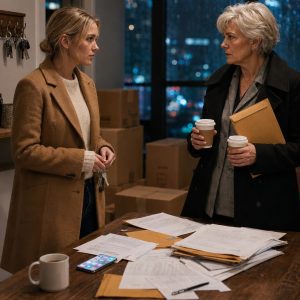
Lydia Chen worked eighteen-hour days, her office becoming a war room of open laptops and coffee cups and printouts spread across every flat surface. She had taken over the case with a ferocity that made Mara nervous and grateful in equal measure.
“Dr. Harrison is cooperating,” Lydia said, sliding a stack of documents across the table. “He is giving us everything. Names, dates, bank records. The full chain of payments.”
Mara picked up the top sheet. A wire transfer record. $500,000 from a shell corporation that traced back to a trust that traced back to Declan Rourke’s estate. The date was stamped 2004. The same year Declan’s brother had taken control of Rourke Holdings.
“How long were they planning this?” Mara asked.
“Years.” Lydia sat down across from her, rubbing her eyes. “Your brother-in-law did not just pay off one doctor. He paid off three. Two lab technicians. A hospital administrator. He built a wall of false evidence so high that no one could see over it.”
“Three doctors?”
“The first one retired to Spain. The second one died in a car accident—actually died, I checked. Dr. Harrison was the last one standing. And he only survived because he kept his mouth shut for twenty years.”
Mara set the paper down carefully, as if it might burn her. “Declan does not know about the other two yet.”
“He will. But Mara—” Lydia leaned forward, her voice dropping. “You need to think about what happens when this goes public. Declan Rourke has enemies. People who have been waiting for him to fall. This story gives them ammunition.”
“This story clears his name.”
“This story exposes a wound. And wounds attract predators.”
Mara looked out the window at the Boston skyline, gray and beautiful and full of secrets. She had known, when she fell in love with Declan, that she was stepping into a world that did not play by normal rules. But she had not known how deep the darkness went.
“I am not afraid of predators,” she said.
Lydia smiled, thin and sharp. “That is why you are dangerous.”
The first public announcement came on a Tuesday morning.
Declan Rourke’s legal team released a statement confirming that an investigation into the South End bombing fertility records had uncovered evidence of fraud. The statement did not name Declan’s brother. It did not name Dr. Harrison. It simply said that “a third party” had tampered with medical records and that the responsible parties were being held accountable.
The media went wild.
Mara watched the coverage from her apartment, a mug of tea growing cold in her hands. She had taken a leave of absence from her job. She could not focus on spreadsheets when her entire life had become a forensic investigation.
Her phone buzzed. A text from Declan.
*They are circling. Stay inside today.*
She typed back: *I am not a bird in a cage.*
His reply came instantly: *You are my future. Stay inside.*
She set the phone down and looked out the window. A news van was parked at the corner. Two reporters were standing outside the bodega across the street, drinking coffee and watching her building.
She had not noticed them before.
She pulled the curtains closed.
The second week brought a new development.
Lydia called Mara at midnight, her voice tight with barely contained excitement. “I found something. You need to come to the office.”
“Now?”
“Now.”
Mara threw on a coat and took a rideshare through the empty streets. The city was quiet, the rain reduced to a fine mist that clung to the streetlights like gauze. Lydia’s office was lit like a lighthouse, the windows glowing through the fog.
She found Lydia sitting at her desk, surrounded by papers, a single photograph in her hand.
“What is it?”
Lydia held up the photograph. It was an old image, grainy and yellowed, showing a hospital room. A man lay in a bed, his face bandaged, his eyes closed. Another man stood beside the bed, his hand resting on the patient’s shoulder.
The man in the bed was Declan.
The man standing over him was his brother.
“This was taken the night of the bombing,” Lydia said. “I found it in the hospital archives. The security cameras caught your brother-in-law entering Declan’s room at 2:47 AM. The nursing logs show no one else entered until 6 AM.”
Mara’s blood ran cold. “He tampered with the test while Declan was unconscious.”
“He had four hours. Four hours to replace the samples, forge the signatures, and walk out without anyone noticing.” Lydia set the photograph down. “This is the smoking gun, Mara. This is the proof that ties everything together.”
Mara picked up the photograph. Declan’s brother looked young in the image, barely older than twenty-five, his face smooth and unmarked by the years of jealousy that would eventually consume him. He was smiling.
“He was smiling,” Mara whispered.
“He had just destroyed his brother’s future.”
Mara set the photograph down carefully, her hands trembling.
“What do we do with this?”
“We wait,” Lydia said. “We wait for the right moment. And then we burn him.”
The third week brought the arraignment.
Dr. Harrison was formally charged with fraud, conspiracy, and falsification of medical records. The courtroom was packed. Reporters lined the benches. Cameras flashed every time the door opened.
Mara sat in the front row, her hand resting on her stomach, her eyes fixed on the old man in the orange jumpsuit. He looked smaller than she remembered. Frailer. The wicker chair on the porch had made him seem like a harmless grandfather. The defendant’s table made him look like what he was—a man who had sold his integrity for half a million dollars.
Declan sat beside her, his jaw tight, his eyes never leaving the doctor.
The judge read the charges. Dr. Harrison entered a plea of not guilty.
The prosecution asked for no bail, citing flight risk.
The defense argued that Dr. Harrison was a seventy-two-year-old man with no prior record, no passport, and no means to flee.
The judge granted bail at $2 million.
Mara felt Declan tense beside her. She put her hand on his arm.
“Not here,” she whispered.
He did not answer.
The fourth week brought a different kind of battle.
Declan’s board of directors called an emergency meeting. The scandal had shaken investor confidence. Stock prices had dropped. Rivals were circling. The board wanted answers.
Declan did not want to bring Mara. She insisted.
“I am the one who found the evidence,” she said. “I am the one who traced the money. If they want answers, they get them from me.”
The boardroom was all glass and chrome, overlooking the city from the fiftieth floor of Rourke Tower. Twelve men and three women sat around a long table, their faces a mix of concern and calculation. The chairman, a gray-haired man named Arthur Vane, started the meeting.
“Mr. Rourke, we have serious concerns about the impact of this scandal on the company’s reputation.”
Declan leaned back in his chair. “The scandal is not mine. It is my brother’s.”
“Your brother is dead. The company is not.”
“The company is mine. And it will remain mine.”
Arthur Vane’s eyes flickered to Mara. “And what role does Ms. Ellis play in this?”
Mara answered before Declan could. “I am the one who uncovered the fraud. I am the one who traced the payments. And I am the one who will testify in court, if necessary.”
The room went quiet.
Arthur Vane studied her with cold interest. “You are a forensic accountant.”
“I am.”
“And you are pregnant with Mr. Rourke’s child.”
“I am.”
“Then you have a vested interest in protecting his reputation.”
Mara smiled, thin and sharp. “I have a vested interest in the truth. The truth protects itself.”
The meeting lasted three hours. By the end, the board had voted unanimously to support Declan’s leadership. But the tension lingered, coiled beneath the surface like a snake waiting to strike.
The fifth week brought a new discovery.
Mara was going through the final box of Declan’s brother’s personal effects when she found the journal. It was leather-bound, worn at the edges, the pages yellowed and brittle. She opened it carefully, expecting to find business notes or personal reflections.
Instead, she found a confession.
The first entry was dated 2004, two months after the bombing.
*July 14, 2004*
*It is done. The doctor has been paid. The records have been altered. Declan will never know what I took from him. He will spend the rest of his life believing he is broken. And I will spend the rest of mine watching him suffer.*
Mara’s hands shook as she turned the page.
*August 3, 2004*
*Father is dying. He keeps asking for Declan. He does not ask for me. He never asks for me. I am the son who stayed. I am the son who handled the business. I am the son who cleaned up his messes. And still, he loves Declan more.*
*I have taken Declan’s future. But I will never take his place in Father’s heart.*
The entries continued for years. Each one dripped with jealousy, with bitterness, with a rage that had festered like an untreated wound. Mara read until her eyes burned, until the words blurred together, until she reached the final entry, dated three days before Declan’s brother died.
*May 17, 2019*
*I am drinking more. I know it. I cannot stop. The guilt is eating me alive, but the guilt is better than the truth. If Declan ever finds out what I did, he will destroy me. He will destroy everything I built. I have to live with this. I have to die with this.*
*I have to make sure he never knows.*
Mara closed the journal.
She sat in the silence of Declan’s study, the rain tapping against the windows, the city lights blurred through the water. The journal sat in her lap like a weight, heavy with twenty years of lies.
She did not know how to tell Declan.
She did not know if she should.
She told him that night.
They were sitting on the couch in the penthouse, the city glittering below them, a fire crackling in the hearth. Mara had the journal in her hands. Declan was watching her with an expression she could not read.
“I found something,” she said.
“What?”
She handed him the journal.
He took it carefully, as if it might explode. He opened to the first page. He read.
Mara watched his face as he read. She saw the recognition dawn. She saw the anger rise. She saw the grief follow close behind, dark and unavoidable.
When he finished, he closed the journal and set it on the coffee table.
“He wrote it all down,” Declan said. His voice was flat. Hollow. “He wrote down every lie.”
“He could not live with the guilt.”
“He could not live with the truth either.”
Mara moved closer, resting her hand on his knee. “You do not have to read it all tonight.”
“I have to read it all.” He picked the journal back up. “I have to know everything he took from me.”
She stayed beside him as he read. She watched the firelight play across his face, watched the shadows deepen and shift with every page. When he reached the final entry, he stopped.
“Three days before he died,” he said. “He was still planning to keep the secret.”
“He did not know I would find it.”
“He did not know you existed.” Declan set the journal down and turned to look at her. “You changed everything, Mara. You found what no one else could find. You broke through a wall that took my brother twenty years to build.”
“I had help.”
“You had Lydia.”
“I had you.” She took his hand. “You gave me the folder. You trusted me with the truth.”
He looked at her for a long moment. Then he leaned forward and pressed his forehead against hers.
“I love you,” he said.
She closed her eyes.
“I love you too.”
The arraignment for Dr. Harrison was scheduled for the following Monday.
Mara woke up that morning with a knot in her stomach. She had not slept well. The dreams had been strange and fragmented, full of hospital corridors and closing doors and a baby crying somewhere she could not reach.
Declan was already dressed when she came downstairs. He was standing by the window, his back to her, a cup of coffee in his hand.
“You are nervous,” she said.
“I am ready.”
She walked up behind him and wrapped her arms around his waist. He leaned into her touch.
“Whatever happens today,” she said, “we face it together.”
He turned and kissed her forehead.
“Together.”
The courtroom was packed again.
Mara sat in the front row, Lydia beside her, Lydia’s hand resting on her arm. The prosecution had called three witnesses: the hospital administrator who had approved the falsified records, the lab technician who had processed the tampered samples, and Dr. Harrison himself.
Dr. Harrison took the stand looking pale and diminished. His lawyer guided him through the initial questions, establishing his credentials, his years of service, his reputation.
Then the prosecution began.
“Dr. Harrison, did you falsify the fertility test results of Declan Rourke in 2004?”
The courtroom held its breath.
Dr. Harrison’s eyes found Declan. They held for a long moment. Then they dropped.
“Yes,” he said.
A ripple of shock went through the room.
“And who paid you to do this?”
“Declan Rourke. The younger one.”
“Declan Rourke, the defendant’s brother?”
“Yes.”
“And how much were you paid?”
“Five hundred thousand dollars.”
“And what did you do with that money?”
“I bought a condo on the Cape. I retired early. I tried to forget.”
“But you did not forget, did you, Dr. Harrison?”
The old man’s face crumpled.
“No,” he whispered. “I did not forget.”
The cross-examination was brutal.
Dr. Harrison’s lawyer tried to paint his client as a victim, a man who had been manipulated by a powerful family, a man who had made a terrible mistake under pressure. But the prosecution had the journal. They had the bank records. They had the photograph from the hospital security camera.
Piece by piece, they built a wall of evidence that could not be broken.
When the testimony ended, the judge called for a recess.
Mara stepped outside into the hallway, her heart pounding, her hands shaking. Lydia followed her.
“You did it,” Lydia said. “You broke the case.”
“We broke the case.”
“No. You. You found the file. You traced the money. You found the journal.” Lydia’s eyes were bright. “You saved him, Mara. You saved Declan.”
Mara leaned against the wall, her hand on her stomach.
“I have to tell you something,” she said.
Lydia’s expression shifted. “What?”
“The folder. The one I found in Declan’s safe. I did not just stumble across it.”
Lydia went still.
“What do you mean?”
Mara met her eyes.
“You put it there, did not you?”
The silence stretched between them.
Lydia’s face flickered through a dozen emotions—surprise, recognition, a strange kind of relief.
“Yes,” she said quietly. “I did.”
Mara had known. She had suspected for weeks, ever since she found the journal, ever since she realized how perfectly the pieces had fallen into place. Lydia was too good. Too prepared. She had known exactly where the file was, exactly how to lead Mara to it.
“How long have you known?” Mara asked.
“Five years.” Lydia’s voice was steady, but her hands were shaking. “I found the file when I was handling your brother-in-law’s estate. I knew what it meant. I knew what it would do to Declan. But I could not just hand it to him. He would not have believed me.”
“So you waited.”
“I waited for the right person.” Lydia’s eyes softened. “And then you walked into his life. I saw the way he looked at you. I saw the way you looked at him. I knew you were the one who could deliver the truth.”
Mara felt a strange mix of betrayal and gratitude.
“You used me.”
“I trusted you.” Lydia stepped closer. “I trusted you to find the truth and to have the strength to share it. And I was right.”
Mara looked at her best friend, her lawyer, the woman who had been by her side through everything.
“You should have told me.”
“If I had told you, it would not have been your discovery. It would have been mine. And you needed to be the one to bring this truth to Declan. You needed to be the one he trusted.”
Mara closed her eyes.
She did not know if she was angry or grateful.
Maybe she was both.
The verdict came down three days later.
Dr. Harrison was found guilty on all counts. He was sentenced to twelve years in federal prison. His medical license was revoked. His pension was forfeited.
The judge called the case “a betrayal of the highest order.”
Mara watched from the gallery as the old man was led away in handcuffs. She felt no satisfaction. She felt no triumph. She felt only a deep, quiet relief that the truth had finally been spoken.
Declan was waiting for her outside the courthouse.
The media swarmed them, cameras flashing, voices shouting questions. But Declan took her hand and led her through the crowd without a word, his grip steady and warm.
They drove home in silence.
When they reached the penthouse, Declan led her to the couch and sat her down.
“I need to tell you something,” he said.
Mara’s heart tightened. “What?”
“I have been thinking about what happens next. About us. About the baby.” He took her hands in his. “I want to marry you, Mara.”
She stared at him.
“I know it is fast,” he continued. “I know we have a lot to figure out. But I have spent twenty years believing I was broken. And you—you showed me that I was never broken. I was just lied to.”
“Declan—”
“I want to build a family with you. I want to wake up every morning knowing that the woman beside me is the one who saved my life.” He squeezed her hands. “Marry me.”
Mara felt tears prick her eyes.
“Yes,” she whispered.
He kissed her.
And for the first time in twenty years, Declan Rourke felt whole.
The courthouse steps were a battlefield.
Photographers pressed against the barricades, their cameras firing in staccato bursts. Reporters shouted questions over each other, their voices tangling into a single relentless roar. Mara kept her head down, Declan’s hand clamped around hers, his body a shield between her and the chaos.
“Mr. Rourke! Was your brother involved in the bombing?”
“Ms. Ellis! Did you know about the tampered records before the pregnancy?”
“How does it feel to be carrying the heir to the Rourke empire?”
Declan did not stop. He did not answer. He simply moved forward, his jaw set, his eyes fixed on the black SUV waiting at the curb. A security guard opened the door, and Mara slid inside, her heart hammering against her ribs.
The door slammed shut.
Silence.
The armored glass muted the noise of the crowd, turning their shouts into distant static. Mara leaned her head against the seat, her eyes closed, her hand pressed to her stomach.
“Are you okay?” Declan asked.
“I don’t know.”
He took her hand and held it. “That was the easy part.”
“The easy part?”
“Now we have to live with what we found.”
The SUV pulled away from the curb, and the courthouse disappeared behind them.
The fallout came in waves.
First, the federal investigation. The FBI opened a formal inquiry into Dr. Harrison’s practice, reviewing every medical record he had signed in the past thirty years. They found three other cases where test results had been altered for personal gain—a paternity test that had been swapped to protect a wealthy client’s reputation, a cancer screening that had been falsified to delay a life insurance payout, a genetic test that had been changed to hide a hereditary condition. Each case was a thread leading back to a different family, a different secret, a different payment.
Dr. Harrison was facing additional charges. His sentence would likely double.
Second, the corporate fallout. Rourke Holdings had been built on the foundation of Declan’s reputation—a man who could not be broken, a man who had survived the bombing, a man who had rebuilt his father’s empire from the ashes. But the revelation that his own brother had orchestrated the deception sent shockwaves through the boardroom. Shareholders demanded answers. The board launched an internal investigation into Declan’s brother’s tenure as CEO.
Declan let them.
“Let them dig,” he told Mara one night, his voice flat. “Let them find every dirty deal he made. Every bribe he took. Every secret he buried. I want the truth, even if it destroys the company.”
“Declan—”
“I don’t care about the company, Mara. I care about the truth.”
The investigation revealed that Declan’s brother had embezzled nearly forty million dollars over three years, funneling money into offshore accounts and shell corporations. He had bribed city officials to approve construction projects that never broke ground. He had laundered money through a chain of car dealerships in New Hampshire.
The board voted unanimously to strip his name from the company’s headquarters. The Rourke Holdings building in downtown Boston would be renamed. The family legacy was being dismantled, piece by piece.
Declan did not fight it.
“Let them burn it,” he said. “I’ll build something new.”
Third, the personal fallout.
Mara’s phone rang constantly. Friends she had not spoken to in years called to offer congratulations. Strangers sent letters, some supportive, some cruel. One woman wrote to tell Mara that she was a “homewrecker” who had “trapped a billionaire with a baby.” Another wrote to thank her for exposing the truth, saying she had been lied to by a doctor in the same hospital twenty years ago.
Lydia handled the calls. Lydia handled the letters. Lydia handled everything.
“You need to rest,” Lydia said one afternoon, setting a cup of tea on Mara’s coffee table. “You’re nine weeks pregnant. You’re not supposed to be running a media campaign.”
“I’m not running anything. They’re running at me.”
“Then let me run interference.”
Mara looked at her best friend, her lawyer, the woman who had kept a secret for five years and planted a file that had changed everything. She wanted to be angry. She wanted to feel betrayed.
But she could not.
“You saved him,” Mara said quietly.
Lydia’s eyes flickered. “What?”
“You kept the file for five years. You waited for the right moment. You made sure I found it.” Mara set down the tea. “You saved him, Lydia. And you saved me.”
Lydia sat down across from her. “I should have told you sooner.”
“Yes.”
“I was afraid.”
“Of what?”
“Of ruining what you had.” Lydia’s voice was raw. “You and Declan—I saw it before you did. I saw the way he looked at you. I saw the way you softened around him. I knew that if I handed you the truth too early, it would destroy the trust you were building. You needed to find it on your own.”
“That’s a convenient excuse.”
“It’s the truth.”
Mara stared at her for a long moment. Then she reached across the table and took Lydia’s hand.
“Thank you,” she said.
Lydia’s eyes widened. “You’re not angry?”
“I’m furious.” Mara squeezed her hand. “But I’m also grateful. You did what you thought was right. And you were right.”
Lydia let out a shaky breath. “I don’t deserve your forgiveness.”
“You don’t have to deserve it. You just have to accept it.”
The fourth wave came from an unexpected direction.
Declan’s mother called.
Mara had never met her. Declan rarely spoke about her. She had left the family when he was sixteen, fleeing the violence and the paranoia and the constant threat of federal prosecution. She had remarried and moved to Arizona, cutting all ties with the Rourke name.
But when the news broke, she called.
Declan answered the phone in his office, his voice careful, his eyes fixed on the city skyline. Mara watched from the doorway as he listened, his expression shifting from surprise to something softer, something she had never seen before.
“Yes,” he said. “I’m okay.”
A pause.
“No, you don’t need to come. I’m fine.”
Another pause.
“I know. I know.”
He listened for a long time, his hand pressed against the glass, his shoulders slowly relaxing.
“I forgive you,” he said finally.
And then he hung up.
Mara stepped into the room. “Your mother?”
“She wanted to apologize.” Declan’s voice was rough. “She said she should have been there. Should have protected me. Should have seen what my brother was doing.”
“Did you forgive her?”
“I don’t know.” He turned to face her. “But I told her I did. Because I’m tired of carrying anger. I’ve been carrying it for twenty years. And it almost cost me everything.”
Mara walked to him and wrapped her arms around his waist. He buried his face in her hair.
“What happens now?” she asked.
“We rebuild.”
“How?”
“Together.”
The apartment on Beacon Hill was small, but it had a view of the river and a fireplace that crackled on cold nights. Mara stood at the window, watching the lights of the city flicker in the distance, her hand resting on the swell of her stomach.
She was sixteen weeks now. The morning sickness had faded. The exhaustion had lifted. She felt stronger than she had in months.
Declan came up behind her and wrapped his arms around her waist.
“You’re thinking too loud,” he said.
“I’m thinking about the future.”
“That’s what I’m afraid of.”
She laughed softly. “I’m not afraid anymore.”
He pressed a kiss to her shoulder. “Good.”
“I want to keep the apartment.”
He pulled back, surprised. “The apartment?”
“I know you offered to buy us a house. A big house. A house with a yard and a nursery and a room for a nanny.” She turned to face him. “But I don’t want that. I want this. I want a small space where we have to be close to each other. I want a fireplace and a view of the river and a kitchen where we can cook together.”
Declan studied her face. “You’re serious.”
“I’ve never been more serious about anything.”
He smiled, a real smile, the kind that reached his eyes and crinkled the corners. “Then we keep the apartment.”
“We keep the apartment.”
He kissed her, slow and soft, the firelight casting their shadows across the wall.
“I love you,” he said.
“I love you too.”
The baby shower was small, just a handful of friends and a table full of pastries from the bakery down the street. Lydia had organized everything, from the decorations to the guest list to the cake that read “Welcome, Little One” in delicate blue icing.
Mara sat in the corner of Lydia’s living room, her feet propped up on an ottoman, a cup of herbal tea in her hands. The afternoon sun streamed through the windows, catching the dust motes floating in the air.
“Are you ready?” Lydia asked, sitting down beside her.
“Ready for what?”
“Ready to be a mother.”
Mara looked at the gifts piled on the coffee table—tiny onesies, soft blankets, a stuffed elephant with floppy ears. She thought about the ultrasound she had seen twelve weeks ago, the tiny heartbeat flickering on the screen. She thought about the life growing inside her, a life that should not exist but did.
“I’m terrified,” she admitted.
“That’s normal.”
“I’ve never done this before. I don’t know how to be a mother. I don’t know how to balance work and a baby and a relationship. I don’t know—”
“You’ll figure it out.” Lydia squeezed her hand. “You always do.”
Mara looked at her best friend, the woman who had kept a secret for five years, the woman who had planted a file that had changed everything.
“Promise me something,” Mara said.
“Anything.”
“If I ever start to lose myself—if I ever forget who I am—you’ll remind me.”
Lydia’s eyes glistened. “I promise.”
The night before the trial ended, Mara could not sleep.
She lay in bed, staring at the ceiling, her hand resting on her stomach. The baby was moving now, tiny flutters that felt like butterflies trapped beneath her skin. She had read that the baby could hear her voice, that it could feel her emotions, that it was already learning the rhythm of her heartbeat.
She wondered what the baby would learn about the world.
She wondered if the baby would ever know the truth about the family it was born into.
Declan stirred beside her. “Can’t sleep?”
“No.”
He turned on the lamp, casting a warm glow across the room. “What’s wrong?”
“I keep thinking about what happens after.”
“After the trial?”
“After everything.” She sat up, pulling the blanket around her shoulders. “After the baby is born. After the media forgets about us. After we’re just… normal.”
Declan reached for her hand. “We’ll never be normal, Mara.”
“I know.”
“But we can be happy.”
She looked at him, at the scar on his jaw, at the gray eyes that had seen so much pain. “Can we?”
He pulled her close, his lips brushing her forehead. “We already are.”
The final verdict came on a Thursday afternoon.
Dr. Harrison was found guilty on all counts. The judge sentenced him to eighteen years in federal prison, with no possibility of parole. His medical license was revoked permanently. His assets were seized to pay restitution to the victims.
Mara sat in the gallery, her hands folded in her lap, her face calm.
Beside her, Declan watched the old man being led away in handcuffs. His expression was unreadable.
When the courtroom cleared, Declan stood and walked to the defense table. The lawyer was packing his briefcase, his face tired and defeated.
“Mr. Rourke,” the lawyer said, “I’m sorry for what my client did.”
Declan did not respond.
He simply turned and walked away.
They drove home in silence.
The sun was setting over the Charles River, painting the water in shades of gold and amber. Mara watched the city pass by, the buildings she had known her whole life, the streets she had walked a thousand times.
“I want to change my name,” she said suddenly.
Declan looked at her. “What?”
“After we get married. I want to take your name.”
“You don’t have to.”
“I know.” She turned to face him. “But I want to. I want to be Mara Rourke. I want to carry your name. I want to prove that your brother did not win.”
Declan’s eyes softened. “That’s the most beautiful thing anyone has ever said to me.”
“Good. Because I mean it.”
He pulled the car over to the side of the road and turned to face her fully.
“Mara Rourke,” he said, testing the name on his tongue. “I like it.”
“Me too.”
He kissed her, long and slow, the sun dipping below the horizon, the city lights flickering on one by one.
The wedding was small.
A justice of the peace. A handful of witnesses. A bouquet of wildflowers that Mara had picked herself from the farmer’s market that morning.
Lydia stood beside her, holding a camera and crying.
Declan stood at the altar, his hands shaking, his eyes fixed on Mara as she walked toward him.
“I do,” she said.
“I do,” he said.
And then they were married.
The sun was setting over the Charles River, painting the water in shades of rose and lavender. Mara stood on the balcony of the Beacon Hill apartment, her hand resting on the swell of her stomach, the city lights flickering on one by one.
Declan came up behind her and wrapped his arms around her waist.
“Happy?” he asked.
“Yes.”
“Really happy?”
“Really happy.”
He pressed a kiss to her hair. “Good. Because I’m going to spend the rest of my life making sure you stay that way.”
She leaned back against him, feeling the warmth of his body, the steady beat of his heart.
“I know,” she said.
The baby was born on a Tuesday.
A girl. Six pounds, eleven ounces. A full head of dark hair and lungs that filled the delivery room with a furious, beautiful cry.
Mara held her against her chest, tears streaming down her face.
“Hello, little one,” she whispered.
Declan stood beside her, his hand trembling as he reached out to touch the baby’s tiny fingers.
“She’s perfect,” he said.
“She’s ours.”
He leaned down and kissed Mara’s forehead. “Thank you.”
“For what?”
“For giving me everything I thought I could never have.”
Mara looked at her daughter, at the tiny life she had carried and protected and brought into the world.
“Her name is Grace,” she said.
Declan’s eyes filled with tears. “Grace Rourke.”
“Grace Rourke.”
And in that room, surrounded by the hum of machines and the soft light of dawn, the three of them became a family.
*The end.*