I finally understood what my family thought of me on a Sunday evening, when my fourteen-year-old nephew shoved my daughter hard enough to make her chair scrape against the floor.
The sound was small, just wood legs dragging across tile, but something about it cut through seven years of excuses. I saw my ten-year-old daughter, Trixie, clutching the edge of the table with one hand and staring at the fantasy novel lying under Brian’s sneaker with the shocked, frozen expression of a child trying not to cry in front of people who should have protected her. I saw my sister Ethel smirking from the main table, one elbow propped beside her wine glass, phone still glowing in her hand. I saw my parents look down at their plates as if the macaroni casserole suddenly required deep moral attention. And then Brian looked at my little girl and said, loud enough for every adult in that room to hear, “Why do you even care? You’re broke and worthless. Mom says your family doesn’t matter.”
For a second, nobody breathed.
That was the part I remember most clearly. Not the words. Not even Trixie’s face. The silence after. The way four adults sat in my parents’ dining room and waited to see whether I would swallow it like I had swallowed everything else. My mother’s fancy dishes glinted under the chandelier. My father’s fork hovered halfway to his mouth. My sister’s smile twitched like she was trying not to laugh too hard. And my nephew, who had been wearing sneakers that cost more than my daughter’s entire winter wardrobe, ground his heel once more into the cover of her book like he wanted to make sure the lesson stuck.
I stood up so fast my chair hit the wall behind me.
“Pick it up,” I said.
Brian blinked at me, not scared, not ashamed, just annoyed. He had never been good at hiding the contempt he learned at home. “It’s just a book. Chill out, Uncle Parker.”
“Pick it up.”
My voice came out low and sharp, the kind of voice I used at work when a server went down and six departments were pretending they had nothing to do with it. Controlled. Cold. Dangerous in a way I hadn’t meant to show in front of my daughter.
Ethel finally looked up from her phone. “Parker, relax. He’s just messing around.”
“He shoved my daughter and ruined her book.”
“Oh my God.” She rolled her eyes. “You make everything so serious.”
I stepped around the side table where my daughter and I had been placed like overflow guests. Not family. Overflow. I bent down, picked up Trixie’s book, brushed at the dusty print of Brian’s sneaker, and handed it back to her. She took it with both hands, her lips pressed together so tightly they had gone pale.
“You’re going to apologize to her,” I told Brian.
He looked at his mother.
Ethel laughed.
Not loudly. That would have been easier. It was a small laugh, dismissive and lazy, like my daughter’s humiliation was background noise. “Parker, honestly. She’s fine.”
Trixie was not fine.
I was not fine.
And for the first time in seven years, maybe longer, I stopped caring whether anyone in that room thought I was being difficult.
“No,” I said, turning toward my sister. “She’s not fine. And I’m done pretending this is normal.”
My father cleared his throat from the head of the table. “Parker, sit down. This is a family dinner, not a courtroom.”
That sentence snapped something inside me more cleanly than Brian’s insult had.
A family dinner.
I looked at the table. My father at the head, my mother fussing over Brian’s plate, Ethel in the seat of honor beside her son, and my daughter and me at the side table by the kitchen doorway because, according to my mother, “the main table was getting crowded.” I looked at the expensive white BMW key fob sitting near Ethel’s wine glass, a car I had paid for every month for four years. I looked at Brian’s private school sweatshirt, the tuition for which had come out of my account for three straight years. I looked at my parents, who had spent years telling me family helped family as long as “family” meant my sister taking and me giving.
Then I looked back at Trixie.
She was staring down at her book, trying not to make a sound.
That was my little girl. My kid who organized her bookshelf by genre and author. My kid who wrote thank-you notes without being reminded. My kid who asked questions about black holes and bird migration and how computer networks talked to each other because she actually cared about the answers. My kid who had never once been rude to any of them, even when they ignored her. And they had just sat there while a spoiled fourteen-year-old treated her like dirt.
I turned to Ethel and said, “From today on, handle your own life.”
She blinked, still smiling a little because she didn’t understand. Not yet.
“What’s that supposed to mean?”
“It means I’m done.”
“Oh, please.” She waved a hand. “You always say that when you’re mad.”
“No,” I said. “I’ve never said it before. That’s why you should listen.”
My mother’s face tightened. “Parker, don’t threaten your sister in my house.”
“I’m not threatening her.” I picked up Trixie’s coat from the back of the chair. “I’m leaving.”
“Over a joke?” Ethel scoffed.
“Over seven years.”
The room went quiet again.
My father frowned. “What is that supposed to mean?”
“It means you all got very comfortable watching me carry Ethel’s life while she laughed at mine.”
Ethel’s face changed then. The smirk slipped, just for a second. Something like panic flashed behind her eyes, and that told me everything I needed to know. She understood exactly what I meant. She just never thought I would say it out loud.
Trixie stood beside me without a word. I put my hand gently on her shoulder, guided her toward the door, and did not look back when my mother called my name.
In the car, Trixie was silent for almost ten minutes.
The road from my parents’ house to ours ran past strip malls, gas stations, dark little pockets of suburbia, and Christmas lights still hanging from porches even though it was late January. Usually, Trixie would point out the decorations she liked or ask if we could stop for milkshakes. That night, she sat with her book in her lap, fingers rubbing over the footprint on the cover.
Finally, she asked, “Dad?”
“Yeah, sweetheart?”
“Are we broke?”
I gripped the steering wheel hard enough that my knuckles ached.
“No,” I said carefully. “We’re not broke.”
“Then why did Brian say that?”
Because his mother resents every dollar I spend on you instead of her. Because your grandmother thinks money only counts when it goes to the loudest person in the room. Because your aunt has been telling her son that kindness is weakness and help is proof of superiority. Because I let them.
I didn’t say any of that.
I glanced at her in the rearview mirror and said, “Some people confuse quiet with weak. And some people think if you don’t show off, you must not have anything. That doesn’t make them right.”
She nodded, but she didn’t look convinced.
That hurt worse than the insult.
By the time we pulled into our driveway, I had made a decision so solid it felt like it had been waiting inside me for years.
I was done being my family’s emergency fund.
My name is Parker Hartwell. I’m thirty-eight years old, married to a woman named Eva, father to a daughter named Beatrix, though only teachers and doctors call her that. To us, she’s Trixie. I work as a network systems administrator for a regional hospital network outside Kansas City. It’s not glamorous work, unless you find uptime percentages and cybersecurity compliance emotionally thrilling, which I sometimes do. I manage servers, supervise a team of six, troubleshoot systems doctors swear they “didn’t touch,” and spend more time than any adult should explaining why password123 is not acceptable in a medical environment.
It pays well. Not private-jet money, not vacation-home money, but solid, steady, middle-class American money. Enough for the mortgage on our three-bedroom house in the suburbs. Enough for groceries, insurance, retirement contributions, school supplies, dance lessons, a modest college fund. Enough that Eva and I should have been comfortable.
But comfortable had been delayed for seven years.
Seven years of Ethel.
Ethel is four years younger than me. When we were kids, people said she was “spirited,” which was family code for selfish but cute. She was the only girl after three boys, and my parents treated her like she had been sent to compensate them for the burden of raising sons. She got the pink bedroom with the white canopy bed. She got dance lessons, pageant dresses, a Sweet Sixteen party with a rented hall. When I graduated college, my father gave me a handshake and my mother cried because Ethel had just broken up with a boyfriend and was “having a hard week.”
That was how it always worked.
My brothers moved away early and learned to keep their distance. I was the one who stayed within driving range. That was my mistake. Proximity became responsibility. Responsibility became expectation. Expectation became entitlement.
Ethel got pregnant at nineteen. My parents turned it into a heroic story. Their baby girl, so brave, choosing motherhood. They threw her a baby shower bigger than my wedding. They bought her a crib, a stroller, a designer diaper bag she never used because she said it clashed with her outfits. When Brian was born, the entire family rearranged itself around Ethel’s needs. She was tired. She was stressed. She was overwhelmed. She needed support. Always support.
Support, in practice, usually meant me.
At first, I didn’t mind. That’s the part I need to be honest about. I loved my sister. Or maybe I loved the idea that if I helped enough, she would one day see me as more than the boring older brother with a stable paycheck. When her marriage fell apart and her ex disappeared into another state with a new girlfriend and a habit of missing child-support payments, Ethel called me sobbing at eleven o’clock on a Tuesday night.
“I don’t know what I’m going to do,” she cried. “I have Brian. I have bills. I have no one.”
“You have me,” I said.
That sentence cost me $119,000.
Not all at once. If someone had asked me for $119,000 in one conversation, I would have laughed, hung up, and maybe changed my number. But family debt doesn’t usually arrive as a single invoice. It comes disguised as emergencies.
The first electric bill was $213. She promised to pay me back Friday.
Then groceries. Just this once.
Then school supplies for Brian because his father hadn’t sent money.
Then an apartment application fee.
Then a deposit.
Then the first month’s rent because she was “between checks.”
Then real estate licensing classes because she wanted to build a better future.
Then test fees, marketing materials, headshots, desk fees, business cards, a laptop, a printer, professional clothes, dental work for Brian, a summer camp deposit, the school fundraiser she forgot about, a cracked phone screen, an insurance lapse, and eventually, the BMW.
The BMW was the biggest mistake.
Four years earlier, Ethel called me from a dealership parking lot, crying hard enough that I could barely understand her. Her old car had died, she said. She needed reliable transportation for work and Brian’s school. The dealership had found a vehicle she loved. Safe. Professional. Perfect for showing houses. But her credit was too damaged to qualify.
“I just need a co-signer,” she said. “I’ll make every payment. I swear on Brian’s life.”
I should have walked away from that sentence alone.
Instead, I drove to the dealership.
The car was a white BMW X3 with tan leather seats and a monthly payment that made my eye twitch. Ethel stood beside it in heels, makeup perfect, tears dry by the time I arrived. She hugged me in front of the salesman, whispered, “You’re saving my life,” and signed paperwork with the confidence of someone who already knew she would not be the one paying.
She missed the first three payments.
My credit score took the hit.
I took over.
At first, I told myself it was temporary. Just until she stabilized. Just until commissions came in. Just until Brian got older. Just until the next good month. But Ethel’s good months always became reasons to reward herself, while her bad months became reasons I needed to help.
Eva saw it before I did.
She never liked Ethel, though she tried to be fair. Eva is calm in a way that sometimes makes people underestimate her. She teaches fourth grade, which means she can smell manipulation through drywall. The first year I helped Ethel, Eva asked gentle questions. The second year, sharper ones. By the third, she stopped asking and started documenting.
“Do you know how much you’ve given her?” she asked one night while I was transferring money to cover Ethel’s car insurance.
“Not exactly.”
“That’s a problem.”
“She’s family.”
Eva looked at me then, not angry, just tired. “So are we.”
I heard the sentence. I did. I just didn’t let it land because if it landed, I would have to do something. And doing something meant admitting I had been used. It meant facing the fact that every dollar going to Ethel came from somewhere else. From our kitchen renovation. From the new roof. From vacations we postponed. From Trixie’s college account. From Eva’s patience.
After the first year, I started making Ethel sign promissory notes for the larger loans. My friend Anton suggested it. Anton was a paralegal at a civil litigation firm, the kind of guy who read contracts for fun and alphabetized his pantry. He had known me since college and had never trusted Ethel.
“Get it in writing,” he told me over lunch one afternoon.
“She’s my sister.”
“That’s why you need it in writing.”
So I did. Loan agreements. Repayment terms. Interest rates that were modest but real. Witness signatures from Anton. Dates. Amounts. Everything neat and enforceable. I thought that made me smart.
It only made me a documented fool.
Because paperwork doesn’t matter if you never intend to enforce it.
Three years in, I asked Ethel about repayment. Not aggressively. Not even formally. We were standing in my parents’ kitchen after Thanksgiving dinner, and she was showing Mom a new purse. I said, quietly, “Hey, can we talk next week about setting up a repayment schedule? Even small monthly payments would help.”
She stared at me like I had slapped her.
Then her eyes filled. “Wow.”
“Ethel—”
“I didn’t realize you saw me as a burden.”
“I didn’t say that.”
“No, it’s fine.” Her voice trembled just enough to draw my mother’s attention. “I get it. You help me and then hold it over my head. I thought you cared about Brian, but I guess everything has a price.”
By dessert, my mother was pulling me aside.
“You embarrassed your sister.”
“I asked about money she owes me.”
“She’s trying, Parker.”
“So am I.”
Mom’s mouth tightened. “You’ve always been more stable than her. Don’t punish her for struggling.”
I apologized to Ethel that night.
I hate writing that sentence.
I apologized for asking my sister to repay money she had promised to repay, and then I kept sending more.
Seven years in, I finally made the spreadsheet.
It happened on a Thursday night after I caught myself telling Eva we couldn’t afford the new roof until spring. She said nothing, just looked at me over her laptop. That look followed me into my home office. I opened Excel and started digging through bank records.
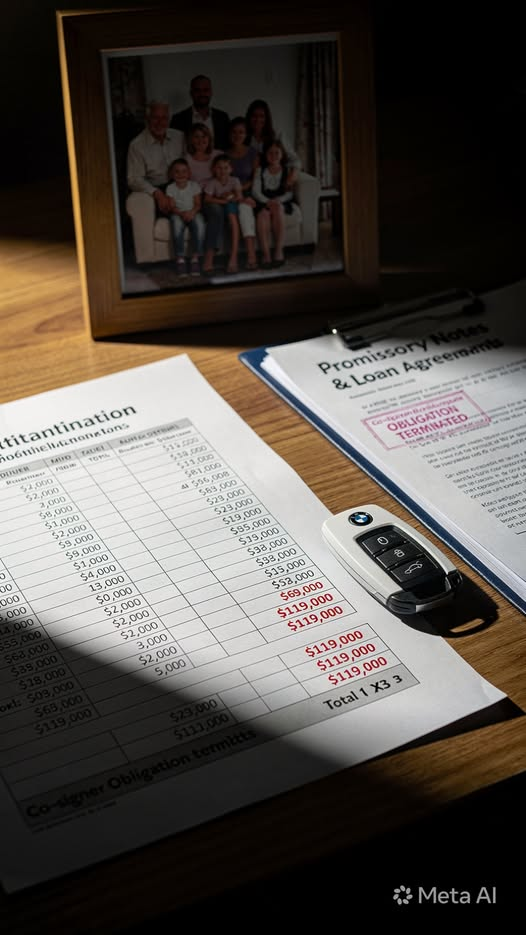
Direct financial assistance: $47,000.
Documented loans with signed agreements: $31,000.
BMW payments: $23,000.
Brian’s private school tuition contributions: $18,000.
Utilities, insurance, dental bills, laptop, furniture, emergency transfers, miscellaneous: enough to make my stomach turn.
Total: roughly $119,000.
I stared at that number until the screen blurred.
That was not help.
That was a second household.
And at Sunday dinners, my parents still praised Ethel for how well she was “holding it together.” My mother still said things like, “You have no idea how hard single mothers work.” My father still slipped Brian twenties for “being the man of the house.” Ethel still arrived late, tossed her BMW keys on the counter, and let everyone believe her real estate career paid for her lifestyle.
Meanwhile, my family sat at the side table.
I didn’t sleep after the dinner where Brian humiliated Trixie.
Eva got home around eleven from helping her mother with medical appointments. I was sitting at the kitchen table with a glass of water I hadn’t touched. She walked in, saw my face, and put down her purse slowly.
“What happened?”
I told her everything.
Every detail. The side table. The book. Brian’s words. Ethel’s laugh. My father telling me to sit down. Trixie asking if we were broke.
Eva listened without interrupting. She didn’t gasp. She didn’t say, “I told you so.” That would have been easier to resent. Instead, she sat across from me with tears in her eyes when I got to the part about Trixie in the car.
When I finished, she asked one question.
“What are you going to do about it?”
“I’m done.”
She nodded once. “Then do it right.”
That was Eva. No theatrics. No revenge fantasy. Just clean, practical moral clarity.
The next morning, I called Anton.
He answered on the third ring. “You finally woke up, huh?”
“I need your help.”
“I’ve been waiting seven years to hear that sentence.”
We met at a diner near his office, the kind with cracked vinyl booths and coffee strong enough to restart a dead router. I brought everything. Bank statements, transfer receipts, promissory notes, the BMW lease, tuition payment records, insurance policies, utility account access, credit card statements, emails from Ethel promising repayment, texts where she said things like “I swear I’ll pay you back after this closing.”
Anton spread the papers across the table with the grim satisfaction of a man seeing a preventable disaster finally enter the documentation phase.
“Parker,” he said after half an hour, “this is a lot.”
“I know.”
“No, I don’t think you do. This is not normal family help. This is financial dependency.”
“I know that now.”
He tapped the promissory notes. “These are enforceable. Not all of the money you gave her is recoverable, but the documented loans? You have a case. You can file for judgments.”
“Will I get paid?”
“Maybe. Maybe not soon. If she has no assets or income, collection is a pain. But a judgment lives. It follows her. If she ever wants financing, if she earns commissions, if she has bank accounts, if she gets serious about life, you have a legal claim.”
“What about the car?”
Anton pulled the lease agreement closer. “You’re co-signer. You’ve made every payment?”
“Every one.”
“She made none?”
“Zero.”
He leaned back. “Call the leasing company. Tell them you want to terminate your co-signer obligation. Because you’ve made all payments, they may authorize a co-signer surrender if the vehicle is returned.”
“Can I take the car?”
“Carefully. Get authorization in writing first.”
“Ethel’s going to lose her mind.”
“Good. Maybe she’ll find it while she’s looking.”
For the first time in two days, I laughed.
We built a plan.
Step one: stop all automatic payments.
Step two: remove my card from Ethel’s utilities, insurance, and tuition contributions.
Step three: contact the BMW leasing company.
Step four: file on the documented loans.
Step five: block the noise.
“Your parents are going to come at you,” Anton warned.
“They always do.”
“No, they’re going to come harder this time because you’re not just setting boundaries. You’re collapsing the system they’ve been using to avoid responsibility.”
“I know.”
“Do you?”
I thought of Trixie’s book under Brian’s shoe.
“Yes,” I said. “I do.”
Monday morning, I started with the BMW.
The first representative didn’t understand what I was asking. She kept repeating that I was the co-signer, not the primary lessee.
“I understand,” I said. “But I have made forty-seven consecutive payments. The primary lessee has made zero. I want to terminate my co-signer liability and discuss surrender options.”
That got me transferred.
The woman in special accounts was named Rachel. She had a tired, competent voice that made me trust her immediately.
“Mr. Hartwell,” she said after reviewing the account, “I can see that all payments have come from your bank account.”
“That’s correct.”
“And you no longer wish to support the lease?”
“That’s correct.”
“Given the payment history, we can send a formal notice requiring the primary lessee to provide alternative credit support. If she cannot, the vehicle must be surrendered.”
“How long?”
“Thirty days.”
“Is there a faster option?”
“If you have possession of the vehicle and can return it to an authorized location, we can process a co-signer-initiated surrender. It’s unusual, but not unheard of. We would need signed documentation from you and approval from our risk department.”
“Send it.”
By noon, I had the forms.
By three, Rachel had confirmation.
By five, I had written authorization to retrieve and return the vehicle, with my payment history attached as standing.
Tuesday, I called Brian’s private school.
The billing office was polite. I terminated the third-party tuition payment arrangement effective immediately. They asked if I wanted to notify Ethel myself or have them send standard notice.
“Send standard notice,” I said.
Then utilities.
Then insurance.
Then the monthly transfers.
By Tuesday evening, every financial artery running from my household to Ethel’s had been cut.
Wednesday morning, I took a personal day from work.
Ethel lived in a newer apartment complex with fake stone accents and a leasing office that smelled like vanilla air freshener. Her BMW sat in her assigned spot, white and gleaming, a perfect symbol of everything wrong with my life. I parked across the lot, checked the paperwork one more time, and walked over with the spare key she had given me years ago “for emergencies.”
This qualified.
I unlocked the door, got in, and started the engine.
As I backed out, an older neighbor walking a dog stopped and stared. I gave him a polite wave like I was doing the most normal thing in the world.
The return location was forty minutes away. I drove carefully, obeying every speed limit. The entire time, I kept expecting my phone to ring, expecting Ethel to somehow know, expecting guilt to rise up and stop me.
It didn’t.
At the dealership, I parked in the surrender area, handed over the paperwork, and waited while they inspected the car. There was minor wear, a scratch on the rear bumper, crumbs in the back seat, and a faint perfume smell that made me think of Ethel leaning across my parents’ table, laughing while my daughter looked down.
The final release document printed at 10:48 a.m.
My co-signer obligation was terminated.
The lease account would now be handled directly with Ethel.
I stood in the parking lot afterward, hands in my coat pockets, looking at the empty space where the BMW had been, and felt something almost unfamiliar.
Relief.
Not joy exactly. Joy would come later, maybe. This was lighter and stranger. The feeling of removing a weight I had carried so long I had mistaken it for part of my body.
I called Anton.
“It’s done.”
“How do you feel?”
“Like an idiot.”
“You’re supposed to feel free.”
“I think idiot comes first.”
“That’s fair. Free will catch up.”
It did.
Ethel called Thursday evening.
I was in the backyard with Trixie, helping her hang a bird feeder she had received for her birthday. She was carefully pouring seed into the top, tongue sticking out in concentration. Eva was inside making chili. The air smelled like cold earth and woodsmoke from a neighbor’s fireplace. It was the kind of ordinary evening I had spent years sacrificing for emergencies that were never mine.
My phone rang.
Ethel.
I let it ring five times before answering.
“Where is my car?” she screamed.
I stepped away from Trixie. “Hello to you, too.”
“Don’t play with me, Parker. The dealership called. They said the vehicle was surrendered. What did you do?”
“I returned the BMW.”
“You what?”
“I terminated my co-signer obligation. Since I’ve made every payment for four years, the leasing company authorized surrender.”
“That was my car.”
“No, Ethel. It was a leased vehicle I was paying for.”
“I need that car for work. How am I supposed to show houses? How am I supposed to drive Brian?”
“Figure it out.”
Silence. Then, lower: “You can’t do this to me.”
“I already did.”
“Over a stupid dinner argument?”
“Your son shoved my daughter, stepped on her book, called her broke and worthless, and you laughed.”
“Oh my God, Parker, kids say things.”
“Kids repeat things.”
“I never told him—”
“Stop.”
She did.
I could hear her breathing.
“I’ve canceled the tuition payments, too,” I said. “And the utilities. And the insurance. And every automatic transfer. Anton is filing on the promissory notes.”
Her voice changed completely. “Parker.”
There it was. The sudden softness. The emergency tone. The one that used to work.
“Please don’t do this.”
“I’m done doing this.”
“You’re going to ruin me.”
“No. I’m going to stop funding you. If that ruins you, you should think about what that means.”
“You’re my brother.”
“And Trixie is my daughter.”
She sucked in a breath.
“Mom and Dad are going to be furious.”
“Tell them to write you a check.”
I hung up.
She called back immediately.
I declined.
Mom called thirty seconds later.
I let it go to voicemail.
Eva came outside wiping her hands on a towel. “Everything okay?”
I looked at my daughter, who had successfully hung the bird feeder and was now standing very still to see if birds would arrive instantly, because ten-year-olds are hopeful in a way adults don’t deserve.
“Yeah,” I said. “Everything’s okay.”
Mom’s voicemail was exactly what Anton predicted.
“How could you do this to your sister? She is struggling, Parker. She has a child. You have always been more stable. You know that. Family supports family. You don’t punish people because of one uncomfortable dinner. Call me back immediately. Your father and I are very disappointed.”
I saved it.
Then I blocked her number.
I blocked Ethel’s, too.
Then my father’s.
For the first time in my adult life, my phone went quiet.
The fallout started within days.
Without the BMW, Ethel’s real estate image collapsed faster than I expected. Her business had always relied on performance: the luxury car, the sharp blazers, the social media captions about hustle and abundance, the implication that she was already successful enough to guide other people into better lives. But real estate is a trust business, and arriving late to showings in borrowed cars does not inspire trust.
A mutual acquaintance told Eva that Ethel showed up to a listing appointment in a borrowed minivan with crushed Cheerios in the floor mats and a car seat she forgot to remove. The clients went with another agent. A week later, she missed a showing because her rideshare canceled. Another client dropped her. Then a broker she worked under began asking questions about her reliability.
Without the private school payment, Brian was pulled mid-semester. Ethel tried to negotiate. She cried in the billing office. She implied discrimination against single mothers. The school, which had been receiving payments from me for years, did not care. They required money. She did not have it.
Brian enrolled in the public high school in his district.
There was nothing wrong with that school. It had decent teachers, sports, clubs, AP classes, everything a kid needed if he wasn’t raised to think ordinary life was punishment. But Brian treated it like exile. Within a month, he got into two fights, one over something he said to a girl in the cafeteria and another because he called a boy’s shoes “welfare sneakers.” That one ended badly for him. Apparently, public school kids were less impressed by his mother’s BMW stories than private school kids had been.
Without my utility payments, Ethel’s power was shut off for three days before she scraped together the deposit to restart service in her own name. She stayed with a friend and posted vague Instagram stories about “being tested by the universe.”
Without my insurance contribution, she had to buy her own policy. The quote nearly made her faint.
Without my automatic monthly transfers, she began missing rent.
One month after I cut her off, Ethel’s life no longer looked polished enough for captions.
She tried three different lawyers about the BMW. Anton heard about it because one of them knew his firm and called, amused, asking whether I needed representation.
“She has no case,” Anton told me. “The surrender was authorized. She never made payments. If anything, she’s lucky the leasing company isn’t pursuing her for misrepresentation.”
“What about the loans?”
“Filed. She’ll be served next week.”
“She’s going to explode.”
“She’s been exploding for years. You’re just not paying for the cleanup anymore.”
My parents showed up at my house on a Saturday morning in early March.
They didn’t call first. Of course they didn’t. Boundaries were something other families had, like lake houses or emotional intelligence.
I was upstairs getting out of the shower when the pounding started. By the time I came down, Eva had opened the door but not let them past the entryway. My father was red-faced, fists clenched at his sides. My mother had already arranged her face into tragedy.
“Parker,” Dad snapped. “This has gone far enough.”
I dried my hair with a towel. “Good morning.”
“Don’t be sarcastic.”
“I wasn’t.”
Mom stepped forward. “Your sister is falling apart.”
“Sounds like she needs support.”
“She needs her family.”
“Then help her.”
Dad scowled. “You know we can’t afford to cover what you were covering.”
There it was. Honest by accident.
I folded the towel over the banister. “So you knew how much I was doing.”
Mom looked away.
“You knew,” I repeated.
Dad’s jaw worked. “We knew you helped.”
“You knew I was paying for her car?”
Silence.
“Brian’s school?”
Mom whispered, “She wanted the best for him.”
“Utilities? Insurance? Licensing fees? Loans?”
Dad said, “You offered.”
“I was manipulated.”
“That’s a strong word,” Mom said.
“Good. It matches the behavior.”
Dad took a step toward me. Eva moved slightly, not in front of me exactly, but enough that my father noticed. Her eyes went cold.
“Daniel,” she said, using my father’s name in a tone I had never heard from her, “do not come into our home and intimidate my husband because your daughter has to pay her own bills.”
My father blinked.
Eva was small, five-foot-three on a good day, with soft curls and teacher-cardigan energy. People often mistook that for gentleness without steel. They were wrong.
Mom’s tears began. “Eva, please. You’re a mother. You understand how hard it is to see your child suffer.”
Eva looked at her. “I watched my child come home from your house asking if she was worthless. I understand plenty.”
My mother flinched, but only for a moment. “Brian shouldn’t have said that, but—”
“No,” I said. “There is no but. That was the line. He crossed it. Ethel laughed. You all stayed quiet. Now I’m quiet too. With my money.”
Dad pointed at me. “You’re tearing this family apart.”
“No,” I said. “I’m refusing to finance the version where you pretend it was together.”
They left twenty minutes later, after cycling through guilt, anger, disappointment, and the grandparent card. Mom tried to mention Brian’s future. Dad tried to mention loyalty. Eva eventually opened the door wider and said, “You should go.”
They sat in the driveway for five minutes after.
We watched from the kitchen window.
Then Eva turned to me and said, “Do you want pancakes?”
I laughed so hard I almost cried.
By April, the judgments were filed.
Ethel did not contest them. She couldn’t afford to. The documented loans became official: $31,000 owed, plus interest and costs. It didn’t mean I would see the money soon, but the record existed. That mattered more than I expected. For years, Ethel had survived by making everything emotional and vague. She needed help. She was trying. I was stable. Family was family. The judgments stripped all that fog away.
Amount owed.
Name signed.
Date witnessed.
Debt recorded.
Truth, in legal formatting.
Life at home began changing in small ways.
The first was financial. Without Ethel’s monthly drain, our budget breathed. Eva and I sat down on a Friday evening with spreadsheets, bank statements, and a bottle of wine. We increased Trixie’s college contributions. We funded the emergency account properly. We scheduled the roof replacement. We priced the kitchen renovation we had postponed for years.
Eva cried when we picked the countertops.
Not sobbing. Just one quiet tear she wiped away quickly.
I saw it anyway.
“I’m sorry,” I said.
She looked at me. “For what?”
“For making you wait.”
Her expression softened, but the sadness in it hurt. “I wasn’t waiting for countertops, Parker.”
“I know.”
“I was waiting for you to choose us without feeling guilty.”
That one sat between us for a long time.
“I’m choosing you now,” I said.
She reached across the table and took my hand. “I know.”
We renovated the kitchen in June. Nothing extravagant. Warm wood cabinets, quartz counters, better lighting, a real island with three stools. Trixie picked the drawer pulls because she had strong opinions about brushed nickel. The first night the kitchen was done, we made grilled cheese and tomato soup like it was a five-star meal.
Trixie sat at the island, swinging her legs. “It feels like a cooking show in here.”
Eva smiled. “Your father can now dramatically chop onions.”
“I have waited my whole life for this power,” I said.
Trixie laughed.
That sound became my new measurement for wealth.
In July, we took our first real vacation in years. Four days at the beach. Not a luxury resort. Not international. Just a rented cottage, sandy towels, cheap sunscreen, board games, and the ocean. Trixie collected shells, named three seagulls, and convinced me to read aloud from the same fantasy series Brian had stepped on. The book still had a faint mark on the cover. She refused to replace it.
“It survived,” she said.
I didn’t argue.
On the last night, we built a small campfire on the beach. Trixie fell asleep against my shoulder before I finished the chapter. Eva sat on my other side, her head resting against my arm. The fire cracked. Waves rolled in dark beyond the glow. My phone sat inside the cottage, blocked numbers silent.
I realized then that peace wasn’t dramatic. It didn’t arrive like a reward. It was what remained when chaos stopped being invited in.
Ethel’s life continued unraveling.
Her brokerage let her go after she missed too many appointments and had what one person described as “an unprofessional emotional incident” in the office. That sounded like Ethel screaming at a receptionist, though I never got confirmation. She lost her apartment when the lease came up and she couldn’t provide proof of income. My parents let her and Brian move in, which lasted exactly as well as anyone could have predicted.
Three adults and one angry teenager in a house too small for them, with too little money and too much resentment.
Dad spent more time in the garage. Mom called relatives crying about stress. Brian got suspended twice. Ethel posted inspirational quotes about betrayal and “rising from ashes,” though from what I heard, she mostly rose from my parents’ couch around noon.
Shawn—one of my older brothers, not to be confused with any family golden-child nonsense, though our family had plenty—called me in August. He had moved two states away years earlier and kept contact minimal.
“Mom called me,” he said.
“I’m sorry.”
“She said you’re destroying Ethel.”
“I stopped paying her bills.”
“Yeah, that sounds like Mom.”
There was a pause.
Then he said, “For what it’s worth, I’m proud of you.”
I leaned back in my office chair. “You are?”
“Parker, we all left because we saw what was happening. You stayed because you thought being decent meant being available. I’m glad you figured it out.”
“Would have been nice if someone told me sooner.”
“We tried. You weren’t ready.”
That annoyed me because it was true.
In September, Ethel showed up at my house.
It was a cold Tuesday evening, the first one that felt like fall. I was in the garage organizing tools, something I had meant to do for months. Eva was inside helping Trixie with a science project involving bird migration. The garage door was open halfway, letting in the smell of wet leaves.
An old sedan pulled into the driveway. Rust around the wheel wells. Dented fender. Engine knocking like it had regrets.
Ethel got out.
For a moment, I barely recognized her. Her hair was pulled back in a messy bun. No makeup. Clothes wrinkled. Dark circles under her eyes. The polished woman who had smirked at my daughter’s humiliation was gone. In her place stood someone life had finally stopped cushioning.
I didn’t move from the workbench.
She walked into the garage and wrapped her arms around herself.
“Parker.”
“Ethel.”
“I know you don’t want to see me.”
“Correct.”
She flinched.
“I deserve that,” she said quickly. “I know I screwed up. I know I should have been more grateful. I know Brian was out of line. Everything has been awful, Parker. I lost my job. Brian is struggling. Mom and Dad are impossible. I can’t breathe in that house. I just need one chance to get back on my feet.”
“How much?”
Her mouth opened. Closed.
“What?”
“How much money are you asking for?”
“I’m not—”
“Ethel.”
She looked down. “Just enough for a deposit on an apartment. And maybe a used car down payment. I have a lead on a job, but I need transportation.”
I nodded slowly.
There it was. Dressed differently, but the same animal.
“No.”
Her eyes filled. “Please.”
“No.”
“I’ll sign anything. I’ll pay you back.”
“You already signed things.”
“I mean it this time.”
“I don’t care.”
Her face hardened at the edges. “So that’s it? You’re just going to let your sister drown?”
“You’ve been using me as a life raft while drilling holes in my boat.”
“Don’t talk like that.”
“Then don’t ask me for money.”
She wiped at her face angrily. “This is because of one stupid thing Brian said.”
“No,” I said. “This is because he said out loud what you all believed quietly.”
“I never said your family was worthless.”
“Maybe not in those exact words.”
“He’s a kid.”
“He’s old enough to learn cruelty. He’s old enough to learn consequences.”
Her voice rose. “You think Trixie is perfect?”
“No. I think she’s kind. And I think when someone hurt her in front of her family, the adults in the room should have defended her.”
Ethel stared at me.
For one second, something in her face cracked. Shame, maybe. Or exhaustion. Then it hardened again because shame requires responsibility, and Ethel had spent a lifetime outsourcing that.
“You’ve changed,” she said.
“No,” I replied. “I stopped.”
“Stopped what?”
“Paying the price of being related to you.”
She looked like I had slapped her.
Good.
“Leave, Ethel.”
“Parker—”
“Leave now, or I’ll call someone to remove you.”
She waited. I think she expected the old pattern to reappear. The sigh. The softening. The reluctant check. The apology for making her ask twice.
I picked up a wrench and set it in its drawer.
Eventually, she turned and walked back to the sedan.
Eva appeared in the doorway between the garage and kitchen after the car left.
“You okay?”
“Yeah.”
“She ask for money?”
“Of course.”
Eva leaned against the frame. “Did you give her any?”
“No.”
She smiled. Not because Ethel was suffering. Eva was not cruel. She smiled because the man she had married had finally come home from a war he had been fighting in the wrong direction.
“Dinner’s almost ready,” she said. “Trixie wants to show you a map of goose migration.”
“Wouldn’t miss it.”
Inside, Trixie had colored arrows across North America in blue marker. Her fantasy book sat beside her elbow, still worn, still loved, still surviving.
My parents tried one more time around Thanksgiving.
A letter arrived from my mother, handwritten on floral stationery.
Parker,
I don’t know how we got here. Your sister made mistakes, but so have you. Family should not keep score. Your father and I are heartbroken that you’ve chosen money over blood. Brian misses his cousin. Ethel cries every day. We hope you will remember the values we raised you with and come home for Thanksgiving. Life is short. Pride is dangerous. Love, Mom.
I read it twice.
Then I handed it to Eva.
She read it, snorted, and said, “Brian misses his cousin?”
“I noticed that too.”
“Does Trixie want to see him?”
“No.”
“Then there’s your answer.”
I did not go to Thanksgiving.
We hosted our own. Eva’s mother came. Anton came with his partner. My brother Shawn and his wife drove in from out of state and brought pie. Trixie made place cards. We ate too much, played a card game, and nobody insulted my child.
After dinner, Anton helped me carry folding chairs to the garage.
“You look better,” he said.
“I feel better.”
“Still angry?”
“Sometimes.”
“Good. Anger is useful if you don’t marry it.”
I laughed. “That from a law office poster?”
“No. From my second divorce.”
By December, Ethel had found a job as an office coordinator for a property management company. Not glamorous. Not sales. No luxury car required. She was making less than she had pretended to make before, but for the first time in years, she had predictable income. My parents complained to relatives that she was “starting over after Parker pulled the rug out from under her,” which was one way to describe an adult paying her own bills.
Brian stayed in public school. He got into fewer fights after one particularly stern assistant principal apparently made him clean graffiti off cafeteria tables for a week. I heard through Shawn that Brian joined the wrestling team and got humbled quickly by boys who didn’t care where he used to go to school. That, honestly, may have done more for him than any adult in our family ever had.
One afternoon, near Christmas, a package arrived for Trixie.
No return address, but the handwriting on the label was Brian’s. Messy, tilted, teenage.
I almost threw it away.
Eva said, “Let her decide.”
Inside was a new copy of the fantasy novel he had stepped on, hardback, special edition, with a note tucked inside.
Trixie,
I’m sorry I ruined your book and said mean stuff. I was being a jerk. My mom says things sometimes and I repeated them because I thought it made me better. It didn’t. You didn’t deserve it.
Brian
Trixie read the note quietly.
“What do you want to do?” I asked.
She ran her hand over the new cover. “Can I keep the book but not talk to him yet?”
“Absolutely.”
“Is that mean?”
“No. That’s a boundary.”
She considered that, then nodded like she was filing the word somewhere important.
On Christmas morning, we stayed home.
Eva made cinnamon rolls. I made coffee. Trixie opened presents in pajamas covered with tiny owls. Snow fell lightly outside, just enough to dust the yard without becoming a chore. My phone remained quiet except for one message from Shawn: Merry Christmas. Proud of you, little brother.
Later that afternoon, Trixie curled up on the new kitchen island stool with the special edition book from Brian. Her original copy sat on the shelf in her room, footprint still faintly visible. She had refused to throw it away.
“Why keep both?” I asked.
She shrugged. “One reminds me what happened. The other reminds me he said sorry.”
I looked at my daughter and thought maybe she understood healing better than most adults.
The judgments against Ethel remained unpaid, but I no longer checked obsessively. The money mattered, but not the way it once did. The record mattered more. The line mattered most.
We rebuilt our emergency fund. Increased retirement savings. Finished the roof in spring. Took another beach trip in summer. Trixie joined a book club. Eva and I went out once a month, sometimes to a restaurant, sometimes just to a hardware store and coffee because marriage after stress can be delightfully unglamorous.
My parents and I remain mostly estranged. My mother sends cards on major holidays with stiff little notes. My father called once after a minor health scare and left a voicemail that said, “Hope you’re doing all right.” I called back. We spoke for seven minutes. It was awkward, but not hostile. Maybe one day he’ll apologize. Maybe he won’t. I no longer organize my life around possibilities that require other people to become braver than they are.
Ethel has not asked me for money again.
That might be the closest thing to respect she can currently manage.
Sometimes I think about that Sunday dinner. The side table. Brian’s sneaker on Trixie’s book. My sister’s laugh. My father telling me to sit down.
For years, I believed keeping the peace meant absorbing the damage.
I was wrong.
Peace built on one person’s silence is not peace. It’s a hostage situation with better lighting.
The night I walked out, I thought I was destroying my family. That’s what they wanted me to believe. But what I actually destroyed was a payment system disguised as love. A hierarchy disguised as tradition. A script where I worked, paid, swallowed, apologized, and came back next Sunday with a casserole and a smile.
I don’t live in that script anymore.
My house is quieter now. Warmer too. The new kitchen catches morning light in a way that makes the counters glow. Trixie reads at the island while Eva grades papers and I check hospital system alerts from my laptop. Birds visit the feeder in the backyard. Bills get paid from one household for one household. Help, when we give it now, comes from choice, not guilt.
That is what I wish I had understood earlier.
You can love people and still stop funding their disrespect.
You can be family and still say no.
You can walk out of a room where your child was hurt and never again mistake silence for maturity.
And sometimes, when someone calls you cruel for finally closing your wallet, what they really mean is that they miss the version of you who let them empty it.
That version of me is gone.
My daughter deserved better than him.
My wife deserved better than this.
And after seven years of paying for everyone else’s emergencies, I finally understood something simple enough to feel revolutionary.
So did I.
THE END.