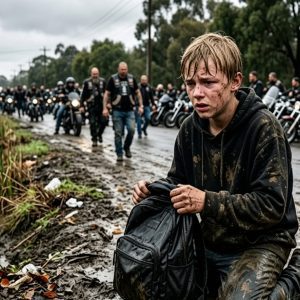
And that morning it covered everything like a damp sheet. Laila, 10 years old, tightened her worn-out jacket around her small body. Her breath came out white in the air as she moved between the rows of scrap metal, with steady steps, knowing every curve of that maze, like someone who knows their own backyard.
Searching for things of value had become her routine. Copper wire, aluminum parts, engine components that Mr. Henrique bought for a few reais, enough to help Grandma Bernadete with the week’s groceries. Laila’s eyes scanned the scrapyard methodically.
She had developed a sixth sense for finding treasures that others overlooked. It was a necessity, not a talent. That’s when she spotted the black sedan.
It was partially hidden behind a pile of crushed cars, with elegant lines that once meant a lot of money, completely out of place among all that rust. Laila circled the vehicle towards the trunk and stopped. A weak, muffled thud came from inside.
Laila stood still. Her breath held. The silence of the scrapyard was different from the silence of the streets, heavier, older.
And from inside, the thud came again, weaker. This time, her heart raced. She pressed her ear against the cold metal.
The sound was unmistakable. Someone was in there, losing strength with every passing second. “Hey,” Laila called out, her voice trembling.
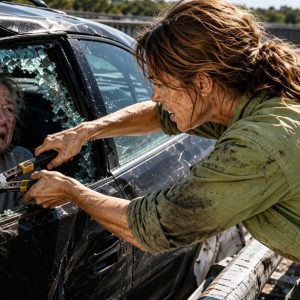
“Is someone there?” A faint groan answered. Without wasting a moment, Laila scanned the ground with her eyes until she found a rusty crowbar a few meters away.
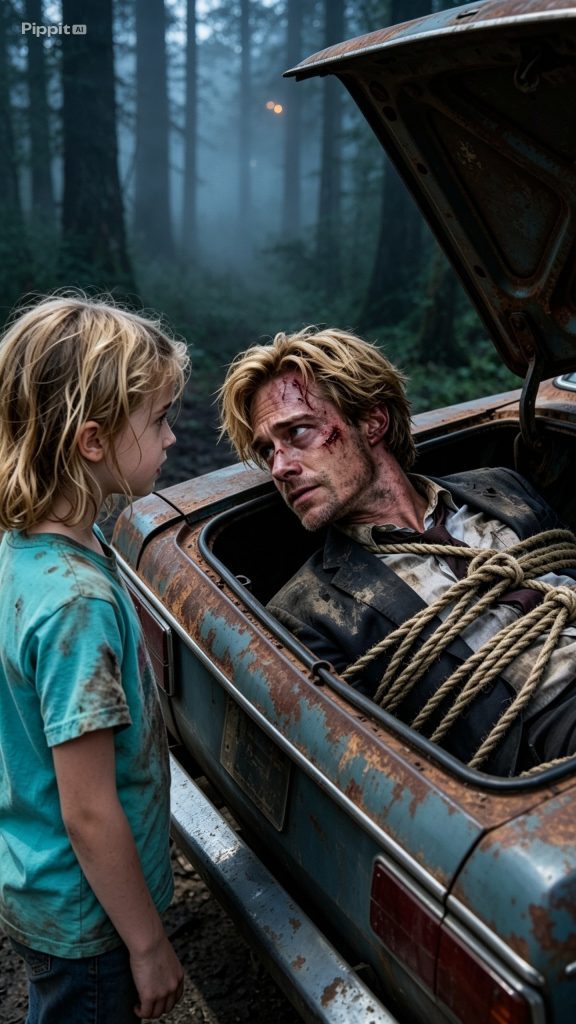
With a determination far beyond her years, she wedged the tip into the gap of the trunk lid and pushed with all her body weight. The lock gave way with a metallic click. Inside the trunk, tied up with duct tape and rope, was a man in a suit, his face bruised, his skin pale as paper.
When his eyes opened and met the girl standing over him, his expression was one of pure disbelief. “Help,” he managed to whisper, his lips cracked.
“Please.” Laila had already started working on the bindings before he even finished the sentence. “What happened to you?” she asked.
“They kidnapped me,” the man replied, his eyes moving nervously. “A business partner. Please, be quick.”
As Laila freed his hands, the man tried to sit up, clearly with his strength at its limit. “What’s your name?” he asked.
“Laila,” she replied, tearing off the last strip of tape from his ankles.
For the first time, the man’s gaze truly fixed on her face and froze. His eyes landed on a small, crescent-shaped scar just below the corner of the girl’s right eye. He stared as if he had seen a ghost.
“What is it?” asked Laila, suddenly uncomfortable. The man shook his head slightly, as if dismissing an impossible thought. “Nothing. I’m Hugo.
Hugo Vasconcelos.” Laila vaguely recognized the name. She had seen it on billboards around the city, something about technology. Before she could answer, the sound of approaching voices put them both on alert.
“You need to go,” Hugo whispered urgently. “It’s not safe. Go now!” Laila hesitated, not wanting to leave the injured man alone.
“Please,” he pleaded. “You’ve helped enough. Go!” With one last worried look, Laila disappeared into the fog.
Seconds later, two truck drivers turned the corner, drawn by the noise of the trunk. Hugo collapsed back, relief flooding his body as the men ran towards him. “My God, what happened to you? Call an ambulance.” Hugo managed to say before losing consciousness.
Hours later, in the sterile light of the Hospital das Clínicas, Hugo woke to the constant beep of monitors and the worried face of Police Chief Marcelo Braga. “Can you tell me what happened?” “They took me from the Vasconcel parking lot,” Hugo said, ordering the fragments.
“They wanted me to sign over control of the company. When I refused…” He left the sentence unfinished. The hours in the darkness were still too raw to put into words.
“Suspects?” asked the chief.
“My CFO, Felipe Caldas. We were in disagreement about selling the company to Globotec. Felipe stands to make a fortune if the sale goes through. I was blocking the deal.”
When he was alone with his thoughts, Hugo couldn’t shake the image of the girl. The same heart-shaped face he knew, the same determined jaw, and the crescent-shaped scar, identical to the one his daughter Ana had gotten from falling off the park swing at age 5.
But Ana was gone. Lost two years ago in that terrible storm, when Hugo’s car was swept away by the Tietê River flood and fell from the bridge on the Anhanguera highway. Ana’s body was never found. The official report concluded that the currents had carried her far away.
And yet, the girl from the scrapyard was the spitting image of Ana. The age also matched. Ana would be 10 years old now. For the first time in two years, Hugo felt something stir inside him.
Hope, dangerous and fragile, but hope.
Three days after the rescue, Hugo stood in the doorway of the intact room, his fingers tracing the doorframe. Ana’s room remained exactly as she had left it on that rainy night. Shelves full of stuffed animals, science fair certificates pinned to a corkboard. On top of the dresser, a silver frame held Ana’s last school photo, with a missing tooth, her hair held back with a shiny barrette, the crescent-shaped scar visible near her eye.
“I saw you today,” Hugo whispered to the photograph.
“Or someone who could be your twin.”
Behind him, Mauro Saraiva, his personal lawyer and closest friend, waited in the hallway. “You should be resting,” Mauro said gently.
“The police are handling the investigation.”
Hugo led him to the home office, where files were already spread across the table: accident reports, search and rescue documentation, newspaper clippings. “What if they were wrong?”
Hugo pulled out his phone and opened the gallery. “Look, this is Ana from years ago, and this is from a security camera at a market near the scrapyard, taken three days ago.”
Mauro studied the images. His professional composure wavered. “The resemblance is striking,” he admitted. “But Hugo, you know how grief works.
We see what we want to see.”
“It’s not just the face, it’s the scar. Identical location, identical shape.
What are the chances of it being a coincidence?”
Hugo went to the safe behind a painting and took out a small velvet box. Inside was a silver star pendant with a broken chain, Ana’s favorite piece of jewelry, recovered from the wrecked car.
“I’m going back to that scrapyard,” he said calmly, decisively. “Every day, if I have to.”
At dawn, Hugo was at the Cantareira scrapyard with a cooler bag beside him. He convinced Mr. Henrique for R$100. He spent 3 hours wandering the maze without finding Laila. At the end, he left water and cheese bread by the black sedan.
Now an empty shell with the trunk open. A simple note accompanied the provisions: “Thank you for saving my life. I would like to help you too, if you’ll let me. I’ll be back tomorrow.”
Hugo returned the next day. The food was gone, but there was no sign of the girl. Hugo left more provisions and another note.
On the third day, he found a small origami bird, folded from the paper of his previous note, carefully placed on top of the cooler bag.
Progress.
On the fifth day, a small figure slid between two stacked cars, watching him from a distance. “Laila!” he called softly. “I just want to talk.”
The girl stayed half-hidden, cautious as a stray cat, but she didn’t run. “You were the one who left the food. I wanted to thank you properly. Are you okay?”
In the clear morning light, the resemblance to Ana was even more striking. The same thoughtful eyes, the same determined jaw, the same crescent-shaped scar.
“My grandma says we shouldn’t expect a reward for doing the right thing,” Laila said, lifting her chin slightly.
“Your grandmother sounds like a very wise woman. I’d like to meet her someday.”
Caution returned to Laila’s face. “Why?”
“To thank her for raising such a brave girl. And maybe to see if there’s any way I can help you two, just as you helped me.”
A voice called out in the distance. Laila looked over her shoulder.
“It’s Grandma. I have to go.”
“Will you be back tomorrow?”
“I’ll be here,” Hugo promised.
“And Laila?”
“Thank you again.”
===== PART 2 =====
“You saved my life.”
Laila offered a quick smile before disappearing into the maze of cars. Leaving Hugo alone with his heart racing, in a mix of hope and terror he hadn’t felt in two years.
The Liberdade street market was teeming with shoppers that Saturday. Hugo’s attention remained fixed on the small figure moving between the stalls with a heavy backpack on her narrow shoulders, counting coins from a cloth pouch with the seriousness of someone who knows exactly how much they have. When Laila headed for the exit, Hugo calculated his approach to seem casual.
“Laila, didn’t expect to find you here.”
She turned, recognition flashing across her face.
“I need to call Grandma first,” Laila said when Hugo suggested lunch.
“She worries.”
Over coxinhas and papaya smoothie, Hugo kept the conversation light. Laila gradually relaxed, revealing a brilliant intelligence that made Hugo’s heart ache with recognition.
Laila loved science. Her favorite subject was astronomy. “The stars make me feel at peace,” she explained, stirring her smoothie thoughtfully.
“It’s like, no matter what problems we have down here, they keep shining.”
“My daughter felt exactly the same way,” Hugo said softly.
“You have a daughter?”
“Had. Ana would be about your age now.” He slid a photo across the table, the school portrait. Laila studied the image, her expression unreadable.
“What happened to her?”
“There was an accident. Two years ago, during that big storm, the car went off a bridge over the Tietê River. I survived, but Ana was never found.”
“I’m sorry,” Laila said, pushing the photo back. “It must be very hard.”
“It is. But recently I’ve had reasons to believe that miracles are possible.”
“Why are you telling me this?”
“Because when I first saw you in that scrapyard, I thought I was seeing a ghost,” Hugo admitted. “You look a lot like Ana. Even the scar is the same.”
Laila’s hand unconsciously touched the crescent-shaped mark near her eye. “A lot of people have scars.”
“That’s true,” Hugo agreed, taking a step back.
By the time they finished lunch, Laila had agreed to introduce him to Grandma Bernadete that afternoon.
The encampment under the Viaduto do Chá was a patchwork of tents and makeshift shelters, evidence of the housing crisis swallowing parts of São Paulo. Laila led Hugo directly to a small blue tent, slightly set apart from the others, notably organized despite its humility.
Bernadete emerged from the tent. Hugo’s first impression was of dignity personified. The woman stood erect, her white hair carefully arranged, wearing clean, though patched, clothes. Her sharp eyes assessed Hugo, not hiding her distrust.
“Mr. Vasconcelos, Laila tells me you’ve been leaving food at the scrapyard.
===== PART 3 =====
I don’t know whether to thank you or scold her for talking to strangers.”
Over the next hour, Hugo presented a proposal. Not charity, an agreement: a small apartment in Pinheiros, school expenses for Laila, basic necessities. In exchange, Bernadete’s commitment to ensure Laila attended school regularly.
“Why?” Bernadete asked directly. “Why would a man of your resources take such an interest in a homeless girl and an old woman?”
“The truth is,” Hugo began slowly, “that Laila reminds me very much of my daughter, who disappeared two years ago. The resemblance is extraordinary.”
Something flickered in Bernadete’s eyes. Caution, perhaps, or recognition.
“Many children have similar features. That’s true. But not identical scars in identical locations.”
Bernadete’s hands tightened firmly in her lap. “What exactly are you insinuating?”
“For now, nothing. I’m just asking for the opportunity to help you both while I try to understand why a girl who looks exactly like my lost daughter appeared precisely when I needed to be saved.”
Bernadete looked at her granddaughter, who had followed the conversation in silence. “What do you think, girl? Do you trust him?”
Laila considered the question seriously. “He seems different from other rich people. He listens when I talk, just like you, and he looks sad even when he’s smiling.”
The simple observation left Hugo speechless. It was exactly the kind of insightful comment Ana would have made.
Bernadete nodded slowly. “We accept your offer, conditionally. One month. If at any moment I feel Laila’s well-being is compromised, we leave without discussion.”
Two hours later, Hugo watched Bernadete and Laila exploring the apartment in Pinheiros.
“This room would be yours, Laila,” he said, opening the door to reveal a simple room with a single bed and a desk. Laila entered cautiously, her fingers gliding over the desk’s surface, as if she couldn’t believe it was real. “My own room,” she whispered, turning to her grandmother. “Grandma, look, it has a real bed.”
Bernadete stood in the doorway, emotion briefly overcoming her stoic expression. “It’s very beautiful, Laila.”
Three weeks transformed the apartment in Pinheiros. Curtains framed the windows. A colorful rug brightened the living room. Laila had gained weight, her previously hollow cheeks now rounded, her eyes brighter. Enrolled in the neighborhood school, she impressed the teachers with her intelligence and enthusiasm.
That morning, Hugo arrived with astronomy books and fresh cheese bread. Laila was at the table building a model of the solar system.
“Hugo, look what I’m making for the science fair. Teacher Andrade said I could get a certificate if I can get all the planetary distances to scale.”
While Laila explored the books with enthusiasm, Bernadete spoke in a low voice: “She’s been having those dreams again. About water filling a car, about screaming for help. Last night she woke up calling for someone named ‘Dad’ before she was fully awake.”
Hugo’s breath caught.
“Has she always had these dreams?”
“Since I found her, but they’ve been getting more frequent since she met you.”
Hours later, Chief Braga reported progress on the case. A warehouse located in Santo André, fingerprints of Jonas Macedo, a former Vasconcel security guard, and a transfer of R$50,000 from an overseas account linked to Felipe Caldas.
Leaving the police station, Hugo asked Mauro to take him to the Anhanguera bridge, the site of the accident.
“Hugo, are you sure?”
“I need to see it again.”
Standing on the bridge with the Tietê River roaring below, the memory of that night came back with visceral force: the fury of the storm, the road giving way, the free fall before the impact with the overflowing river. Hugo had managed to free himself, but Ana’s seatbelt was stuck. His last memory was his daughter’s terrified face as the water filled the car.
“The current would have carried her downstream,” Hugo said. “If she somehow managed to free herself and reach the bank, she could have been found kilometers away, near where Bernadete says she found Laila.”
“You’re building a narrative based on hope, not evidence,” Mauro warned.
“I’ve considered that possibility. And if that’s the case, I’ll still make sure they’re both well. But I need to know, Mauro.”
After dinner that night, while Laila did her homework in her room, Hugo helped Bernadete with the dishes.
“Senhora Bernadete, Laila’s dreams. My daughter Ana disappeared when our car fell from a bridge during the storm. Ana was trapped in her seatbelt as the water filled the car. The dreams Laila has are exactly what happened to Ana that night.”
Bernadete slowly dried her hands on a dish towel, her expression unreadable. “I found her by the river,” Bernadete finally said, her voice barely above a whisper. “Soaked to the bone, half-frozen, unconscious. I thought she would die before dawn.”
Hugo’s heart pounded. “Two years ago, during the great storm?”
Bernadete’s eyes filled with tears. “She had no identification. When she woke up, she remembered nothing. I tried to take her to a hospital, but they wanted documents I didn’t have. They said she would go into the foster system.”
“So you kept her,” Hugo said, no judgment in his voice.
Bernadete nodded. “I gave her the name Laila, which was my own daughter’s name, who passed away years ago. I never intended to steal anyone’s child. I truly believed the girl was lost to whoever had loved her before.”
“I believe you,” Hugo assured her, struggling with his own emotions. “You saved her life, you cared for her when I couldn’t. If Laila is Ana, I would never separate her from you. You are her family now, as much as I am.”
Their conversation was interrupted by a small noise from the hallway. Laila stood in the doorway, her expression confused and frightened.
“Grandma, what’s happening? Why are you crying?”
Before anyone could speak, Laila’s eyes widened suddenly, fixed on something behind them. Hugo turned to follow her gaze. On the refrigerator was a souvenir magnet, a miniature of the Banespa tower, with the São Paulo skyline lit up at night.
Laila wasn’t looking at the magnet; she was staring intently at it. “I went there,” she whispered, approaching slowly. “At night, with the lights on everywhere. Someone was holding my hand, someone tall.”
She turned to Hugo, her expression perplexed. “Why do I remember that?”
Hugo’s heart seemed to stop. The visit to the Banespa tower had been their last family outing before the accident. The celebration of Ana’s 8th birthday, exactly two weeks before the storm.
“What else do you remember, Laila?”
The girl frowned in concentration. “It was night, everything was shining. You could see the other buildings far away.” She paused. “Someone bought me chocolate chip ice cream.”
Hugo struggled to keep his voice neutral. “I took my daughter Ana to the Banespa Tower for her eighth birthday. We ate chocolate chip ice cream while we looked at the city.”
Laila’s eyes widened. “Is that why you think I could be her?”
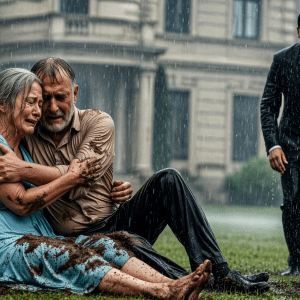
With remarkable composure, Bernadete sat the girl at the table and explained how she had found her by the river two years before, cold, injured, with no memory of who she was.
“So you’re not really my grandma?” Laila asked, her voice small.
“In every way that matters, I am. Love makes a family, not just blood.”
Laila turned to Hugo. “And you think I’m your daughter, the one who was lost in the river?”
“I think it’s possible. The timing matches. You look exactly like her, and now you’re remembering things that Ana lived.”
“But I’m Laila,” the girl insisted, a note of panic in her voice.
“You’re still you,” Bernadete assured her quickly. “Whatever name you had before, nothing changes who you are inside.”
Laila was silent for a long moment. “If I am your daughter, what happens to Grandma Bernadete?”
“I won’t leave her. Not at all.” Hugo reached his hand across the table, including them both. “If you are Ana, nothing will change in your relationship with Bernadete, I promise. She saved your life, she cared for you when I couldn’t. We’ll find a way to be a family together.”
“The three of us,” Bernadete added, squeezing Laila’s hand.
The following afternoon, Hugo’s car drove up the long entrance road of the spacious house in Alphaville, overlooking the artificial lake. Laila’s eyes widened at the sight of glass and wood nestled among palm trees and ipê trees.
They toured the main rooms without anything sparking recognition in Laila. It wasn’t until they reached the second floor that her attitude changed.
In front of a door at the end of the hallway, Laila stopped suddenly. Her hand flew to her eye, where the crescent-shaped scar marked her skin. “Something about this hallway feels familiar.”
Hugo opened the door to Ana’s room. Sky-blue walls adorned with glow-in-the-dark stars, shelves full of astronomy books, a telescope by the window. Laila entered slowly, ran her fingers over the book spines, stopped at a worn copy of The Little Prince and opened it to the title page: “For my star explorer, Ana. May you always find your way by the stars. With love, Dad.”
She looked up at Hugo. “You wrote this?”
It wasn’t a question. Hugo was unable to speak; he simply nodded.
Laila carefully put the book back and moved to the bed. Without hesitation, she reached for a very worn teddy bear wearing a small NASA t-shirt. “Cosmo.” Then she turned to Hugo with a speed that startled both adults. “You gave him to me when I had my tonsils out. You said he had been to space and back. So he knew all about being brave.”
Hugo’s legs almost gave way. It was true. He had invented an elaborate story about Cosmo, the astronaut bear, when 5-year-old Ana was terrified of her tonsillectomy.
“It’s true,” he managed to say, his voice barely audible. “You remember that?”
“I don’t know how I remember. It just appeared in my head when I touched him.”
Laila opened the photo album on the desk and slowly turned the pages. Ana as a baby, Ana at the beach, Ana on her first day of school. She stopped at a June festival photo, where the Ana in the picture wore a silver star pendant, standing by a Ferris wheel.
“My necklace. The star pendant you gave me for my seventh birthday. The Ferris wheel got stuck and I was scared. But you told me stories until it started moving again.”
Hugo crossed to the safe behind a painting and took out a small velvet box. Inside was the silver star pendant with the broken chain, recovered from the wrecked car.
Laila stared at the necklace, her fingers hovering over it. “I remember wearing it all the time. I never took it off.”
“There’s no rush,” Hugo said gently. “Your memories are coming back naturally.”
Laila sat down. Her expression was troubled again. “If I am Ana, does that mean Laila wasn’t real? That my whole life with Grandma Bernadete was a lie?”
“Not at all,” Hugo said firmly, kneeling to be at her eye level. “The last two years with Bernadete were completely real. The love between you is real. Discovering you had a life before doesn’t invalidate anything that came after.”
After dinner, Laila reappeared in the living room doorway. “Can I play the piano? I remembered something today. You used to play a special song when I couldn’t sleep.”
Hugo froze. “You remember that?”
“It was calm and slow. You made it just for me. You called it ‘Ana’s Starlight’.”
Unable to deny it, Hugo led them to the living room, where a grand piano rested against the wall of windows overlooking the lake. Moonlight streamed through the glass, illuminating the instrument that had remained silent since the night Ana disappeared.
Hugo lifted the lid hesitantly. His fingers hovered over the keys. For a moment, he feared he had forgotten how to play, that this part of himself had been lost along with his daughter.
Then, slowly, his hands found the familiar pattern. The soft melody filled the room. Laila closed her eyes, an expression of peace settling on her features.
Bernadete watched them, tears silently sliding down her weathered cheeks.
When the last notes faded, Laila opened her eyes. “Now I remember. You played this every night before bed, and then you’d say, ‘Sweet dreams, my little star explorer.'”
Hugo nodded, unable to trust his own voice. That was their nightly ritual, something he had never shared with anyone outside the family. Laila was Ana.
Chief Braga’s call came shortly after. “We arrested Jonas Macedo. He gave up everything: the recordings, the planning, the execution. Felipe Caldas was arrested an hour ago on the Vasconcel premises.”
Hugo absorbed the news with a calm that surprised him. “Thank you, Chief, for everything.”
He shared the news with Bernadete in a low voice so Laila wouldn’t hear. “Finding her put everything in perspective,” Hugo said, looking down the hallway where the light from Laila’s room still shone. “The company, the money, even getting justice against Felipe. None of it matters compared to this.”
Bernadete smiled. “That’s being a father. Nothing else ever reaches the same level of importance as your child.”
Mauro arrived with a folder of legal documents to discuss the next legal steps: Ana’s declaration of being alive, shared custody, recognition of Bernadete’s humanitarian role.
But Hugo’s phone rang again. It was Chief Braga, this time with urgency. “Caldas’s electronic ankle monitor was deactivated 20 minutes ago. He cut it off. Stay inside. Activate your security system.”
Bernadete stood up immediately, her expression resolute. “We’re going to your house tonight.”
At the lakeside house in Alphaville, midway through dinner, the security system siren sounded. The perimeter sensor by the lake was flashing red. “Stay here,” Hugo instructed, moving to check the cameras.
Before he reached the panel, the power went out. Emergency lights activated moments later, casting an eerie glow through the hallways. Hugo’s cell phone had no signal. The landline was also dead.
Signal jammer. Felipe had planned this carefully.
Bernadete returned with a sleepy Laila, who was clutching Cosmo against her chest. The sound of breaking glass from the conservatory interrupted them. Someone was inside the house.
Without hesitation, Hugo led Bernadete and Laila to the office, which had reinforced walls and a mechanical lock. “Lock the door when I leave. Don’t open it for anyone except me or the police.”
“Where are you going?” Bernadete demanded.
“To intercept Felipe before he gets to this side of the house.”
Hugo moved silently through the darkened corridors of his own home. He had no weapon, but he had the advantage of knowing every inch of the house.
“I know you’re here, Hugo,” Felipe’s voice called out, unnaturally calm. “You’ve made a pretty mess of things. The sale to Globotec was almost complete.”
“We were already rich, Felipe,” Hugo replied, projecting his voice to draw him away from the office. “What happened to you? We built Vasconcelos Tech to change the world, not to sell it to the highest bidder.”
The two moved through the darkened house, Hugo retreating towards the kitchen, where there was an independent phone line. In the dim emergency light, he caught the silhouette of his former partner.
Hugo’s fingers closed around the phone as he entered the kitchen, just as Felipe came in behind him, a pistol in his hand.
“Drop it, Hugo.”
“Think about what you’re doing. The kidnapping was already serious enough.”
“I lost everything because of your stubbornness. I have nothing left to lose.”
Hugo slowly raised his hands.
Then the unmistakable sound of a child’s voice came from the hallway. “Hugo, are you okay?” Laila’s voice, high-pitched and frightened, cut through the tense standoff.
Both men froze. Laila stood in the kitchen doorway, clutching Cosmo with one hand, her eyes wide as she took in the scene.
“Laila, go back to Bernadete!” Hugo urged urgently, but Laila remained frozen, looking not at Hugo, but at Felipe.
“I remember you,” she said, her voice small but clear. “You came to our house for my birthday party. You brought me a telescope.”
Felipe’s pistol wavered. “What? I don’t know what you’re talking about.”
“Ana,” Hugo corrected automatically. “Her name is Ana.”
“Your daughter is dead. She drowned two years ago.”
Ana took another step into the kitchen. “You made a cake shaped like the solar system,” she continued, her gaze never leaving Felipe. “And you told me stories about when you and my dad were in college together. You said he always wanted to save the world, and you always wanted to own it.”
Felipe’s expression shifted from confusion to disbelief. “That’s impossible,” he whispered. The pistol dropped completely. “It can’t be, Ana.”
“But I am,” Ana replied with the simple certainty of a child. “I got out of the car when it fell into the river. The current carried me far away. I forgot who I was until I found my dad at the scrapyard.”
Bernadete appeared behind Ana, her face tight with fear. “Come, girl, come with me now.”
“It’s okay, Grandma Bernadete,” Ana said calmly. “He won’t hurt us. He’s my dad’s friend, he’s just scared.”
The innocent assessment struck something in Felipe. He stared at the girl with an expression of growing horror, as if only now fully understanding the magnitude of everything he had done and everything he had almost destroyed.
Then, the unmistakable sound of sirens cut through the night, growing louder. Flashing lights illuminated the windows as police cars surrounded the house.
“Looks like Mrs. Dália got out and called the police,” Hugo said, relief washing over him completely. “It’s over, Felipe!”
With a defeated gesture, Felipe placed the pistol on the counter and sank into a chair, his head in his hands.
Chief Braga handcuffed Felipe personally while officers checked the rest of the property. “Is everyone alright?” Braga asked.
“We’re fine,” Hugo assured him, keeping a protective arm around Ana’s shoulders. “Better than fine.” He looked down at his daughter with undiminished wonder. “We’re whole again.”
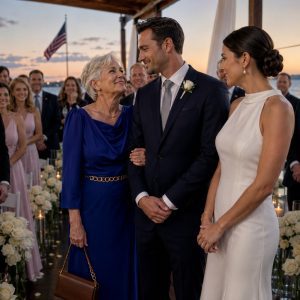
Two weeks later, they gathered in Judge Vera Monteiro’s chambers, a compassionate woman with three decades of experience in family law. The DNA results had confirmed what their hearts already knew. Laila was indeed Ana Vasconcelos, returned from an aquatic grave by what the judge called an “extraordinary confluence of circumstances and human resilience.”
Bernadete’s role was recognized not as kidnapping, but as an act of humanitarian rescue. The story of a woman who found a lost child and loved her as if she had always been her own.
“This is one of the most extraordinary cases I have encountered in my career,” Judge Monteiro said, signing the final document. “Ana Vasconcelos is legally restored to life, with shared custody granted to her biological father, Hugo Vasconcelos, and her legal guardian, Bernadete Menezes.”
Ana, wearing a blue dress that matched her eyes, sat between Hugo and Bernadete, her small hands grasping each of them.
“Does this mean Grandma Bernadete is really my grandma now?” Ana asked as they left the courthouse.
“In every way that matters,” Hugo assured her. “Legally, emotionally, permanently.”
Bernadete, who had moved into the east wing of the lakeside house, smiled with tears in her eyes. “Family is more than blood, my child. It’s love and commitment.”
Felipe Caldas pleaded guilty to all charges, accepting a 15-year sentence. Hugo visited him once in prison, not to offer forgiveness, but to close a chapter of his life.
The driven, solitary executive had been replaced by a father whose priorities had completely realigned. Hugo stepped back from day-to-day operations at Vasconcelos Tech and focused on what he now understood to be his most important job: being Ana’s father.
Hugo returned to playing the piano regularly. “Ana’s Starlight” remained the special favorite, but he also composed new pieces. One was called “Bernadete’s Wisdom,” a gentle, resilient melody that honored the woman who had become an unexpected but deeply cherished part of his family.
As spring blossomed in São Paulo, Hugo finalized his most ambitious project: the Ana Vasconcelos Institute, dedicated to supporting children in care and providing resources for families in crisis. Bernadete agreed to serve as director.
“You have a gift for helping vulnerable children,” Hugo said as they reviewed plans for the first community center. “You saved Ana when the system might have failed her. Think of how many others you can help now.”
On the anniversary of Ana’s rescue from the scrapyard, the three of them returned together to the Cantareira scrapyard. Mr. Henrique, surprised by the visit, sheepishly accepted a donation to renovate the shed.
“This place will always be special to us,” Hugo explained. “It’s where our family began to find each other again.”
As they prepared to leave, Ana stopped near the spot where she had once found a stranger trapped in a trunk. A stranger who turned out to be the father she had forgotten.
“Do you ever think about how so many things had to happen exactly right for us to find each other?” Ana asked thoughtfully. “If I hadn’t been searching that exact day, in that exact place…”
“I think about it every day,” Hugo admitted, placing his hand on her shoulder.
“Some call it coincidence,” Bernadete added, with the serene tone of someone who has made peace with mystery. “But I prefer to think it’s something more meaningful. A reminder that even in our darkest moments, hope persists.”
“Like the stars,” Ana said, touching the pendant around her neck. That same silver star pendant, now with a new chain that shone in the sun. “Even when you can’t see them, they’re still there, shining.”
As they walked back to the car, hand in hand, their family united by choice as much as by circumstance, the São Paulo fog began to lift. Sunlight broke through the clouds, illuminating the road ahead. Three lives shattered by tragedy, now restored and reimagined into something new and precious.
Behind them, the scrapyard, which once held only broken and discarded things, stood as a testament to what can be saved and what can become whole again when found by the right hands, guided by love, illuminated by the unbreakable light of hope. The broken star pendant, once lost in the river, now shone around Ana’s neck, a symbol of resilience, of lives interrupted but not ended. A family defined not only by blood, but by the choice to love and protect each other, no matter what waters might rise to separate them.
And that’s where we’ll stop for today, my friend. This story touched me deeply. A girl with almost nothing found a man on the brink of death. And in her silent act of courage, asking for nothing in return, fate began to weave something far greater than either of them could have imagined. Because sometimes the people who come into our lives in the darkest moment don’t arrive by accident; they arrive because the universe still has plans for us.
And you, is there something in this story that touched something inside you? A hope you thought was lost, that might still be shining in the dark? Tell us in the comments. From your iced açaí from Pará, your brigadeiro from São Paulo, your warm cheese bread from Minas Gerais, your acarajé from Bahia. Wherever you come from, your voice matters here.
If this story lit even a spark of hope in your heart, give it a like. Share it with someone who needs to hear it today. And if you haven’t subscribed yet, subscribe now so the next story reaches you as soon as it’s live. Thank you so much for being here. See you next time.