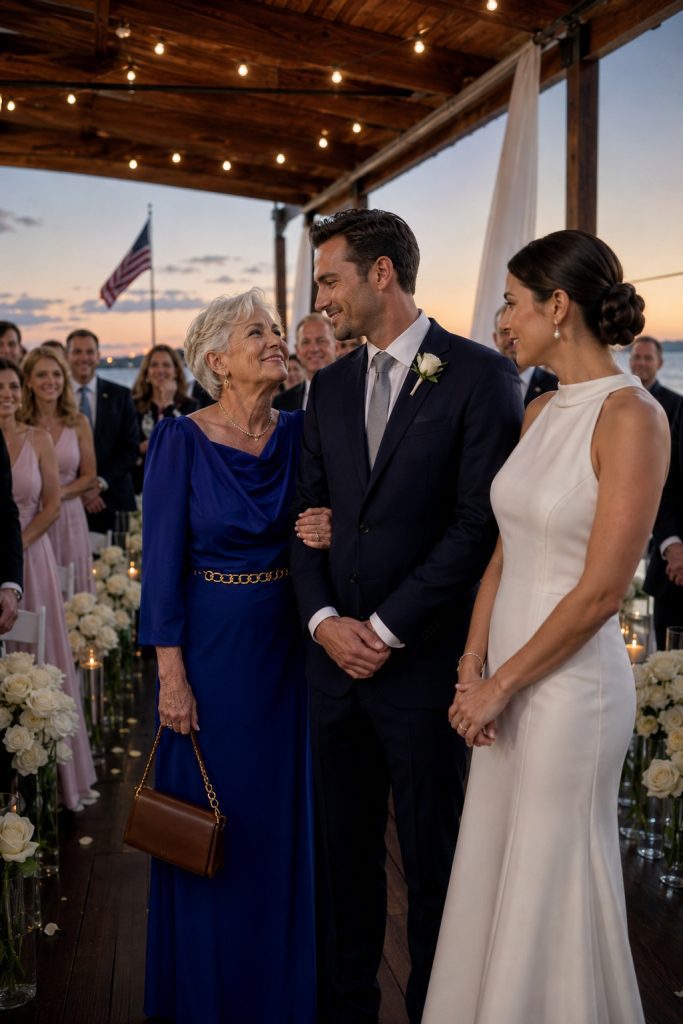
I walked into my son’s wedding wearing a royal blue dress that had belonged to my mother, carrying nothing but pride, love, and the quiet hope that the boy I raised would look at me once that night and remember everything we had survived together.
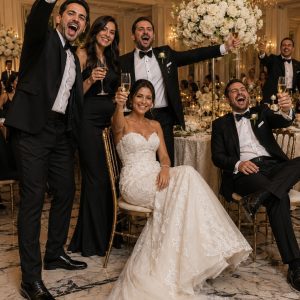
The garden lights were glowing over the ranch. The white flowers were arranged along the walkway. A string quartet played softly near the patio while guests in pressed suits and summer dresses laughed under the Texas evening sky.
It should have been the kind of night a mother keeps in her heart forever.
And maybe it was.
Just not for the reason I expected.
My name is Emilia DelleFave. I was fifty-seven then, a widow, a ranch owner, and the kind of woman who had learned to stand still when life tried to knock her down.
I had raised my son Daniel on that land after his father was gone. I had stretched every dollar, repaired fences when my hands could barely close, sat through parent-teacher meetings with dirt still under my nails, and kept that old ranch alive because it was more than property.
It was our history.
Daniel used to know that.
When he was twelve, he would wake before sunrise and follow me to the barn in boots too big for his feet. He would carry tools he could barely lift and tell me he was the man of the house now.
I always told him he was still a child.
But the truth was, he grew up faster than any boy should have to.
For years, it was just the two of us. Coffee on the porch. Bills spread across the kitchen table. Long evenings watching the sky turn orange behind the mesquite trees.
Then Sarah Thornbush arrived.
She was polished, confident, and always looking at the ranch the way a buyer looks at a house during an open showing. Not with affection. With calculation.
At first, I tried to welcome her.
I told myself Daniel had chosen her for a reason. I told myself love sometimes wears a face we do not understand at first. I cooked for her, made space for her at Sunday dinners, and stayed quiet when she called our home “charming” in that careful tone people use when they really mean outdated.
Then Daniel began to change.
He stopped sitting with me on the porch. He started talking about “modernizing” the ranch, about turning the garden into an event venue, about using the old house for something “more practical.”
Practical.
That word hurt more than I wanted to admit.
Because to him, maybe it was just land.
To me, it was his father’s hands in every beam, my grandfather’s trees still bending in the wind, my mother’s dishes in the cupboard, and my whole life folded into every hallway.
Still, I stayed calm.
A mother forgives small changes. She waits. She hopes the child she raised will come back through the fog.
But at his wedding, the fog became a wall.
I had barely stepped into the reception when Sarah looked at my dress and whispered into Daniel’s ear. Her lips brushed his temple, her hand resting on his chest, and her voice was so low I almost missed it.
“She looks desperate, Daniel. That dress. It’s too much. Everyone is staring.”
I saw his face change.
He crossed the room with that tight jaw I knew too well, the one he wore as a boy when he had done something wrong but wanted me to apologize for noticing.
“Mom,” he said quietly at first, “Sarah thinks your dress is too much.”
I looked down at the blue fabric. It was elegant. Not flashy. Not bridal. Just a mother trying to look worthy of the day. The fabric was a deep, rich royal blue, the kind my mother had worn to my own wedding thirty-two years ago. It had been preserved in tissue paper, folded with cedar chips, waiting for a moment worthy of its history.
“I brought another dress in the car,” I told him. “I can change.”
His eyes flicked toward Sarah.
Then his voice hardened.
“No. It’s better if you just leave.”
For a second, the music seemed to fade. The string quartet kept playing, but the notes felt distant, like sound underwater. The white flowers blurred at the edges of my vision. I thought I had misheard him.
“Leave?”
He looked over his shoulder at his bride, then back at me, as if I were the problem standing between him and happiness.
“She’s nervous,” he said. “Your presence is making her uncomfortable.”
Around us, guests kept talking. Glasses clinked. Someone laughed near the dessert table. The American flag by the entrance moved softly in the evening breeze, as if everything in the world was still normal.
But my world had stopped.
“Daniel,” I said, keeping my voice low, “I am your mother.”
That was when he raised his voice.
In front of the guests.
In front of the family.
In front of people who had eaten at my table and watched my son grow up.
“Get out, Mom. My bride doesn’t want you here.”
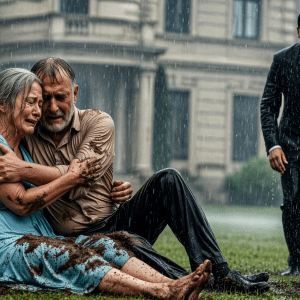
The words landed like a physical blow. I felt them in my chest, sharp and cold, spreading through my ribs like ice water. I looked around the room, searching for someone—anyone—who might step forward. Rose Pendleton, my neighbor from two properties over, stood near the dessert table with her hand over her mouth. Judge Harlan Croft, our family attorney for forty years, was frozen near the bar, his glass of whiskey halfway to his lips. Marta, my mother’s old friend, looked away when our eyes met.
Nobody moved.
Nobody defended me.
The room went still, but not one person stepped forward.
I looked at my son, and for one brief moment, I did not see the man in the wedding suit. I saw the little boy with scraped knees running toward me from the barn, asking if I had seen how brave he was. I saw the teenager who had cried on my shoulder after his first heartbreak. I saw the young man who had promised me, on the night of his father’s funeral, that he would never let anyone take the ranch from me.
Then I nodded.
I picked up my purse.
And I left.
No scene. No tears. No raised voice.
Just the sound of my heels crossing the polished floor while two hundred people pretended not to watch.
The gravel crunched under my tires as I pulled out of the parking lot. The wedding lights faded in my rearview mirror, replaced by the dark stretch of county road that led back to the ranch. The mesquite trees lined the road like silent sentinels, their branches casting long shadows in the headlights.
I drove with both hands on the wheel, my knuckles white, my jaw clenched so tight my teeth ached. The keys to the ranch were around my neck, heavy and warm against my collarbone. My father had placed them in my hands thirty-five years ago, on the day I married Liam. “This land is yours now,” he had said. “Guard it like you guard your heart.”
I had guarded it.
But I had not guarded my heart.
And tonight, my son had shattered it.
The porch light was still on when I pulled into the driveway. The house looked warm from the outside, but inside, it felt wider than it ever had. The kitchen was dark except for the small lamp I always left on by the window. The floorboards creaked under my feet as I walked through the living room, past the faded photographs on the wall, past Liam’s old hat still hanging on the hook by the door.
I went upstairs, took off the blue dress, folded it carefully, and placed it back in the closet.
Then I sat in the kitchen until sunrise.
The keys to the ranch hung around my neck the entire time.
They were old, heavy, and worn smooth from years of use. My father had placed them in my hand before he passed the land to me, and my husband Liam DelleFave had made sure I would keep control of the ranch for as long as I lived. He had added a leather cord before he died, five years ago, and he had made sure the legal documents gave me sole authority over any sale or transfer of the land.
At the time, I thought that clause was just paperwork.
Now I understood it was protection.
I sat at the kitchen table, the same table where Daniel had done his homework as a boy, where Liam and I had planned our future, where I had cried alone after his funeral. The coffee pot was cold. The clock on the wall ticked slowly. The first light of dawn crept through the window, pale and gray, casting long shadows across the wooden floorboards I had walked a thousand times.
I thought about the wedding. The way Sarah had whispered. The way Daniel had looked at me. The way no one had spoken.
I thought about the years I had given. The sacrifices I had made. The love I had poured into that boy like water into dry earth.
And I thought about the keys around my neck.
The next morning, Daniel called.
I stared at his name on the screen for a long time before answering. The phone vibrated in my hand, buzzing against my palm, and I watched it ring three times before I picked up.
I thought maybe he would apologize.
I thought maybe the weight of what he had done would finally reach him.
But when I picked up, his voice was not soft with regret.
It was cautious. Pressured. Almost rehearsed.
“Mom,” he said, “I need the keys to the estate.”
I closed my eyes.
Behind his voice, I could hear someone else moving in the background. A woman’s voice. Sarah’s.
And suddenly, the wedding made sense in a way I wished it didn’t.
This had never been about a blue dress.
It had never been about nerves.
It had never even been about me.
It was about the ranch.
The house. The land. The keys. The one thing I still held that Sarah had not managed to touch.
I wrapped my fingers around the necklace and felt the cold metal press into my palm.
For years, I had believed love meant giving until nothing was left. Giving your time, your money, your sleep, your forgiveness, your pride.
But that morning, with the sun coming through the kitchen window and my son waiting on the other end of the line, I realized something every mother learns sooner or later.
There are moments when love is not giving.
Love is refusing.
Daniel kept talking. He said they only wanted to make changes. He said the ranch had potential. He said Sarah had spoken to people who knew how to turn a place like ours into something profitable.
“There’s a developer from Houston,” he said. “They’ve made an offer. A good one, Mom. We can pay off everything. Start fresh.”
“Start fresh where?” I asked.
He hesitated.
“We could buy a place in Austin. Something smaller. Easier.”
“This is our place, Daniel. This is where your father is buried. This is where you learned to walk.”
“I know, Mom. But things change.”
I heard Sarah’s voice in the background again, sharp and fast, telling him to push harder.
“Mom,” he said, his voice tighter now, “I need the keys.”
I listened without interrupting.
Then I took one deep breath.
And I gave him four words he would remember long after that wedding night.
“The land is not yours.”
Silence.
The line crackled. I heard Sarah’s voice again, louder this time, demanding something I couldn’t make out. Daniel’s breathing was heavy, uneven.
“What do you mean?” he asked.
“I mean,” I said slowly, “that your father made sure no one could take this land from me. Not you. Not Sarah. Not any developer from Houston.”
“Mom, that’s not—”
“The deed has an addendum,” I said. “Signed by your father, witnessed by Judge Harlan Croft, filed with the county clerk five years ago. It gives me sole authority over any sale or transfer of this land. For as long as I live.”
The silence stretched.
Then I heard Sarah’s voice, sharp and furious, in the background.
“She’s lying!”
But I knew she wasn’t.
And I knew Daniel knew it too.
“Mom,” he said, his voice cracking, “can we talk about this?”
“Not over the phone,” I said. “If you want to talk, you come here. Alone.”
I hung up.
The keys were still around my neck. The coffee was still cold. The sun was fully up now, casting long shadows across the kitchen floor.
I went upstairs, opened the bottom drawer of Liam’s old dresser, and pulled out the manila envelope I had kept sealed for five years.
The paper inside was yellowed at the edges. Liam’s handwriting was still clear.
He had written it three weeks before he died, when the cancer had already stolen most of his strength but none of his mind. He had called Judge Croft to the house, dictated every word, signed it in front of two witnesses, and handed it to me with hands that trembled.
“Keep this close,” he had whispered. “One day, someone will try to take this land from you. And when they do, you show them this.”
I had cried then.
I did not cry now.
I placed the document back in the envelope, slipped it into my purse, and walked out to the porch to wait.
The gravel driveway stretched out before me, lined with the same mesquite trees that had been there since I was a girl. The barn stood to the left, its red paint faded but still sturdy. The cattle were grazing in the far pasture, their bells ringing softly in the morning air.
This was my land.
This was my life.
And no one—not my son, not his wife, not any developer—was going to take it from me.
I heard the truck before I saw it. The rumble of the engine, the crunch of tires on gravel. Daniel’s old Ford came around the bend, kicking up dust, and I saw Sarah in the passenger seat.
Of course.
She wouldn’t let him come alone.
The truck stopped at the bottom of the porch steps. Daniel got out first, his boots heavy on the gravel. Sarah followed, her blonde hair perfect, her sunglasses hiding whatever calculation was running behind those sharp blue eyes.
“Mom,” Daniel said, “we need to talk.”
I stayed on the porch.
“I think we already did.”
Sarah took off her sunglasses and smiled. It was the kind of smile that looked warm but felt cold.
“Emilia,” she said, “let’s not make this harder than it needs to be. The ranch is sitting on millions. A developer from Houston has already made an offer. We can all walk away from this rich.”
I looked at my son.
“Daniel, did you know about this?”
He shifted his weight.
“Sarah has been working on it for months. It’s a good deal, Mom. We can pay off everything. Start fresh.”
“Start fresh where?”
He didn’t answer.
Sarah stepped forward.
“The contract is already signed, Emilia. The developer is ready to break ground in sixty days. All we need is your signature to transfer the deed. And since Daniel is your only living heir, we assumed you would want what’s best for him.”
She pulled a folded document from her designer handbag and held it out.
I did not take it.
“Let me guess,” I said. “You had him sign it without reading the fine print.”
Sarah’s smile flickered.
Daniel frowned.
“What do you mean, without reading it?”
I reached into my purse and pulled out the manila envelope.
“I mean,” I said slowly, “that your father knew someone like Sarah would come along one day.”
I opened the envelope and pulled out the yellowed document.
“This is a legal addendum to the DelleFave Ranch deed,” I said. “Signed by your father, witnessed by Judge Harlan Croft, and filed with the county clerk five years ago.”
Daniel’s face went pale.
“A what?”
“A clause,” I said, “that gives me sole authority over any sale or transfer of this land. For as long as I live. No one—not you, not Sarah, not any developer—can force me to sell.”
Sarah laughed.
“That’s not possible. I had our lawyers check the deed. There’s no such clause.”
I held up the document.
“Your lawyers checked the public deed. This addendum was filed separately, in a sealed trust. Only Judge Croft and I have the original.”
Sarah’s face hardened.
“You’re bluffing.”
“Call Judge Croft,” I said. “His number hasn’t changed in forty years.”
Daniel stepped forward, his voice cracking.
“Mom… is this true?”
I looked at my son.
“Your father loved you more than anything in this world,” I said. “But he also knew that love is not enough to protect a person from being used.”
Sarah grabbed Daniel’s arm.
“She’s lying. This is a forgery. She’s trying to keep the money for herself.”
I looked at Sarah’s hand on my son’s arm, and I thought about the wedding night. The whisper in his ear. The way she had sent me out of that room like I was garbage.
“Sarah,” I said quietly, “I know about the developer contract.”
Her eyes widened.
“I know you signed it in your name only. I know Daniel’s name is nowhere on it. And I know that if this sale went through, he would walk away with nothing while you walked away with millions.”
Daniel turned to her.
“What?”
Sarah’s composure cracked.
“That’s not true.”
“Then show him the contract,” I said. “The real one. Not the version you let him see.”
Daniel’s face went through a series of changes I had not seen since he was a boy caught in a lie.
“Sarah,” he said, “show me the contract.”
She did not move.
“Show me the contract,” he repeated, louder.
Sarah’s face twisted.
“Fine. Yes. I signed it in my name. But it was for us. For our future. Your mother was never going to let go of this land, Daniel. She would have let it rot before she let us have it.”
Daniel stepped back from her.
“I asked you to leave my mother’s wedding,” he said, his voice hollow. “I told my own mother to leave. For you.”
“You did what needed to be done,” Sarah snapped. “She was in the way.”
Daniel looked at me.
And for the first time in seven years, I saw my son again.
The boy who used to follow me to the barn.
The boy who told me he would take care of me.
The boy who got lost somewhere along the way.
“Mom,” he whispered, “I’m sorry.”
I did not say it was okay.
Because it was not.
Not yet.
But I nodded.
And I held the keys a little tighter.
Sarah realized she had lost.
She grabbed her handbag, turned on her heel, and walked toward the truck.
“This isn’t over,” she called over her shoulder. “I have lawyers too.”
But we both knew it was.
The clause was ironclad. Judge Croft had written it himself. The developer would pull out the moment they learned the sale was blocked.
Sarah drove away in a cloud of dust.
Daniel stood in the driveway, his hands hanging at his sides, looking like a man who had just woken up from a long, bad dream.
“Mom,” he said, “can we talk?”
I looked at him.
And I thought about the blue dress I had folded in the closet.
“Not today,” I said.
I turned and walked back into the house.
The keys were still around my neck.
And for the first time in five years, I felt like I was standing on ground that no one could take from me.
The door clicked shut behind me, and the silence of the house swallowed the sound of Sarah’s tires grinding against the gravel.
I stood in the hallway for a long moment, my hand still resting on the brass knob, my breath slow and even. The keys pressed against my chest through the fabric of my shirt, and I could feel the warmth of the metal, as if it had absorbed the heat of the morning sun and was now returning it to me like a secret kept safe.
I walked to the kitchen and poured myself a fresh cup of coffee. The old percolator hissed and sputtered, filling the room with the smell of dark roast and chicory, the same smell that had greeted me every morning for thirty years. I sat at the table, the same table where I had taught Daniel to write his name, where I had paid the bills after Liam’s funeral, where I had folded the blue dress the night before.
I did not cry.
I did not smile.
I just sat there, holding the cup in both hands, and let the truth of what had just happened settle into my bones.
Daniel had chosen me.
At the end of everything, after all the whispering and the manipulation and the public humiliation, my son had finally opened his eyes.
But that did not mean the wound was healed.
A wound does not close because the knife is removed. It closes because the body works, day after day, to rebuild what was broken.
And I knew, sitting there in the quiet of my kitchen, that the work was only beginning.
The next three days passed slowly.
I did not answer Daniel’s calls. He left three voicemails, each one shorter and more fragile than the last. The first was apologetic. The second was desperate. The third was barely a whisper.
“Mom… I know you don’t want to talk. But I need you to know I’m sorry. I mean it. I’m so sorry.”
I listened to each one once, then deleted them.
Not because I was cruel.
Because I needed time.
Time to separate the mother in me from the woman.
The mother wanted to run to him, to hold him, to tell him everything would be okay.
But the woman knew that some things cannot be fixed with a hug. Some things require a season of silence before the healing can begin.
On the fourth morning, I drove into town.
The sun was already high by the time I reached the old courthouse on Main Street. The building was limestone and faded brick, with a clock tower that had stopped working sometime in the eighties and never been repaired. The parking lot was half-empty, and the air conditioner hummed weakly through a window unit on the second floor.
I walked up the steps, my boots echoing against the concrete, and pushed through the heavy glass doors.
Judge Harlan Croft’s office was at the end of the hall on the first floor. The nameplate was brass, worn smooth at the edges, exactly as I remembered it from five years ago when Liam and I had sat in that same office to file the addendum.
I knocked.
“Come in.”
I opened the door and found Judge Croft sitting behind his desk, a pair of reading glasses perched on his nose, a stack of papers spread out in front of him. He was seventy-two now, with silver hair and the kind of deep laugh lines that came from a lifetime of telling hard truths with a gentle voice.
He looked up and smiled.
“Emilia. I was wondering when you would show up.”
I sat in the chair across from him.
“Then you probably know why I’m here.”
He leaned back, folded his hands over his stomach, and studied me for a moment.
“I heard about the wedding,” he said quietly. “I’m sorry, Emilia. That should never have happened.”
I nodded.
“It didn’t happen the way everyone thinks.”
Judge Croft raised an eyebrow.
“Tell me.”
So I did.
I told him everything. The blue dress. The whisper. The public humiliation. The phone call the next morning. Sarah’s demand for the keys. The developer contract. The confrontation on the driveway.
When I finished, Judge Croft was silent for a long moment.
Then he reached into his desk drawer and pulled out a manila folder.
“I was hoping it wouldn’t come to this,” he said. “But your husband was a smart man. He knew the kind of people who circle land like ours.”
He opened the folder and slid a document across the desk.
I recognized it immediately.
The addendum.
Yellowed at the edges, signed in Liam’s shaky hand, witnessed by Judge Croft and two other signatures I did not recognize.
“I want you to know,” Judge Croft said, “that this document is ironclad. I wrote it myself. It has been filed with the county clerk and sealed in a trust that only you and I can access. No court in this state will overturn it.”
I picked up the document and read the words I already knew by heart.
*”I, Liam DelleFave, being of sound mind and body, do hereby declare that my wife, Emilia DelleFave, shall retain sole and absolute authority over the sale, transfer, or encumbrance of the DelleFave Ranch property for the duration of her natural life. No heir, beneficiary, or third party may override her decision, regardless of any subsequent legal documents or claims.”*
I ran my finger over his signature.
The last time I had seen his handwriting was on a get-well card he had written to me from the hospital, three days before he died.
“I should have shown this to Daniel years ago,” I said quietly.
Judge Croft shook his head.
“No. You did the right thing by keeping it sealed. If Sarah had known about this clause, she would have found a way to challenge it while Liam was still alive. She would have dragged you through the courts for years.”
I looked up at him.
“How did you know about Sarah?”
He smiled, but it did not reach his eyes.
“I’ve been practicing law in this county for forty years, Emilia. I know a predator when I see one. The way she looked at this land at Liam’s funeral… I knew it was only a matter of time.”
I folded the document and placed it back in my purse.
“Thank you, Harlan.”
He nodded.
“If you need anything — anything at all — you call me. Day or night.”
I stood up and walked to the door.
Then I stopped.
“Harlan,” I said, “did you know about the developer contract?”
He was quiet for a moment.
“I heard rumors. A company out of Houston has been buying up land along the river for the past year. They’ve been offering top dollar, but they’re not interested in ranches. They want to build luxury resorts.”
I turned to face him.
“Sarah signed the contract in her name only. Daniel’s name isn’t on it.”
Judge Croft’s face hardened.
“Then she was planning to cut him out entirely. If the sale had gone through, she would have walked away with everything, and Daniel would have been left with nothing.”
I nodded.
“That’s what I thought.”
I walked out of the office and into the hallway, my footsteps echoing against the old wooden floors.
The sun was brighter now, streaming through the tall windows and casting long rectangles of light across the floor. I walked through them one by one, feeling the warmth on my face, and thought about the road ahead.
I had the legal document.
I had the truth.
But I knew that Sarah would not give up easily.
She was the kind of woman who did not know how to lose. She would find another angle, another lawyer, another way to twist the situation until she got what she wanted.
And I needed to be ready.
So I started preparing.
Over the next two weeks, I made phone calls I had never expected to make.
I called the county clerk’s office and confirmed that the addendum was on file, properly sealed and witnessed. I called a land surveyor and had the boundaries of the ranch re-measured for the first time in a decade. I called a local title company and requested a full title search, just to make sure there were no liens or encumbrances I had forgotten about.
And I called Rose Pendleton.
Rose lived two properties down, in a small house with a wraparound porch and a garden full of wildflowers. She was sixty years old, widowed like me, with a quiet laugh and a sharp eye for detail. We had been neighbors for twenty years, but we had never been close — not the kind of close where you call each other in the middle of the night.
But after what she had done at the wedding, I knew I could trust her.
We met at the diner on Main Street, the one with the cracked vinyl booths and the coffee that tasted like it had been sitting on the burner since 1998.
Rose was already there when I arrived, sitting in the back corner with a cup of tea and a worn leather notebook.
“Emilia,” she said, “you look tired.”
I sat down across from her.
“I’ve had a long couple of weeks.”
She nodded.
“I heard about the confrontation. Rose Pendleton’s grapevine is faster than the internet.”
I almost smiled.
“Then you probably heard that Sarah drove off in a cloud of dust.”
“I heard that too.” She took a sip of her tea. “But I also heard she’s been making phone calls. She’s been talking to a lawyer in Austin. A big one.”
I felt a chill run down my spine.
“How do you know that?”
Rose tapped her temple.
“I have my ways.”
I leaned forward.
“Rose, why did you record the wedding?”
She was quiet for a moment.
Then she set down her tea and looked at me with eyes that had seen more than they let on.
“Because I saw the way Sarah looked at you,” she said. “And I saw the way Daniel looked at her. I knew something was wrong. I didn’t know what, but I knew it wasn’t right.”
She reached into her purse and pulled out a small brown envelope.
“The USB drive is still in there,” she said. “I haven’t shown it to anyone. I was waiting for you to ask.”
I took the envelope and held it in my hands.
“Thank you, Rose.”
She nodded.
“You’re a good woman, Emilia. You don’t deserve what happened to you. And if that recording can help you get some justice, then I’m glad I was there.”
I tucked the envelope into my purse, next to the addendum.
Two weapons.
One legal.
One truth.
I was beginning to feel like I might have a fighting chance.
But I knew the real battle had not yet begun.
Because Sarah was not the kind of woman who accepted defeat quietly.
And three days later, I found out just how far she was willing to go.
I was in the barn, mending a broken fence post, when my phone buzzed.
It was a text from an unknown number.
*”Emilia DelleFave. This is Marcus Webb, attorney at law. I represent Sarah Thornbush. I would like to schedule a meeting to discuss the disposition of the DelleFave Ranch property. Please respond at your earliest convenience.”*
I stared at the screen for a long moment.
Then I typed back:
*”Thursday. 10 AM. My house. Bring your evidence.”*
I did not tell Daniel.
I did not tell Judge Croft.
I wanted to face Sarah’s lawyer alone, with nothing but the addendum and the truth.
But the night before the meeting, I did something I had not done in years.
I went into Liam’s study.
The room was dusty and dark, the blinds drawn, the bookshelves lined with old ranching manuals and leather-bound journals. I had not been in here since the week after his funeral, when I had packed away his clothes and closed the door.
But tonight, I needed to feel close to him.
I sat in his old chair, the leather cracked and worn, and I closed my eyes.
And I remembered.
I remembered the way he used to laugh, deep and full, like thunder rolling across the hills. I remembered the way he held my hand during the hard years, when the drought killed half the cattle and the bank was calling every week. I remembered the night he came home from the hospital after the diagnosis, how he had sat in this same chair and told me he was not afraid.
“The land will take care of you,” he had said. “As long as you hold on to it, it will hold on to you.”
I opened my eyes.
The room was still dark.
But I felt something settle in my chest.
Certainty.
I was doing the right thing.
Thursday morning arrived gray and overcast, with the kind of low clouds that pressed against the hills and made the whole world feel quiet and waiting.
I woke before sunrise, made coffee, and sat on the porch.
The keys were around my neck.
The addendum was in my purse.
The USB drive was in my pocket.
I was ready.
At exactly ten o’clock, a black sedan pulled up the gravel drive.
Marcus Webb stepped out.
He was younger than I expected — maybe forty, with a sharp suit and a briefcase that probably cost more than my truck. He had the kind of smile that looked practiced, the kind that lawyers learn in school and never quite lose.
“Mrs. DelleFave,” he said, extending his hand. “Thank you for seeing me.”
I shook his hand.
“I didn’t have much of a choice.”
He chuckled, but it did not reach his eyes.
“Shall we go inside?”
I led him into the kitchen and offered him a seat at the table.
He sat down, opened his briefcase, and pulled out a thick stack of papers.
“I’ll be direct,” he said. “My client, Sarah Thornbush, has signed a binding contract with Horizon Development Group for the purchase of the DelleFave Ranch property. The offer is for three point two million dollars.”
I did not blink.
“That’s a lot of money.”
“It is,” he said. “And it’s a fair offer. More than fair, given the current market.”
I nodded slowly.
“And what does Sarah get out of this deal?”
Marcus Webb’s smile flickered.
“She gets her share of the proceeds, as per the terms of the contract.”
I leaned forward.
“I know the contract is in her name only. I know Daniel’s name isn’t on it. And I know that if this sale goes through, my son walks away with nothing.”
Marcus Webb’s face went still.
“Where did you hear that?”
I reached into my purse and pulled out the addendum.
“Before we go any further,” I said, “I think you should read this.”
I slid the document across the table.
He picked it up, his eyes scanning the text.
And I watched the color drain from his face.
“This is… this is a legal addendum to the deed,” he said slowly. “Signed by Liam DelleFave. Witnessed by Judge Harlan Croft.”
“That’s right.”
He looked up at me.
“This gives you sole authority over any sale or transfer of the property.”
“That’s right.”
“For as long as you live.”
“That’s right.”
Marcus Webb set the document down and took a long, slow breath.
“Mrs. DelleFave,” he said, “this changes everything.”
I did not smile.
“I know.”
He was silent for a long moment.
Then he said, “My client was not aware of this addendum.”
“I know that too.”
He looked at me, and for the first time, I saw something like respect in his eyes.
“You came prepared.”
“I’ve been preparing for five years.”
He gathered his papers and stood up.
“I’ll need to verify this document with the county clerk’s office. But assuming it’s legitimate… my client’s contract is void.”
I stood up as well.
“It’s legitimate.”
He nodded.
“I’ll be in touch.”
He walked to the door, then paused.
“Mrs. DelleFave,” he said, “I’ve been practicing law for fifteen years. I’ve seen a lot of people lose things they shouldn’t have lost. But I’ve never seen someone fight this quietly and win this cleanly.”
I met his eyes.
“Some fights don’t need noise.”
He nodded once, then walked out the door.
I watched his sedan disappear down the gravel drive.
The keys were still around my neck.
And for the first time in five years, I felt like I was standing on ground that no one could take from me.
But I knew the war was not over.
Sarah would not accept this defeat quietly.
She would come back.
And next time, she would bring everything she had.
But I was ready.
Because I had something she would never understand.
I had the land.
And the land had me.
I sat in the kitchen for another hour after Marcus Webb left.
The coffee had gone cold. The morning light shifted through the windows, moving across the floorboards like it was measuring the distance I had traveled since that wedding night.
I did not move.
I held the addendum in my hands and read it again, slowly, as if I needed to remind myself that this paper was real. That Liam had written it. That he had known, somehow, that I would need it one day.
The keys pressed against my chest.
I thought about calling Daniel.
I thought about driving to his house and sitting him down and explaining everything. The addendum. The developer contract. The way Sarah had been playing him like a chess piece for seven years.
But I did not.
Because some lessons cannot be told.
They have to be lived.
And Daniel had not lived this one yet.
He was still standing in the wreckage of the wedding morning, still trying to understand how the woman he loved had turned out to be the woman who had destroyed his family.
He would need time.
And I had learned, over fifty-seven years, that time is the only thing that cannot be rushed.
The next three days passed in a strange kind of silence.
I stayed on the ranch. I fed the horses. I checked the fences. I swept the porch even when it did not need sweeping.
I did not answer my phone.
Rose Pendleton called twice. Judge Croft called once. I let all of them go to voicemail.
I needed the quiet.
I needed to hear myself think.
On the third night, I was sitting on the porch when a pair of headlights appeared at the end of the driveway.
I watched them approach, slow and hesitant, like the driver was not sure they had the right to be there.
The truck stopped.
Daniel stepped out.
He looked different than he had at the wedding. His shirt was untucked. His jaw was shadowed with stubble. His eyes were red, like he had not slept in days.
“Mom,” he said, “can I sit?”
I gestured to the chair beside me.
He sat.
For a long time, neither of us spoke.
The crickets were loud. The stars were bright. The wind moved through the mesquite trees like it was carrying something old and patient.
“I read the contract,” Daniel finally said.
I did not look at him.
“The real one,” he continued. “Sarah left it on the kitchen table when she packed her things. I didn’t know she had signed it in her name only. I didn’t know she had cut me out completely.”
I stayed silent.
“She was going to take everything,” he said. “The money. The land. And I would have been left with nothing. Nothing except the memory of telling my own mother to leave my wedding.”
His voice cracked.
“How did I not see it?”
I turned to look at him.
“Because you loved her,” I said. “And love makes us blind to the things we do not want to see.”
He buried his face in his hands.
“I sent you away. I told you to leave. In front of everyone.”
“You did.”
“I don’t know if I can ever forgive myself for that.”
I reached out and placed my hand on his shoulder.
“Forgiveness is not something you decide,” I said. “It is something you grow into. Like a tree. It takes time. It takes rain. It takes roots that are deep enough to hold the weight.”
He looked up at me.
“Are you saying you forgive me?”
I met his eyes.
“I am saying I am still your mother. And I will always be your mother. But trust is different from forgiveness. Trust has to be rebuilt. Brick by brick. And that starts now.”
He nodded slowly.
“What do I do?”
I looked out at the land.
“You start over,” I said. “You get a job. You pay your own bills. You learn what it means to stand on your own two feet without someone whispering in your ear.”
“And the ranch?”
I touched the keys around my neck.
“The ranch stays with me,” I said. “For now. When you have proven you can take care of yourself, when you have shown me that you understand what this land really means, we will talk about the future.”
He did not argue.
He just nodded again, stood up, and walked back to his truck.
Before he got in, he turned.
“Mom,” he said, “thank you. For not giving up on me.”
I watched him drive away.
The tail lights disappeared into the darkness.
And I sat there, alone, under the Texas sky, feeling something I had not felt in a very long time.
Hope.
The next morning, I drove into town to see Judge Harlan Croft.
His office was on Main Street, above the old bakery, in a building that smelled like paper and dust and decades of legal battles won and lost.
He was seventy-two years old, with white hair and the kind of tired eyes that had seen too many families break apart over money.
But when I walked in, he smiled.
“Emilia,” he said, rising from his chair. “I was wondering when you would come.”
I sat down across from him.
“I need to file a permanent injunction against any future claims on the ranch,” I said.
He raised an eyebrow.
“That’s a strong measure.”
“I know.”
He leaned back in his chair.
“Sarah has already withdrawn her contract with the developer,” he said. “Marcus Webb called me yesterday. The deal is dead.”
I nodded.
“That doesn’t mean she won’t try again. Or that someone else won’t come along.”
Judge Croft studied me.
“You’re thinking long-term.”
“I’m thinking about the land,” I said. “About what happens after I’m gone. I want to make sure it stays in the family. And that no one can ever use my son against me again.”
He was quiet for a moment.
Then he opened a drawer, pulled out a legal pad, and picked up his pen.
“Tell me exactly what you want.”
I told him.
I told him I wanted a trust that would hold the ranch for Daniel’s children, if he ever had any. I wanted a board of advisors that included Rose Pendleton and Judge Croft himself. I wanted a clause that required unanimous approval for any sale or transfer.
When I finished, he looked at me with something like admiration.
“Your husband would be proud of you,” he said.
I felt a lump form in my throat.
“I hope so.”
“He would,” Judge Croft said. “Liam knew what he was doing when he wrote that addendum. He knew you would protect this land better than anyone.”
I left his office an hour later, carrying a folder of paperwork that would take weeks to finalize.
But I felt lighter than I had in years.
That evening, Rose Pendleton came over.
She brought a bottle of wine and a plate of cookies, and she sat on my porch like she had a thousand times before, back when Liam was alive and the world was simpler.
“So,” she said, pouring two glasses, “I heard Sarah left town.”
I took the glass.
“She did?”
“Marcus Webb told my cousin. Apparently she drove straight to Houston. Didn’t even pack everything.”
I sipped the wine.
“Good.”
Rose laughed.
“You say that like you don’t enjoy the victory.”
“I don’t,” I said. “Victory never tastes the way you think it will.”
She looked at me.
“Then what does it taste like?”
I thought about it.
“Quiet,” I said. “It tastes like quiet. Like knowing you did the right thing, even when it hurt. Like standing on land that no one can take from you.”
Rose raised her glass.
“To quiet, then.”
I raised mine.
“To quiet.”
We sat there for hours, talking about nothing and everything. The horses. The garden. The way the light changed in October. The old stories that never got old.
And for the first time in seven years, I felt like myself again.
Not a widow.
Not a mother fighting for her son.
Not a woman holding on to a ranch with both hands.
Just Emilia.
The woman who had walked into her son’s wedding wearing a blue dress, and walked out with her dignity intact.
The next morning, I woke up before sunrise.
I made coffee, walked to the porch, and watched the sky turn pink over the hills.
The keys were around my neck.
The addendum was in the safe.
The USB drive was in my pocket.
I had everything I needed.
I thought about calling Daniel.
I thought about telling him to come home.
But I did not.
Because he was not ready yet.
And neither was I.
Some distances cannot be crossed in a day.
Some bridges have to be rebuilt one plank at a time.
I took a sip of coffee and looked out at the land.
The grass was green. The horses were grazing. The wind was moving through the trees like it was singing a song older than memory.
And I smiled.
Because this was mine.
Not because I had fought for it.
But because I had loved it.
And love, I had learned, was the only thing that could never be taken away.
Six months later, Daniel came back.
He showed up on a Sunday afternoon, driving a truck that was older and dirtier than the one he had left in. His hands were calloused. His face was thinner. His eyes were clearer.
He stood at the bottom of the porch steps and looked up at me.
“I got a job,” he said. “Working on a ranch outside San Antonio. Fixing fences. Mucking stalls. Learning what it means to earn a day’s work.”
I nodded.
“Good.”
“I’ve been going to meetings,” he said. “Talking to a counselor. Trying to understand how I let myself get so lost.”
I did not say anything.
He took a step forward.
“I’m not asking for the keys,” he said. “I’m not asking for anything. I just wanted you to know that I’m trying. I’m trying to become the son you raised.”
I felt my throat tighten.
“I know,” I said.
And I did.
I could see it in his hands. In his eyes. In the way he stood, steady and grounded, like a man who had finally found his footing.
“Can I stay for dinner?” he asked.
I smiled.
“Always.”
He climbed the steps, and I pulled him into an embrace that held seven years of waiting.
He cried.
I did not.
But I came close.
We ate on the porch that night, just the two of us, under the same sky that had watched over us for thirty-two years.
He told me about the ranch he was working on. The owner was old, like me, and stubborn, like me, and had taught him more in six months than he had learned in a decade.
I told him about the trust I had set up. About the board of advisors. About the clause that would protect the land for generations.
He listened without interrupting.
And when I finished, he said, “It’s perfect.”
I looked at him.
“You think so?”
He nodded.
“Dad would have wanted it this way.”
I reached up and touched the keys.
“He would have.”
We sat in silence for a long time, watching the stars come out one by one.
And I thought about the night of the wedding.
The blue dress.
The cold walk to the car.
The hours in the kitchen, holding the keys, wondering if I had lost my son forever.
I had not lost him.
I had just let him go long enough to find his way back.
The next morning, I walked to the barn.
The horses were waiting, as they always were, their breath fogging in the cool air.
I opened the gate and stepped inside.
The keys swung against my chest.
And I thought about the future.
About the grandchildren I might one day hold.
About the stories I would tell them.
About the land that would outlast me, and my children, and their children after them.
I ran my hand along the wooden beam that Liam had carved his initials into, thirty years ago.
“Thank you,” I whispered.
The wind moved through the barn.
And somewhere, in the quiet of the morning, I felt him smile.
I walked back to the house, the keys warm against my skin.
The sun was rising over the hills, painting the world in gold and pink and the color of new beginnings.
And I stood on the porch, alone but not lonely, holding the land in my hands and the memory of my husband in my heart.
I had won.
But more than that, I had kept what mattered most.
The land.
The truth.
And the love that had survived everything.
*The end.*