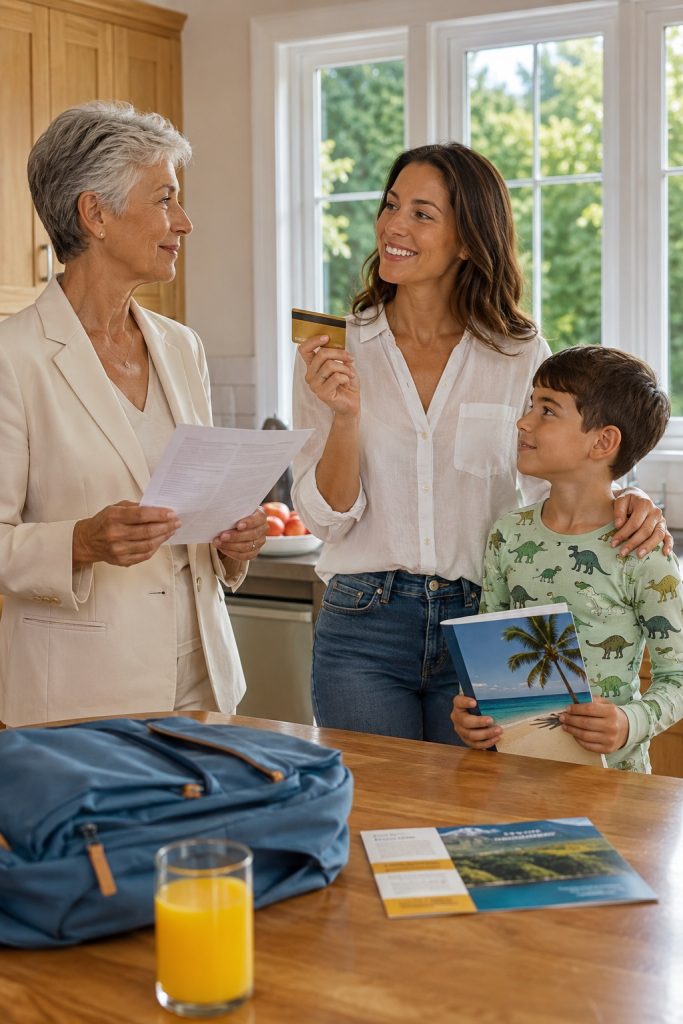
The fluorescent light in my kitchen hummed like a trapped insect, a sound I had always hated but never noticed until that moment. My mother’s cream coat smelled of cold air and expensive perfume, a scent that had meant authority in our house for as long as I could remember. She placed my bank card on the counter, the plastic clicking against the granite like a judge’s gavel, and I watched her fingers linger on it for a second too long, as if she expected me to thank her for returning it.
“We decided you won’t be going,” she said, without looking at me. Her silver bob caught the light as she turned her head slightly toward the window, avoiding my eyes. “Jessica doesn’t want to see you there.”
I heard Noah’s breath catch from the hallway. He was still wearing his dinosaur pajamas, the ones with the green stegosaurus on the chest and the hole in the left knee he had refused to let me patch. The Hawaii brochure was crushed in his small fist, the edges crumpled from three weeks of being pulled out from under his pillow every morning and unfolded on the kitchen table every night.
“Mom,” he whispered, his voice cracking like a twig under a boot, “did I do something wrong?”
That question hit me in the chest like something physical. I knew that feeling. The child’s confusion when adults take joy away and somehow make you wonder if you deserved it. I had felt it at twelve, standing in the living room while my sister’s award certificate was pinned above the fireplace and my drawing was placed face down on the counter. I had felt it at sixteen, when my summer program acceptance was put on hold because it might “conflict with Jessica’s schedule.” I had felt it every time my mother said “this is what’s best for the family” while I disappeared into the background like furniture.
My mother adjusted her purse strap, the leather creaking as she shifted her weight. “You’ve always made things complicated, Emily,” she said. “This is why we handle things without you.” She thought she was closing a conversation. She thought I would swallow this insult, comfort my child, and quietly absorb the damage so Jessica could have a softer version of life.
But I was looking at Noah. At his small hands, trembling around the brochure. At the way he was trying so hard to be brave that his bottom lip had gone white from biting it.
“Go finish your cereal, sweetheart,” I said gently. “I’m going to handle this.”
My mother laughed. Not a real laugh. The kind people use when they think they have already won. “Handle what, exactly? It’s done, Emily. The trip is canceled. Jessica is going instead. That’s the end of it.”
I picked up my bank card from the counter. The plastic was warm from her hand. I turned it over and looked at the chip, the numbers, the name embossed in silver. ELARA CHEN-MERCADO. Not Emily. I had changed it when I got married, even though the marriage had ended three years ago. I had kept the name because it was mine. Because I had chosen it.
“You don’t even know what I do for a living, do you?” I asked quietly.
My mother blinked. “You work at a travel company. You help with bookings.”
I almost laughed. Almost. “I designed the booking system, Mom. The one you just used to try to lock me out of my own trip.”
She stared at me, processing, rejecting, processing again. “That’s not—”
“It is.” I opened my laptop on the kitchen counter. The screen lit up, and I was inside the travel dashboard within seconds. My fingers moved across the keyboard from muscle memory, navigating through layers of security and permissions that I had written myself during late nights when my family never called to ask how I was.
My mother’s expression flickered. Not fear yet. Just irritation. “Emily, do not make this dramatic.”
But I was already clicking through the account history. Changes made without my approval. Seat reassignments. My access restricted. A secondary authorization added under my mother’s name. And then I saw it—a full administrative override submitted under my identity. Someone had tried to steal control of the entire itinerary.
I turned the laptop so she could see the screen. Her eyes moved across the dashboard, and for the first time since she walked into my house, the calm disappeared from her face. “What is that?” she asked.
I smiled then. Not warmly. Not cruelly. Just enough for her to know the old version of me was not coming back. “That,” I said, “is the part of the trip you should have asked me about before you tried to remove me from it.”
She reached for her phone immediately, probably to call Jessica, to call anyone who could turn this back into a family issue before it became what it really was. But it was too late. On the screen, the system had already detected the unauthorized override. Everything froze. Flights. Hotels. Resort access. Payment authorizations. All of it locked under a compliance review.
Then Jessica’s name flashed across my phone. I answered. Her voice came through sharp and confident. “Emily, stop whatever you’re doing.”
I looked at my mother, then at Noah standing silently in the hallway, the brochure pressed against his chest like a shield. And I said the one sentence that made both of them go pale.
“I didn’t stop the trip, Jessica. You triggered the audit.”
The silence that followed was the first honest thing my family had given me in years.
I was not always this person. The one who could freeze their entire family’s travel plans with a few keystrokes. The one who knew the exact location of every security protocol in a system they had never bothered to understand.
For most of my life, I was the quiet one. The reliable one. The one who showed up, did the work, and never complained about the way the credit always went somewhere else.
I grew up in a house where love was measured in attention, and attention was a finite resource that belonged mostly to Jessica. She was two years older than me, with wavy auburn hair that my mother styled into perfect curls for school pictures and pastel sweaters that never had holes in the knees. She was the one who got the piano lessons, the art classes, the summer camps. She was the one whose achievements were celebrated, whose feelings were protected, whose comfort was the family’s top priority.
I was the one who figured out how to fix the wifi when it went down. The one who helped my father organize his files when he couldn’t find a document. The one who learned to cook dinner by the time I was fourteen because my mother was too tired and Jessica was “too busy with schoolwork.”
I did not resent Jessica for this, not at first. She was my sister. I loved her. I wanted her to be happy. But somewhere along the way, I realized that my happiness was always expected to shrink to make room for hers. My space was always the one that got smaller. My plans were always the ones that got postponed. My feelings were always the ones that got explained away with “you know how Jessica is.”
Twenty-two years ago, when I was twelve and Jessica was sixteen, I drew a picture of a beach. It was not a good drawing. The waves were lopsided, the sun was too orange, and the palm trees looked more like broccoli than trees. But I had worked on it for three days, carefully adding details, trying to capture the way the ocean looked during our family trip to the coast the summer before.
I gave it to my mother on a Thursday evening, right before dinner. She took it from my hands without looking at it, smiled a tight smile, and placed it face down on the kitchen counter. “That’s nice, sweetheart,” she said. Then she turned to the living room, where my father was pinning Jessica’s piano certificate above the fireplace. “Higher, Ethan. Let people see it when they walk in.”
I waited for her to look at my drawing. She never did. By the end of the night, it had been moved to the recycling bin, crumpled on top of old newspapers, the lopsided waves and too-orange sun folded into creases that could not be smoothed out.
I did not tell anyone how much it hurt. I did not cry in front of them. I waited until I was in my room, under my covers, and then I let myself feel the full weight of it. The understanding that what I created, what I cared about, what I loved—it would never hold the same space in their world as what Jessica did.
That night, I made a promise to myself. I would stop waiting for them to see me. I would build something that did not need their approval. I would become someone who did not need their validation to feel whole.
It took me years to figure out what that meant. I went to college on scholarships, worked two jobs, and graduated with a degree in information systems. I took a job at Pacific Horizon Travel, a small luxury travel firm that was just starting to expand its digital infrastructure. I started as a junior analyst, fixing bugs and streamlining workflows. Within two years, I had been promoted to operations strategist. Within five, I had designed the entire travel dashboard from scratch—the system that managed bookings, payments, permissions, and compliance for the company’s highest-profile clients.
I built it because I understood something most people did not. Systems are not just about code. They are about control. About who gets access, who gets removed, who gets to make decisions that affect other people’s lives. I had spent my childhood being the person whose access was always restricted, whose permissions were always revoked, whose presence was always optional. I was not going to let that happen to anyone else in a system I controlled.
But my family never knew this. They saw my job as “helping with travel.” They saw my expertise as “being available to fix things.” They saw me as the same quiet, accommodating daughter who had learned to make herself small so Jessica could take up more space.
I let them believe it. Partly because explaining would have been exhausting. Partly because I liked having a part of my life they did not understand. A part they could not touch or take or twist into something that served them.
But when my mother walked into my kitchen and placed my bank card on the counter, I realized that my silence had cost me something. It had let them believe they could still control me. It had let them think that I would bend, shrink, and disappear, just like I always had.
Noah’s question broke the last thread of that illusion. “Did I do something wrong?”
I looked at my son, standing in the hallway in his dinosaur pajamas, holding a crumpled brochure that represented three weeks of unguarded hope. He had never learned to protect himself from disappointment the way I had. He had never learned to expect betrayal from the people who were supposed to love him.
I wanted him to stay that way. I wanted him to keep believing that the world was fair, that adults kept their promises, that joy was something you could hold onto without having it pried from your fingers.
But I could not protect him from the truth. Not anymore.
“No, baby,” I said, my voice steady even though my hands were shaking. “You didn’t do anything wrong. You never did.”
My mother made a sound of impatience. “Emily, stop filling his head with drama. This is between adults.”
“No,” I said, turning to face her fully. “This is about my son. And you walked into my house and tried to take something from him because your other daughter felt uncomfortable.”
“Jessica has her reasons,” my mother said, her voice hardening.
“I don’t care about her reasons.”
The words came out before I could stop them. They hung in the air between us, sharp and final.
My mother’s mouth opened, then closed. She was not used to being interrupted. She was not used to being contradicted. She was certainly not used to being dismissed.
“You have changed,” she said slowly, as if discovering a flaw in a piece of furniture she had purchased.
“No,” I said. “I just stopped pretending.”
She looked at me for a long moment. Then she looked at Noah, who was still standing in the hallway, still clutching the brochure, still waiting for someone to tell him everything was going to be okay.
“This is not over,” she said quietly.
“Yes,” I replied. “It is.”
She left without another word. The door clicked shut behind her, and the kitchen fell into a silence that felt louder than her voice had been.
Noah padded over to me, his dinosaur feet scuffing against the tile. He did not say anything. He just leaned against my leg, and I put my hand on his head, feeling the warmth of his scalp through his hair.
“Mom,” he said finally, his voice muffled against my jeans. “Are we still going to Hawaii?”
I crouched down to his level. “I don’t know yet, baby. But I promise you something.”
He looked up at me, his eyes red-rimmed but dry.
“I am not going to let anyone take anything from you ever again. Not your dreams. Not your joy. Not your hope. Do you understand?”
He nodded slowly.
“Good,” I said. “Now go get dressed. We have things to do.”
He hesitated, then hugged me so tightly I could feel his heartbeat against my chest. Then he ran down the hallway, his small footsteps fading into the sound of his bedroom door closing.
I stood up and looked at my laptop screen.
The audit was still running. The system was still scanning every transaction, every login attempt, every change made to account 4492-HV. But I had already found what I needed.
The override request had been submitted at 2:47 AM. From a device I did not recognize. Using a password that had been changed six months ago.
Someone had either guessed or been told my credentials.
I checked the access history. Three failed attempts. Then a successful login. But the successful login did not match my typical behavior patterns. The system had flagged it because the user had taken seventeen seconds between typing the username and typing the password.
I never took seventeen seconds. I knew my password like I knew my son’s birthday.
That delay had triggered the secondary security protocol. The person who submitted the override had not known the password by heart. They had typed it slowly, carefully, reading from a piece of paper or a phone screen.
And there was only one person in my family who had access to my old physical files. The notebooks I kept in a box under my childhood bed, filled with passwords and notes from a time when I trusted them.
I pulled up the metadata. The IP address of the device used to submit the override did not match Jessica’s home network. It did not match my mother’s house.
It matched a mobile hotspot.
Registered to a phone number I recognized.
The same number that had called me that morning, thirty minutes before my mother arrived.
I stared at the screen, and for a long moment, I could not breathe.
The system log did not lie. It could not be argued with, gaslit, or dismissed. It was cold, hard, unchangeable truth.
And it told me that my mother had not just known about the override.
She had been the one sitting in her car outside my house at 2:47 AM, using her own phone to connect to a hotspot, typing my password letter by letter, submitting the override request that would lock my son out of his dream trip.
Jessica was the face of the cruelty.
But Linda was the hand that typed the command.
I closed my laptop, walked to the kitchen window, and looked out at the empty street.
My mother’s car was gone.
But I knew she would be back. They always came back, my family, when they needed something fixed or someone removed.
This time, they had picked the wrong daughter.
I picked up the Hawaii brochure from the counter where Noah had left it. The edges were soft from handling, the corners creased. I smoothed it flat and looked at the picture on the front—the turquoise water, the white sand, the palm trees that did not look like broccoli.
I had spent my whole life building systems that protected other people’s dreams.
It was time to protect my own.
The hallway was quiet. Too quiet. I could hear the old house settling around me, the creak of floorboards, the distant hum of the refrigerator, the soft sound of Noah humming a tune from a cartoon in his room. I stood there with the brochure in my hand, the glossy paper warm against my palm, and I felt a strange stillness settle over me.
It was not peace. It was something sharper. Something that had been forming in my chest since the moment Noah asked if he had done something wrong.
I walked to my bedroom, closed the door, and sat on the edge of my bed. The laptop was still open on the nightstand, the audit log frozen on the screen. I looked at the metadata again. The IP address. The timestamp. The phone number registered to my mother’s mobile hotspot.
Linda had been outside my house at 2:47 AM.
She had typed my password slowly, carefully, reading from a piece of paper.
She had submitted the override that would have transferred control of the entire trip to Jessica.
And then she had waited until morning to walk into my kitchen, place my bank card on the counter, and deliver the news like she was doing me a favor.
I set the brochure down and opened my laptop fully.
The audit was still running. The system was still scanning every transaction, every login attempt, every change made to account 4492-HV. But I was not going to wait seventy-two hours for the results. I had already seen enough.
I pulled up the account history and began documenting everything.
The unauthorized login attempts. The password reset request that had been denied because my security questions were answered incorrectly. The secondary authorization added under my mother’s name. The payment method change. The seat reassignments. The removal of Noah from the active travel list.
I took screenshots of every single entry. I saved them to a folder labeled “Audit — 4492-HV — Evidence.” I typed a timestamped note summarizing each event in plain language, the kind that would make sense to a compliance officer, a lawyer, or a judge.
Then I called Liam O’Connell.
He picked up on the second ring.
“Emily?” His voice was groggy, confused. “It’s barely eight in the morning. What’s wrong?”
“I need you to pull the full access logs for account 4492-HV,” I said. “Everything from the last seven days. Login attempts, device fingerprints, IP addresses, geolocation data. Can you do that?”
There was a pause. Then the sound of him moving, probably sitting up in bed.
“Yeah, I can do that. But you know that level of detail requires a formal compliance request. I can’t just pull it because you ask.”
“I know. That’s why I’m already running an audit on my end. But I need a secondary verification. Someone else’s eyes on the data.”
“What happened?”
I told him. The whole thing. The bank card. The override. Noah’s question. The metadata that showed my mother’s phone.
When I finished, he was silent for a long moment.
“Emily,” he said finally, “do you understand what you’re saying? You’re saying your mother committed identity fraud. That’s a felony.”
“I know.”
“And you’re okay with that?”
I looked at the brochure on my nightstand. The picture of the turquoise water. The white sand. The palm trees.
“I’m not okay with anything,” I said. “But I’m done pretending it didn’t happen.”
Another pause.
“I’ll pull the logs,” he said. “Give me an hour.”
“Thank you.”
“Emily?”
“Yeah?”
“Noah’s going to be okay. You know that, right?”
I closed my eyes.
“I know.”
I hung up and sat in the silence of my bedroom, the morning light filtering through the blinds, casting long shadows across the floor. For a moment, I let myself feel it. The weight of what I was about to do. The knowledge that there was no going back after this.
My family had spent thirty-four years teaching me to shrink.
I was done shrinking.
An hour later, Liam called back.
“I have the logs,” he said. “And Emily?”
“What?”
“It’s worse than you think.”
I felt my stomach drop.
“What do you mean?”
“The override request wasn’t just submitted from your mother’s phone. It was submitted using a password that was stored in a file on her laptop. A file that was created six months ago.”
I closed my eyes.
“She had my password for six months.”
“Looks like it. And she didn’t just use it for the travel system. There are login attempts on three different accounts associated with your name. The travel dashboard. The employee portal. And one other.”
“What other?”
“The company’s internal financial system.”
I went cold.
“She tried to access my payroll account?”
“No,” Liam said quietly. “She accessed it. Successfully. Six months ago. And then again two weeks ago.”
I stood up from the bed, my heart pounding.
“Why would she—“
“I don’t know. But the logs show she viewed your salary information, your bonus structure, and your recent promotion history. Both times.”
My mother had been digging through my financial records for six months.
She had been planning this for longer than I wanted to admit.
“Emily,” Liam said, “you need to report this. Not just the travel thing. All of it. This is a federal violation.”
“I know.”
“Do you want me to come over?”
I thought about Noah in his dinosaur pajamas, humming in his room. I thought about the brochure under his pillow. I thought about the look on my mother’s face when she placed my bank card on the counter.
“No,” I said. “I need to handle this myself.”
“Are you sure?”
“Yes.”
“Okay. But I’m sending you the full log file. And Emily?”
“Yeah?”
“You’re not alone in this.”
I hung up and stared at the laptop screen. The log file appeared in my inbox a moment later. I opened it and began reading.
The evidence was damning. Every login attempt, every failed password entry, every successful access was timestamped and geolocated. My mother’s phone had been used to access my accounts from her home, from her car, and from a location near my office building.
She had been tracking me.
She had been planning this for months.
And I had been completely blind to it.
I closed the laptop and walked to Noah’s room. He was sitting on his bed, the brochure spread out in front of him, his finger tracing the outline of a beach.
“Mom,” he said without looking up, “do you think the water is really that blue?”
I sat down next to him.
“I don’t know, baby. But I promise you, we’re going to find out.”
He looked up at me, his eyes hopeful.
“Together?”
“Together.”
That night, I could not sleep.
I lay in bed staring at the ceiling, the log file replaying in my mind. Every detail. Every timestamp. Every piece of evidence that painted a picture of a woman who had spent six months planning to take my life apart.
But the more I thought about it, the more I realized something.
My mother had not acted alone.
She did not have the technical knowledge to access the financial system. She barely knew how to use her own email. Someone had helped her.
Someone had told her where to find my password.
Someone had shown her how to navigate the travel dashboard.
Someone had guided her through the process of submitting an administrative override.
And there was only one person in my family who had both the technical patience and the entitlement to do that.
Jessica.
But Jessica was not the one sitting in a car at 2:47 AM.
Jessica was not the one typing my password letter by letter.
Jessica was the idea.
Linda was the execution.
And together, they had almost succeeded.
I sat up in bed and reached for my laptop.
I pulled up the company’s internal messaging system and typed a message to Marcus Webb, the head of travel system security.
*Marcus — I need to report a potential security breach involving account 4492-HV. Multiple unauthorized access attempts, including a successful login to the financial system. I have evidence. Please advise on next steps.*
I hit send before I could second-guess myself.
Then I closed the laptop and lay back down, my heart pounding in my chest.
There was no going back now.
The next morning, Noah woke me up by shaking my shoulder.
“Mom, there’s a car outside.”
I blinked, disoriented.
“What?”
“A black car. It’s been sitting there for a while.”
I got up and walked to the window. A dark sedan was parked across the street, the engine running, the windows tinted.
My phone buzzed.
*Emily, we need to talk. I’m outside.*
It was my mother.
I stared at the message for a long moment, the anger rising in my chest like a tide.
Then I typed back:
*I have nothing to say to you.*
The response came immediately:
*This isn’t about the trip. It’s about your father.*
I felt my breath catch.
Ethan had been gone for eight years. My mother rarely mentioned him. When she did, it was always to weaponize his memory, to remind me of what I had lost, to make me feel guilty for not being the daughter he would have wanted.
I looked at Noah, who was watching me with concern.
“Get dressed, baby. We’re going to have breakfast at the diner down the street.”
“What about the car?”
“The car will be gone by the time we leave.”
I was wrong.
The car was still there when we walked out the front door.
My mother stepped out as I locked the door behind us.
She was wearing the same cream coat, her silver bob perfectly styled, her expression carefully neutral.
“Emily,” she said, “please. Just give me five minutes.”
Noah looked up at me, his small hand gripping mine.
“Go wait on the porch,” I said to him quietly. “I’ll be right there.”
He hesitated, then walked to the edge of the porch and sat down, his backpack clutched to his chest.
I turned to my mother.
“You have two minutes.”
She took a breath.
“I know what you found,” she said. “The logs. The password. The override.”
I said nothing.
“I want to explain.”
“There’s nothing to explain. You committed fraud. You tried to steal my identity. You spent six months planning to take my son’s vacation away from him.”
Her face tightened.
“It wasn’t about the vacation.”
“Then what was it about?”
She looked away, her jaw working.
“Jessica is struggling,” she said finally. “She’s been struggling for a long time. And she needed this trip. She needed to feel like she was still the priority.”
I felt something cold settle in my chest.
“So you decided to destroy my son’s happiness to make her feel better?”
“It wasn’t about destroying anything. It was about maintaining balance.”
“Balance?” I laughed, but there was no humor in it. “You think stealing my password, accessing my financial records, and submitting a fraudulent override is about balance?”
“Jessica is fragile, Emily. She needs—“
“She needs to grow up.”
My mother’s eyes flashed.
“You don’t understand. You’ve never understood. You’ve always been the strong one. The one who could handle anything. Jessica needed the support. She needed the protection. And I gave it to her.”
“At my expense.”
“Yes,” she said, without hesitation. “At your expense. Because you could handle it. You always could.”
I stared at her, the words sinking into my skin like cold water.
For thirty-four years, I had been told I was the strong one.
I had worn it like a badge of honor.
But now I understood what it really meant.
It meant I was the one who could be sacrificed.
It meant my pain was acceptable collateral.
It meant my son’s joy was disposable.
“Get in your car,” I said quietly.
“Emily—“
“Get in your car, Linda. And don’t come back.”
She opened her mouth to argue, but something in my face must have stopped her.
She turned, walked to the sedan, and drove away without looking back.
I stood on the porch, watching the car disappear around the corner, and I felt something break inside me.
Not in a bad way.
It was the breaking of a chain I had been carrying my whole life.
Noah came up beside me and slipped his hand into mine.
“Mom?”
“Yeah, baby?”
“Are you okay?”
I looked down at him, at his small face, at the hope that had not yet been crushed out of him.
“I will be,” I said. “I promise.”
That afternoon, I received a call from Marcus Webb.
“Ms. Carter,” he said, his voice formal, “I’ve reviewed the evidence you submitted. The audit has been escalated to a full security investigation. Based on the findings, I am recommending that all accounts associated with the primary family profile be permanently locked until further notice.”
“What does that mean for the trip?”
“The trip is canceled. The reservations cannot be reinstated under the current account holder’s authority. Any attempt to rebook under the same family profile will be automatically denied.”
I closed my eyes.
“What about Jessica and my mother?”
“Their personal accounts have been flagged for review. If the investigation confirms unauthorized access and identity fraud, they will be permanently banned from using any Pacific Horizon Travel services.”
I felt a weight lift from my shoulders.
“Thank you, Marcus.”
“One more thing, Ms. Carter.”
“What?”
“The investigation has uncovered an additional attempt to override the system under your identity. This one was submitted last night, after you triggered the audit. The IP address traces back to your mother’s home network.”
She had tried again.
Even after I confronted her.
Even after she knew I had the evidence.
She had tried to take control again.
“I’ll send you the full report within seventy-two hours,” Marcus said. “In the meantime, I recommend you change all your passwords and enable two-factor authentication on every account associated with your name.”
“I will.”
“And Ms. Carter?”
“Yes?”
“I’m sorry this happened to you.”
I hung up and sat in the silence of my kitchen, the Hawaii brochure still on the counter where Noah had left it.
He walked in a moment later, his blue backpack slung over one shoulder.
“Mom, are we still going to Hawaii?”
I looked at him, at his hopeful eyes, at the way he held that brochure like it was the most precious thing in the world.
“No, baby,” I said softly. “Not this time.”
His face fell.
“But I promise you something,” I continued. “We are going to go. Together. Just you and me. And it’s going to be better than anything they could have given us.”
He looked at me, searching my face for the truth.
“You promise?”
“I promise.”
He nodded slowly, then walked over and hugged me.
“I believe you, Mom.”
I held him, feeling his small body against mine, and I made a silent vow.
I was done being the strong one who absorbed the damage.
I was done being the sacrifice that kept the family together while I fell apart.
I was done letting them define who I was.
The next morning, I woke up early and opened my laptop.
The full audit report had arrived.
I scanned through it, page after page of evidence, timestamps, IP addresses, login attempts, and financial records.
And then I found something I had not expected.
A message log.
A series of text messages between my mother and Jessica, recovered from the device used to submit the override.
They had been planning this for months.
Not just the trip.
Everything.
The password theft. The financial records. The override. The confrontation.
They had planned every step, every word, every moment of my humiliation.
And they had recorded it.
I opened the message log and began reading.
*Linda: I have the password.*
*Jessica: Good. Submit the override tonight. I’ll handle the rest.*
*Linda: Are you sure she won’t fight back?*
*Jessica: She never does.*
*Linda: What about the boy?*
*Jessica: What about him?*
*Linda: He’s going to be upset.*
*Jessica: He’s ten. He’ll get over it.*
I closed the laptop and sat in the silence of my kitchen, the words burning into my memory.
*He’s ten. He’ll get over it.*
Noah would not get over it.
And neither would I.
I picked up the phone and called Liam.
“I need you to help me with something.”
“What?”
“I’m going to rebook the trip. On my own account. With my own money. And I’m going to do it without them ever knowing.”
There was a pause.
“Emily, that’s going to be complicated. The system is locked. Your family profile is flagged.”
“I know. That’s why I need your help.”
Another pause.
“What’s the plan?”
I told him.
It took three days.
Three days of working late into the night, sifting through system logs, verifying evidence, and building a case that would hold up in any investigation. Three days of Liam sending me encrypted files and Marcus Webb calling with updates. Three days of Noah asking every morning if we were going to Hawaii and me telling him to wait just a little longer.
On the third day, I received a call from Marcus.
“The investigation is complete,” he said. “The evidence has been forwarded to the appropriate authorities. Your mother and sister have been permanently banned from using any Pacific Horizon Travel services. Their accounts have been frozen pending further legal action.”
I felt a weight lift from my shoulders.
“Thank you, Marcus.”
“There’s one more thing.”
“What?”
“The system log shows that the override request was not the first attempt to access your account. There were several attempts over the past six months, all traced back to your mother’s home network. But one of them was different.”
“Different how?”
“It came from a device that was not registered to your mother or your sister. The IP address traced back to a public Wi-Fi network near your office building.”
I felt my blood run cold.
“Someone was watching me.”
“It appears so. The device accessed your account during business hours, while you were at work. The user viewed your calendar, your travel history, and your recent communications with the travel agency.”
“Who was it?”
“We don’t know yet. The device was not registered to any known account. But we have a timestamp and a location.”
I sat in silence, the implications sinking in.
Someone had been tracking me.
Someone had been watching my movements, my schedule, my plans.
Someone had been feeding information to my mother and sister.
And I had no idea who it was.
“Emily?” Marcus’s voice broke through my thoughts. “Are you okay?”
“I’m fine,” I said, though my hands were shaking. “I just need to think.”
“I’ll send you the full report. If you need anything else, let me know.”
I hung up and stared at the wall, my mind racing.
Someone had been watching me.
Someone had been inside my life, inside my schedule, inside my plans.
And I had never noticed.
I thought about the people I worked with. The neighbors I waved to. The strangers I passed on the street.
Anyone could have done it.
Anyone could have been feeding information to my mother.
But there was only one person who had access to my calendar, my travel history, and my communications with the travel agency.
One person who had the technical knowledge to navigate the system.
One person who had the motive to help my mother and sister destroy me.
I picked up the phone and called Liam.
“I need you to check something for me.”
“What?”
“The IP address of the device that accessed my account from near my office. Can you trace it to a specific user?”
There was a pause.
“I can try. But it’s going to take some time.”
“Take all the time you need.”
I hung up and sat in the silence of my kitchen, the Hawaii brochure still on the counter where Noah had left it.
I picked it up and looked at the picture on the front.
The turquoise water. The white sand. The palm trees.
I had spent my whole life building systems that protected other people’s dreams.
It was time to protect my own.
I opened my laptop and began typing.
I opened my laptop and began typing, my fingers moving with a precision that came from years of late nights and quiet determination. The system log was still open, the evidence still visible, every timestamp and IP address a testament to the betrayal that had unfolded under my own roof.
But I was done looking backward.
I pulled up the travel booking interface and began creating a new itinerary. Not under account 4492-HV. Not under any account my family could access. A fresh account, tied to my personal email, my personal card, my personal name alone.
Noah walked into the kitchen, still holding the Hawaii brochure. His eyes were red, but he was trying so hard to be brave that it made my chest ache.
“Mom, what are you doing?”
I looked up and smiled. “I’m booking our trip.”
“Really?” His voice cracked with hope.
“Really. Just the two of us. No one else.”
He ran to me and wrapped his arms around my waist, pressing his face into my shirt. I held him tight, feeling the smallness of his body, the fragility of his trust, and the weight of everything I had to protect.
That night, I worked until my eyes burned.
I transferred funds. I confirmed reservations. I double-checked every detail, every confirmation number, every departure time. The hotel was booked. The snorkeling excursion was reserved. The pineapple farm tour was scheduled for the third day.
And I did it all without asking permission from anyone.
At 2:00 AM, I closed my laptop and walked to Noah’s room. He was asleep, the brochure clutched to his chest, his face peaceful in the dim glow of his nightlight. I kissed his forehead and whispered, “We’re going, baby. I promise.”
The next morning, my phone exploded with messages.
Jessica: *You think you’re so clever. You think you’ve won. But you haven’t.*
Jessica: *Mom is devastated. She can’t sleep. She can’t eat. You did this to her.*
Jessica: *You’ve always been selfish. You’ve always been jealous. And now you’ve ruined everything.*
I read each message without flinching.
Then I typed a single response: *The system log doesn’t lie, Jessica. Neither do I. If you have something to say, say it to the authorities.*
She did not respond.
My mother called seven times. I let each call go to voicemail.
Her messages started with anger, shifted to pleading, and ended with a cold, clipped tone I recognized from my childhood. “Emily, you’re making a mistake. You’re destroying this family. When you’re ready to act like a daughter, call me back.”
I deleted the messages without replying.
At noon, Liam arrived with coffee and a folder of documents. His red hair was messy, his glasses were crooked, and he looked like he had not slept in days.
“It’s done,” he said, sliding the folder across the kitchen counter. “The audit report is finalized. The evidence has been submitted to Pacific Horizon’s legal team. Your mother and sister are officially banned from using any company services. Their accounts are frozen indefinitely.”
I opened the folder and scanned the pages. The system log. The IP addresses. The timestamps. The password reset requests. The failed login attempts. The successful override.
It was all there.
Every detail.
Every betrayal.
“I also found something else,” Liam said, his voice dropping. “Something I didn’t want to put in the official report.”
I looked up. “What?”
He pulled out a single sheet of paper. “The device that accessed your account from near your office? I traced it back to a specific user.”
“Who?”
“An intern in your department. Name is Marcus’s report mentioned it was a public Wi-Fi network, but I dug deeper. The device’s MAC address matched a phone registered to someone who works in your building. Someone who had access to your calendar, your travel history, and your recent communications.”
I felt the blood drain from my face. “Who?”
“Her name is Sarah. She’s your assistant’s assistant. She’s been feeding information to your mother for the past six months.”
I sat back in my chair, the world tilting around me.
Sarah. The quiet girl who brought me coffee. Who scheduled my meetings. Who always asked how Noah was doing.
She had been the spy.
“Why?” I asked, my voice barely a whisper.
“She needed money,” Liam said. “Your mother paid her. A few hundred dollars here and there. Enough to make a difference for someone living paycheck to paycheck.”
I closed my eyes and took a deep breath.
“Is she still working there?”
“She was fired this morning. Marcus handled it personally.”
I nodded slowly, processing the information.
“Emily,” Liam said gently, “are you okay?”
I opened my eyes and looked at him. “I don’t know. I thought I knew who my family was. I thought I understood the rules of the game. But I was wrong. They were always playing a different game than I was.”
Liam reached across the counter and took my hand. “You’re not wrong for wanting to be loved, Emily. You’re not wrong for believing they could change. But now you know the truth. And you get to decide what to do with it.”
I squeezed his hand. “Thank you. For everything.”
“Always.”
That afternoon, I took Noah to the park.
We sat on a bench near the pond, watching ducks paddle through the murky water. The sun was warm, the breeze was gentle, and for a few minutes, the world felt almost normal.
“Mom,” Noah said, “are we still going to Hawaii?”
“Yes, baby. We leave in two weeks.”
“Just us?”
“Just us.”
He smiled, a real smile, the kind that reached his eyes and made his whole face light up.
“Good,” he said. “I don’t want anyone else there anyway.”
I laughed, a sound that surprised me because I had not expected it to come out so easily.
“Me neither, buddy. Me neither.”
The next week was a blur of preparation.
I bought new swimsuits for Noah and myself. I packed sunscreen, hats, and sandals. I printed the new itinerary and taped it to the refrigerator, where Noah could see it every morning when he woke up.
He checked it three times a day.
“Mom, are we really leaving on Saturday?”
“Yes, baby.”
“Mom, is the hotel really right on the beach?”
“Yes, baby.”
“Mom, can I bring my dinosaur backpack?”
“You can bring whatever you want.”
He grinned and ran off to pack and repack his bag.
My mother called twice more. Jessica sent a final text that said, *You’ll regret this. You’ll see. They always come back.*
I did not respond.
On Thursday, two days before the flight, I received an official letter from Pacific Horizon Travel’s legal department.
The letter confirmed that my mother and sister had been permanently banned from all company services. It also informed me that an internal investigation into Sarah’s conduct was ongoing, and that I would be contacted if any further action was required.
I read the letter twice, then filed it away in a drawer.
The chapter was closing.
On Friday evening, I sat on the back porch, watching the sunset paint the sky in shades of orange and pink. Noah was inside, watching a movie, his laughter drifting through the open window.
My phone buzzed.
A text from an unknown number: *Emily, it’s Sarah. I’m so sorry. I didn’t know what they were planning. I was just trying to make rent. Please don’t hate me.*
I stared at the message for a long time.
Then I typed: *I don’t hate you, Sarah. But I hope you find a better way to pay your bills.*
I blocked the number and put my phone away.
That night, I lay in bed, staring at the ceiling, thinking about everything that had happened.
Twenty-two years ago, I was a twelve-year-old girl standing in the living room, watching my mother pin my sister’s award certificate above the fireplace while my drawing sat face down on the counter.
I had drawn a beach that day.
A lopsided beach with an orange sun and waves that did not quite look like waves.
But it was mine.
And my mother had placed it face down.
She had not even looked at it.
I had carried that moment with me for twenty-two years. I had let it shape the way I saw myself, the way I navigated the world, the way I accepted small cruelties because I believed I did not deserve better.
But I was not that twelve-year-old girl anymore.
I was thirty-four years old.
I was a mother.
I was the architect of systems that protected people’s dreams.
And I was done letting anyone place my drawing face down.
The morning of the flight, I woke up before the sun.
Noah was already dressed, sitting on the edge of his bed, his dinosaur backpack strapped to his shoulders, the Hawaii brochure in his hands.
“Are we ready?” he asked, his voice trembling with excitement.
I smiled. “We’re ready.”
We took a taxi to the airport. Noah pressed his face against the window, watching the city blur past, his small hands leaving prints on the glass.
At the check-in counter, I handed the agent my passport and credit card. She typed away at her computer, then smiled and handed me two boarding passes.
“Enjoy Hawaii,” she said.
“We will,” I said.
We walked through security, past the shops and cafes, to our gate. Noah held my hand the whole time, his grip tight, his steps quick.
When we finally boarded the plane, he found our seats and immediately pressed his face to the window.
“Mom, look! The plane is so big!”
I laughed and buckled my seatbelt. “It is, baby.”
“Do you think we’ll see dolphins?”
“Maybe.”
“Do you think the water will be warm?”
“I hope so.”
“Do you think—”
“Noah,” I said gently, “just wait and see. You’re going to love it.”
He grinned and turned back to the window.
As the plane taxied down the runway, I felt a strange sense of peace settle over me.
I was leaving everything behind.
The betrayal.
The manipulation.
The years of being told I was not enough.
I was leaving it all on the tarmac, watching it shrink as the plane lifted into the sky.
Noah grabbed my hand as the wheels left the ground.
“Mom,” he whispered, “we’re flying.”
“Yes, baby,” I said, squeezing his hand. “We’re flying.”
The flight was smooth.
Noah fell asleep somewhere over the Pacific, his head resting against my shoulder, his breathing soft and even. I watched the clouds drift past the window, white and endless, and I let myself feel the full weight of what I had done.
I had walked away.
Not in anger. Not in revenge. But in the quiet, steady certainty that I deserved more than what they had given me.
And I had given my son the same gift.
By the time we landed in Honolulu, the sun was setting, painting the sky in shades of gold and rose. The air smelled of salt and flowers, warm and humid, a welcome embrace.
Noah woke up as the plane touched down, rubbing his eyes and looking around.
“Are we there?”
“We’re there.”
He pressed his face to the window, his breath fogging the glass. “It’s beautiful.”
We collected our bags and stepped outside. The warm air wrapped around us like a blanket, and Noah spun in circles, his arms outstretched, laughing.
“Mom, it’s so warm!”
I laughed with him. “It is, baby.”
We took a shuttle to the hotel, a beachfront resort with palm trees and tiki torches and the sound of waves crashing in the distance. Noah ran ahead, his dinosaur backpack bouncing, his voice a constant stream of excitement.
“Mom, look at the pool!”
“Mom, look at the ocean!”
“Mom, can we go swimming right now?”
“After we check in,” I said, smiling.
The room was simple but beautiful. White linens, sliding glass doors that opened onto a small balcony overlooking the ocean. Noah immediately ran to the balcony and leaned over the railing, his eyes wide.
“Mom, we can see the water from here!”
I stood beside him, looking out at the endless blue, the horizon where the sky met the sea.
“We can, baby.”
He turned to me, his face serious. “Mom, thank you for bringing me here.”
I felt tears prick the corners of my eyes. “Thank you for being worth it.”
He hugged me, his small arms tight around my waist, and I held him, feeling the warmth of his body, the steadiness of his heart.
We spent the next five days doing everything Noah wanted.
We swam in the ocean, the waves pushing and pulling, saltwater stinging our eyes. We built sandcastles that crumbled before we finished them. We ate pineapple until our stomachs hurt, sitting at a beachside stand, juice dripping down our chins.
We snorkeled in a coral reef, Noah’s face pressed to the surface, his voice muffled as he yelled, “Mom, a fish! A blue one!”
We watched the sunset every evening, sitting on the sand, Noah’s head resting on my shoulder, his breathing slow and peaceful.
On the last night, as we walked back to the hotel, Noah stopped and looked up at me.
“Mom, this was the best trip ever.”
I knelt down to his level. “It was, baby.”
“Can we do it again next year?”
I smiled. “Just you and me.”
“Promise?”
I held up my pinky. “Promise.”
He wrapped his pinky around mine, his small finger warm against my skin, and I felt something settle inside me.
A quiet certainty.
A peaceful resolve.
I had built my own dream.
And I was living it.
The next morning, we flew home.
The return flight was quieter. Noah slept most of the way, exhausted from a week of sun and sand and endless adventure.
I sat beside him, watching the clouds, thinking about the journey ahead.
When we landed, I turned on my phone to a flood of messages.
My mother had called six times.
Jessica had sent a dozen texts, alternating between anger and pleading.
Liam had sent a single message: *Welcome home. Let me know if you need anything.*
I deleted my mother’s voicemails without listening to them. I blocked Jessica’s number. I replied to Liam: *We’re home. Everything is fine. Let’s get coffee next week.*
He responded immediately: *Deal.*
I took Noah home, helped him unpack, and made us dinner.
The kitchen felt different now. Lighter. Cleaner.
The Hawaii brochure was still on the counter, but it was no longer a symbol of what had almost been taken from us.
It was a reminder of what we had built together.
That night, as I tucked Noah into bed, he looked up at me with sleepy eyes.
“Mom, I love you.”
“I love you too, baby. More than anything.”
“Will you stay until I fall asleep?”
I nodded and sat beside him, stroking his hair, watching his eyelids grow heavy.
“Mom,” he murmured, “thank you for fighting for us.”
I felt tears slide down my cheeks.
“I would fight a thousand battles for you, Noah.”
He smiled, a sleepy, peaceful smile, and closed his eyes.
I stayed until his breathing evened out, until his hand relaxed in mine, until I knew he was safe and dreaming of turquoise water and golden sunsets.
Then I walked to my room, opened my laptop, and began to write.
Not a system log.
Not an audit report.
A new chapter.
A story about a woman who finally learned to draw her own beach, hang it on her own wall, and never let anyone place it face down again.
*The end.*