The champagne flute stopped exactly halfway between my hand and my lips.
The ballroom had been buzzing—silverware against porcelain, heels shifting on polished floors, the low hum of a hundred conversations warming up after dinner. Then my father’s voice cut through it all, smooth as the expensive whiskey he was holding, and every single sound collapsed into silence.
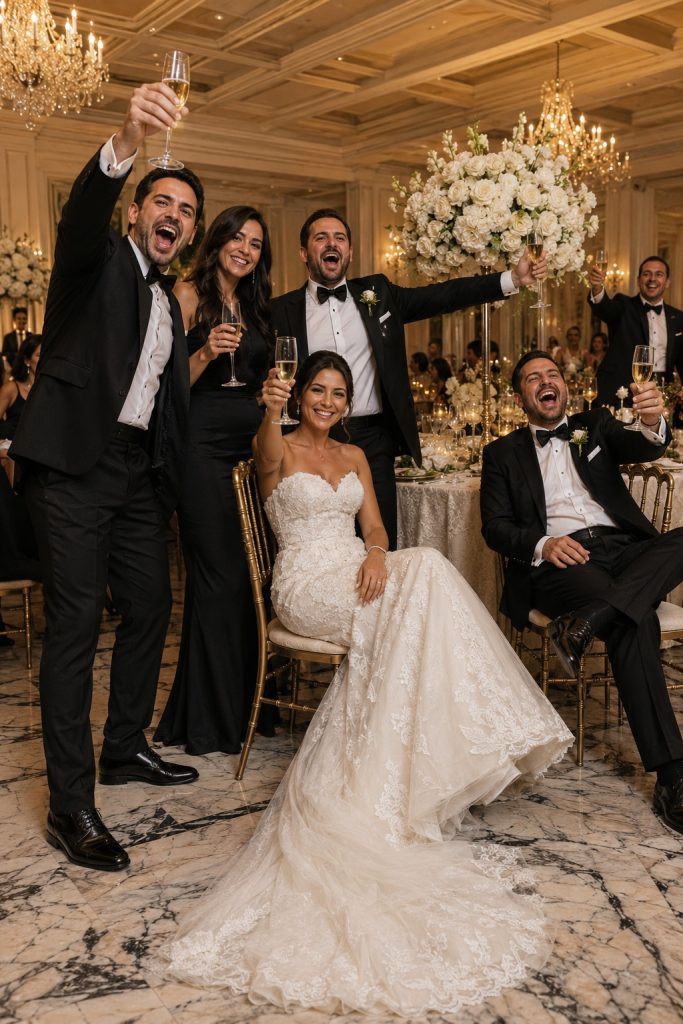
“Some kids make you proud,” William Henry Miller said, raising his glass toward the head table.
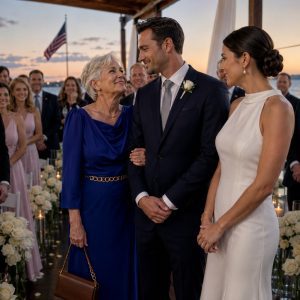
Cara beamed in her white lace, blonde curls perfect, flawless makeup catching the chandelier light. Ethan James Holloway sat beside her, his hand on hers, a nervous smile frozen on his face like he was already uncomfortable but too polite to show it.
“Others just take up space.”
The laughter started like a wave.
Polite at first. Then louder. Easier. People who had never met me before tonight decided it was safer to laugh than to question a powerful man humiliating his own daughter at her sister’s wedding.
I sat at table fourteen. The overflow table. Near the kitchen doors where the servers came through with steam rising off the plates. The chair felt too small. The air felt too thin. The tablecloth was a slightly different shade of white than the others, a detail only someone who had been placed at the wrong table their entire life would notice.
But I did not cry.
That was the part they had not planned for.
For twenty-four years, I had been the daughter who swallowed everything. The one who paid her own tuition while Cara backpacked through Europe on my parents’ credit card. The one who worked double shifts at a diner four blocks from campus and still came home to find her bedroom had been turned into Cara’s walk-in closet. The one who brought home straight A’s and heard, “Good. Now mow the lawn.”
I remembered being twelve years old, sitting at this same dining table in our house on Maple Street, watching my father help Cara with her math homework while I sat across from them with a book I had checked out from the school library. He never asked what I was reading. He never asked if I needed help. I was the child who figured it out. The child who did not demand attention. The child who made parenting look easy, which meant I received none of it.
“You’re so independent,” my mother used to say, like it was a compliment.
It was not a compliment.
It was permission to stop looking at me.
So I sat at table fourteen, holding my champagne glass, and I felt something inside me click closed. Not break. Close. Like a door that had been rattling in the wind for years finally latching shut.
I set the glass down.
The sound it made against the tablecloth was soft. Almost nothing. But somehow the people nearest me heard it anyway. They stopped laughing.
I stood up.
My father’s smile froze. His hand holding the champagne glass did not move. He was still standing at the head table, still wearing that smug expression, but something flickered behind his eyes—a split second of uncertainty, like a predator realizing its prey was not running the right direction.
Beside him, my mother Evelyn touched her pearl necklace, her fingers moving in that nervous habit she had when things were not going according to script. She knew what was coming. She always knew. And she always let it happen anyway.
Cara’s face shifted too. The perfect bride smile faltered for just a moment, her eyes narrowing as she tried to read me across the room. She was calculating, always calculating, always trying to figure out which angle gave her the most light.
I lifted my glass anyway, not to toast him, but to hold it steady while I spoke the sentence I had been saving for six months.
“Good thing I just got my own place two thousand miles away.”
The room went quiet in a way that felt heavier than the laughter. A server dropped a fork somewhere near the kitchen, and the sound echoed like a gunshot.
“Don’t worry,” I said, looking straight at my father. “You’ll never have to watch me take up space again.”
I walked.
Not fast. Not slow. Just steadily, past tables of strangers who had watched me get humiliated and done nothing. Past the bar where a bartender paused mid-pour. Past my mother’s frozen face, her mouth slightly open, her hand still on those pearls. Past Cara’s mouth opening like she wanted to say something but had no words prepared because this was not how the script went.
Ethan looked up as I passed. His eyes met mine for a fraction of a second, and I saw something unexpected there—not pity, not guilt, but something closer to recognition. Like he understood exactly what I was doing and wished he had the courage to do it too.
Then I was through the ballroom doors, into the lobby, where the air was cooler and the music from inside was muffled into something distant and harmless.
The valet brought my car. An old Honda Accord that my father once called embarrassing. I tipped the young man, Leo Markham, whose name I remembered because he was the only person at that entire venue who looked at me with something like respect.
“You okay?” he asked, holding the door open for me.
I almost laughed. A stranger, a valet, asking if I was okay when my own family had just spent the last five minutes publicly humiliating me.
“I will be,” I said.
And I meant it.
I drove home to my small apartment on the south side of town. The one they had never visited. The one I had rented with money I earned myself, from a landlord who had never met my father and therefore had no reason to treat me like an inconvenience.
The apartment was small. A studio with a kitchen counter that doubled as a desk, a bed that folded into the wall, and a window that faced the parking lot of a laundromat. But it was mine. Every square inch of it was paid for with my own labor, my own sacrifice, my own refusal to ask for help I knew would never come.
I sat on the edge of my bed and let the silence settle around me.
My phone buzzed.
Cara had sent a photo from earlier, her smiling with Ethan beneath the floral arch.
Then another message.
You missed the cake.
I stared at it for a long time.
That was Cara.
Her wedding had included a public humiliation of her own sister, and what mattered to her was cake.
I turned the phone face-down on the counter and did not answer.
Because I had spent twenty-four years answering.
Twenty-four years of explaining myself, justifying my existence, apologizing for taking up space.
And I was done.
Two days later, I went back to my parents’ house for the last of my things.
The driveway was empty. My father’s car was gone, which meant he was at the office, which meant my mother would be alone. That was better. Easier. I did not have the energy for another confrontation with William Henry Miller.
I parked on the street, walked up the front path, and used my key for what I knew would be the last time.
The house smelled the same as it always did. Lemon polish and lavender candles, the scent of a home that was always clean because my mother spent her days making sure everything looked perfect while the people inside it fell apart.
She was in the kitchen, standing at the counter with a cup of tea. Her grey-streaked hair was pulled back, her eyes tired, her pearl necklace still around her neck even though it was a Tuesday afternoon.
She looked up when I walked in.
“Sophia.”
“I’m here for my papers,” I said. “My birth certificate. My diploma. The documents I need for the move.”
She set her teacup down slowly, deliberately, like she was buying time to think.
“Your father is very angry.”
“I’m sure he is.”
“He said you embarrassed him in front of everyone.”
I almost laughed. “He embarrassed himself. I just refused to pretend it didn’t hurt.”
My mother’s face softened into that familiar expression—the one that said she understood but could not say it, the one that meant she was on my side in her heart but would never take my side in public.
“Where are you going, really?”
“Portland.”
“Oregon?”
“Yes.”
She blinked. “That’s so far.”
“I know.”
“You don’t have a job there.”
“I do. I got one six days ago. A graphic design studio on the waterfront. The owner, Miles Theodore Grant, hired me after a single interview.”
My mother’s hand went to her pearls again. “You planned this.”
“Yes. For six months.”
She did not say anything for a long moment. She just stood there in her perfect kitchen, in her perfect house, with her perfect pearl necklace, and she looked at me like she was seeing me for the first time in years.
“Your father—”
“I don’t care what my father says anymore.”
The words hung in the air between us, heavy and final.
My mother opened her mouth to speak, then closed it. She looked down at her tea, then back at me, and for a moment I thought she might say something real. Something honest. Something that acknowledged the years of silence, the years of watching me disappear while Cara took up all the light.
But she did not.
“Your papers are in the desk in the study,” she said. “Top drawer on the left.”
I nodded, turned, and walked down the hall.
The study smelled like my father’s cologne, expensive and sharp, the same scent he had worn for as long as I could remember. The desk was mahogany, polished to a mirror shine, with a leather blotter and a silver pen set that had never been used.
I opened the top drawer on the left.
My birth certificate was there, tucked inside a manila folder with my name written on the tab in my mother’s handwriting. My diploma was underneath it, still in its frame, the gold tassel pressed flat against the cardboard.
I took them both.
Then I saw something else in the drawer.
A piece of paper folded in half, with the words “TRUST — GRANDMOTHER MILLER” written across the top in my father’s handwriting.
I did not open it.
I should have.
But I was tired. Tired of fighting, tired of digging, tired of finding more evidence of how little I mattered in this house.
I closed the drawer and walked out.
My mother was still in the kitchen, still holding her tea, still wearing that same tired expression.
“I’m leaving now,” I said.
“Sophia—”
“I’m not coming back, Mom.”
Her eyes glistened. Whether it was real grief or guilt or just the exhaustion of maintaining a lie for twenty-four years, I could not tell.
“I know,” she said.
And that was it.
No hug. No apology. No last-minute confession that she had always loved me more than she showed.
Just two words. I know.
I walked out the front door, got in my car, and drove away.
I did not look back.
The drive to Portland took four days.
I did it alone, in my Honda Accord packed to the ceiling with everything I owned. Clothes in garbage bags. Books in milk crates. A lamp my grandmother gave me before she died, the one with the stained glass shade that cast colored light across the walls of every room I had ever lived in.
The signed lease for the Portland studio sat in the glove compartment like a promise I kept touching to make sure it was real.
I stopped at a motel in Nebraska on the first night. The room smelled like bleach and old carpet, and the air conditioner rattled every time it turned on. I sat on the edge of the bed with my phone in my hand, staring at the messages I had not answered.
Cara had sent twelve texts since the wedding.
The first few were angry.
How could you do this to me.
You ruined my special day.
Everyone is talking about you.
Then they shifted. Concerned.
Are you okay.
Mom is worried.
Just come home and we can talk.
Then desperate.
Please, Sophia. I didn’t mean for it to happen that way. Dad just gets carried away sometimes. You know how he is.
I did know how he was.
But I also knew something Cara did not know I knew.
The night before the wedding, I had come back to my parents’ house to pick up a dress I had left in my old closet. I had parked on the street instead of the driveway, and I had walked around the side of the house to the back door because the front lock was broken.
That was when I heard them.
My father’s voice, low and amused, coming through the kitchen window.
“Just wait until tomorrow night,” he said. “I have something special planned for the toast.”
Cara’s laugh followed. Light. Giddy.
“Don’t make it too obvious,” she said. “You want everyone to laugh, not feel sorry for her.”
“Trust me,” my father said. “I know exactly what to say.”
I had stood there in the dark, my hand on the back door handle, and I had listened to them rehearse.
Not a joke.
Not a spontaneous moment.
A performance.
They had written the lines together. Practiced the timing. Chosen the exact words that would cut the deepest.
Some kids make you proud.
Others just take up space.
And then they had laughed about it, clinking their glasses in the kitchen while I stood outside in the cold, finally understanding that the cruelty was not accidental.
It was deliberate.
It was choreographed.
It was the point.
So when Cara’s texts turned desperate, I did not answer.
Because I knew what she was really asking.
She was not asking me to come home.
She was asking me to pretend the performance had not happened.
And I was done pretending.
I arrived in Portland on a Tuesday afternoon.
The studio was on the top floor of an old building downtown, the kind of place with exposed brick and windows that faced the river. The elevator was slow and creaked on every floor, and the hallway smelled like coffee from the café downstairs.
But when I opened the door to my studio, I forgot all of that.
The room was small. Barely three hundred square feet. A bed in one corner, a kitchen counter that doubled as a desk, a closet that was really just a curtain over a hole in the wall. But the windows.
The windows were floor-to-ceiling, facing west, with the Willamette River glittering in the afternoon light and the city stretching out in every direction like a map of all the places I had never been.
I stood in the middle of the empty room with my duffel bag at my feet and I let myself feel the weight of what I had done.
No safety net.
No backup plan.
No family calling to check if I had arrived safely.
Just me. A lease. A job that started in two weeks. And two thousand miles of distance between me and the people who had spent my whole life making me feel like I was not enough.
I unpacked slowly.
The sheets I had bought at a thrift store in Indiana. The single pot I had packed in the trunk. The framed photo of my grandmother, the only person in my family who had ever looked at me like I mattered.
I set it on the windowsill and called the only number that felt safe.
Miles Theodore Grant picked up on the second ring.
“Sophia,” he said. “Tell me you made it.”
“I made it,” I said.
The owner of the studio in Portland. The man who had hired me after a single interview, who had trusted me enough to send the lease before I even had a plane ticket. He did not know my family. He did not know my history. He only knew my work, and that was enough.
“Good,” he said. “The studio is yours. Take the week to settle in. We start June first.”
June first.
I repeated the date to myself like a prayer.
Twenty-four years old, starting over in a city where nobody knew my name.
And for the first time in my life, that felt like freedom, not loneliness.
I hung up and stood by the window, watching the river move slow and steady beneath the bridges.
My phone buzzed again.
Another text from Cara.
This time, a photo.
A picture of my mother, sitting at the kitchen table, her face in her hands.
The caption read: She can’t stop crying. Is this really what you want?
I looked at the photo for a long time.
Then I looked at my grandmother’s picture, the one with the stained glass lamp casting colored light across her face.
And I made a decision.
I did not answer Cara.
I turned my phone off, set it on the counter, and walked to the window.
The city was waiting for me.
And for the first time in my life, I was ready to meet it.
The first week in Portland passed like a single long breath.
I woke early every morning, before the sun cleared the buildings, and I sat on the fire escape with coffee in a chipped mug I had found at a thrift store. The city was quiet at that hour. Just the hum of a delivery truck, the hiss of a bus braking at the corner, the distant clatter of the espresso machine starting up in the café below.
I did not check my phone.
I did not call anyone.
I let the silence settle into my bones like a language I was learning for the first time.
By the end of the first week, I had unpacked everything. The studio looked lived in now. A bed with sheets I had washed twice because the thrift store smell lingered. A small desk beneath the window where I had stacked my notebooks and laptop. A single plant I bought from a corner market because the woman at the register said it was impossible to kill, and I liked the sound of that.
I called Miles Theodore Grant on the Friday before my start date.
“I’m ready,” I said.
“Good,” he said. “Because I have something for you.”
The studio he owned was in the Pearl District, a converted warehouse with high ceilings and the smell of sawdust and ink. Miles was forty-one years old, with grey threading through his dark hair and the calm, steady voice of someone who had built his life from nothing.
He met me at the door with a key in his hand.
“Your first project,” he said, handing me a folder.
Inside was a proposal for a photography exhibition. A local artist’s first solo show. Everything from the lighting design to the promotional materials was outlined in careful detail.
“Your job is to make it happen,” Miles said. “Budget, timeline, vendors. All of it.”
I looked at the folder in my hands.
“Why me?”
Miles studied me for a moment.
“Because you showed up,” he said. “That’s more than most people do.”
I spent the next two weeks learning the rhythm of Portland.
The mornings were for planning. The afternoons for meetings with printers, framers, lighting technicians. The evenings for walking the city, learning its streets, its corners, the way the light fell across the river at sunset.
I met Nora Beth Collins at a coffee shop on the third week.
She was thirty-three, a wedding photographer who had moved to Portland from Chicago two years before me. We started talking because she was reading a book I had loved in college, and by the time our coffees were empty, we had exchanged numbers.
“You’re new here,” she said. “I can tell.”
“Is it that obvious?”
“You still look around when you cross the street,” she said. “That stops after about six months.”
I laughed, and it surprised me. The sound felt unfamiliar, like a muscle I had not used in years.
Nora became my first real friend in Portland.
She showed me the best food carts, the hidden parks, the spots along the river where you could sit and watch the herons fish. She did not ask about my family. She did not ask why I had moved. She just let me exist in her presence, and that was more than anyone had given me in years.
“You seem like you’re carrying something heavy,” she said one evening, as we sat on a bench overlooking the water.
I considered lying.
“I am,” I said.
“Does it get lighter here?”
I thought about the fire escape. The morning coffee. The quiet.
“Yeah,” I said. “It does.”
The exhibition launched on the third Saturday of June.
The gallery was full. Artists, collectors, critics, strangers who had wandered in off the street. The walls were covered in photographs that felt alive, each one a window into someone else’s world.
I stood near the entrance, watching people move through the space. They were looking at the art. They were talking about the art. They were asking questions that showed they cared.
And I had helped build this.
I had found the framer who understood the artist’s vision. I had negotiated the rental price for the lighting equipment. I had written the press release that brought the local paper to review the show.
This was mine.
This was real.
My phone buzzed in my pocket.
I looked down.
Cara.
Again.
She had been texting every few days, the messages growing shorter, more demanding.
*Mom is in the hospital.*
*She asked for you.*
*You’re really going to ignore her?*
I stared at the screen.
Then I put the phone back in my pocket.
I did not reply.
But the guilt crept in anyway, quiet and familiar, like a draft under a door I thought I had sealed shut.
I excused myself to the bathroom and stood in front of the mirror, gripping the sink.
“Stay,” I whispered to myself.
The word felt like a prayer.
The next morning, I got a call from Sean Patrick O’Malley.
The HR manager who had hired me six days before the wedding. The man who had trusted me with a job before I had even moved.
“Sophia,” he said. “I need to talk to you about something.”
My stomach tightened.
“Is something wrong?”
“No,” he said. “But I want you to come to my office. Today, if you can.”
I went.
His office was on the second floor of the warehouse, a small room with a window that faced the street. Sean was forty-one, with a kind face and a habit of tapping his pen against his desk when he was thinking.
He closed the door behind me.
“I got a call this morning,” he said. “From a woman named Patricia Anne Huxley.”
The name did not register immediately.
“She said she’s a wedding planner,” Sean continued. “She said she worked on your sister’s wedding.”
I felt the air change.
“She wanted to know if you were employed here. She asked about your start date. She asked about your salary.”
I sat down slowly.
“What did you tell her?”
“I told her I couldn’t share that information,” Sean said. “But I wanted you to know. Because I don’t think she was calling for a reference.”
Patricia Anne Huxley.
The wedding planner.
The woman who had stood beside my mother at the ballroom, nodding as the toast was delivered.
She was calling my employer.
Checking on me.
Reporting back.
I thanked Sean and walked out of his office with my hands shaking.
I knew what this meant.
Cara was not just texting me.
She was tracking me.
She was sending people to find out where I was, what I was doing, how I was surviving.
She wanted to know if I was struggling.
She wanted to know if I had failed.
And when I did not answer her messages, she sent someone to check.
I sat on the fire escape that evening, watching the city lights flicker to life, and I felt the old anger stirring again.
But beneath it, something else.
A cold clarity.
They were scared.
Not of me.
Of what I might become without them.
And that thought, strange and unfamiliar, felt almost like power.
The second exhibition launched in August.
This time, I was the one who found the artist. A photographer named Leo Markham—the same young man who had been the valet at the wedding.
I had not recognized him when he walked into the gallery with his portfolio. But he recognized me.
“Sophia?” he said, his eyes widening. “From the ballroom?”
I stared at him.
“Leo,” I said. “You were the valet.”
“Yeah,” he said, shifting his weight. “I, uh, I remember you. You tipped me twenty bucks and told me to keep the change.”
I had not remembered that.
“I moved out here a few weeks after that,” he said. “I’ve been shooting street photography ever since.”
He opened his portfolio.
The images were raw. Honest. Full of light and shadow and the quiet dignity of people living ordinary lives.
“These are incredible,” I said.
“Yeah?”
“Yeah.”
I showed his work to Miles. He agreed immediately.
“We’ll do a show in October,” he said.
The night of Leo’s exhibition, the gallery was packed.
His photographs lined the walls, each one telling a story I had not known I needed to hear.
I stood near the back, watching people stop in front of his images, their faces changing as they recognized something of themselves in the frame.
Leo found me during a break.
“I wanted to thank you,” he said. “For giving me a chance.”
“You earned it,” I said.
He hesitated.
“I also wanted to tell you something.”
I waited.
“After you left the wedding that night,” he said, “I heard your father talking to the wedding planner. Patricia Anne Huxley.”
The name made my chest tighten.
“He was laughing,” Leo said. “He said, ‘She’ll be back. They always come back. They don’t have anywhere else to go.'”
The words landed like stones.
“And then your sister walked over,” Leo continued. “And she said, ‘Make sure the photographer got a good shot of the toast. I want to remember her face.'”
I stood very still.
They had planned the humiliation.
They had documented it.
They had preserved it.
Not as a mistake.
As a trophy.
“How do you know all this?” I asked.
“Because I was standing right there,” Leo said. “They didn’t think I was listening. Valets are invisible.”
I looked at him, this young man who had been invisible at the same event where I had been humiliated.
And I realized something.
I was not invisible anymore.
And neither was he.
“Thank you,” I said. “For telling me.”
He nodded.
“I figured you should know,” he said. “Before you decided whether to go back.”
I shook my head.
“I’m not going back.”
He smiled.
“Good,” he said. “Neither am I.”
October turned into November.
The city grew cold and grey, the rain settling in like a permanent guest. I bought a heavier coat. I learned to carry an umbrella everywhere. I discovered that Portland in the rain was still beautiful, just quieter, like the whole city was holding its breath.
I had been gone for six months.
Six months since the wedding.
Six months since I had walked out of that ballroom.
And in that time, I had built something.
A career. A community. A life.
I had friends now. Real ones. Nora, who called me every Sunday to check in. Leo, who stopped by the gallery with prints he wanted my opinion on. Miles, who trusted me with projects that mattered.
I had a routine. Coffee on the fire escape. Work at the gallery. Evening walks along the river. Dinner with friends at food carts where nobody knew my name.
I had peace.
But peace, I was learning, was fragile.
Because on the first Tuesday of November, my phone rang.
The number was not saved.
But I recognized it anyway.
The area code was Indiana.
I let it ring.
It rang again.
Then a voicemail notification appeared.
I stared at the screen for a long time.
Then I pressed play.
“Sophia. It’s your mother.”
Evelyn Rose Miller’s voice was tired. Older than I remembered.
“I know you don’t want to talk to me. I know you’re angry. But there’s something you need to know. About the wedding. About the money.”
She paused.
“Your father didn’t pay for Cara’s wedding with savings. He borrowed against the trust fund your grandmother left for you. The one you were supposed to get when you turned twenty-five.”
My hand froze.
“Every dollar of that wedding came from your inheritance, Sophia. The dress. The venue. The flowers. The honeymoon. He took it all. And he told me not to tell you.”
I replayed the message.
Then I replayed it again.
The trust fund my grandmother left me.
The woman who had looked at me like I mattered.
The only person in my family who had ever seen me.
And my father had stolen it.
Not borrowed. Stolen.
To pay for the wedding where they humiliated me.
To finance the party they threw while I sat at the overflow table.
To buy the laughter that had filled that ballroom while I walked out alone.
I sat on the fire escape with the voicemail still playing, and I felt something shift inside me.
Not anger.
Not sadness.
Clarity.
They had taken everything. My childhood. My place in the family. My inheritance.
But they had not taken my future.
That was still mine.
And I was never going back.
I called Nora.
“I need to tell you something,” I said.
“Tell me.”
I told her everything. The wedding. The toast. The plan my father and sister had rehearsed. The trust fund my grandmother left me. The money my father stole to pay for the wedding. The voicemail from my mother.
When I finished, Nora was quiet for a long moment.
“Sophia,” she said. “That’s theft.”
“I know.”
“You could go after him.”
“I know.”
“Are you going to?”
I looked out at the city, the lights reflecting off the river, the bridges arching into the dark.
“No,” I said. “Because if I go after him, I have to go back. I have to sit in a courtroom in Indiana. I have to look at his face. I have to let him explain himself.”
I paused.
“And he would find a way to make it my fault.”
Nora sighed.
“He would try,” she said. “But that doesn’t mean he’d be right.”
“I know,” I said. “But I don’t need to win a case against him. I need to win my life.”
She was quiet again.
“Then win it,” she said. “And let the silence be your revenge.”
I hung up and sat on the fire escape for a long time.
The rain had stopped. The clouds were breaking apart, revealing stars I had not seen in months.
And for the first time since the wedding, I smiled.
Not because I was happy.
But because I was free.
The call came two days later.
I was at the gallery, hanging new prints for an upcoming show, when my phone buzzed.
Cara.
This time, I answered.
“Sophia.”
Her voice was sharp. Angry.
“Did you get Mom’s message?”
“I did.”
“And you’re not going to say anything?”
I set down the print I was holding.
“What do you want me to say, Cara?”
“I want you to say you’re coming home. I want you to say you’re going to forgive Dad. I want you to stop pretending you’re better than us.”
I leaned against the wall.
“I’m not pretending,” I said. “I am better.”
The silence on the other end was thick.
“You think you’re so special,” Cara said. “Moving to Portland. Getting a fancy job. Making new friends. You think that makes you better than us?”
“I think it makes me happier,” I said. “And I think that scares you.”
“Don’t flatter yourself.”
“Then why are you calling?”
She did not answer.
“You called me, Cara. You’ve been calling me for six months. You sent the wedding planner to my job. You left voicemails pretending Mom was sick. You’ve been trying to pull me back into your orbit since the moment I left.”
I took a breath.
“And I think it’s because you know I was right to leave. And you’re terrified that I’m going to be okay. Because if I can be okay without you, then everything you told yourself about me being the weak one falls apart.”
She was silent.
And in that silence, I heard the truth.
“Goodbye, Cara.”
I hung up.
And this time, when my phone buzzed again, I did not look at it.
I just kept hanging the prints.
The show opened that weekend.
The gallery was full. People moved through the space, their voices low and warm, the art glowing under the soft lights.
I stood near the entrance, watching.
Miles came up beside me.
“Good crowd,” he said.
“Yeah.”
He looked at me.
“You okay?”
I thought about the voicemail. The phone call. The inheritance. The theft.
“I am,” I said.
And I meant it.
Because standing in that gallery, surrounded by beauty I had helped create, surrounded by people who saw me, I understood something I had never understood before.
My family had spent twenty-four years teaching me that I was not enough.
But they were wrong.
I had always been enough.
I just needed to get two thousand miles away to see it.
The gallery settled into a comfortable rhythm around me, the clink of wine glasses and the murmur of art lovers filling the space like a heartbeat. I let myself breathe.
But I knew it was not over.
Cara did not give up. She never did. She needed the last word the way she needed attention, the way she needed my parents to look at her, the way she needed me to stay small so she could feel big.
The text came three days later.
Not from Cara. From my mother.
*I need to see you. Please.*
I stared at the screen for a long time.
My mother had never asked to see me before. She had never asked anything of me. She had only ever asked me to be quiet, to be patient, to be invisible.
But now she was asking.
And I was not the same person who had sat at table fourteen.
I flew back to Indiana on a Thursday.
Not because I wanted to. Because I needed to close the door properly. Because the voicemail she had left, the one about the trust fund, had cracked something open inside me that I could not ignore.
My mother met me at a coffee shop near the old house.
She looked smaller than I remembered. The grey in her hair had spread, and her hands trembled slightly as she lifted her cup.
“Thank you for coming,” she said.
I sat across from her.
“Why now?”
She set the cup down.
“Because I’m tired of being a coward.”
I waited.
“Your father,” she said, “took your grandmother’s money. I knew about it. I didn’t stop him.”
“I know.”
Her eyes filled.
“I told myself it was easier to let him have his way. I told myself you would be fine. You were always so strong, Sophia. You never needed me.”
I felt something twist in my chest.
“Strength wasn’t a choice,” I said. “It was survival.”
She nodded slowly.
“I know. And I failed you.”
She reached into her bag and pulled out an envelope.
“I’ve been saving,” she said. “A little at a time. From the grocery money, from the household account. I have twelve thousand dollars here.”
She pushed it across the table.
“It’s not everything he took. But it’s what I could do.”
I looked at the envelope.
Then I pushed it back.
“I don’t want your money, Mom.”
“Sophia—”
“I don’t want anything from that house. I don’t want anything from him. I don’t want anything from you that cost you your voice.”
She stared at me.
“What I want,” I said, “is for you to look at me and see me. Not the daughter who didn’t need you. The daughter who needed you anyway.”
She started crying.
Not the polite tears she used at weddings. Real crying. The kind that came from somewhere deep.
“I see you,” she whispered. “I’m so sorry I didn’t see you before.”
I reached across the table and took her hand.
“I forgive you,” I said. “But I’m not coming back.”
She nodded.
“I know.”
I let her hand go.
“Take the money,” I said. “Use it for yourself. Leave him. Stay. Do whatever you need to do. But don’t give it to me. I don’t owe him anything, and I won’t take a bribe for silence.”
She looked at the envelope, then back at me.
“I’m proud of you,” she said.
The words landed like a weight I had been carrying my whole life.
“Thank you,” I said.
And I meant it.
I flew back to Portland that night.
The city looked different from the air. Smaller. More contained. Like something I could hold in my hands.
I took a taxi to my studio, climbed the stairs, and stood in the middle of the room.
The envelope from my mother sat in my bag, untouched.
I had not taken the money.
But I had taken something else.
Her apology.
Her admission.
Her recognition.
And that was worth more than any inheritance.
The next morning, I called Sean Patrick O’Malley, the HR manager who had hired me.
“Sean,” I said. “I need to ask you something.”
“Shoot.”
“Can I change my emergency contact?”
He laughed.
“You can change it to whoever you want.”
I smiled.
“Good. I’m putting down Nora.”
“Nora Beth Collins?”
“Yeah.”
“Done.”
I hung up and stared at the phone.
No more parents. No more sister. No more ties to Indiana.
Just me.
And Nora.
And the life I was building.
The weeks passed.
I settled into the job. I learned the rhythm of the gallery. I made coffee for artists and listened to their stories. I hung prints and adjusted lights and learned the names of regulars who stopped by on their lunch breaks.
It was simple.
It was small.
It was mine.
One evening, I was closing up the gallery when my phone buzzed.
An unknown number.
I almost ignored it.
But something made me pick up.
“Sophia?”
The voice was male. Hesitant.
“Who is this?”
“It’s Ethan.”
Cara’s husband.
I had not spoken to him since the wedding. He had sat at the head table, uncomfortable, watching the toast unfold like a car crash he could not stop.
“Why are you calling?”
He sighed.
“Because I need to tell you something.”
“Go ahead.”
“Cara is pregnant.”
I sat down.
“And she wants me to ask you to come back. She wants you to be the godmother. She thinks it will fix everything.”
I closed my eyes.
“Ethan.”
“Yeah?”
“You’re a good person. You married into a family that doesn’t deserve you. And I’m sorry for what you’re about to go through.”
He was quiet.
“But I’m not coming back. Not for a baby. Not for a reconciliation. Not for anything.”
“I know,” he said. “I told her you would say that.”
“Then why did you call?”
“Because I wanted you to know that I understand. I saw the way they treated you at the wedding. I saw the way you walked out. And I think you did the right thing.”
I felt something warm in my chest.
“Thank you, Ethan.”
“Take care of yourself, Sophia.”
“You too.”
I hung up.
The gallery was quiet around me, the last light of evening streaming through the windows.
I finished closing up, walked home through the streets of Portland, and climbed the fire escape to my studio.
The city glittered below me, alive and indifferent.
Cara was pregnant.
My father was still furious.
My mother was trying.
And I was here.
Two thousand miles away.
Alive.
Free.
I sat on the fire escape until the stars came out.
And I thought about my grandmother.
The woman who had left me the trust fund.
The woman who had seen me when no one else did.
She had died when I was nineteen. Cancer. Quick and brutal. I had sat by her bed in the hospital, holding her hand, while she told me stories about her own childhood.
“You’re like me,” she had said. “You see things the way they are, not the way people want you to see them.”
I had nodded.
“Don’t let them change that, Sophia. Don’t let them make you small.”
I had promised her I would not.
And I had kept that promise.
Even when it cost me everything.
The trust fund was gone.
But her words were not.
And those words were worth more than any amount of money.
I pulled out my phone and opened the voicemail from my mother one more time.
I listened to her voice crack as she told me about the theft.
Then I deleted it.
Not because I was angry.
Because I was done carrying it.
The weight of their choices was theirs, not mine.
And I was finally light enough to fly.
I stood up, climbed back through the window into my studio, and looked around the small space.
The bed in the corner. The kitchen counter. The framed photo of my grandmother on the windowsill.
It was not much.
But it was mine.
And I had built it with my own hands.
I picked up the photo of my grandmother and held it for a moment.
“I did it,” I whispered. “I made it out.”
The photo did not answer.
But I felt her anyway.
The next morning, I woke up early and walked to the gallery.
The streets were quiet, the air cool and clean.
I unlocked the door, turned on the lights, and stood in the middle of the empty space.
The new show was opening in two weeks.
Prints to hang. Frames to adjust. Lighting to perfect.
I had work to do.
And for the first time in my life, I was excited to do it.
I thought about the past.
The wedding. The toast. The walk out.
The drive to Portland. The motel in Nebraska. The phone calls.
The voicemail. The trust fund. The theft.
I thought about Cara, pregnant and desperate for control.
I thought about my father, furious and alone.
I thought about my mother, finally seeing me.
And I thought about my grandmother, whose love had outlasted her life.
They had taken her money.
But they could not take her legacy.
Because her legacy was me.
And I was still standing.
I grabbed a print from the stack and carried it to the wall.
The gallery was quiet.
The city was waking up outside.
And I was exactly where I was supposed to be.
The day of the new show arrived.
The gallery filled with people. Artists, collectors, strangers who had walked in off the street. Wine glasses clinked. Conversations hummed. The prints glowed under the soft lights.
I stood near the entrance, watching.
Miles came up beside me.
“Good crowd,” he said.
“Yeah.”
He looked at me.
“You seem different tonight.”
“I am different.”
He smiled.
“Good different?”
“The best different.”
He nodded.
“Welcome to Portland, Sophia.”
I smiled.
“Thanks. I think I’ll stay.”
He laughed and walked away.
I stayed by the entrance, watching the crowd.
Then I saw her.
Nora Beth Collins.
My photographer. The only person from that wedding who had looked at me like I mattered.
She walked through the door, her camera bag slung over her shoulder, her face breaking into a smile when she saw me.
“You made it,” I said.
“Of course I made it. I wouldn’t miss this.”
We hugged.
“You look good, Sophia.”
“I feel good.”
She looked around the gallery.
“This is beautiful.”
“Thank you.”
She turned to me.
“Have you heard from them?”
“Cara called. My mom called. My dad texted.”
“What did he say?”
I pulled out my phone and showed her.
*You’re dead to me.*
Nora stared at the screen.
“Wow.”
“Yeah.”
“Did you block him?”
“First thing.”
She smiled.
“Good.”
She looked at me.
“Are you okay?”
I looked around the gallery. At the prints. At the people. At the city outside the windows.
“I am,” I said. “I really am.”
Nora raised an imaginary glass.
“To new beginnings.”
I raised mine.
“To Portland.”
We clinked.
And I felt the last weight lift off my shoulders.
The show ended at ten.
The guests trickled out, their voices fading into the night.
Miles locked the door and turned to me.
“Good work tonight, Sophia.”
“Thanks, Miles.”
“Get some rest. You’ve earned it.”
I nodded.
He left.
I stood alone in the gallery.
The lights were dim. The prints were still.
I walked through the space slowly, looking at each piece.
They were not my work.
But they were part of my story now.
I stopped at a print near the back.
A photograph of a woman standing on a fire escape, looking out at a city skyline.
It had been taken by a local artist, a woman named Elena.
I had hung it myself.
And I had not realized until now how much it looked like me.
I stared at it for a long moment.
Then I turned off the lights and walked home.
The streets were quiet.
The air was cool.
I climbed the stairs to my studio, opened the window, and stepped onto the fire escape.
The city spread out before me, glittering and alive.
I sat down and looked up at the stars.
They were the same stars I had seen in Indiana.
But they looked different here.
Brighter.
Closer.
Like they were mine.
I pulled out my phone and opened the messages.
Cara. Blocked.
William. Blocked.
Evelyn. Not blocked. But quiet.
I scrolled to my grandmother’s old contact.
The one I had never deleted.
I stared at her name for a moment.
Then I closed the phone and set it down.
I did not need to call her.
She was already with me.
The wind picked up, carrying the smell of rain.
I leaned back and closed my eyes.
I thought about the wedding.
The toast.
The walk out.
I thought about the fear.
The loneliness.
The doubt.
I thought about the drive to Portland.
The motel in Nebraska.
The first night in my studio.
I thought about the voicemail.
The trust fund.
The theft.
And I thought about this moment.
Right now.
On this fire escape.
In this city.
Alive.
Free.
Mine.
I opened my eyes and looked out at Portland.
The lights flickered.
The river glittered.
And somewhere in the distance, a train whistled, carrying someone else toward their own new beginning.
I smiled.
And I let the silence be my answer.
*The end.*