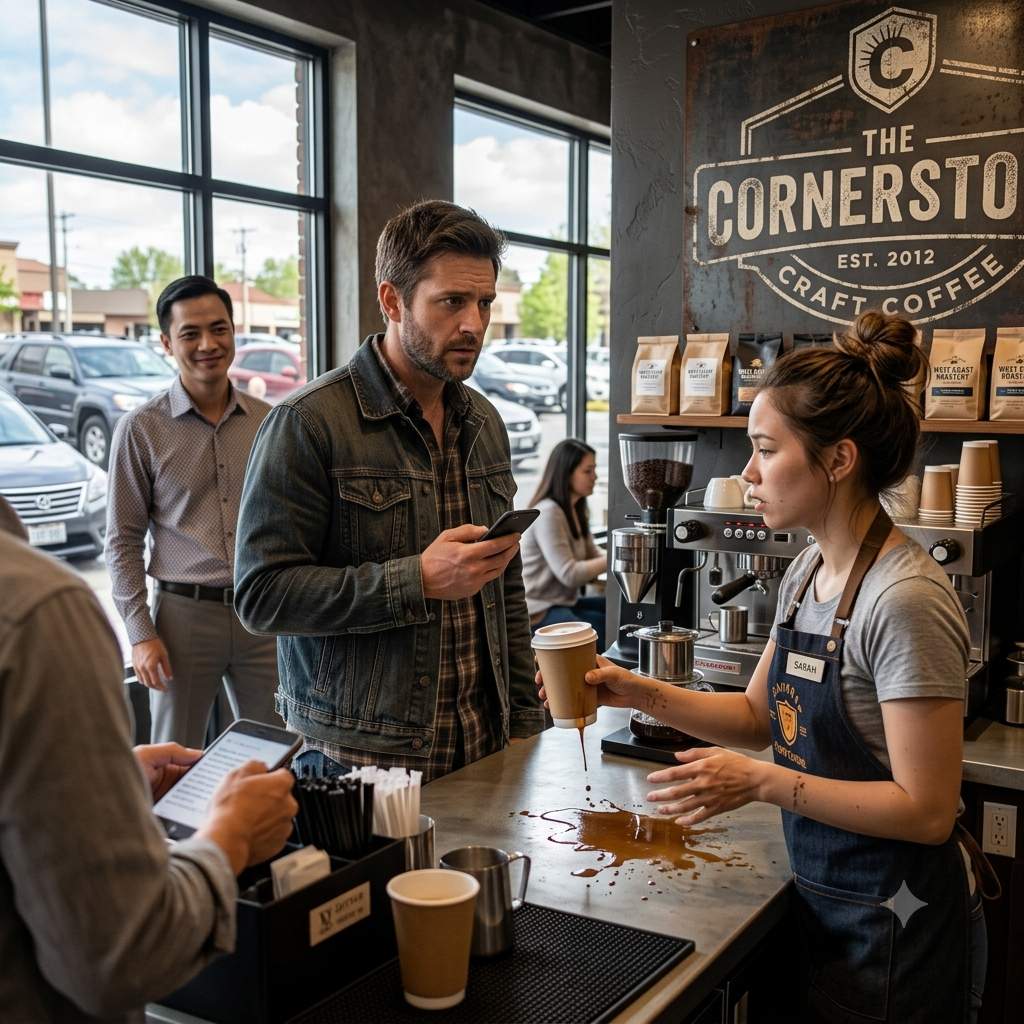
I was about to tell her it was fine when I noticed her eyes weren’t on me, but on someone behind me in line. I turned and saw a man standing too close to the person in front of him, his gaze locked on the barista with an intensity that made my stomach turn. He was maybe 35, dressed in business casual, holding his phone up in a way that suggested he was recording her.
When our eyes met, he didn’t look away or seem embarrassed. He smiled. The barista, whose name tag read Vanessa, handed me my coffee with a whispered, “Thank you.” that sounded more desperate than polite.
I took the cup and moved toward the door, but something about the fear in her voice stopped me. I’d seen that kind of fear before in my younger sister when her ex-boyfriend wouldn’t accept their breakup. I’d seen it in my mother when my father’s anger issues escalated before she finally left him.
I recognized it and I couldn’t walk away from it. I stepped aside near the condiment station and watched. The man ordered a black coffee and spent the entire transaction staring at Vanessa in a way that felt predatory.
When she handed him his cup, he said loud enough for several customers to hear, “Same time tomorrow, Vanessa. I’ll be counting the hours until I see you again.” Vanessa’s face went pale. She nodded quickly and turned to the next customer, but I could see her hands were shaking worse now.
The man left, glancing back twice at her before exiting onto the street. I should have minded my own business, but instead I approached the counter when there was a brief lull in customers. Vanessa looked up at me with obvious anxiety, probably thinking I was going to complain about something.
I kept my voice low and asked if she was okay, if that man was bothering her. Her eyes filled with tears instantly, and she glanced around to make sure her manager wasn’t nearby before nodding. She said he’d been coming in every single day for 6 weeks, always at the same time, always ordering the same thing, always staring at her and making comments about how beautiful she was and how they were meant to be together.
She’d asked him to stop, told him she wasn’t interested, and he’d responded by showing up more frequently by waiting for her outside after her shifts by following her to her car. She said she’d reported it to her manager who’d banned him from the store, but he kept coming back anyway. She’d filed a police report twice, and both times they’d said they couldn’t do anything unless he made an explicit threat or physically touched her.
Everything else was just free speech and public spaces. She was terrified. I asked if she was here now because she had to work or because she was afraid not showing up would make things worse.
Vanessa said both. Her manager had been sympathetic at first, but after the second police report went nowhere, the manager had started acting annoyed by the disruption and suggested maybe Vanessa was misinterpreting friendly behavior, that maybe she should just accept the compliments and be flattered. I felt anger rising in my chest at that response, at the dismissal of her obvious fear, at the implication that she should just tolerate harassment because some man decided she was his obsession.
I told Vanessa my name was Colin and asked if she’d be comfortable with me sitting in the coffee shop for a while to see if he came back. She looked surprised and asked why I would do that. And I said because someone should because the system that was supposed to protect her was failing and maybe a visible male presence would deter him.
She hesitated then said he usually came back around 4 hours when her shift ended. Watching from across the street as she closed up. It was currently 2:30.
I told her I’d be back at 3:45. She started to protest saying I didn’t have to do that but I could see the relief in her eyes. I asked for her phone number in case I needed to reach her and she gave it to me.
Then I left to run my actual errands, all the while thinking about what I was getting myself into. I came back at 3:45 as promised and took a seat near the window with a clear view of the street. Vanessa was wiping down tables and shot me a grateful look when I walked in.
At 3:58, the man appeared across the street, leaning against a lamp post with his phone out, clearly photographing or filming the coffee shop. When Vanessa’s shift ended at 15, she grabbed her bag and walked toward the door with visible reluctance. I stood up and intercepted her, saying loud enough for other customers to hear, “Ready to go, honey?
I can drive if you’re tired.” Vanessa’s eyes widened in confusion. Then, understanding, she nodded and said, “Yeah, that would be great.” I put my arm around her shoulders in what I hoped looked like a natural gesture between partners and walked her out. The man across the street straightened up, his phone still raised.
When we reached the sidewalk, I kept my arm around Vanessa and guided her toward my car parked a block away. I could feel the man’s eyes on us. Could sense him following at a distance.
When we reached my car, I opened the passenger door for Vanessa and made a point of kissing her forehead before she got in. A clear signal to anyone watching that she wasn’t alone, that she was claimed, that pursuing her would mean dealing with someone else. I saw the man stop walking about 50 ft away, his expression shifting from confident interest to frustrated confusion.
I drove Vanessa to her apartment building and asked if she felt safe going inside alone. She said yes. The building required key card access, and she didn’t think he knew where she lived yet.
The word yet hung heavy in the e air between us. She thanked me profusely for what I’d done, said she couldn’t believe a stranger would go out of his way to help her when people she actually knew had dismissed her concerns. I told her to text me if she saw him again, that I’d be happy to play the protective boyfriend role as many times as needed until he got the message and moved on.
Vanessa hesitated, then asked why I was doing this, what I wanted in return. The question made me sad that she’d been conditioned to expect every man who helped her wanted something from her. I said I didn’t want anything except for her to be safe.
That my sister had been stalked by an ex, and I knew how terrifying it was, how helpless you felt when the system couldn’t or wouldn’t help. Vanessa started crying in my passenger seat. Months of fear and stress finally breaking through.
I handed her tissues from my glove compartment and waited until she composed herself. She said the man’s name was Derek Hollis, that he was a real estate agent who’d come into the coffee shop one day and decided she was his soulmate based on a single transaction. She’d looked him up online after the stalking started and found his business page, his social media showing a carefully curated life that looked normal on the surface.
The next day, Vanessa texted me that Dererick had shown up at the coffee shop again during her shift. I was in a meeting at my marketing firm, but told her I’d be there when she got off work. My colleague noticed me checking my phone repeatedly and asked if everything was okay.
I said a friend was dealing with a stalker, and I was helping however I could. My colleague, a woman named Iris, who’d worked with me for 3 years, immediately said she’d experienced similar harassment at a previous job and the company had done nothing about it until the man physically assaulted her in the parking lot. She said even then HR had suggested she was partially responsible for encouraging his attention by being friendly to customers.
The story made me even more determined to help Vanessa. I left work at 3:30 and arrived at the coffee shop by 4. Dererick was already across the street in his usual spot, phone in hand.
===== PART 2 =====
When Vanessa finished her shift, I was waiting inside. This time I took her hand and kissed her on the mouth. Brief but visible to anyone watching.
I felt her tense in surprise, then relaxed into it. When we pulled apart, I said quietly, “Sorry, had to make it convincing.” She whispered back, “Thank you.” We walked to my car hand in hand, and I noticed Dererick following us on the opposite sidewalk, no longer bothering to hide. When I opened the car door for Vanessa, Dererick shouted across the street, “Who the hell are you?” I turned to face him directly.
He’d crossed the street and was standing maybe 20 ft away, his face flushed with anger. I kept my voice calm and said, “I’m her husband and you need to leave her alone.” Dererick’s expression shifted through several emotions: shock, disbelief, rage. He said that was impossible, that Vanessa wasn’t married, that he’d been watching her for weeks and never seen a ring or a man.
I held up Vanessa’s left hand, which thankfully had a simple band on her ring finger that could pass for a wedding ring, and said, “Well, you’re seeing one now. My wife has tried to be polite about telling you she’s not interested. I’m not going to be polite.
stay away from her or we’ll take legal action. Dererick stepped closer, aggressive posture, and said I was lying, that Vanessa had never mentioned a husband, that this was obviously a setup. I moved slightly in front of Vanessa and said, “I don’t care what you think.
You’re harassing my wife. You’re following her. You’re making her afraid to go to work.
It stops now.” Dererick pulled out his phone and started filming us, saying he was going to prove we were lying, that he was going to expose this fraud. I told him to do whatever he wanted, but if he came near Vanessa again, I’d file for a restraining order. He shouted that restraining orders don’t mean anything, that he had every right to be on public property, that he wasn’t doing anything illegal.
Then he turned and walked away, but not before saying, “I’ll be seeing you again, Vanessa.” We got in the car and I drove in the opposite direction of Vanessa’s apartment, taking a secuous route to make sure Dererick wasn’t following us. Vanessa was quiet for several minutes, then said, “You just told a stalker you’re my husband. He’s going to look you up now.
He’s going to find out where you live, where you work, everything about you. I’d already considered that possibility and said it was fine, that I could handle some angry phone calls or online harassment if it meant keeping her safe. Vanessa said I didn’t understand that Derek wasn’t just a nuisance.
===== PART 3 =====
He was genuinely dangerous. Two weeks ago, she’d found a dead rat in a plastic bag hanging on her car door handle with a note that said, “Thinking of you.” She’d reported it to police, and they’d said it could have been anyone, that there was no proof Dererick had done it. The fact that it happened the day after she’d refused to give Dererick her phone number was apparently just coincidence.
She said Dererick had also shown up at her gym, at her grocery store, at a restaurant where she was having dinner with friends. He was everywhere, always watching, always getting away with it because technically he wasn’t breaking any laws. I asked why she hadn’t gotten a restraining order herself, and she said she’d tried.
The judge had denied it, saying Dererick’s behavior didn’t meet the threshold for imminent danger, and that his social media posts and public interactions didn’t constitute credible threats. I pulled into a parking lot and turned to face Vanessa directly. I said we needed a plan that went beyond me just showing up occasionally to play her husband.
Dererick had clearly escalated beyond casual harassment and my sporadic presence wasn’t going to be enough to deter him long term. Vanessa looked defeated and said there was no plan that would work, that she’d tried everything, changing her schedule, asking her manager to change her shifts, documenting every interaction, filing reports with police. Nothing made a difference because Dererick was careful to stay just inside the boundaries of legal behavior while making her life a nightmare.
I asked if she’d considered quitting her job and moving, and she said she couldn’t afford to. She was barely making rent as it was, and finding a new job would take time she didn’t have. Plus, Dererick knew where she lived now.
She’d seen him parked outside her building multiple times. Moving wouldn’t solve anything unless she left the state entirely, and even then, he’d probably find her. I sat there feeling helpless and angry at a system that protected stalkers more than victims.
Then I suggested something that sounded insane even as I said it. What if we made the fake marriage real enough that Dererick couldn’t ignore it? Not actually getting married, but creating a life that looked convincingly coupled.
Moving in together, being seen together regularly, building a narrative that she was unavailable and protected. Vanessa stared at me, waiting for the punchline. When she realized I was serious, she said that was crazy, that I couldn’t upend my entire life for someone I’d just met.
I told her my life wasn’t that complicated to upend. I was 32, single, living alone in a two-bedroom apartment because I’d thought I’d need the extra space for a home office that I never actually used. My job was flexible with remote work options.
I didn’t have a girlfriend or any romantic entanglements that would be complicated by pretending to be married. The more I talked, the more it made sense in a weird, logical way. Dererick was a predator who’d fixated on Vanessa because he saw her as vulnerable and alone.
Taking away that vulnerability by making her visibly coupled and protected might be enough to make him lose interest and move on to an easier target. It was a terrible thing to think that we’d essentially be redirecting his stalking energy towards some other unsuspecting woman. But my priority was keeping Vanessa safe.
She could think about the moral implications later when she wasn’t living in constant fear. Vanessa said she couldn’t ask me to do that, that it was too much, too invasive, too risky. I pointed out she wasn’t asking, I was offering.
She started crying again and said she didn’t understand why I cared so much about a stranger. I told her that’s exactly why I cared because someone should. Because the world doesn’t work if people only help those they already know.
We sat in that parking lot for another 30 minutes discussing logistics and possibilities before Vanessa finally agreed to try it for a few weeks and see if Dererick backed off. The next day, I helped Vanessa move essential belongings into my apartment. We told her landlord she was temporarily staying with a friend due to safety concerns and he was surprisingly supportive, offering to terminate her lease early without penalty once she explained the stalking situation.
That evening, we went back to the coffee shop during Vanessa’s shift. Walked in together hand in hand, and I kissed her goodbye at the counter before taking a seat to work on my laptop. Dererick showed up at 4:00 as usual, but this time he came inside instead of watching from across the street.
He approached the counter when Vanessa was helping another customer and waited until she had to acknowledge him. He ordered a coffee and asked where her husband was. Vanessa pointed at me sitting by the window and I looked up, made direct eye contact with Derrick, and raised my hand in a brief wave.
Dererick’s face flushed red. He said something to Vanessa I couldn’t hear, but I saw her step back. I immediately stood up and walked over asking if there was a problem.
Dererick said, “No problem. He was just ordering coffee. Was that illegal now?” I said, “Not at all.” But harassing staff was grounds for being banned from the premises.
The manager, who’d been avoiding the situation for weeks, finally intervened and told Dererick he needed to leave. Dererick grabbed his coffee and walked out, but not before saying to me, “This isn’t over.” I replied, “Yeah, it is.” For the next two weeks, Dererick’s behavior intensified in disturbing ways. He started showing up at places Vanessa and I went together.
The grocery store, the gym I’d added her to my membership, a movie theater, where we’d gone on a fake date to maintain the appearance of a real relationship. Each time he’d watch from a distance, sometimes filming us on his phone, sometimes just staring with an expression that oscillated between rage and obsession. Vanessa started having panic attacks when we went out in public, constantly scanning crowds for his face.
I reported each incident to the police, building a documentation trail, but was told repeatedly that Dererick hadn’t broken any laws. Being in the same public places as someone else, wasn’t stalking, according to the legal definition. When I pointed out the pattern of behavior and the obvious harassment, the officer said I’d need to prove Dererick was intentionally following us rather than coincidentally being in the same locations.
The burden of proof was impossibly high. Meanwhile, Vanessa barely slept, jumping at every sound in the apartment, checking window locks multiple times before bed. I’d offered to take the couch, but she’d said having someone in the next room felt safer than being alone, so we’d set up the second bedroom for her.
Living together revealed how deeply Dererick’s stalking had affected her. She’d stopped wearing makeup, stopped styling her hair, dressed in oversized clothes, trying to make herself invisible. She said Dererick had praised her appearance so obsessively that she felt disgusted by her own reflection.
3 weeks into our fake marriage arrangement, Dererick escalated to something that finally caught law, enforcement’s attention. I woke up at 2:00 in the morning to Vanessa screaming. I ran into her room and found her standing by the window, pointing at the parking lot below.
Dererick was there standing next to my car, spray painting something on the driver’s side. I called 911 immediately while pulling Vanessa away from the window. The police arrived within minutes, and by the time they got there, Dererick was gone, but the message he’d left was clear.
He’d spray painted liar across my car door and slashed two of my tires. The responding officers finally seemed to take the situation seriously, especially when I showed them the two weeks of documentation I’d compiled. Photos of Derek following us, screenshots of his social media posts that referenced Vanessa encoded language, a timeline of every incident.
They said vandalism and property destruction were crimes they could act on, and they’d issue a warrant for Dererick’s arrest. I asked what would happen after he was arrested, and the officer admitted he’d probably post bail within hours and be back on the street. I asked about a restraining order and the officer said with this evidence, a judge would likely grant one, but restraining orders were just paper.
They didn’t physically prevent someone from doing anything. They just gave legal consequences if the person violated the order, which meant Derrick would have to violate it first before facing any real repercussions. Dererick was arrested the next day at his office.
According to the police report, he’d insisted he had no idea what they were talking about, that he’d been home all night, that I’d probably vandalized my own car to frame him. Security footage from my apartment building’s parking lot proved otherwise. He was charged with vandalism and criminal mischief, posted bail within 3 hours, and was released with a court date 6 weeks away.
The restraining order was granted that same day, prohibiting Dererick from coming within 500 ft of Vanessa, me, or my apartment. For about a week, things were quiet. Vanessa started to relax slightly, sleeping more than 4 hours a night for the first time in months.
We fell into a comfortable routine, making breakfast together, watching movies in the evening, talking about our lives before Dererick had entered hers. I learned she’d studied art history in college, worked at the coffee shop while trying to build a career as a freelance photographer. Dererick had destroyed that dream by making her afraid to go to locations for photo shoots, afraid to meet with potential clients, afraid to post her work online where he might see it and show up.
She showed me her portfolio one evening, stunning landscape and architectural photography that demonstrated real talent. I asked why she didn’t try to get back into it now that Dererick was legally required to stay away. She said she didn’t trust the restraining order.
didn’t trust that Dererick would follow the law when he’d already proven he didn’t care about boundaries or consequences. Her instinct proved correct. Two weeks after the restraining order was issued, Vanessa received a package at my apartment.
We had no idea how Dererick got the address since it wasn’t listed anywhere publicly under her name. But when she opened it, she found hundreds of photographs. He’d been documenting her life for months before I’d ever met her.
Photos of her walking to work, grocery shopping, sitting in her old apartment, visible through the window, sleeping in her bedroom. The invasion of privacy was so complete and horrifying that Vanessa vomited when she saw them. I called the police immediately and they sent a detective this time instead of patrol officers.
Detective Isaac Brennan took the photos as evidence and explained that Dererick had now violated the restraining order by contacting Vanessa and the photographs constituted stalking under the state’s legal definition. He’d be arrested again, charged with violation of a protective order and felony stalking. Brennan said the felony charge meant Dererick could face actual prison time if convicted, not just fines or probation.
He also said, “I should be prepared for Dererick to escalate further.” In his experience, stalkers who reached this level of obsession didn’t just stop because of legal consequences. They got more desperate and more dangerous. He suggested Vanessa consider relocating permanently, maybe staying with family in another state until the trial concluded, and Dererick was behind bars.
Vanessa said she didn’t have family to stay with. Her parents had died in a car accident 4 years ago, and she was an only child. Dererick was arrested again, but this time he didn’t post bail immediately.
His lawyer argued he should remain in custody pending trial given the violation of the restraining order and the escalating behavior. The prosecutor agreed and Dererick was held without bail. The relief Vanessa felt was visible and immediate.
She started sleeping through the night, stopped checking window locks obsessively, even started smiling again. We celebrated with dinner at a restaurant neither of us had ever been to before, somewhere Dererick couldn’t have any association with. During dinner, Vanessa said something that surprised me.
She said she felt guilty for feeling happy. Guilty that it had taken me getting dragged into her nightmare for anyone to take the stalking seriously. Guilty that I’d sacrificed months of my life to protect someone I barely knew.
I told her she had nothing to feel guilty about. That Dererick’s behavior wasn’t her fault. That the systems failure to protect her wasn’t her fault.
That needing help didn’t make her weak or burdensome. She reached across the table and took my hand, and I realized the touch felt natural now, not performative. We’d been pretending to be married for nearly 2 months, living together, building a life that looked real from the outside.
Somewhere along the way, it had started feeling real on the inside, too. I didn’t say that out loud. Didn’t want to complicate an already complicated situation, but I saw something in Vanessa’s expression that suggested maybe she felt it, too.
The preliminary hearing was scheduled for 6 weeks later. The prosecutor, a woman named Alana Irving, met with us beforehand to prepare Vanessa for testimony. She explained that Dererick’s defense would likely argue that his behavior, while inappropriate, didn’t meet the legal threshold for stalking because he’d never made explicit threats of violence.
The photographs could be explained as a photography hobby. The following could be explained as coincidence. Even the vandalism could be portrayed as a one-time lapse in judgment.
Irving said the strongest part of the case was the pattern of behavior documented over months and the clear obsession demonstrated in the photos. She said Vanessa would need to testify about her fear, about how Dererick’s actions had affected her life, about why she’d felt the need to enter a fake marriage with a stranger just to feel safe. When Irving said fake marriage, Vanessa and I exchanged a look.
The marriage was fake, but the relationship had stopped being fake somewhere along the way. We just hadn’t acknowledged it yet. After the meeting, I drove Vanessa home, the apartment that was now home for both of us.
She was quiet during the drive, processing what the trial would require from her. When we got inside, she sat on the couch and said she didn’t know if she could testify, if she could sit in a courtroom and describe her terror while Dererick sat there watching her. I sat beside her and said she didn’t have to do anything she wasn’t ready for, but I’d be there with her if she decided to go through with it.
She leaned against me and I put my arm around her shoulders. We sat there for a while before she said, “This isn’t pretend anymore, is it?” I said, “No, it wasn’t.” We started officially dating during the weeks leading up to the trial, which was surreal given we’d been living as a married couple for months. Our first real date was to an art gallery showing landscape photography.
Vanessa talked about composition and lighting with an enthusiasm I hadn’t seen from her before. The passion Dererick had tried to destroy slowly coming back. Afterward, we got coffee.
not at the shop where she used to work. She’d quit that job after Dererick’s arrest, but at a different place across town. She told me about her childhood, growing up in Oregon with parents who’d encouraged her creativity, moving to the city for college, and staying because she’d loved the urban energy.
She asked about my life, and I told her about growing up in Illinois, studying marketing because it seemed practical, working my way up at the firm, but never feeling particularly passionate about it. I’d been going through the motions for years, and helping Vanessa had given me a sense of purpose I hadn’t realized I was missing. She said I’d given her much more than purpose.
I’d given her back her life. She kissed me then in the a coffee shop. And it felt completely different from the performative kisses we’d shared to convince Derek.
This was real and wanted and mutual. When we got home that night, she didn’t go to her bedroom. We stayed up talking until 3:00 in the morning, learning each other in ways we hadn’t had time for before when we were just trying to survive Dererick’s harassment.
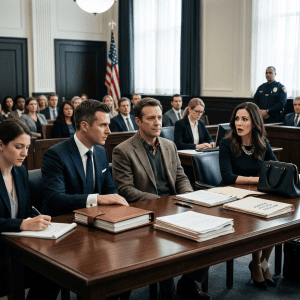
The trial took place 3 months after Dererick’s initial arrest for vandalism. He’d been held without bail for the entire period, which the prosecutor said was unusual, but reflected the judge’s concern about the escalating behavior. Dererick had lost weight in jail, looked smaller and less threatening, which his defense attorney clearly intended as strategy.
The lawyer argued that Dererick was a socially awkward man who’d misread signals and developed an unhealthy fixation, but who had never intended to harm anyone. He portrayed the vandalism as a cry for help from someone mentally struggling rather than a calculated act of intimidation. He called Dererick’s mother to testify and she cried on the stand describing her son’s history of social isolation and rejection painting him as a victim rather than a perpetrator.
Then it was Vanessa’s turn to testify. I watched from the gallery as she walked to the witness stand, her hands shaking but her voice steady. She described 6 months of escalating harassment, the fear that had consumed her life, the inability to sleep or eat or work without constantly looking over her shoulder.
She described finding the dead rat, seeing Dererick outside her apartment at all hours, receiving messages from anonymous accounts that she knew were him based on the writing style and specific details only he would know. The defense attorney tried to discredit her testimony by pointing out that she’d entered a fake marriage with a stranger, suggesting her judgment was questionable and her claims might be exaggerated. Vanessa’s response was powerful.
She said, “I entered that arrangement because every legitimate system meant to protect me had failed. The police said they couldn’t help until he physically hurt me. My workplace said I was overreacting.
The legal system denied my initial restraining order request. So, yes, I made an unconventional choice to protect myself when no one else would. The prosecutor called me to testify next.
I described meeting Vanessa, witnessing Derrick’s behavior firsthand, the decision to pretend to be her husband, and Dererick’s escalation in response. I explained the vandalism, the photographs, the constant surveillance. The defense attorney asked why I’d gone to such extreme lengths for someone I just met, implying my motives were suspicious.
I said I’d done it because Vanessa needed help and because I could provide it, that there was nothing suspicious about basic human compassion. The attorney pushed back, suggesting there must have been some personal benefit or romantic interest motivating my actions. I said there had been no romantic interest initially, that it had developed naturally over months of living together and getting to know each other, and that even if romance had been my initial motivation, it wouldn’t make Derrick’s stalking any less criminal.
The prosecutor showed security footage of Dererick spray painting my car. Showed the timeline of his appearances at locations Vanessa frequented, showed social media posts where he’d referred to his soulmate, who just didn’t understand their connection yet. The evidence was overwhelming.
The jury deliberated for less than 4 hours before returning a guilty verdict on all counts. Stalking, harassment, vandalism, violation of a restraining order. Dererick showed no emotion when the verdict was read.
The judge scheduled sentencing for 2 weeks later. Outside the courthouse, Vanessa collapsed in relief, crying so hard she could barely stand. I held her while she processed months of terror, finally ending with accountability.
Dererick was sentenced to four years in prison with mandatory counseling and a permanent restraining order upon release. The judge was unusually vocal during sentencing, saying stalking was a serious crime that destroyed victims lives and that the legal system needed to do better at intervening before stalkers escalated to violence. He said Dererick’s behavior demonstrated a dangerous obsession that required significant intervention.
Dererick’s mother cried in the courtroom. Part of me felt sympathy for her, losing her son to prison, but the larger part of me remembered Vanessa’s fear and felt the sentence was too short. 4 years meant Dererick would be out when Vanessa was 32, still young, still building her life.
The permanent restraining order helped, but restraining orders were just paper, as the officer had said months ago. After the sentencing, Vanessa and I went back to the apartment, the space that had become genuinely ours rather than just a temporary shelter. She said she wanted to stay, even though Dererick was locked up and she could theoretically move back to her own place or get a new apartment elsewhere.
She said this felt like home now. I said I wanted her to stay, too. We’d started as strangers thrust together by circumstances, evolved into roommates playing roles, and somewhere in the chaos had become partners in the truest sense.
The fake marriage had become a real relationship built on trust and shared trauma and genuine care for each other. A month after the sentencing, I asked Vanessa to marry me for real this time. Not to scare off a stalker, but because I’d fallen in love with her resilience and creativity and the way she’d rebuilt her life despite everything Dererick had tried to destroy.
We got married 6 months later in a small ceremony with close friends. Vanessa wore a simple white dress and carried wild flowers. I cried during my vows, which surprised no one who knew the story of how we’d met.
My vows talked about choosing to help a stranger and finding my person in the process. Vanessa’s vows talked about learning to trust again, about finding safety in someone who’d asked nothing in return for protecting her. Her photographer friend took pictures that Vanessa later included in a portfolio that launched her back into freelance work.
She specialized in documentary photography now, telling stories of women who’d survived stalking and harassment, giving them visibility they had been denied. The work was powerful and necessary, and watching her reclaim the career Derrick had tried to steal brought me more joy than anything in my own professional life ever had. We moved to a bigger apartment after the wedding, one with better security and no memories of Derrick lurking outside.
Vanessa started sleeping through the night without nightmares. I started feeling less hypervigilant about protecting her, trusting that Dererick was behind bars where he couldn’t hurt anyone. The prosecutor had said victims often spent years in therapy, processing trauma from stalking, that fear doesn’t disappear the moment the threat is removed.
Vanessa went to counseling weekly, working through PTSD symptoms and rebuilding her sense of safety in the world. I went with her sometimes when she asked, learning how to support her through the ongoing recovery process. 2 years into our marriage, Vanessa got pregnant.
The news was unexpected, but wanted a signal that we’d built something stable enough to bring a child into. She was terrified throughout the pregnancy, worried Dererick would somehow find out. Worried he’d get early release for good behavior and come looking for her, worried our child would inherit the trauma she carried.
I reassured her as best I could, but I understood the fear. Dererick was scheduled for release in 2 years when our child would be 4 years old. The permanent restraining order would still be in effect, but we both knew restraining orders didn’t physically prevent someone from doing anything.
We’d learned that lesson the hard way. Our daughter was born on a Wednesday morning in April. We named her Riley, and she was perfect and healthy and completely unaware of the violence that had preceded her existence.
Vanessa held her in the hospital and cried, saying she never thought she’d feel safe enough to become a mother after everything that happened with Derek. I kissed them both and promised I’d spend the rest of my life making sure they felt safe. The promise felt enormous and necessary.
3 months after Riley was born, we got a letter from the Department of Corrections. Dererick was being released early for good behavior after serving only 2 and a half years of his 4-year sentence. The letter reminded us that the restraining order remained in effect, that Dererick was prohibited from contacting us or coming within 500 ft of our residence.
The letter said if Dererick violated the order, we should contact police immediately. The letter said nothing about what we should do if police couldn’t respond fast enough if Dererick showed up and hurt someone before law enforcement arrived. Vanessa had a panic attack when she read the letter.
We’d built a life in the 2 and 1/2 years since Dererick’s imprisonment had started believing we were safe, that the threat was behind us. The early release shattered that illusion. I called Detective Brennan, who’d stayed in touch sporadically, and he said early release was common for non-violent offenders who demonstrated good behavior in prison.
He said Dererick had completed anger management and counseling programs, had been a model prisoner, had every incentive to behave in order to maintain his early release. Brennan also said he’d personally reached out to Dererick before his release and reminded him of the legal consequences of violating the restraining order. He’d made clear that any contact with Vanessa would result in immediate arrest and return to prison.
I asked if that was enough and Brennan said honestly he didn’t know. Some stalkers moved on after prison, genuinely rehabilitated or at least deterred by consequences. Others became more obsessed, more dangerous, more determined to reclaim what they believed belonged to them.
We’d have to wait and see which category Dererick fell into. The waiting was agony. Vanessa barely slept again, back to checking locks multiple times, jumping at every sound.
Riley was too young to understand why her mother was suddenly so anxious, but she picked up on the tension and became fussy and difficult to soothe. I worked from home more often, not wanting to leave Vanessa alone with the baby, hiring a security company to install cameras around our apartment building entrance and parking area. 4 months after Dererick’s release, he violated the restraining order.
He showed up at a park where Vanessa was photographing a client’s family portraits. She was focused on her work. didn’t notice him until he was standing 20 ft away watching.
She immediately called police, then called me, her voice shaking so badly, I could barely understand her. I left work immediately and arrived at the park within minutes. Dererick was still there, sitting on a bench, making no move to approach, but clearly visible and clearly violating the court order.
Police arrived shortly after I did and arrested him without incident. He went quietly, claiming he’d just been at the park for a walk and had no idea Vanessa would be there. The park was 15 miles from his apartment and right next to Riley’s daycare, which Vanessa had been near for a pickup later that afternoon.
The proximity wasn’t coincidence. Dererick had been tracking her schedule again, figuring out her patterns, waiting for an opportunity. This time, the justice system moved faster.
Dererick’s early release was revoked, and he was sentenced to an additional 3 years for violating the restraining order. The judge said clearly prison had not rehabilitated Dererick’s obsessive behavior, and that longer incarceration with intensive psychological treatment was necessary. Derrick’s lawyer argued his client had mental health issues requiring treatment, not imprisonment.
But the judge was unmoved. Dererick had been given chances, had been provided counseling, had signed documents acknowledging the restraining order, and had chosen to violate it anyway. The sentence stood.
Vanessa cried in the courtroom again, but this time the tears were anger mixed with relief. She said to me afterward that she was tired of Derek dictating her emotional state, tired of living in fear, tired of celebrating his imprisonment as a victory when she should never have had to fight this battle in the first place. 3 years later, with Dererick still in prison and our second child, a son we named Owen, learning to walk, we received notice that Dererick was up for parole, the letter invited us to submit victim impact statements and to attend the parole hearing if we wanted to speak directly to the board.
Vanessa wrote a statement describing 5 years of terror, the ongoing PTSD, the ways Dererick’s stalking had permanently altered her sense of safety in the world. She described the career opportunities she’d lost, the friendships that had suffered, the constant vigilance required to protect herself and now our children. She described the night terrors, the hypervigilance, the inability to enjoy simple activities without scanning for threats.
She described what it meant to live with the knowledge that someone out there believed he had a right to her life, her time, her attention, her body. I wrote a statement, too, describing the man I’d met in a coffee shop who’d been so desperate for help that she’d accepted protection from a complete stranger. I described watching her rebuild her life piece by piece, therapy session by therapy session, learning to sleep without nightmares, learning to go outside without panic, learning to trust that she deserved safety and happiness.
I described our children who Dererick had never met and never would meet if I had anything to say about it. Children who existed because we’d built something real from the ashes of his harassment. I described the security cameras we still maintained, the self-defense classes Vanessa still attended, the GPS tracking we kept on each other’s phones just in case.
I described a life lived in preparation for Dererick’s return. At the parole hearing, Dererick’s lawyer argued his client had completed every treatment program available in prison, had expressed genuine remorse, had no disciplinary incidents in 5 years, and deserved a chance at rehabilitation in the community. Derrick himself spoke, reading from a prepared statement about understanding the harm he’d caused, taking responsibility for his actions, and committing to never contacting Vanessa again.
His words sounded sincere, but felt hollow. Vanessa spoke after him, looking him directly in the eye for the first time in years and said, “You took 6 months of my life and turned them into 5 years of recovery. You don’t get to be free until I feel free, and I’ll never feel completely free knowing you’re out there.” The parole board denied his petition.
They said his institutional behavior was excellent, but his violation of the restraining order after his first release demonstrated he couldn’t be trusted to follow conditions of parole. He’d be eligible for another parole hearing in 2 years. Now 7 years after I first saw Vanessa shaking while making coffee, we’re building the life Dererick tried to prevent.
Riley is six, Owen is three, and Vanessa’s photography business is thriving. She published a book of portraits last year featuring stalking survivors, their faces showing strength and survival. The book included her own portrait, her face, my hand on her shoulder, our children just visible at the edge of the frame.
The caption said, “I pretended to be married for protection. I stayed married for love. Derek will eventually be released.
We know that the system that failed to protect Vanessa before he was imprisoned will release him back into the world. And we’ll have to navigate that reality when it comes. But we’re not the same people we were seven years ago.
Vanessa isn’t the terrified barista accepting harassment is unavoidable. I’m not the stranger offering temporary help. We’re partners who’ve built a family, a life, a future that Dererick tried to destroy but couldn’t.
The fake marriage that started as survival strategy became the realest thing in both our lives. Our kids will grow up hearing the story of how their parents met. How a moment of compassion in a coffee shop changed everything.
They’ll learn that helping someone in crisis isn’t heroic. It’s basic human responsibility. They’ll learn that the system doesn’t always protect the vulnerable.
So sometimes you have to protect each other. And they’ll learn that sometimes the best things in life come from the worst circumstances. That love can grow in the space fear occupied.
That pretending to be someone’s husband can lead to actually being their husband, their partner, their home. Thanks for watching till the end. Make sure to subscribe and like to not miss the next