
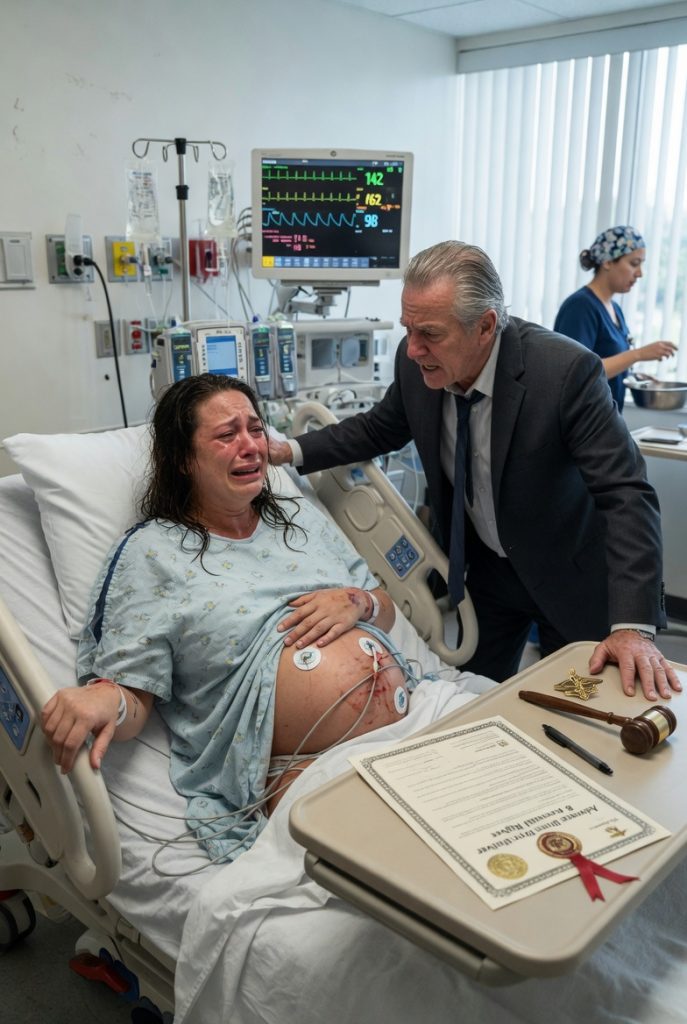
“I need you to delay the surgery.”
Eight months pregnant. Wired to a fetal monitor that keeps dropping my daughter’s heartbeat into the seventies. And my husband is standing at the foot of my hospital bed, talking about investors.
The nurse’s hands freeze mid-adjustment. She doesn’t look at Victor. She looks at me—a quick, sideways glance that says did he really just say that? Then she goes back to checking my IV, jaw tight, saying nothing. Professionals learn to swallow their reactions. But I saw it. That flicker of horror she couldn’t quite hide.
The fluorescent lights in this ER bay are too bright. They hum. The smell is bleach and latex and something sour underneath, maybe fear, maybe me. My gown is damp with sweat. The contraction monitor prints a slow, jagged line that looks like a seismograph during an earthquake nobody else can feel.
Victor is still standing. He hasn’t sat down once.
His suit is charcoal gray, tailored, expensive. He wore it to the office this morning, before I collapsed on the carpet in front of my own desk. It still looks perfect. Not a wrinkle. Not a crease. Meanwhile, I have two IVs in my left arm and a bruise blooming where the third one blew.
He leans closer. Not to comfort me. To make sure the doctor doesn’t hear.
“The investors are already in the boardroom,” he says, voice low and fast. “If you go under the knife tonight, the whole round collapses. We lose momentum.”
I turn my head on the thin hospital pillow. The fetal monitor blinks. Blinks. A flatline for one second, then a spike back up. The baby’s heart is stuttering. She is trying so hard to stay.
“Victor,” I say, and my voice cracks because my throat is dry and because I am terrified and because some stupid, hopeful part of me still believes he hasn’t heard me correctly. “She’s in distress.”
His eyes don’t change.
Not a flicker. Not a blink. He looks at the monitor the way he looks at a bad quarterly report—mildly annoyed, already mentally drafting the email about whose fault this is.
Then he says it.
So quiet I almost miss it. So calm it takes three full seconds for the words to land.
“If the baby doesn’t make it…” He pauses, like he’s considering the phrasing. Like he’s editing himself for clarity. “…it solves problems.”
The nurse is gone. Shift change, maybe. Or maybe she couldn’t stay in the room another second. The door is closed. It’s just us and the machines.
I don’t scream. I don’t cry. I don’t do anything.
That’s the part that scares me later—how still I went. How my body knew before my brain did that this man was not my partner. That he had never been my partner. That the nursery I painted sage green, the onesies I folded into neat stacks, the name we picked out together—all of it was just inventory to him. Assets. Liabilities. Problems to be solved.
The contraction monitor spikes again. I watch the line climb. I do not look at him.
“I’ll tell the doctor we need to wait,” he says, already pulling out his phone. “Just stall. Twenty-four hours. That’s all I’m asking.”
He’s typing. He’s texting someone about the meeting. He’s standing at the foot of my bed, eight feet away from where our daughter is fighting to stay alive, and he is typing.
That’s when the door opens.
It’s not a doctor. It’s not a nurse.
It’s my father.
He doesn’t rush to my bedside. He doesn’t speak. He stands in the doorway for a long moment, taking it in—the monitors, the IVs, the bruise, Victor’s perfect suit, Victor’s phone, Victor’s complete and total lack of awareness that his life just changed.
Then my father walks to the small plastic table against the wall. The one where they left my discharge papers, even though I’m not being discharged. The one where someone set down a foam cup of cold coffee that nobody claimed.
He places a single manila folder on that table.
Not thick. Not labeled. Just a folder.
Victor doesn’t notice. He’s still texting.
My father looks at me. Just looks. Then he nods once, turns, and walks out.
He doesn’t say a word to Victor.
He doesn’t have to.
Because three hours later, when Victor finally walks into his own glass-walled office, my father is already sitting at the conference table. Waiting. And that folder—the same plain folder—is sitting in front of him.
Victor laughs when he sees him. “Douglas. Good morning. I apologize for the scare last night, Bethany is incredibly—”
“Sit down,” my father says.
Victor doesn’t sit. He checks his watch. He’s still performing.
My father reaches forward. Slides the folder across the polished mahogany. Doesn’t open it. Doesn’t explain what’s inside.
“Read this,” he says. “And then tell me again that her pregnancy was the problem.”
Victor’s smirk falters. He picks up the folder. Flips it open.
His face goes pale so fast it looks like special effects.
And that’s when I learned the truth I wasn’t supposed to find.
At the time, I didn’t understand what I was looking at. But Victor did. And the way his hands started shaking told me everything I needed to know.
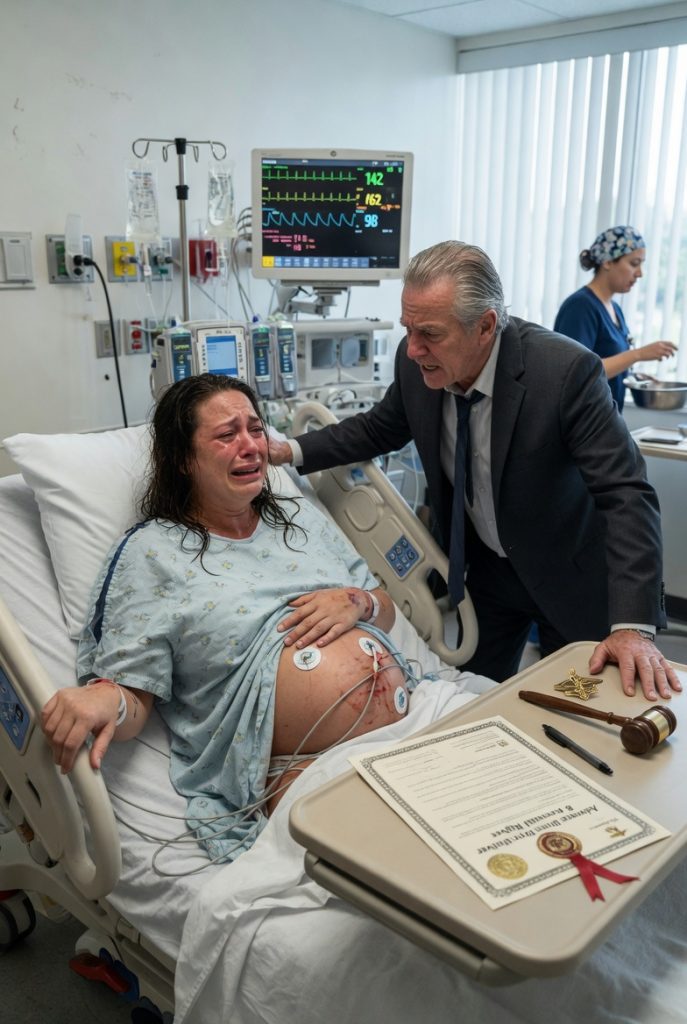
I thought collapsing at my own office—eight months pregnant—would finally make Victor stop. But when I woke in the ER, he hissed, “Delay the surgery. Investors are waiting.” Then, colder: “If the baby doesn’t make it… it solves problems.” The next morning, my father slid a folder across Victor’s desk. “Morrison Industries owns 43% of your company.” Victor went pale. He signed everything over to me—too late to undo the damage. Now I’m rebuilding… and this time, I’m coming for the truth he buried.
I thought collapsing at my own office—eight months pregnant—would finally make Victor stop. One minute I was finishing a launch deck, the next my vision tunneled and the carpet rushed up to meet me. When I came to, the fluorescent lights of the ER stabbed my eyes and the air smelled like antiseptic and panic. A nurse was adjusting monitors near my belly. The baby’s heartbeat flickered on a screen like a tiny metronome begging me to hold on.
Victor stood at the foot of the bed, suit perfect, jaw clenched—not with fear, but annoyance. He didn’t take my hand. He didn’t ask if I could feel our daughter move. He leaned in close enough that only I could hear him and said, “Delay the surgery. Investors are waiting.”
I blinked, convinced I’d misheard. “Victor… she’s in distress.”
His eyes didn’t soften. “We’re twenty-four hours from the biggest meeting of my life. If you go under the knife tonight, I lose momentum.” He glanced at the doctor as if the doctor worked for him too. “Can’t you push it back?”
The doctor’s face tightened. “Mr. Blackstone, this is an emergency.”
Victor exhaled like the doctor was being dramatic. Then he turned back to me, voice dropping even lower, colder than the IV fluid dripping into my arm. “If the baby doesn’t make it… it solves problems.”
For a second I couldn’t breathe. Not because of my lungs—because my entire world cracked. I pictured the nursery I’d painted, the tiny onesies folded in neat stacks, the way I’d defended Victor to friends who warned me he was controlling. I’d told myself he was intense because he cared. I’d told myself I could handle it.
I stared at him and realized the truth: Victor didn’t see me as his wife. I was a liability with a due date.
Hours later, after the emergency procedure stabilized us, I lay awake listening to machines beep and wheels squeak in the hallway. My phone buzzed with a calendar invite Victor had forwarded: “Investor Dinner—Mandatory.” No “How are you?” No “I’m sorry.” Just a meeting.
At dawn, the door opened. My father, Douglas Morrison, stepped in—quiet, composed, the kind of man who never raised his voice because he never had to. He looked at my pale face, then at the bruises blooming where needles had been, and his expression hardened.
“I’m going to handle this,” he said.
And in the hallway, I heard Victor laugh—until my father’s calm voice cut through it like a blade: “Victor, we need to talk. Now.”…
To read the FULL story and discover what happens next:
Like this post
Tap “ALL C0MMENTS” to check C0mment with FULL ST0RY
Type “KITTY To Read The Full Story. When We Reach 30 Comments “KITTY” The Full Story Will Be Revealed.
The following morning, Victor strolled into his sprawling, glass-walled executive suite exactly as he did every other day—as if my plastic hospital admission bracelet wasn’t still cutting into my wrist, as if our daughter’s heartbeat hadn’t violently stuttered under extreme duress.
That was Victor’s primary superpower: he possessed an unparalleled ability to aggressively rewrite reality until the narrative served his ego.
His executive assistant, pale and trembling slightly, informed him that my father was already waiting inside the private conference room.
Victor merely smirked, adjusting his cuffs as he pushed the heavy glass door open. He found Douglas Morrison seated at the far end of the long mahogany table, his hands folded neatly in front of him.
“Mr. Morrison. Good morning,” Victor beamed, projecting the slick, artificial charm he utilized to woo venture capitalists. “I apologize for the scare last night. Bethany is incredibly tough, though. She’ll bounce back. You know how she gets when she’s stressed.”
My father did not return the smile. He didn’t even acknowledge the greeting.
Instead, he reached into his leather briefcase, extracted a thick, heavily tabbed manila folder, and placed it on the polished mahogany. Using just two fingers, he slowly slid the dense file across the table, the gesture mimicking a prosecutor submitting irrefutable evidence to a judge.
“Sit down, Victor,” my father commanded, his tone perfectly even.
Victor remained standing, attempting to assert physical dominance over the room. He checked his luxury watch with exaggerated impatience. “I appreciate you stopping by, Douglas, but I am actually running late for a prep meeting regarding the—”
“You are late for consequences,” my father interrupted, his voice never rising above a conversational volume. “Open the file.”
Victor’s arrogant smile twitched. He huffed a dismissive breath, pulled out a leather chair, and flipped the heavy cover open.
I learned the exact contents of that folder much later, but the sheer volume of data was staggering.
Inside were comprehensive, forensic investment records. There were labyrinthine trails of offshore shell companies. The crowning jewel was a brilliantly clear, undeniable map demonstrating precisely how Morrison Industries—through a complex web of fourteen different subsidiaries and ghost investors—quietly controlled forty-three percent of Victor’s ‘independent’ startup.
For five years, Victor had stood on stages at tech conferences, arrogantly bragging to Forbes and Wired that he was a brilliant, self-made maverick who had built his empire from absolute scratch. The documents sitting in front of him proved that he had been aggressively building his entire kingdom directly on top of my family’s foundation the entire time—without ever possessing the humility to admit it.
Victor swallowed hard, an audible gulp in the quiet room. “This… this isn’t an accurate representation of how equity distribution functions, Douglas.”
My father offered a single, microscopic nod, as if he had anticipated the pathetic denial. “Keep turning the pages. There is significantly more.”
Victor’s trembling fingers turned to the second heavily tabbed section.
This section contained the corporate expense reports. It held falsified vendor invoices. It detailed massive, personal luxury purchases intentionally disguised as “business development capital.” There was the receipt for a seventy-thousand-dollar Patek Philippe watch. First-class flights to St. Barts with women who were definitely not his wife. The crown jewel was the two-million-dollar renovation of a downtown penthouse, criminally billed to the company as an “essential client entertainment venue.”
And then came the final section.
I really appreciate you spending your time with this story. If you’d like the full version, just comment “KITTY.”
I genuinely, foolishly believed that collapsing on the floor of my own corporate office—thirty-two weeks pregnant—would finally force my husband to hit the brakes.
One second, I was frantically finalizing the beta-launch presentation deck for our flagship product, my fingers flying across the keyboard. The next second, my peripheral vision tunneled into a suffocating black dot, the roaring in my ears drowned out the open-plan office, and the gray Berber carpet rushed up to violently meet my face.
When I clawed my way back to consciousness, the aggressive, sterile fluorescent lights of the emergency room stabbed at my retinas. The air smelled sharply of rubbing alcohol, metallic panic, and industrial bleach. A frantic triage nurse was aggressively adjusting the ultrasonic monitors strapped tightly across my swollen belly. On the glowing screen next to my head, my unborn daughter’s heartbeat flickered and dipped, stuttering like a tiny, desperate metronome begging me to hold on.
Victor Blackstone stood at the absolute foot of my hospital bed.
His bespoke charcoal suit remained impeccably unwrinkled. His jaw was locked tight, the muscles jumping beneath his skin—but the emotion radiating from him wasn’t fear. It wasn’t the terror of a husband watching his wife and child edge toward the abyss.
It was pure, unadulterated annoyance.
He didn’t rush to my side. He didn’t reach out to grasp my trembling hand. He didn’t ask the doctors if he could feel his daughter move. Instead, he leaned forward, hovering over the metal footboard, just close enough that only my ringing ears could catch his words.
“Delay the surgical intervention,” he hissed, his voice clipped and efficient. “The primary investors are waiting in the boardroom.”
I blinked slowly, my brain swimming through a haze of pain and IV medication, entirely convinced I had misheard the syllables. “Victor… the monitor. She’s in fetal distress.”
His dark eyes didn’t soften by a single fraction. They remained as cold and calculating as a spreadsheet. “Bethany, we are exactly twenty-four hours out from the most critical Series C meeting of my entire life. If they put you under the knife tonight, the PR narrative shifts. I lose the momentum.”
He casually shifted his gaze to the attending obstetrician, looking at the exhausted woman as if she were a mid-level employee who had just failed a performance review. “Can’t you just push it back? Medicate her and stabilize the situation until Monday?”
The doctor’s expression hardened into professional disgust. “Mr. Blackstone, this is a Category One medical emergency. We are prepping an OR right now.”
Victor exhaled loudly through his nose, a dramatic sigh suggesting the entire medical establishment was conspiring to inconvenience his calendar. Then, he turned his focus back to me. His voice dropped even lower, growing colder than the chilled saline dripping steadily into my vein.
“If the baby doesn’t make it…” he murmured, his eyes dead, “it solves a lot of logistical problems.”
For a full five seconds, I couldn’t draw a breath.
It wasn’t a pulmonary issue. It was the sensation of my entire conceptual universe violently cracking apart. In a flash of agonizing clarity, I pictured the nursery I had spent weekends painting a soft sage green. I saw the tiny, organic cotton onesies I had folded into meticulous, hopeful stacks. I heard the echo of my own voice, desperately defending Victor to my concerned friends over brunch, rationalizing his terrifying, controlling nature. He’s just intense because he cares so deeply about our future, I had lied to them. I can handle the pressure. He needs me.
I stared at the man I had married and finally accepted the terrifying, absolute truth: Victor Blackstone didn’t view me as a human being, let alone his wife.
I was simply a corporate liability with an inconvenient due date.
Hours later, after the emergency surgical team had miraculously managed to stabilize my blood pressure and halt the early labor, I lay awake in the dim recovery room. The rhythmic beeping of the vital monitors and the squeak of rubber shoes in the hallway were my only company.
My phone, resting on the plastic tray table, buzzed aggressively.
It was an automated calendar invitation forwarded by Victor: Investor Dinner — Mandatory Attendance.
There was no accompanying text. No “How are you feeling?” No “I am so sorry.” It was merely a digital summons to perform.
Just as the pale, gray light of dawn began to creep through the hospital blinds, the heavy wooden door pushed open. My father, Douglas Morrison, stepped into the room.
My father is a quiet, profoundly composed man. He built a logistics empire from the ground up, and he is the kind of leader who never raises his voice simply because he has never needed to. He walked to the edge of my bed. He looked down at my pale, exhausted face, taking in the violent purple bruises blooming up my forearms where the nurses had blown three different veins trying to start lines.
His stoic expression didn’t change, but the temperature in the room seemed to drop ten degrees.
“I am going to handle this, Bethany,” he stated quietly.
A moment later, out in the harsh fluorescent glare of the hallway, I heard Victor’s familiar, arrogant laugh barking at a passing nurse.
The laugh was abruptly cut short. My father’s calm, lethal voice sliced through the corridor like a scalpel.
“Victor. We need to have a conversation. Right now.”
But Victor had no idea that the conversation wasn’t going to be about my health. It was going to be an audit of his entire existence.
Chapter 2: The Audit of Arrogance
The following morning, Victor strolled into his sprawling, glass-walled executive suite exactly as he did every other day—as if my plastic hospital admission bracelet wasn’t still cutting into my wrist, as if our daughter’s heartbeat hadn’t violently stuttered under extreme duress.
That was Victor’s primary superpower: he possessed an unparalleled ability to aggressively rewrite reality until the narrative served his ego.
His executive assistant, pale and trembling slightly, informed him that my father was already waiting inside the private conference room.
Victor merely smirked, adjusting his cuffs as he pushed the heavy glass door open. He found Douglas Morrison seated at the far end of the long mahogany table, his hands folded neatly in front of him.
“Mr. Morrison. Good morning,” Victor beamed, projecting the slick, artificial charm he utilized to woo venture capitalists. “I apologize for the scare last night. Bethany is incredibly tough, though. She’ll bounce back. You know how she gets when she’s stressed.”
My father did not return the smile. He didn’t even acknowledge the greeting.
Instead, he reached into his leather briefcase, extracted a thick, heavily tabbed manila folder, and placed it on the polished mahogany. Using just two fingers, he slowly slid the dense file across the table, the gesture mimicking a prosecutor submitting irrefutable evidence to a judge.
“Sit down, Victor,” my father commanded, his tone perfectly even.
Victor remained standing, attempting to assert physical dominance over the room. He checked his luxury watch with exaggerated impatience. “I appreciate you stopping by, Douglas, but I am actually running late for a prep meeting regarding the—”
“You are late for consequences,” my father interrupted, his voice never rising above a conversational volume. “Open the file.”
Victor’s arrogant smile twitched. He huffed a dismissive breath, pulled out a leather chair, and flipped the heavy cover open.
I learned the exact contents of that folder much later, but the sheer volume of data was staggering.
Inside were comprehensive, forensic investment records. There were labyrinthine trails of offshore shell companies. The crowning jewel was a brilliantly clear, undeniable map demonstrating precisely how Morrison Industries—through a complex web of fourteen different subsidiaries and ghost investors—quietly controlled forty-three percent of Victor’s ‘independent’ startup.
For five years, Victor had stood on stages at tech conferences, arrogantly bragging to Forbes and Wired that he was a brilliant, self-made maverick who had built his empire from absolute scratch. The documents sitting in front of him proved that he had been aggressively building his entire kingdom directly on top of my family’s foundation the entire time—without ever possessing the humility to admit it.
Victor swallowed hard, an audible gulp in the quiet room. “This… this isn’t an accurate representation of how equity distribution functions, Douglas.”
My father offered a single, microscopic nod, as if he had anticipated the pathetic denial. “Keep turning the pages. There is significantly more.”
Victor’s trembling fingers turned to the second heavily tabbed section.
This section contained the corporate expense reports. It held falsified vendor invoices. It detailed massive, personal luxury purchases intentionally disguised as “business development capital.” There was the receipt for a seventy-thousand-dollar Patek Philippe watch. First-class flights to St. Barts with women who were definitely not his wife. The crown jewel was the two-million-dollar renovation of a downtown penthouse, criminally billed to the company as an “essential client entertainment venue.”
And then came the final section.
Printed out in high-resolution, full-color ink, were screenshots of the text messages Victor had sent me late at night over the past year. The messages he lovingly referred to as “executive motivation,” but which read like the demands of a hostage taker.
If you don’t fix the UI campaign by midnight, don’t bother coming home to sleep.
Your pregnancy is making you mentally soft. Get it together, Bethany, or I will replace you on the board.
Victor’s face flushed a violent, mottled crimson. He slammed his hand down on the papers. “Those messages are entirely private marital communications!”
“They are documented patterns of psychological abuse,” my father corrected, his gaze unwavering. “And they cease to be private the very second they actively endanger my daughter’s life.”
Victor jumped to his feet, his voice finally rising in panic. “You are completely overreacting! Bethany is notoriously dramatic, she always exaggerates—”
That was the precise moment my father’s stoic composure sharpened into something lethal. He didn’t stand up. He didn’t yell. He simply leaned forward.
“A board-certified trauma surgeon officially documented, in a hospital chart, that you actively pressured medical staff to delay emergency, life-saving care for a woman who was eight months pregnant.”
Victor’s mouth fell open, but no sound emerged. He snapped his jaw shut. For the very first time in his arrogant, charmed life, he looked genuinely, viscerally terrified.
My father steepled his fingers. “Here is precisely what happens next, Victor. You will officially transfer all of your remaining voting shares to Bethany. Before close of business today. You will then draft a letter of resignation, citing personal health reasons, and you will exit this building quietly.”
“You… you can’t demand that,” Victor stammered.
“If you refuse,” my father continued, ignoring the interruption, “I will personally hand-deliver this entire folder to federal investigators at the SEC, and a separate copy to the District Attorney. We will pursue charges of corporate fraud, financial coercion, and reckless endangerment. You will spend the next five to ten years explaining to a federal judge why you firmly believed a beta software launch mattered significantly more than the lives of a mother and her unborn child.”
Victor’s hands shook so violently the heavy mahogany table vibrated. He stared down at the damning ink, desperately hoping the data might miraculously rearrange itself into a loophole of mercy. “You… you can’t do this to me. I built this company.”
My father didn’t blink. His eyes were fragments of blue ice. “I can. And I will.”
When my father relayed the story to me later, I vividly pictured Victor—a man so deeply accustomed to controlling the narrative of every room he entered—suddenly trapped in a corner with absolutely no script left to read. He had spent his entire adult life treating human beings as disposable, liquid assets.
Now, he was the asset being hostilely liquidated.
By noon that day, he signed the transfer papers.
And even from the sterile confines of my hospital bed, miles away from the corporate headquarters, I physically felt it. I felt the monumental shift in gravity. The precise moment the counterfeit empire he had built on my silence finally began to collapse.
But Victor’s desperation was about to manifest in one final, pathetic attempt to maintain control.
Chapter 3: The Reconstruction
Victor’s initial reaction was a frantic attempt to salvage his public image.
Before the ink was even dry on his resignation, he dispatched highly polished, corporate-speak emails to the board of directors, citing a “necessary strategic realignment of personal priorities” to spend time with his growing family.
Then, he attempted to text me, maintaining the terrifying delusion that the status quo remained intact.
Babe, let’s not let your dad’s temper blow this entire thing up. We can talk strategy when you’ve calmed down and your hormones level out. Love you.
It was the exact same toxic gaslighting, simply wrapped in softer, more desperate vocabulary. But the legal machinery was already in motion. The transfer paperwork had been officially filed with the state. His resignation was irreversible. His security access to the building and the servers was permanently revoked.
The luxury penthouse—which he had illegally registered under corporate benefits he had systematically abused—was seized back by the company as a mandatory part of the financial settlement. And my attorneys swiftly secured an aggressive restraining order, severely limiting his physical contact with me for the remainder of my high-risk pregnancy.
The profound quiet that descended upon my life in the following weeks felt entirely unfamiliar.
There was no constantly buzzing phone demanding impossible deadlines. There were no late-night interrogations. There was no cold, clinical inventory of everything I had done “wrong” that day.
My mother temporarily moved into my childhood bedroom with me. She spent her days quietly folding tiny laundry, humming soft melodies as she worked, as if she could manually stitch my frayed nervous system back together one gentle, predictable day at a time. My obstetrician drastically adjusted my treatment plan to prioritize rest. For the first time in three years, I finally slept through the night without waking up with my muscles clenched, bracing for an inevitable conflict.
Four weeks later, in a calm, planned procedure, I gave birth to a perfectly healthy baby girl.
I named her Emma. The name was simple, incredibly steady, and undeniably strong.
When the nurse finally laid her on my chest, Emma’s impossibly tiny fingers curled tightly around my index finger. It felt like a physical promise. I cried significantly harder than I had anticipated. The tears weren’t just a release of joy because she was finally here and safe; I wept because the stark reality hit me—I realized exactly how terrifyingly close Victor had come to stealing this sacred moment from both of us.
People in our social circle naturally assumed I would simply disappear into a comfortable, quiet life after the dust settled. The expectation was that I would take the transferred shares, quietly cash out during the next funding round, and let the ugly story fade into corporate folklore.
But I quickly learned that survival doesn’t feel entirely complete until it mutates into purpose.
Six months after Emma’s birth, I walked back through the revolving glass doors of that startup building. My posture was fundamentally different. The very same hallways where I had once collapsed in terror now felt like sovereign territory I had violently reclaimed.
I convened an all-hands meeting in the main atrium. I stood before the brilliant engineers, the exhausted designers, and the burnt-out marketing team—the people who had watched Victor bully, belittle, and systematically destroy them in the exact same manner he had destroyed me.
I didn’t offer them corporate spin. I told them the absolute, unvarnished truth.
“The leadership of this company has fundamentally changed,” I announced, looking out over the sea of faces. “And as a result, our core mission is changing with it.”
Over the next year, we executed a massive pivot. We rebranded the entire platform, launching the Maternal Wellness Initiative. We transitioned from building aggressive sales software to developing robust tools for prenatal care tracking, accessible mental health support networks, and flexible work integration resources. We forged massive corporate partnerships aimed at actively protecting pregnant employees in the workforce, rather than punishing them for their biology.
We aggressively built out the exact features and support systems that Victor would have sneeringly dismissed as “unprofitable emotional nonsense.”
Ironically, those exact “unprofitable” features became the primary reason major hospital networks and Fortune 500 companies signed massive, multi-year contracts with us.
I didn’t stop there. I utilized my personal equity to launch an aggressive legal and financial support fund specifically designed for survivors of domestic and financial abuse. Because the harsh reality is that leaving a toxic situation isn’t just an emotional hurdle; it is a terrifying, logistical nightmare that requires capital.
Meanwhile, Victor’s world shrank with spectacular speed.
With multiple federal fraud investigations actively looming over his head, and a judge mandating court-ordered behavioral therapy for his documented narcissistic traits, his pristine reputation was ash. He was forced to take whatever freelance consulting work he could scrounge up under the radar.
The same arrogant man who once snapped his fingers to summon terrified assistants now clocked in for hourly shifts. The wealth he had hoarded was systematically drained by legal fees, and he was forced to send mandated child support through a cold, automated state system that cared absolutely nothing for his bruised ego.
The last time I saw him was during a mandatory, court-supervised brief check-in at a sterile neutral facility.
He looked exhausted, the bespoke suits replaced by off-the-rack slacks. He looked past me, his eyes landing on Emma, who was happily babbling in her high-end stroller.
Victor looked back at me, his eyes filled with a bitter, defeated venom. “You completely ruined me, Bethany,” he whispered.
I looked at him. I didn’t feel anger. I didn’t feel fear. I felt absolutely nothing.
I smiled, my expression as calm and inevitable as a sunrise. “No, Victor,” I replied softly. “You did.”