The night my son asked when I planned to move out of his house, I was passing the dinner rolls.
That is the detail I remember most clearly. Not the chicken cooling on the platter. Not the way the chandelier light made everything look too warm to be cruel. Not even the expression on Daniel’s face when the words left his mouth. I remember the basket of rolls in my hands—linen-lined, still warm, the kind of ordinary object that keeps a person anchored to the moment when the rest of the room begins to tilt.
I had lived in his house for two years by then, and in all that time I had learned how to make myself quiet. I had learned which cabinet doors stuck and how hard you had to press them to keep them from slamming. I had learned how much coffee Renee liked in the morning and how Daniel preferred his shirts folded so the sleeves lined up cleanly in the drawer. I had learned that my granddaughter Sophie left her violin books on the kitchen island when she was worried about school, and that Caleb, at thirteen, retreated into his phone whenever anything in the room felt emotionally complicated. I had learned how to cook in someone else’s kitchen without ever looking as though I considered it mine.
What I had not learned, apparently, was how to stop being a burden quickly enough for my son’s comfort.
“Mom,” Daniel said, not even looking up from his plate, “when are you actually planning to move out? I mean… what’s the plan here?”
The words landed with no drama at all. That was what made them so deadly. He didn’t shout. He didn’t accuse. He sounded tired, faintly embarrassed, like a man forcing himself to ask a practical question he had postponed too long.
The table went quiet around us.
Renee looked down at her mashed potatoes. Caleb froze, his phone halfway beneath the table. Sophie stopped talking in the middle of a story about some girl in her class who had cried during math. Even the refrigerator hum from the kitchen seemed suddenly louder, like the house itself had paused to hear the answer.
I looked at my son.
He was forty-four years old. He had his father’s hands and his father’s gray beginning to appear at the temples. When he was ten, he had once cried for an hour because a wounded pigeon in our backyard died before the vet could help it. When he was seventeen, he drove thirty miles in a thunderstorm to bring me groceries after I had the flu because Harold was traveling and he couldn’t bear the thought of me being alone and sick.
And now he was looking at me the way people look at a bill they were meaning to deal with before interest accrued.
I set the basket of rolls on the table.
I folded my napkin.
I pushed back my chair and stood.
“Excuse me,” I said.
My voice was perfectly steady. I am proud of that even now.
I did not go to my room. I did not cry in the bathroom or start gathering my things in some dramatic display of wounded dignity. I walked through the kitchen, opened the sliding glass door, and stepped into the backyard.
The air was cold enough to sting. Phoenix winters are not real winters, not the kind that scrape ice from your windshield or press your bones into submission, but that night the chill was enough. The pool was covered, the tarp sagging slightly in the center where rainwater had gathered. Beyond the fence, the sky was dark purple with the city glowing behind it, and the desert air held that dusty, mineral smell it gets after sunset.
I sat in one of the patio chairs no one ever used and let the quiet settle around me.
Inside, through the glass, I could see the shape of the dining room table, the movement of bodies, the careful hesitation of people who had not expected their words to have immediate consequences. No one came outside after me. No one opened the door and said, Margaret, I didn’t mean it like that. No one said, Mom, can we talk? No one said, You don’t have to leave the table like that.
That silence was the most honest thing that had happened in that house in two years.
I sat there for almost an hour.
I thought about Harold.
He had been dead exactly two years and three weeks. Forty-six years of marriage, and then one Tuesday afternoon in Tucson, he had simply stopped being alive. He was in his armchair with the crossword in his lap and his reading glasses sliding down his nose and I was in the kitchen cutting lemons for iced tea. When I came back into the living room, he was gone before I understood he had left.
There are losses that announce themselves and losses that simply alter the oxygen in a room.
Harold’s death had turned my life from a sentence into a cliff.
After the funeral, Daniel had come to the house in Tucson, stood in our yellow kitchen with his hands shoved into his pockets, and said, “Mom, you can’t stay here alone. Come live with us.”
I had looked out the window at the garden Harold and I had planted ourselves. Tomatoes, rosemary, the jasmine vine that never quite behaved. I had looked at the mugs in the cabinet, the coffee pot he’d repaired twice instead of replacing because he hated waste, the framed photographs on the mantel, all the ordinary sacred evidence of a life built slowly and carefully with another person.
And because grief had made every practical decision feel like it belonged to someone else, I had said yes.
I should have asked more questions.
Daniel’s house in Phoenix was beautiful. Large, bright, expensive in the way newer homes are expensive—not with craftsmanship exactly, but with scale and finish. High ceilings. Four bedrooms. A pool. A kitchen island the size of my old dining table. Renee called the decor “modern farmhouse,” which seemed to mean white walls, reclaimed wood, iron fixtures, and decorative objects that looked as though they had never once survived actual family life.
I was given the guest room at the end of the hall.
It had a narrow window facing the neighbor’s fence and a dresser with two drawers left empty for my things. On the first night, Renee smiled and said, “I hope this feels comfortable for you,” and I heard, beneath the warmth of her tone, the quiet shape of a boundary. Not too much. Don’t settle in. Don’t rearrange. Don’t forget this was generosity, not permanence.
At first I told myself it was all adjustment. They were busy. I was grieving. Everybody was learning how to share space. Daniel worked long hours at an engineering firm where every deadline sounded like an emergency. Renee ran her real estate business with the kind of performative hustle that required constant wardrobe changes and an endless stream of “client lunches.” Caleb and Sophie were children, half-grown and wholly absorbed in their own little storms.
So I made myself useful.
I cooked. Not every night, but often enough that the kitchen came to recognize my hands. I did school pickups when schedules got tangled. I supervised homework. I folded towels. I stripped beds when the housekeeper was delayed. I stocked the pantry when I noticed things were low. I remembered birthdays for everyone. I sent thank-you notes on behalf of children who never would have sent them alone. I sat at the far end of the couch during movie nights and laughed at appropriate moments and excused myself when the family wanted to sprawl.
I became, with skill I hardly noticed developing, easy to live around.
What I did not say out loud was that I felt myself thinning.
There was the evening Renee had her book club over and introduced me as “Daniel’s mother, who’s staying with us for a while,” as though I were an exchange student nobody expected to become fluent. There was the Sunday I came downstairs at ten o’clock to find the kitchen empty except for a note that read, Back by noon, there’s coffee, and later discovered they had all gone to brunch without mentioning it to me because apparently the possibility that I might want to join hadn’t entered anyone’s calculations. There was the October morning I stood in the hallway outside their bedroom and heard Renee’s voice, low but not low enough, saying, “She eats our food, uses our utilities, and contributes what exactly?”
I had gone back to my room and closed the door very quietly behind me, because there are moments when dignity depends entirely on not letting anyone hear the sound you make.
Still, I stayed.
I stayed because Daniel was my son. I stayed because I had sold the Tucson house eight months after moving to Phoenix. Daniel had insisted it made no sense to keep an empty property. “Mom, you’re not going back there,” he had said, kindly, firmly, practically. “It’s just money leaking away.” He was right, in the technical sense. The house sold quickly. After taxes and fees and the old mortgage Harold and I had nearly paid off, I had about two hundred and forty thousand dollars in savings, plus Social Security and Harold’s pension. Enough to live modestly. Not enough to buy another house in Phoenix and keep enough behind for the long years old age demands.
Or so I believed.
The lottery ticket entered my life by accident…
I bought it on a Thursday afternoon at a gas station on Route 9 after a routine doctor’s appointment. The machine was by the register. I had exact change. It felt like one of those tiny, pointless acts people perform because they are tired and the world is dull and possibility costs less than a sandwich.
I tucked the ticket into my coat pocket and forgot about it for four days.
I found it Monday morning while looking for a grocery receipt. I checked the numbers because the television in the breakfast nook was still on from when Caleb had watched sports highlights the night before, and the winning numbers were rolling beneath a weather report about an incoming warm front.
I checked them once. Then again. Then I sat down.
Eighty-nine million dollars.
After taxes, after choosing the lump sum, after all the practical punishments that come for joy in this country, it would be about fifty-two million.
I did not scream. I did not faint. I did not laugh.
I folded the ticket in half, then in half again, and slipped it into my Bible between Proverbs and Psalms as if I were hiding a confession from God.
Then I made my coffee and said nothing.
For two weeks, I said nothing.
I looked up the claim process at night in bed with the lamp off and my phone brightness turned low. I learned that Arizona allowed claims through trusts. I learned how long you had to file. I learned the percentage the government would take and what anonymity actually meant and how many lottery winners had ruined themselves by treating luck like permission to remain foolish.
And then came that dinner.
That question.
Part 2
I went back inside eventually.
Not because anyone called me.
Because the air had turned colder, and because I have never believed in making an exit that gives other people the satisfaction of labeling you dramatic.
The dishes had been cleared.
Renee stood at the sink with her back to me, rinsing plates that did not need rinsing yet. Daniel was at the counter, stacking things with unnecessary focus. Caleb had disappeared. Sophie sat at the far end of the table, swinging her legs gently, watching the room the way children do when they understand something important has happened but don’t yet have the language for it.
No one spoke when I walked in.
I moved through the kitchen quietly, took a glass from the cabinet, filled it with water, and drank half of it in one steady motion. My hand did not shake.
“I’ll be out in the morning,” I said.
I did not raise my voice. I did not look at Daniel when I said it.
It was not a threat.
It was information.
Renee turned slightly, as if she might say something—something soft, something corrective—but whatever thought had begun in her expression did not reach her mouth.
Daniel exhaled.
“Mom, you don’t have to—”
“I’ll be out in the morning,” I repeated.
Then I set the glass in the sink, rinsed it, dried it, and placed it back exactly where I had found it.
That was the last thing I did in that kitchen as someone who lived there.
I did not sleep much.
Not from distress.
From clarity.
There is a particular kind of calm that arrives when a decision removes all alternatives. It is not peaceful, exactly. It is clean.
I packed my things with the same care I had used to unpack them two years earlier. Folded clothes. Stacked books. The framed photograph of Harold that had lived on the narrow dresser. The small wooden box that held letters I had never shown anyone.
At midnight, I sat on the edge of the bed and took the lottery ticket out of my Bible.
I unfolded it slowly.
The numbers had not changed.
Eighty-nine million dollars.
For a moment, I let myself feel it—not the excitement, not the fantasy, but the scale. The quiet, enormous shift in what was possible.
Then I folded it again and slipped it into my purse.
By morning, I was no longer a guest in my son’s house.
I was a woman with options.
I left before anyone else woke up.
Not out of spite.
Out of preference.
I have always believed that departures are cleaner when they are not negotiated in real time.
I loaded my suitcase into my car, closed the trunk without slamming it, and took one last look at the house.
It was still beautiful.
That hadn’t changed.
But beauty, I had learned, is not the same as belonging.
I drove to a hotel ten minutes away and checked in under my own name. The woman at the front desk smiled, handed me a key card, and said, “Enjoy your stay,” with no awareness that she was witnessing the beginning of something that would alter the rest of my life.
I went upstairs, set my bag down, and called the number I had saved the night before.
A real estate agent.
Her name was Elena Ruiz.
She had a voice that moved quickly but not carelessly, the kind of voice that suggested competence rather than enthusiasm.
“I’m looking for a house,” I said.
“Of course,” she replied. “What kind of timeline are you thinking?”
“Immediate.”
There was a pause.
“Alright,” she said, adjusting without comment. “Budget?”
I looked out the hotel window at the parking lot below. Ordinary cars. Ordinary people moving through an ordinary morning.
“Flexible,” I said.
Another pause.
Longer this time.
“I see,” she said. “Do you have anything specific in mind?”
“Yes,” I said. “I want a front porch. I want trees—real ones, not landscaping. I want four bedrooms, even if I only use one. And I want a front door no one else has a key to.”
Elena did not laugh.
“Give me two hours,” she said. “I’ll send you options.”
By that afternoon, I was walking through houses.
Not in the distracted way people sometimes do, imagining furniture and color schemes and where they might put a television.
I was looking for something quieter than that.
A place that did not ask permission for me to exist in it.
The third house we saw was the one.
It sat on a corner lot with mature oak trees that arched over the yard like they had been waiting decades for someone to notice them. The porch wrapped around the front and one side, wide enough for a swing and a pair of chairs and the kind of evenings that stretch without being scheduled.
The front door was solid wood.
Heavy.
It closed with a sound that felt… final.
Inside, the light was soft. Not staged. Not overly curated. Just present.
“This one just came on the market,” Elena said. “It won’t sit long.”
“I’ll take it,” I said.
She blinked. “You’d like to make an offer?”
“I’d like to buy it.”
“In cash?”
“Yes.”
There are moments when people reassess you.
I watched it happen in her face—not suspicion, not greed, just a recalibration.
“Alright,” she said, slower now. “We’ll move quickly.”
I created the trust that night.
I signed the documents the next morning.
I closed on the house in less than two weeks.
That should have been the end of it.
A quiet exit. A quiet beginning.
But families—especially families who have grown accustomed to a certain version of you—rarely accept change without investigation.
Renee started first.
It was subtle.
A question about where I was staying.
A comment about how quickly I had “landed on my feet.”
A suggestion, wrapped in concern, that moving so fast after “everything” might not be the healthiest decision.
Daniel followed.
Calls.
Texts.
A sudden increase in warmth that would have been touching if it hadn’t arrived so precisely on the heels of my departure.
“Mom, we should do lunch.”
“Mom, I just want to make sure you’re okay.”
“Mom, you know you can always come back if this feels like too much.”
Too much.
I agreed to lunch.
Not because I needed reassurance.
Because I wanted to see how far they would go without understanding what had changed.
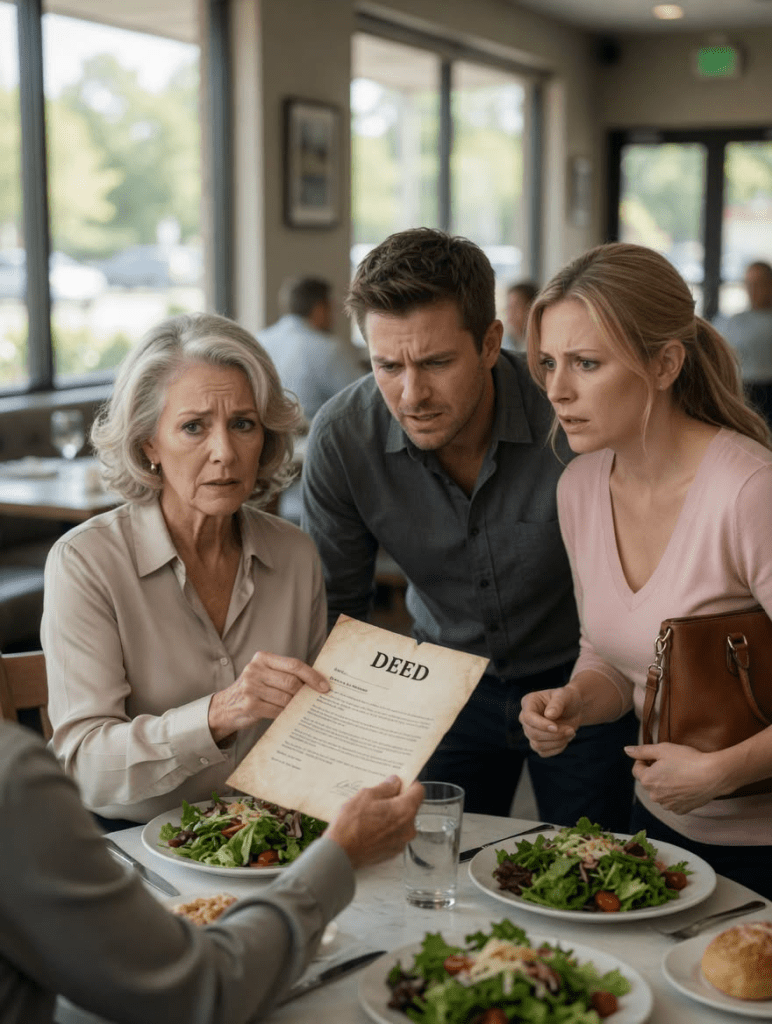
The restaurant was one of Renee’s choices.
Bright. Polished. The kind of place where concern can be performed over salads that cost more than a week of groceries used to.
They were already seated when I arrived.
Daniel stood when he saw me. He hugged me longer than usual.
Renee smiled with practiced warmth.
“I’m so glad you came,” she said.
“Of course,” I replied.
We ordered.
We made small talk.
And then, inevitably, we arrived at the reason for the meeting.
“Mom,” Daniel said gently, “we’ve been thinking about you.”
I folded my hands on the table.
“I’m sure you have.”
Renee leaned forward slightly.
“We just want to make sure you’re making decisions that are… sustainable,” she said. “Buying a house so quickly, on your own—it’s a big step.”
“It is,” I agreed.
Daniel nodded. “We just don’t want you to feel like you have to prove anything.”
There it was.
The assumption.
That my departure had been emotional.
Reactive.
Temporary.
I let the silence sit just long enough.
Then I reached down beside my chair and lifted my handbag onto my lap.
From it, I took out a slim leather folder.
I placed it on the table.
Both of them watched the movement.
Curious.
Concerned.
Unprepared.
I opened it slowly, turned it toward them, and met my son’s eyes.
And then, very calmly, I said the one thing they had not considered possible:
“I didn’t leave because I had nowhere to go.”
I paused.
Just long enough for the sentence to settle.
“I left,” I continued, “because I finally understood that I no longer needed to stay.”